
Smart Materials Market 2026
By Product Type (Piezoelectric Materials, Electro-Rheostatic, Magneto-Rheostatic, Shape Memory Materials, Smart Fluids, Smart Hydrogels, Electrochromic Materials, Other Product Types), By Application Type (Transducers, Actuators And Motors, Sensors, Structural Materials, Coating, Other Applications), By End User (Industrial, Defense And Aerospace, Automotive, Consumer Electronics, Healthcare, Other End User), And By Region, Opportunities And Strategies – Global Forecast To 2035
Smart Materials Market Definition
Smart materials refer to advanced materials that can alter their physical properties in response to external stimuli such as temperature, electric or magnetic fields, stress, potential of Hydrogen (pH) levels, or moisture. These materials are designed to react in a controlled and reversible way, making them highly valuable in industries that require adaptability, automation and functionality. They are used by a wide range of users including manufacturers in aerospace, automotive, defense, electronics, healthcare and industrial sectors. The smart materials market consists of sales, by entities (organizations, sole traders, or partnerships), of smart materials are used in both everyday products and specialized equipment, typically where sensing, actuation, or responsiveness is needed.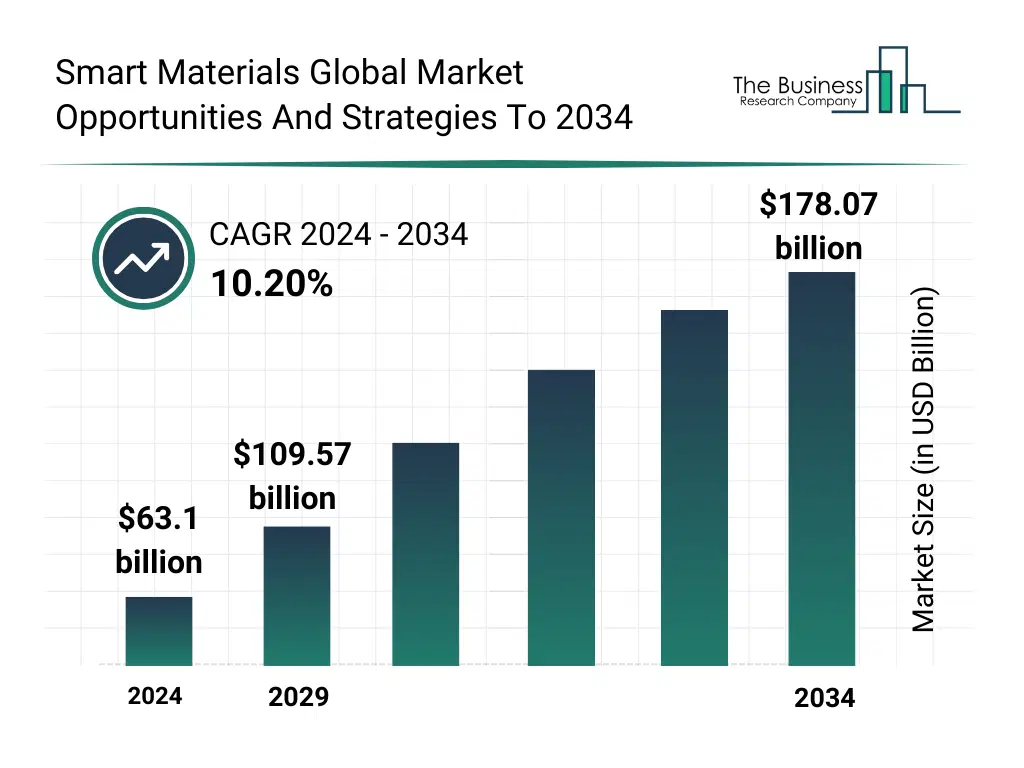
Smart Materials Market Size
The global smart materials market reached a value of nearly $63,098.75 million in 2024, having grown at a compound annual growth rate (CAGR) of 8.11% since 2019. The market is expected to grow from $63,098.75 million in 2024 to $109,569.09 million in 2029 at a rate of 11.67%. The market is then expected to grow at a CAGR of 10.20% from 2029 and reach $178,069.70 million in 2034. Growth in the historic period resulted from rising demand from consumer electronics, expansion of the aerospace and defense sector, advancements in material science and nanotechnology and growth in wearable technology. Factors that negatively affected growth in the historic period were the limited availability of raw materials and shortage of technical expertise and training. Going forward, rising focus on energy efficiency and sustainability, rising use in automotive and transportation, emergence of industry 4.0 and smart manufacturing and rising adoption in healthcare and biomedical applications will drive growth. Factors that could hinder the growth of the smart materials market in the future include impact of trade war and tariffs and strict regulatory and certification hurdles and high initial and production costs.Smart Materials Market Drivers
The key drivers of the smart materials market include: Rising Focus On Energy Efficiency and Sustainability During the forecast period, the rising focus on energy efficiency and sustainability will propel the growth of the smart materials market. As governments and industries intensify efforts to achieve global climate targets, there is an increasing emphasis on technologies and materials that reduce energy consumption, enhance performance and support decarbonization. Smart materials, with their ability to adapt to environmental changes, improve thermal regulation and extend product lifecycles, are expected to play a pivotal role in meeting these objectives. The transition toward energy-efficient infrastructure, sustainable mobility and low-carbon manufacturing will further accelerate demand for smart materials that enable higher efficiency and lower environmental impact. The growing alignment of industrial innovation with sustainability goals is therefore anticipated to strengthen the adoption of smart materials across multiple sectors during the forecast period. The rising focus on energy efficiency and sustainability during the forecast period in 2024 is 2.00%.Smart Materials Market Restraints
The key restraints on the smart materials market include: Strict Regulatory And Certification Hurdles Strict regulatory and certification hurdles are expected to restrict the growth of the smart materials market during the forecast period. The commercialization of advanced materials—such as self-powered sensors, adaptive composites and piezoelectric systems, requires adherence to complex safety, performance and environmental regulations across different regions. These stringent standards often lead to increased compliance costs, longer approval cycles and delayed product launches, particularly for smaller manufacturers and startups. Moreover, varying certification requirements across countries make global market entry more challenging, slowing down innovation and commercialization. As regulatory frameworks continue to tighten to ensure reliability and sustainability, these challenges are anticipated to act as a significant restraint on the expansion of the smart materials market. Growth affected by strict regulatory and certification hurdles during the forecast period in 2024 is -2.03%.Smart Materials Market Trends
Major trends shaping the smart materials market include: Introduction of Large-Format Electrochromic Glazing Major companies in the smart materials market are increasingly developing large-format electrochromic glazing solutions designed for automotive and architectural applications, particularly to meet demands for energy efficiency, user comfort, and advanced aesthetics. These innovations focus on enabling panoramic, curved glazing panels that transition between clear and tinted states, offering improved light control, thermal management, and design flexibility. For instance, in March 2025, Miru Smart Technologies, a Canada-based company that develops advanced window technologies for residential, commercial and transportation applications, in collaboration with Argotec (a subsidiary of Mativ), a US-based manufacturer of extruded polymer film, unveiled one of the world’s largest electrochromic sunroof/window prototypes measuring approximately 1.5 m × 1.6 m for automotive applications. By leveraging this large-format electrochromic glazing technology, the companies aim to support next-generation vehicle design—enhancing comfort, reducing solar heat gain, improving energy efficiency (particularly in EVs), and enabling premium user experiences through dynamic tinting. Launch of Lead-Free Ultrasonic Flow Metering Solutions in Smart Materials Companies in the smart materials market are focusing on the development of lead-free piezoelectric components and integrated sensor systems designed to meet stricter environmental and regulatory standards, while also enhancing performance and system-integration capabilities. For instance, in October 2024, Audiowell (China), a manufacturer specializing in sensor components and sensing solutions, and ScioSense (Netherlands), a specialist in environmental and flow sensor technology, jointly launched a new ultrasonic flow-metering solution combining Audiowell’s lead-free transducer technology with ScioSense’s advanced ultrasonic flow-converter chip (AS6040). These units offer improved environmental compliance by eliminating traditional lead-based ceramics, enhanced signal-processing performance, and streamlined integration into water-meter systems. By leveraging specialised piezoelectric-ceramic development, sensor-electronics co-design and global standards-compliance efforts, the companies aim to deliver solutions that combine sustainability, precision and ease-of-integration for industrial, smart-building, and IoT applications in both domestic and global markets.Opportunities And Recommendations In The Smart Materials Market
Opportunities – The top opportunities in the smart materials market segmented by product type will arise in the shape memory materials segment, which will gain $11,809.75 million of global annual sales by 2029. The top opportunities in the smart materials market segmented by application type will arise in the actuators and motors segment, which will gain $19,779.53 million of global annual sales by 2029. The top opportunities in the smart materials market segmented by end user will arise in the defense and aerospace segment, which will gain $13,385.85 million of global annual sales by 2029. The smart materials market size will gain the most in the USA at $11,484.70 million. Recommendations- To take advantage of the opportunities, The Business Research Company recommends the smart materials companies to focus on large-format electrochromic glazing for automotive and architectural applications, focus on lead-free ultrasonic flow metering solutions for sustainable applications , focus on electrochromic window lamination for automotive and architectural applications , focus on biodegradable and biocompatible shape-memory resins for biomedical applications, focus on lead-free piezoelectric materials for sustainable electronics and sensor applications, focus on liquid thermoplastic polyurethane (ltpu) for sustainable footwear applications, focus on electro-rheostatic materials for high-growth applications, expand in emerging markets, continue to focus on developed markets, provide competitively priced offerings, continue to use b2b promotions, focus on sensors segment to drive end-user engagement, focus on healthcare end-users to accelerate market growth.
Smart Materials Market Segmentation
The smart materials market is segmented by product type, by application type and by end user.By Product Type –
The smart materials market is segmented by product type into:
- a) Piezoelectric Materials
- b) Electro-Rheostatic
- c) Magneto-Rheostatic
- d) Shape Memory Materials
- e) Smart Fluids
- e) Smart Hydrogels
- e) Electrochromic Materials
- e) Other Product Types
By Application Type –
The smart materials market is segmented by application type into:
- a) Transducers
- b) Actuators And Motors
- c) Sensors
- d) Structural Materials
- e) Coating
- f) Other Applications
By End User –
The smart materials market is segmented by end user into:
- a) Industrial
- b) Defense And Aerospace
- c) Automotive
- d) Adhesives
- e) Consumer Electronics
- f) Healthcare
- g) Other End User
By Geography - The smart materials market is segmented by geography into:
- • China
- • India
- • Japan
- • Australia
- • Indonesia
- • South Korea
- • USA
- • Canada
- • Brazil
- • France
- • Germany
- • UK
- • Italy
- • Spain
- • Russia
-
o Asia Pacific
o Africa