
Smart Nanomaterials Market Report 2026
Global Outlook – By Type (Carbon-Based Nanomaterials, Metal-Based Nanomaterials, Polymeric Nanomaterials, Other Types), By Functionality (Structural Nanomaterials, Functional Nanomaterials), By Form (Powder, Suspension, Composite), By Application (Display Technology, Drug Delivery, Coating And Nanofilms, Monitoring And Biosensing, Water Treatment, Other Applications), By End-Use (Pharmaceuticals, Transportation, Electronics, Construction, Environment, Other End-Uses) – Market Size, Trends, Strategies, and Forecast to 2030
Smart Nanomaterials Market Overview
• Smart Nanomaterials market size has reached to $0.85 billion in 2025 • Expected to grow to $3.94 billion in 2030 at a compound annual growth rate (CAGR) of 36% • Growth Driver: Expansion Of Consumer Electronics Is Fueling The Growth Of The Market Due To Demand For Lightweight Energy-Efficient And Advanced Devices • Market Trend: Advancements In Carbon-Based Nanomaterials Accelerate Innovation In Solid-State Battery Technology • North America was the largest region in 2025 and Asia-Pacific is the fastest growing region.Market Gains By 2030 – Top Opportunities By Segment
Market Gain identifies the most promising market opportunities by highlighting the segments or products expected to generate the highest incremental revenue growth over the next five years.
What Is Covered Under Smart Nanomaterials Market?
Smart nanomaterials are nanoscale materials designed to react intelligently to external stimuli such as temperature, light, pH, magnetic fields, or pressure. They can alter their properties or behavior in real time, making them highly suitable for advanced applications. Their core purpose is to boost performance, functionality, and efficiency, driving innovation across cutting-edge industries. The main types of smart nanomaterials are carbon-based nanomaterials, metal-based nanomaterials, polymeric nanomaterials, and others. Carbon-based nanomaterials are strong, lightweight, and conductive, making them ideal for use in electronics, batteries, sensors, and smart biomedical systems. It shows different functionality, such as structural nanomaterials and functional nanomaterials in several forms, including powder, suspension, and composite. It is applicable in various applications such as display technology, drug delivery, coating and nanofilms, monitoring and biosensing, water treatment, and others, and is used by several end-users, including pharmaceuticals, transportation, electronics, construction, environment, and others.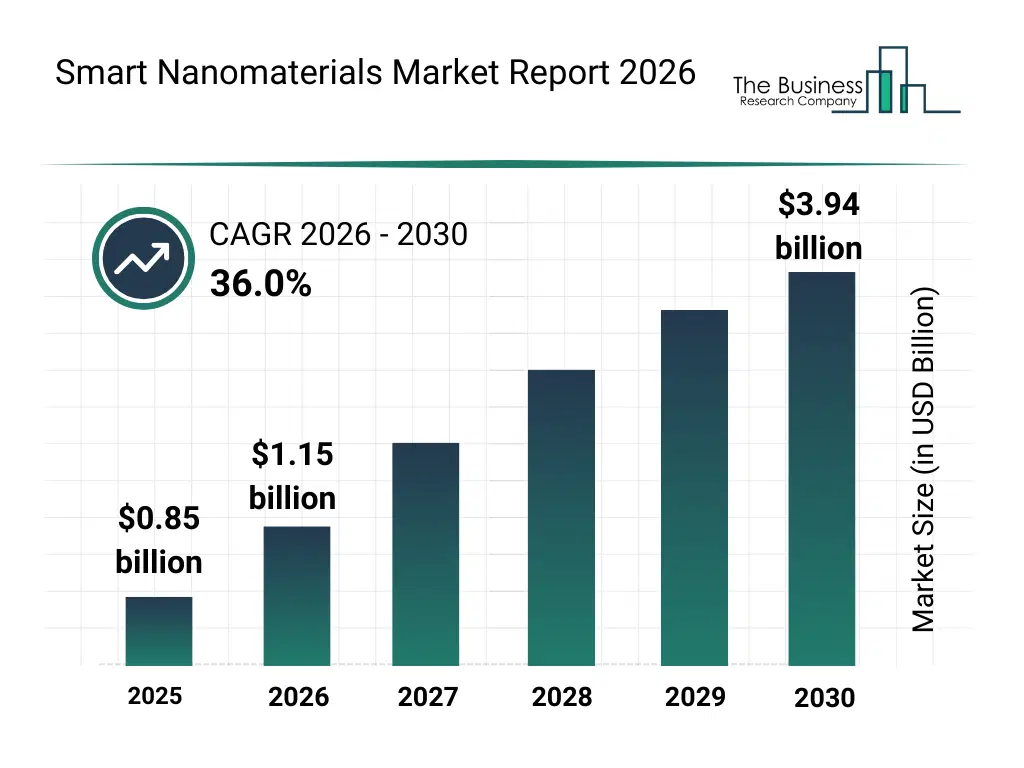
What Is The Smart Nanomaterials Market Size and Share 2026?
The smart nanomaterials market size has grown exponentially in recent years. It will grow from $0.85 billion in 2025 to $1.15 billion in 2026 at a compound annual growth rate (CAGR) of 36.3%. The growth in the historic period can be attributed to advances in nanotechnology research, early biomedical nanomaterial adoption, government funded R&D programs, miniaturization of electronics, material science innovation.What Is The Smart Nanomaterials Market Growth Forecast?
The smart nanomaterials market size is expected to see exponential growth in the next few years. It will grow to $3.94 billion in 2030 at a compound annual growth rate (CAGR) of 36.0%. The growth in the forecast period can be attributed to precision medicine growth, smart electronics demand, environmental monitoring needs, advanced manufacturing adoption, investment in nanomaterial commercialization. Major trends in the forecast period include rising adoption of stimuli responsive materials, growing use in targeted drug delivery systems, expansion of smart coating and nanofilm applications, increased integration in biosensing technologies, focus on high performance adaptive nanostructures.
Global Smart Nanomaterials Market Segmentation
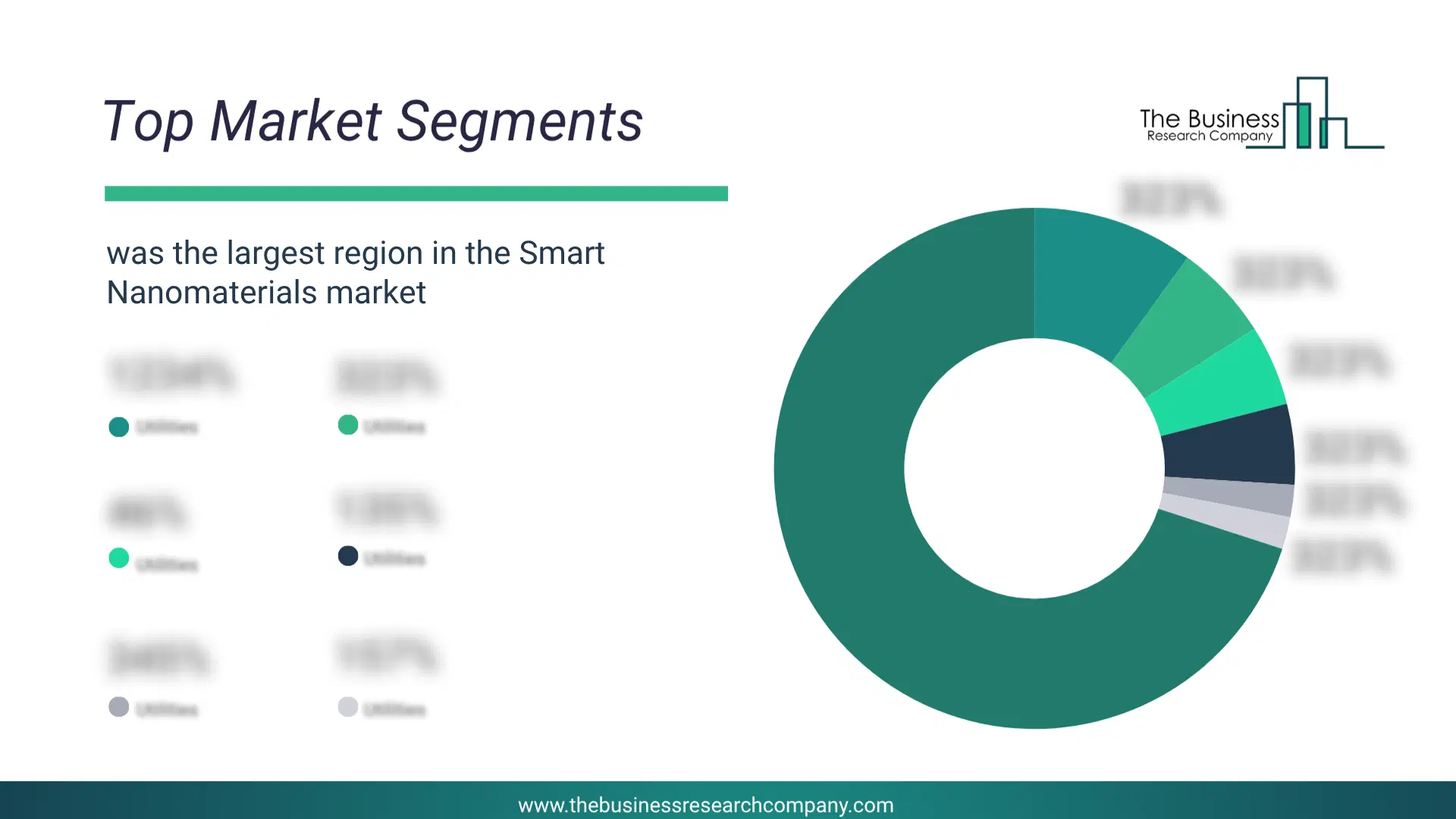
1) By Type: Carbon-Based Nanomaterials, Metal-Based Nanomaterials, Polymeric Nanomaterials, Other Types 2) By Functionality: Structural Nanomaterials, Functional Nanomaterials 3) By Form: Powder, Suspension, Composite 4) By Application: Display Technology, Drug Delivery, Coating And Nanofilms, Monitoring And Biosensing, Water Treatment, Other Applications 5) By End-Use: Pharmaceuticals, Transportation, Electronics, Construction, Environment, Other End-Uses Subsegments: 1) By Carbon-Based Nanomaterials: Carbon Nanotubes, Graphene, Fullerenes, Carbon Nanofibers 2) By Metal-Based Nanomaterials: Silver Nanoparticles, Gold Nanoparticles, Metal Oxide Nanoparticles, Quantum Dots 3) By Polymeric Nanomaterials: Dendrimers, Nanogels, Polymeric Micelles, Hyperbranched Polymers 4) By Other Types: Lipid-Based Nanomaterials, Ceramic Nanomaterials, Hybrid Nanomaterials, Nanoclays The top segments in the smart nanomaterials market will be: • Functional Nanomaterials will reach $517.87 Million by 2025. • Powder will reach $382.41 Million by 2025. • Carbon-Based Nanomaterials will reach $298.32 Million by 2025. • Structural Nanomaterials will reach $294.53 Million by 2025. • Metal-Based Nanomaterials will reach $262.21 Million by 2025.What Is The Driver Of The Smart Nanomaterials Market?
The growing demand for consumer electronics is expected to propel the growth of the smart nanomaterials market going forward. Consumer electronics refer to electronic devices intended for everyday personal use, such as smartphones, televisions, laptops, audio systems, and home appliances. The demand for consumer electronics is rising due to increasing digital connectivity in daily life, as more people rely on smart devices for communication, work, and entertainment. Smart nanomaterials boost consumer electronics by providing lightweight, energy-efficient, and responsive functionalities. Their properties, such as self-healing, high conductivity, and environmental adaptability, enhance device durability, performance, and miniaturization. For instance, in May 2023, according to the Japan Electronics and Information Technology Industries Association, a Japan-based trade association, consumer electronics production equipment reached 32,099 million yen ($279.01 million). Therefore, the growing demand for consumer electronics is driving the growth of the smart nanomaterials industry.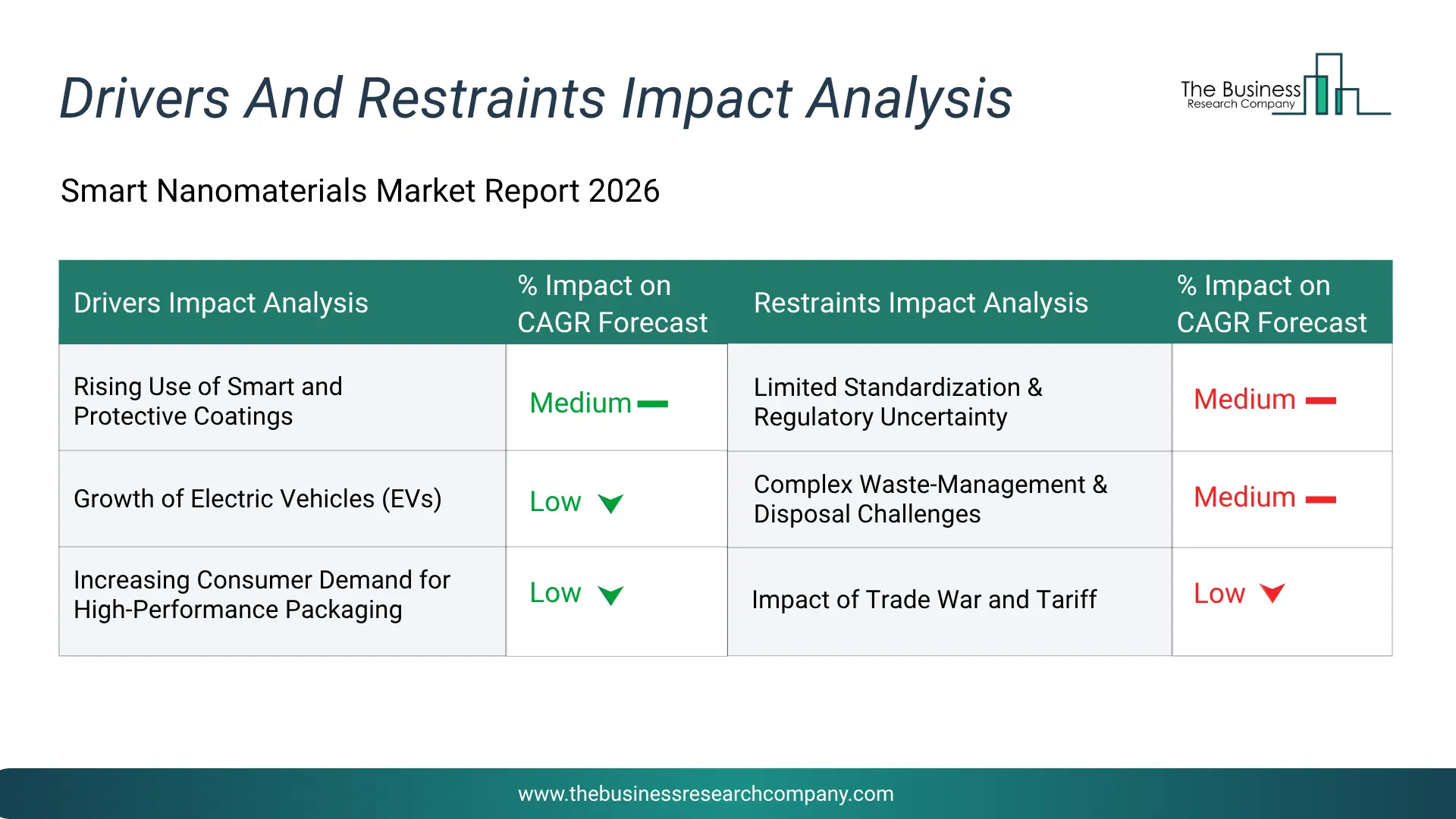
Infographic Chart Showing Key Market Drivers Analysis And Restraints For Smart Nanomaterials Market
The chart presents an impact analysis of key drivers and restraints, quantifying their relative influence on the market's growth rate and helping assess the balance between growth enablers and limiting factors. This chart offers a high-level perspective; the full report contains more detailed insights.
How Will The Drivers Impact Growth In The Global Smart Nanomaterials Market?
• Rising Use of Smart and Protective Coatings (Medium) – The rising use of smart and protective coatings will become a key driver of growth in the smart nanomaterials market by 2030. As industries increasingly seek advanced surface solutions that provide corrosion resistance, durability, self-healing capabilities and enhanced environmental protection, the demand for nanomaterial-based coatings continues to expand. Smart coatings incorporate functional nanostructures that improve barrier performance, mechanical strength, thermal stability and surface responsiveness, making them essential for applications in automotive, aerospace, construction, electronics and marine industries. Moreover, the growing focus on sustainability, longer asset lifecycles and reduced maintenance costs is encouraging the adoption of next-generation coatings that can sense, repair, or prevent damage more effectively than conventional materials. As manufacturers adopt these advanced protective systems to enhance product performance and meet stricter operational standards, the need for high-performance smart nanomaterials rises correspondingly, thereby driving the growth of the smart nanomaterials market. As a result, the rising use of smart and protective coatings is anticipated to contributing to a 1.2% annual growth in the market. • Growth of Electric Vehicles (EVs) (Low) – The growth of electric vehicles will emerge as a major factor driving the expansion of the smart nanomaterials market by 2030. Electric vehicles require advanced materials that enhance battery performance, improve thermal regulation, reduce overall vehicle weight and support longer operational life, all of which are effectively addressed by smart nanomaterials. These engineered materials provide superior conductivity, increased durability and optimized structural strength, making them essential for next-generation batteries, power electronics and lightweight composite components. This is particularly important as the global transition toward cleaner mobility accelerates, leading automakers to adopt materials that enable higher energy efficiency, faster charging capabilities and improved safety standards in electric vehicles. As governments strengthen emission regulations, expand charging networks and promote electrification across transport segments, the need for high-performance materials designed to meet these evolving requirements will intensify, thereby driving the growth of the smart nanomaterials market during the forecast period. Consequently, the accelerating growth of electric vehicles capabilities is projected to contributing to a 0.7% annual growth in the market. • Increasing Consumer Demand for High-Performance Packaging (Low) – The increasing consumer demand for high-performance packaging will serve as a key growth catalyst for the smart nanomaterials market by 2030. As consumers prioritize packaging that offers enhanced durability, superior barrier protection, longer shelf life and improved sustainability, manufacturers are accelerating the use of advanced nanomaterial-based solutions to meet these evolving expectations. High-performance packaging incorporating smart nanomaterials provides benefits such as better resistance to oxygen and moisture, improved product preservation, lightweight construction and greater material efficiency. Moreover, as brands compete to deliver packaging that not only protects products but also communicates quality, safety and environmental responsibility, the role of smart nanomaterials becomes increasingly essential in achieving these goals. Therefore, this increasing consumer demand for high-performance packaging operations is projected to supporting to a 0.5% annual growth in the market. • Increasing Prevalence of Chronic Diseases (Low) – The increasing prevalence of chronic diseases will become a significant driver contributing to the growth of the smart nanomaterials market by 2030. As conditions such as cardiovascular disorders, diabetes, respiratory illnesses and various forms of cancer become more widespread, the need for advanced diagnostic tools, targeted therapies and efficient drug-delivery systems continues to rise. Smart nanomaterials are uniquely positioned to address these requirements by enabling precise detection, controlled release of therapeutic agents and enhanced interaction with biological systems. This is particularly important as healthcare systems globally shift toward earlier diagnosis, more personalized treatment approaches and technologies that improve long-term disease management. Moreover, the growing recognition of non-communicable diseases as a major public health challenge is prompting increased investment in innovative materials and technologies capable of improving clinical outcomes. As healthcare providers, governments and medical technology companies continue to focus on more efficient and patient-centric solutions, the demand for advanced materials that support improved biomedical performance will increase, thereby driving the smart nanomaterials. Consequently, the increasing prevalence of chronic diseases strategies is projected to contributing to a 0.2% annual growth in the market.How Will The Restraints Impact Growth In The Global Smart Nanomaterials Market?
• Limited Standardization & Regulatory Uncertainty (Low) – Limited Standardization & Regulatory Uncertainty will restrict the growth of the Smart Nanomaterials market during the forecast period. Smart nanomaterials lack standardized testing and characterization protocols, creating regulatory uncertainty. Regulatory gaps can affect product approval and market entry. Standardization challenges can limit the commercialization of smart nanomaterial products. • Complex Waste-Management & Disposal Challenges (Low) – Complex Waste-Management & Disposal Challenges will restrict the growth of the Smart Nanomaterials market during the forecast period. Smart nanomaterials raise concerns about waste management and disposal due to their unique properties. Environmental and health concerns about nanomaterial disposal can affect regulatory acceptance. Waste management challenges can limit the widespread adoption of smart nanomaterials. • Impact of Trade War and Tariff (Low) – Impact of Trade War and Tariff will restrict the growth of the Smart Nanomaterials market during the forecast period. Smart nanomaterial production relies on imported materials and equipment subject to trade tariffs. Trade barriers can increase production costs and affect availability. Trade tensions may also impact research collaboration and technology transfer.Key Players In The Global Smart Nanomaterials Market
Major companies operating in the smart nanomaterials market are Arkema S.A., Sumitomo Metal Mining, Resonac Holdings Corporation, General Atomics, Advanced Nano Products Co. Ltd., NovaCentrix, OCSiAl, CVD Equipment Corporation, Altairnano, nanoComposix, Alchemy Nano, Raymor Industries Inc., Nanopartz Inc., SkyNano, Brite Solar, AdNano Technologies Pvt Ltd., Sino Applied Technology, Smart Nanotechnologies, Platonic Nanotech Pvt., Shilpa Enterprises.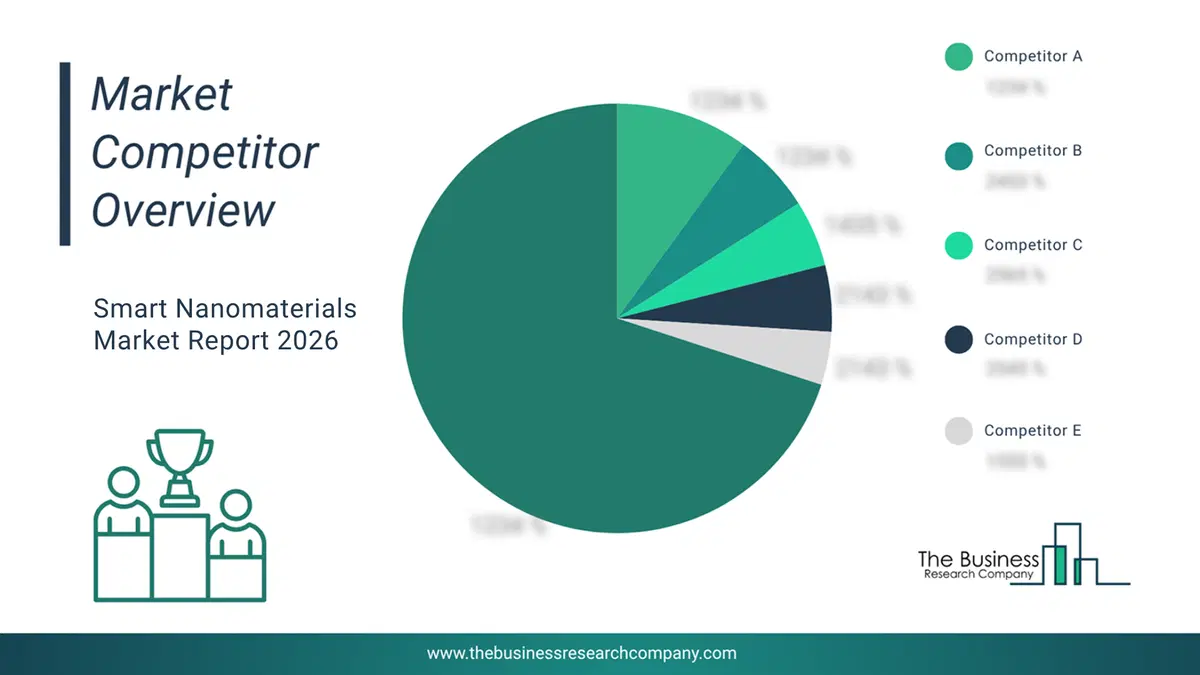
This chart is for illustrative purposes; the full report includes a detailed competitor analysis and comprehensive overview of the top 10 companies in the market.
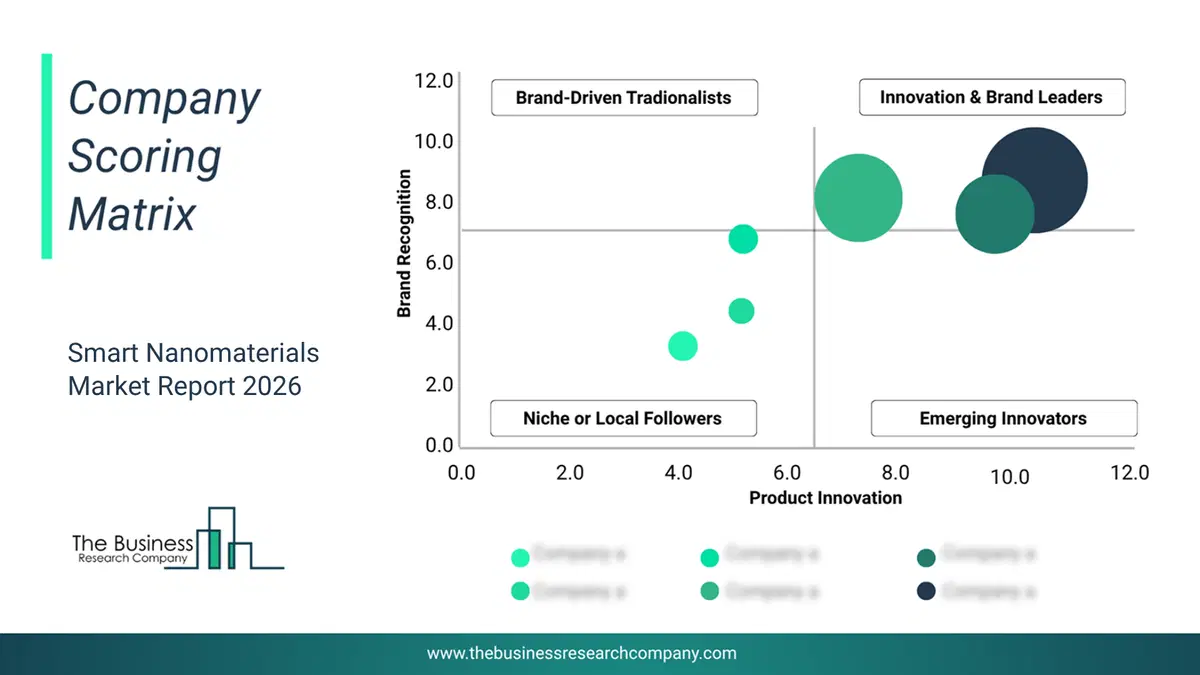
This chart maps companies by product innovation and brand strength, with bubble size indicating relative revenue, helping identify market leaders, challengers, and niche players. This is an illustrative chart; the full report provides a complete and accurate competitive analysis.
Global Smart Nanomaterials Market Trends and Insights
Major companies operating in the smart nanomaterials market are focusing on developing advanced products such as carbon-based nanomaterials to meet the evolving demands of high-performance electronic and industrial applications. Carbon-based nanomaterials are tiny structures made of carbon atoms, known for their superior strength, conductivity, and thermal stability. For instance, in January 2025, Tiannai Technology, a China-based company that focuses on the research, development, production, and sales of nanoscale carbon materials, launched a new single-walled carbon nanotube (SWCNT) specifically designed to drive innovation in solid-state batteries. These SWCNTs significantly enhance the conductivity, mechanical strength, and energy density of batteries, improving their cycle life and making them more suitable for applications requiring lightweight and reliable power sources, such as electric vehicles and consumer electronics. This development not only consolidates Tiannai's market position in advanced battery materials but also supports the broader adoption of solid-state batteries, which are valued for their safety and efficiency in demanding environments.What Are Latest Mergers And Acquisitions In The Smart Nanomaterials Market?
In October 2023, Birla Carbon, a US-based manufacturer and supplier of carbon black additives, acquired Nanocyl SA for an undisclosed amount. This acquisition aims to expand Birla Carbon's presence in the energy systems market by enhancing its product portfolio for lithium-ion battery materials and other conductive applications, positioning the company as a leader in materials critical to battery performance and supporting the electrification and sustainability agenda in sectors such as transportation. Nanocyl SA is a Belgium-based manufacturer of multi-wall carbon nanotubes (MWCNTs).
Regional Insights
North America was the largest region in the smart nanomaterials market in 2025. Asia-Pacific is expected to be the fastest-growing region in the forecast period. The regions covered in this market report are Asia-Pacific, South East Asia, Western Europe, Eastern Europe, North America, South America, Middle East, Africa The countries covered in this market report are Australia, Brazil, China, France, Germany, India, Indonesia, Japan, Taiwan, Russia, South Korea, UK, USA, Canada, Italy, SpainWhat Defines the Smart Nanomaterials Market?
The smart nanomaterials market consists of sales of ceramic-based nanomaterials, lipid-based nanomaterials, peptide-based nanomaterials, and hybrid nanomaterials. Values in this market are ‘factory gate’ values, that is, the value of goods sold by the manufacturers or creators of the goods, whether to other entities (including downstream manufacturers, wholesalers, distributors, and retailers) or directly to end customers. The value of goods in this market includes related services sold by the creators of the goods.How is Market Value Defined and Measured?
The market value is defined as the revenues that enterprises gain from the sale of goods and/or services within the specified market and geography through sales, grants, or donations in terms of the currency (in USD unless otherwise specified). The revenues for a specified geography are consumption values that are revenues generated by organizations in the specified geography within the market, irrespective of where they are produced. It does not include revenues from resales along the supply chain, either further along the supply chain or as part of other products.
This chart presents market attractiveness based on a quantitative evaluation of growth, competition, strategic alignment, and risk, offering a clear view of opportunity areas for decision-making. This chart is for illustrative purposes; the full report contains the complete analysis.

This chart highlights the Total Addressable Market (TAM) by estimating the maximum revenue opportunity using an assumption-driven approach, supporting strategic planning and opportunity sizing across markets. The chart is illustrative; the full report provides a more comprehensive analysis.
What Key Data and Analysis Are Included in the Smart Nanomaterials Market Report 2026?
The smart nanomaterials market research report is one of a series of new reports from The Business Research Company that provides market statistics, including industry global market size, regional shares, competitors with the market share, detailed market segments, market trends and opportunities, and any further data you may need to thrive in the smart nanomaterials industry. The market research report delivers a complete perspective of everything you need, with an in-depth analysis of the current and future state of the industry.Smart Nanomaterials Market Report Forecast Analysis
| Report Attribute | Details |
|---|---|
| Market Size Value In 2026 | $1.15 billion |
| Revenue Forecast In 2030 | $3.94 billion |
| Growth Rate | CAGR of 36.3% from 2026 to 2030 |
| Base Year For Estimation | 2025 |
| Actual Estimates/Historical Data | 2020-2025 |
| Forecast Period | 2026 - 2030 |
| Market Representation | Revenue in USD Billion and CAGR from 2026 to 2030 |
| Segments Covered | Type, Functionality, Form, Application, End-Use |
| Regional Scope | Asia-Pacific, Western Europe, Eastern Europe, North America, South America, Middle East, Africa |
| Country Scope | The countries covered in the report are Australia, Brazil, China, France, Germany, India, Indonesia, Japan, Taiwan, Russia, South Korea, UK, USA, Canada, Italy, Spain. |
| Key Companies Profiled | Arkema S.A., Sumitomo Metal Mining, Resonac Holdings Corporation, General Atomics, Advanced Nano Products Co. Ltd., NovaCentrix, OCSiAl, CVD Equipment Corporation, Altairnano, nanoComposix, Alchemy Nano, Raymor Industries Inc., Nanopartz Inc., SkyNano, Brite Solar, AdNano Technologies Pvt Ltd., Sino Applied Technology, Smart Nanotechnologies, Platonic Nanotech Pvt., Shilpa Enterprises. |
| Customization Scope | Request for Customization |
| Pricing And Purchase Options | Explore Purchase Options |