
Smart Utilities Market 2025
By Component (Hardware, Software, Services), By Communication Technology (Wired, Wired-Less), By Application (Meter Hardware, Communications And Networking, Power Quality Equipment, Technologies), And By Region, Opportunities And Strategies – Global Forecast To 2035
Smart Utilities Market Definition
Smart utilities refer to utility services, such as electricity, water, gas, and district heating, that leverage advanced digital technologies, sensors, and communication networks to monitor, manage, and optimize the generation, distribution, and consumption of resources. These systems integrate smart meters, Internet of Things (IoT) devices, data analytics, and automated control to improve operational efficiency, reliability, and customer service. The primary purpose of smart utilities is to enhance resource efficiency, reduce operational costs, and provide real-time insights for better decision-making. The smart utilities market consists of sales, by entities (organizations, sole traders, or partnerships), of digital solutions and connected devices designed to modernize electricity, water and gas infrastructure using technologies. These systems enable real-time data collection, remote monitoring and predictive management of utility services, enhancing efficiency and reliability.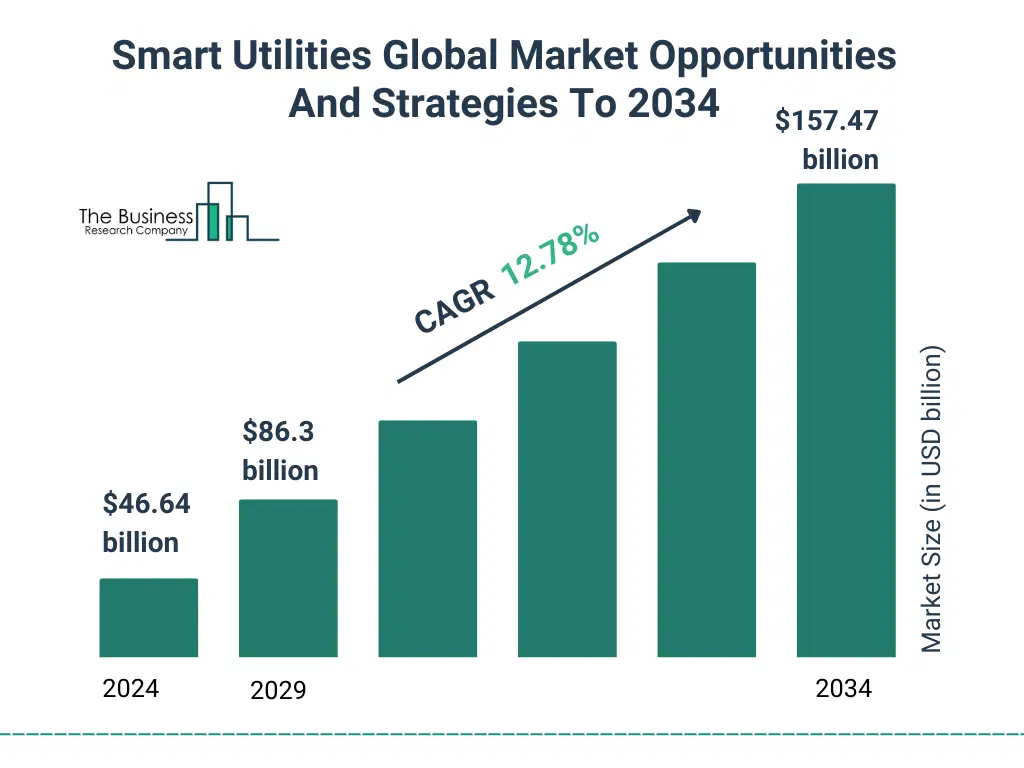
Smart Utilities Market Size
The global smart utilities market reached a value of nearly $46,640.68 million in 2024, having grown at a compound annual growth rate (CAGR) of 9.89% since 2019. The market is expected to grow from $46,640.68 million in 2024 to $86,297.61 million in 2029 at a rate of 13.10%. The market is then expected to grow at a CAGR of 12.78% from 2029 and reach $157,469.82 million in 2034. Growth in the historic period resulted from increasing electricity demand, growing investment in grid automation, favorable government incentives and growing integration of energy storage systems. Factors that negatively affected growth in the historic period were high capital investment requirement and cybersecurity risks. Going forward, expanding deployment of smart meters, increasing development of smart grids and micro grids, rise in digitalization and IoT adoption in energy sector and adoption of renewable energy and distributed generation will drive the growth. Factors that could hinder the growth of the smart utilities market in the future include integration challenges with legacy systems, regulatory and policy uncertainty and impact of trade war and tariff.Smart Utilities Market Drivers
The key drivers of the smart utilities market include: Expanding Deployment Of Smart Meters The growing deployment of smart meters is expected to be a major driver of growth in the smart utilities market during the forecast period. By enabling real-time monitoring of electricity, water, and gas consumption, smart meters help utilities enhance operational efficiency, minimize losses, and streamline billing processes. As their adoption increases, the demand for complementary technologies such as communication networks, data analytics platforms, and integration tools will also rise, further strengthening the smart utilities ecosystem. Moreover, smart meters will play a key role in supporting demand response initiatives and encouraging consumer involvement in energy management, opening up new possibilities for interactive utility services. Their widespread use will also lay the groundwork for advanced capabilities like automated outage detection and dynamic pricing models. The expanding deployment of smart meters contribution during the forecast period in 2024 is 1.75%.Smart Utilities Market Restraints
The key restraints on the smart utilities market include: Semiconductor And Critical Component Shortages Regulatory and policy uncertainty is expected to restrain the growth of the smart utilities market during the forecast period. Inconsistent or unclear regulatory frameworks create hesitation among utilities and investors, disrupting long-term planning and delaying modernization efforts. Frequent shifts in government priorities, lack of standardization, and ambiguous guidelines around digital infrastructure and renewable integration contribute to an unpredictable environment. This uncertainty not only slows the rollout of funding initiatives but also discourages private sector involvement. Over time, it stifles innovation and prevents utilities from scaling smart solutions efficiently, ultimately hindering the transformation of utility infrastructure. Growth affected by regulatory and policy uncertainty during the forecast period in 2024 is -1.19%.Smart Utilities Market Trends
Major trends shaping the smart utilities market include: Adoption Of Intelligent Home Energy Management Solutions To Drive Smart Utilities Market Companies in the market are focusing on smart home energy management and optimization to meet growing consumer demand for energy efficiency and sustainability. These solutions empower homeowners to monitor, control, and automate their energy usage, reducing costs and environmental impact. By integrating technologies like solar energy, EV charging, and dynamic load balancing, they enable more intelligent and responsive energy consumption. This shift supports the growth of the smart utilities market by driving demand for connected infrastructure and data-driven energy services. For example, in May 2025, ABB, a Switzerland-based automation company, launched ABB Smart EMS, a smart energy management solution that puts homeowners in control of their energy use – cutting costs, maximizing efficiency, and automating energy management – all controlled through an intuitive app. ABB Smart EMS automates energy flows, ensuring homeowners get the most out of every locally produced kilowatt while balancing energy costs and consumption. Whether managing solar energy production, EV charging, or high-energy appliances, it intelligently optimizes electricity use at the most cost-effective time, maximizing efficiency with minimal effort, while continuously monitoring and optimizing the electrical infrastructure through smart load balancing and dynamic load prioritization. Adoption Of Edge Computing For Real-Time Energy Management Companies operating in the smart utilities market are deploying edge computing platforms that process data locally at meters, sensors, and substations to enable real-time decision making, low-latency control of distributed energy resources (DERs), and more resilient grid operations. These developments are designed to reduce reliance on centralized cloud processing (which has higher latency and bandwidth requirements), improve response to grid disturbances, enable faster demand forecasting, and help utilities manage DERs, EV loads, and other dynamic grid conditions more efficiently. For instance, in March 2025, Itron, Inc, a US-based provider of grid edge intelligence and metering solutions, collaborated with NVIDIA to incorporate NVIDIA’s AI-powered solutions including the Jetson Orin Nano and NVIDIA AI Enterprise platforms into Itron’s “Grid Edge Intelligence” portfolio, enabling utilities to perform real-time data processing at the grid edge for operations like demand forecasting, DER management, and grid resilience. NVIDIA is a US-based world leader in artificial intelligence computing.Opportunities And Recommendations In The Smart Utilities Market
Opportunities – The top opportunities in the smart utilities market segmented by component will arise in the software segment, which will gain $20,721.66 million of global annual sales by 2029. The top opportunities in the smart utilities market segmented by communication technology will arise in the wired-less segment, which will gain $38,086.64 million of global annual sales by 2029. The top opportunities in the smart utilities market segmented by application will arise in the technologies segment, which will gain $12,156.37 million of global annual sales by 2029. The smart utilities market size will gain the most in the USA at $9,958.19 million. Recommendations- To take advantage of the opportunities, The Business Research Company recommends the smart utilities companies to focus on integrated home energy optimization, focus on expanding edge intelligence and real-time grid capabilities, focus on expanding metering as a service models, focus on accelerating digital grid automation and intelligence, focus on scaling advanced smart water management solutions, focus on distributed energy resource integration, focus on building integrated data fabric and grid orchestration platforms, focus on scaling advanced metering and smart grid deployments, focus on accelerating growth in the services segment, focus on expanding wired-less communication solutions, expand in emerging markets, focus on strategic partnerships to scale smart utility solutions, focus on expanding integrated distribution access and reach, focus on transparent pricing models and value-linked tariffs, strengthen awareness and trust through educational outreach and transparent communication, drive adoption with targeted incentives and personalized engagement programs and focus on accelerating growth in advanced technologies.
Smart Utilities Market Segmentation
The smart utilities market is segmented by component, by communication technology and by application.By Component –
The smart utilities market is segmented by component into:
- a) Hardware
- b) Software
- c) Services
By Communication Technology –
The smart utilities market is segmented by communication technology into:
- a) Wired
- b) Wire-Less
By Application –
The smart utilities market is segmented by application into:
- a) Meter Hardware
- b) Communications And Networking
- c) Power Quality Equipment
- d) Technologies
By Geography - The smart utilities market is segmented by geography into:
- • China
- • India
- • Japan
- • Australia
- • Indonesia
- • South Korea
- • USA
- • Canada
- • Brazil
- • France
- • Germany
- • UK
- • Italy
- • Spain
- • Russia
-
o Asia Pacific
o Africa