
Smart Weather Station Market Report 2026
Global Outlook – By Product Type (Wireless Weather Stations, Wired Weather Stations, Smartphone-Integrated Weather Stations, Portable Weather Stations, Professional Weather Stations), By Sensor Type (Temperature Sensors, Humidity Sensors, Pressure Sensors, Wind Sensors, Rainfall Sensors), By Technology (Internet of Things (IoT) Enabled Weather Stations, Standalone Weather Stations, Cloud-Based Weather Dashboards, Smart Home Integration, Bluetooth And Wi-Fi Enabled Devices), By Distribution Channel (Online Sales, Offline Sales), By End User (Individuals And Households, Agricultural Professionals, Educational Institutions, Businesses, Government Agencies) – Market Size, Trends, Strategies, and Forecast to 2030
Smart Weather Station Market Overview
• Smart Weather Station market size has reached to $2.54 billion in 2025 • Expected to grow to $4.22 billion in 2030 at a compound annual growth rate (CAGR) of 10.6% • Growth Driver: Expansion Of Smart City Initiatives Fueling The Growth Of The Market Due To The Need For Hyper-local Environmental Data • Market Trend: Integration Of Hyperlocal Environmental Data With Professional Meteorological Networks • North America was the largest region in 2025 and Asia-Pacific is the fastest growing region.What Is Covered Under Smart Weather Station Market?
Smart weather station is an advanced monitoring device that collects real-time atmospheric data using interconnected sensors and communicates this information digitally. It leverages automation, wireless connectivity, and intelligent analytics to provide highly accurate local weather insights. These systems enable continuous tracking of conditions such as temperature, humidity, rainfall, wind, and air quality with minimal manual intervention. The main product types of smart weather station include wireless weather stations, wired weather stations, smartphone-integrated weather stations, portable weather stations, and professional weather stations. Wireless weather stations are designed for remote and flexible weather monitoring in various environments. Different different sensor types are temperature sensors, humidity sensors, pressure sensors, wind sensors, and rainfall sensors. Multiple technologies include Internet of Things (IoT) enabled weather stations, standalone weather stations, cloud-based weather dashboards, smart home integration, and Bluetooth and Wi-Fi enabled devices. Various distribution channels are online sales, offline sales, and others, and they are used by several end-users such as individuals and households, agricultural professionals, educational institutions, businesses, government agencies, and others.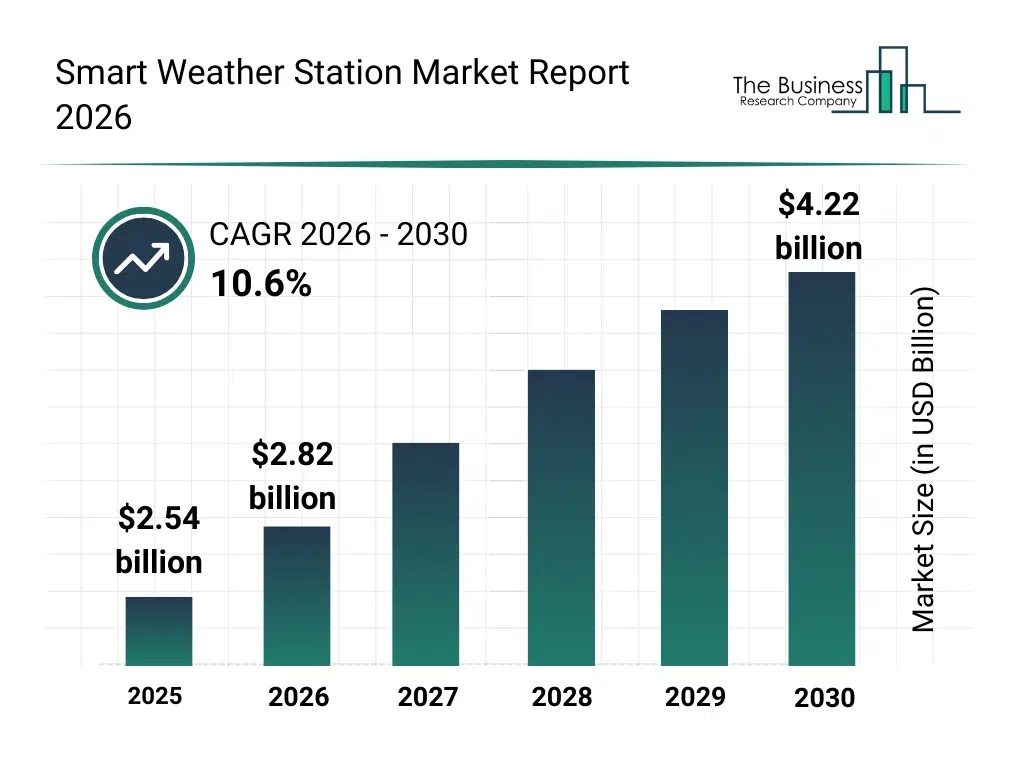
What Is The Smart Weather Station Market Size and Share 2026?
The smart weather station market size has grown rapidly in recent years. It will grow from $2.54 billion in 2025 to $2.82 billion in 2026 at a compound annual growth rate (CAGR) of 10.9%. The growth in the historic period can be attributed to increasing need for real-time weather monitoring, rising adoption of wireless connectivity, growth in precision agriculture practices, government focus on disaster preparedness, and advancements in environmental sensor technology.What Is The Smart Weather Station Market Growth Forecast?
The smart weather station market size is expected to see rapid growth in the next few years. It will grow to $4.22 billion in 2030 at a compound annual growth rate (CAGR) of 10.6%. The growth in the forecast period can be attributed to growing integration of AI-based weather analytics, expansion of smart city infrastructure, rising deployment in renewable energy projects, increasing demand for remote automated monitoring, and widening use of cloud-based data platforms. Major trends in the forecast period include integration of IoT-enabled multi-sensor systems, growth of portable home-use weather stations, adoption of solar-powered smart stations, expansion of mobile app-based weather insights, increasing use of 5g and LPWA connectivity.
Global Smart Weather Station Market Segmentation
1) By Product Type: Wireless Weather Stations, Wired Weather Stations, Smartphone-Integrated Weather Stations, Portable Weather Stations, Professional Weather Stations 2) By Sensor Type: Temperature Sensors, Humidity Sensors, Pressure Sensors, Wind Sensors, Rainfall Sensors 3) By Technology: Internet of Things (IoT) Enabled Weather Stations, Standalone Weather Stations, Cloud-Based Weather Dashboards, Smart Home Integration, Bluetooth And Wi-Fi Enabled Devices 4) By Distribution Channel: Online Sales, Offline Sales 5) By End User: Individuals And Households, Agricultural Professionals, Educational Institutions, Businesses, Government Agencies Subsegments: 1) By Wireless Weather Stations: Remote Sensor Wireless Units, Solar-Powered Wireless Units, Home Automation-Compatible Wireless Units, Long-Range Wireless Units, Indoor-Outdoor Wireless Units 2) By Wired Weather Stations: Ethernet-Connected Weather Stations, Cable-Linked Sensor Stations, Fixed-Mount Wired Stations, Industrial Wired Monitoring Units, Laboratory Wired Weather Stations 3) By Smartphone-Integrated Weather Stations: Bluetooth-Enabled Weather Stations, App-Controlled Weather Modules, USB-Connected Weather Devices, Wi-Fi Synced Weather Stations, Compact Smartphone-Linked Sensors 4) By Portable Weather Stations: Handheld Weather Stations, Field Survey Weather Kits, Travel-Friendly Weather Units, Compact Outdoor Weather Devices, Battery-Operated Weather Instruments 5) By Professional Weather Stations: Research-Grade Weather Stations, Agricultural Monitoring Stations, Industrial Climate Measurement Systems, Environmental Observation Stations, High-Precision Meteorological UnitsWhat Is The Driver Of The Smart Weather Station Market?
The expansion of smart city initiatives is expected to propel the growth of the smart weather station market going forward. Smart city initiatives refer to urban development strategies that utilize disparate types of electronic data collection sensors to supply information which is used to manage assets and resources efficiently. The rise in smart city initiatives is due to the need for better environmental monitoring and urban planning, as municipalities aim to improve air quality, traffic management, and resilience against climate change. Smart weather stations support the expansion of smart city initiatives by collecting hyper-local meteorological and air quality data, owing to their compact design and ability to transmit real-time insights to centralized city management platforms. For instance, in July 2025, according to the European Commission, a Belgium-based executive body of the European Union, the Climate Neutral and Smart Cities Mission aims to deliver 100 climate neutral and smart cities by 2030 while positioning these cities as experimentation and innovation hubs to support the transition of all European cities toward climate neutrality by 2050. Therefore, the expansion of smart city initiatives is driving the growth of the smart weather station industry.Key Players In The Global Smart Weather Station Market
Major companies operating in the smart weather station market are Honeywell International Inc., Vaisala Oyj, Airmar Technology Corporation, Campbell Scientific Inc., Netatmo SAS, La Crosse Technology Ltd., METER Group Inc. USA, Davis Instruments Corporation, Nielsen-Kellerman Company, Oregon Scientific Inc., Advanced Environmental Monitoring LLC, Sencrop SAS, G. Lufft Mess- und Regeltechnik GmbH, BloomSky Inc., Geosense Ltd., RainWise Inc., Skye Instruments Ltd., AcuRite, Ambient LLC, Sainlogic Corporation, ThermoPro, Columbia Weather Systems Inc., Fine Offset Electronics Co.Ltd.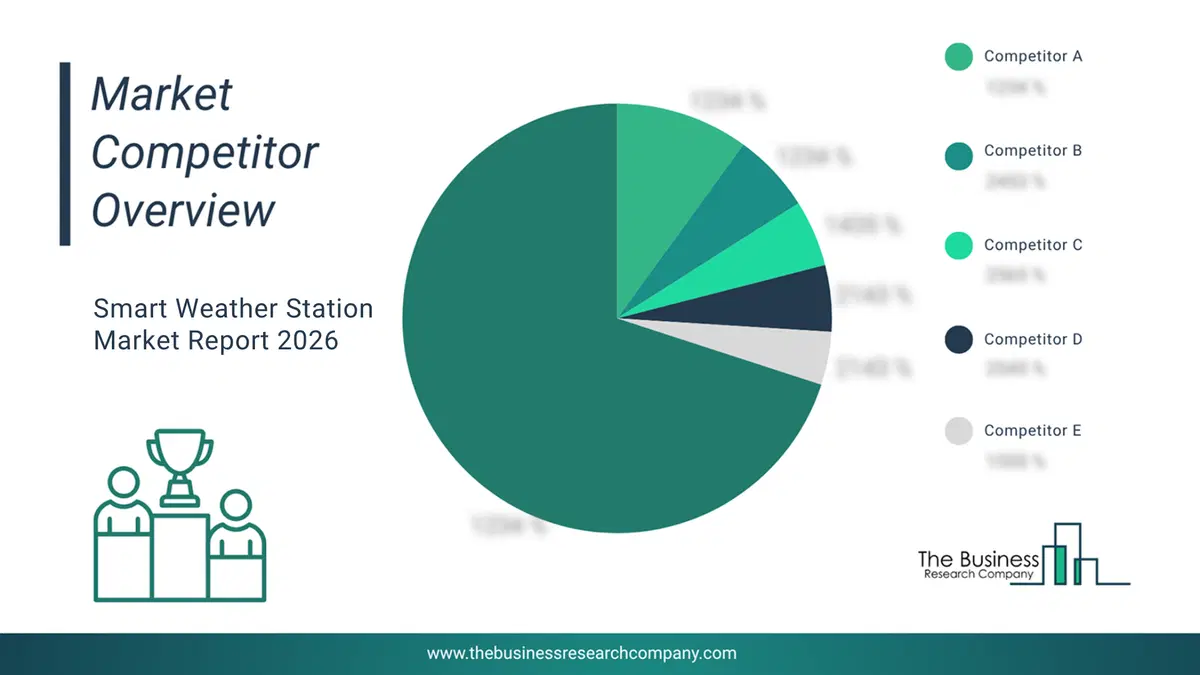
This chart is for illustrative purposes; the full report includes a detailed competitor analysis and comprehensive overview of the top 10 companies in the market.
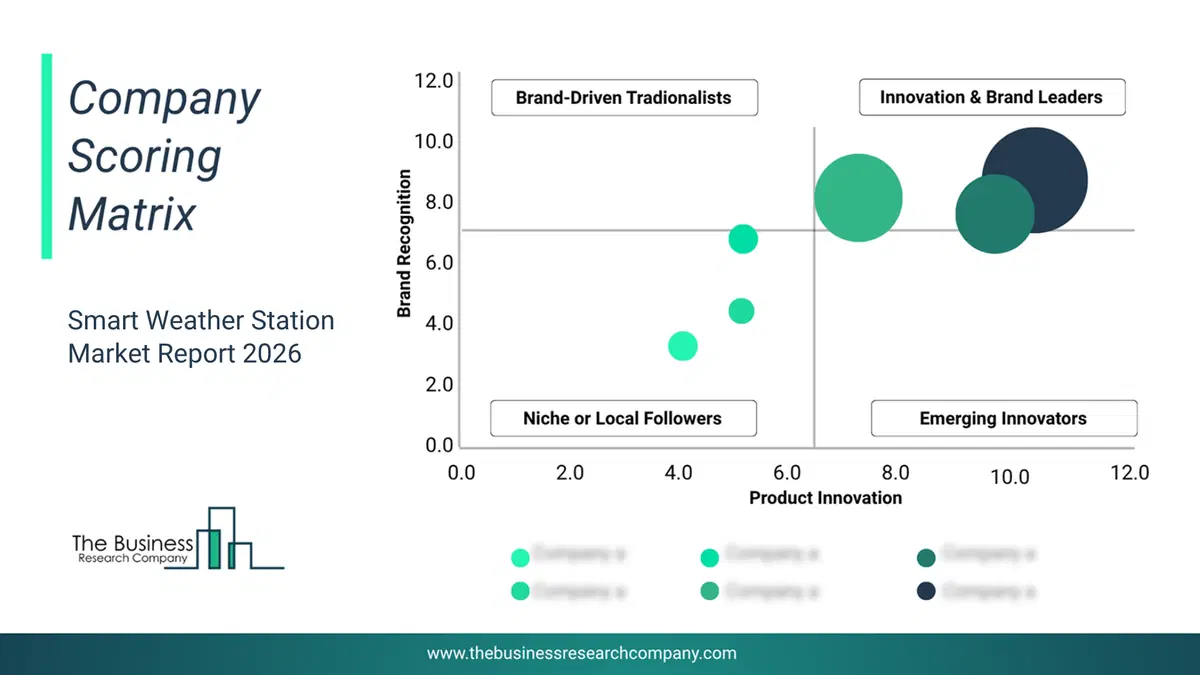
This chart maps companies by product innovation and brand strength, with bubble size indicating relative revenue, helping identify market leaders, challengers, and niche players. This is an illustrative chart; the full report provides a complete and accurate competitive analysis.
Global Smart Weather Station Market Trends and Insights
Major companies operating in the smart weather station market are focusing on developing advanced products, such as the ultrasonic sensor array and advanced color display, to deliver more accurate wind and weather measurements while providing clear, real-time visual data that enhances usability for both consumers and professionals. Ultrasonic sensor array and advanced color display refer to a combination of multiple ultrasonic sensors arranged to detect distance and obstacles with high spatial resolution, along with a high-quality color screen that visually presents this data and system status to the user in an intuitive way. For instance, in March 2024, AccuWeather Inc., a US-based media and weather forecasting company, partnered with Nielsen-Kellerman Co., a US-based Portable weather instruments manufacturing company, and launched the AccuWeather Ambient Weather Station product line. The suite, comprising the WS-2000, WS-2902, and WS-5000 models, features advanced ultrasonic wind sensors and support for up to 10 simultaneous sensor connections, allowing for the granular measurement of indoor and outdoor conditions. These stations seamlessly integrate with the ambient weather network and AccuWeather’s proprietary algorithms, providing users with extended hourly forecast graphs and severe weather alerts while contributing localized data points to refine broader forecast accuracy.What Are Latest Mergers And Acquisitions In The Smart Weather Station Market?
In October 2024, Senseca Germany GmbH, a Germany-based manufacturer of measurement and control technology, acquired Bristol Industrial and Research Associates Ltd. for an undisclosed amount. With this acquisition, Senseca sought to strengthen its position in the environmental monitoring sector by adding Biral’s specialized portfolio of visibility and present weather sensors, which are critical for applications in aviation, wind energy, and road safety. Bristol Industrial and Research Associates Ltd. is a UK-based designer and manufacturer of high-precision meteorological sensors and lightning detection systems used for smart weather stations.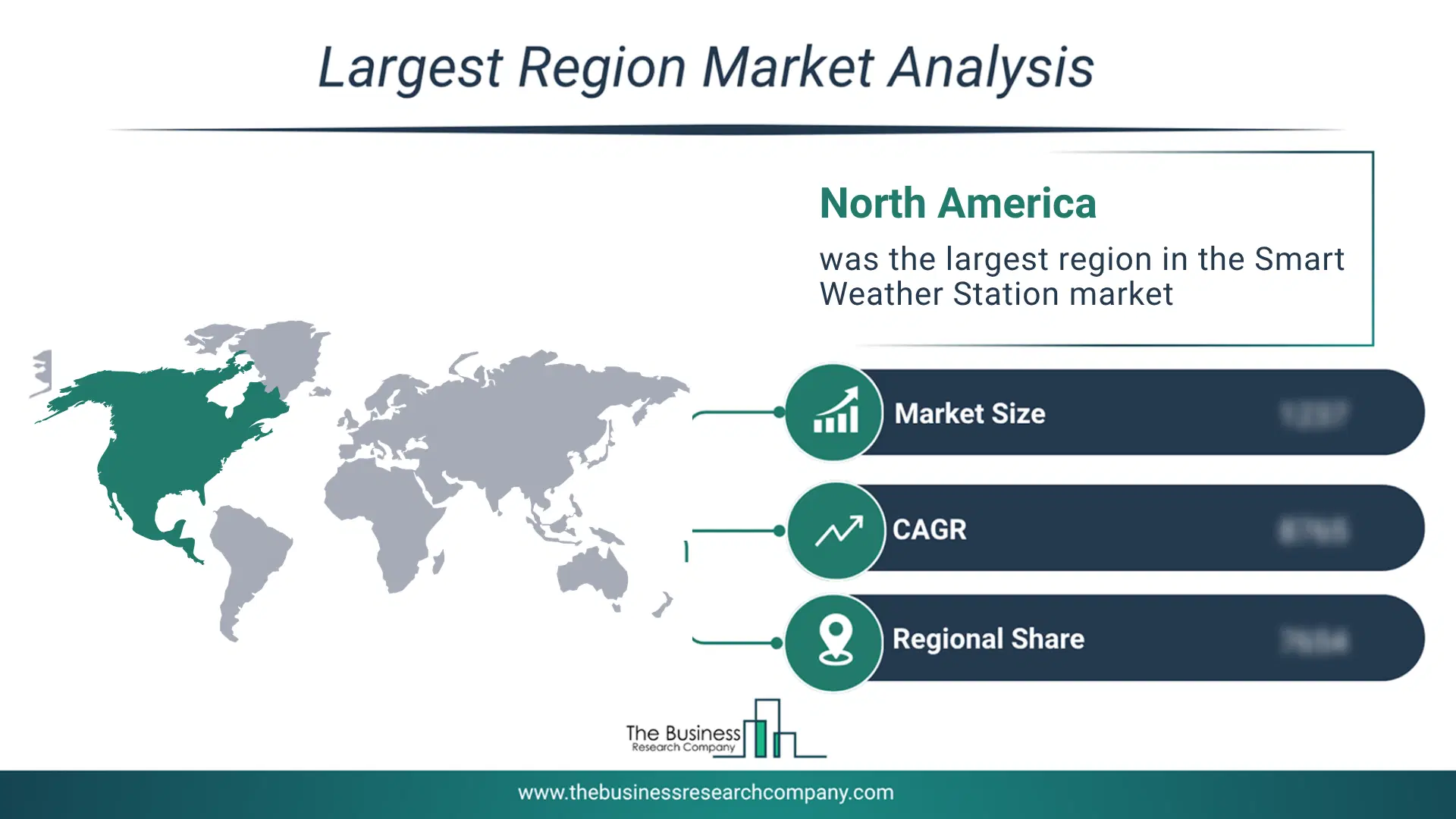
Regional Insights
North America was the largest region in the smart weather station market in 2025.Asia-Pacific is expected to be the fastest-growing region in the forecast period. The regions covered in this market report are Asia-Pacific, South East Asia, Western Europe, Eastern Europe, North America, South America, Middle East, Africa. The countries covered in this market report are Australia, Brazil, China, France, Germany, India, Indonesia, Japan, Taiwan, Russia, South Korea, UK, USA, Canada, Italy, Spain.What Defines the Smart Weather Station Market?
The smart weather station market consists of revenues earned by entities by providing services such as calibration services, data analytics services, remote monitoring services, and technical support services. The market value includes the value of related goods sold by the service provider or included within the service offering. The smart weather station market also includes sales of rain gauges, air quality monitors, data loggers, communication modules, solar panels, and mounting equipment. Values in this market are ‘factory gate’ values, that is, the value of goods sold by the manufacturers or creators of the goods, whether to other entities (including downstream manufacturers, wholesalers, distributors, and retailers) or directly to end customers. The value of goods in this market includes related services sold by the creators of the goods.How is Market Value Defined and Measured?
The market value is defined as the revenues that enterprises gain from the sale of goods and/or services within the specified market and geography through sales, grants, or donations in terms of the currency (in USD unless otherwise specified). The revenues for a specified geography are consumption values that are revenues generated by organizations in the specified geography within the market, irrespective of where they are produced. It does not include revenues from resales along the supply chain, either further along the supply chain or as part of other products.
This chart presents market attractiveness based on a quantitative evaluation of growth, competition, strategic alignment, and risk, offering a clear view of opportunity areas for decision-making. This chart is for illustrative purposes; the full report contains the complete analysis.

This chart highlights the Total Addressable Market (TAM) by estimating the maximum revenue opportunity using an assumption-driven approach, supporting strategic planning and opportunity sizing across markets. The chart is illustrative; the full report provides a more comprehensive analysis.
What Key Data and Analysis Are Included in the Smart Weather Station Market Report 2026?
The smart weather station market research report is one of a series of new reports from The Business Research Company that provides market statistics, including industry global market size, regional shares, competitors with the market share, detailed market segments, market trends and opportunities, and any further data you may need to thrive in the smart weather station industry. The market research report delivers a complete perspective of everything you need, with an in-depth analysis of the current and future state of the industry.Smart Weather Station Market Report Forecast Analysis
| Report Attribute | Details |
|---|---|
| Market Size Value In 2026 | $2.82 billion |
| Revenue Forecast In 2030 | $4.22 billion |
| Growth Rate | CAGR of 10.9% from 2026 to 2030 |
| Base Year For Estimation | 2025 |
| Actual Estimates/Historical Data | 2020-2025 |
| Forecast Period | 2026 - 2030 - 2030 |
| Market Representation | Revenue in USD Billion and CAGR from 2026 to 2030 |
| Segments Covered | Product Type, Sensor Type, Technology, Distribution Channel, End User |
| Regional Scope | Asia-Pacific, Western Europe, Eastern Europe, North America, South America, Middle East, Africa |
| Country Scope | The countries covered in the report are Australia, Brazil, China, France, Germany, India, Indonesia, Japan, Taiwan, Russia, South Korea, UK, USA, Canada, Italy, Spain. |
| Key Companies Profiled | Honeywell International Inc., Vaisala Oyj, Airmar Technology Corporation, Campbell Scientific Inc., Netatmo SAS, La Crosse Technology Ltd., METER Group Inc. USA, Davis Instruments Corporation, Nielsen-Kellerman Company, Oregon Scientific Inc., Advanced Environmental Monitoring LLC, Sencrop SAS, G. Lufft Mess- und Regeltechnik GmbH, BloomSky Inc., Geosense Ltd., RainWise Inc., Skye Instruments Ltd., AcuRite, Ambient LLC, Sainlogic Corporation, ThermoPro, Columbia Weather Systems Inc., Fine Offset Electronics Co.Ltd. |
| Customization Scope | Request for Customization |
| Pricing And Purchase Options | Explore Purchase Options |