
Software-Defined Vehicles Market Report 2026
Global Outlook – By Propulsion (ICE Vehicles, Electric Vehicles), By Vehicle Type (Passenger Car, Commercial Vehicles), By Level Of Autonomy (Level 1, Level 2, Level 3, Level 4, Level 5), By Application (ADAS And Safety, Connected Vehicles Services, Autonomous Driving, Body Control And Comfort System, Powertrain System) – Market Size, Trends, Strategies, and Forecast to 2035
Software-Defined Vehicles Market Overview
• Software-Defined Vehicles market size has reached to $64.92 billion in 2025 • Expected to grow to $147.73 billion in 2030 at a compound annual growth rate (CAGR) of 17.9% • Growth Driver: Rising Demand For Commercial Vehicles Propels Growth In The Software-Defined Vehicle Market • Market Trend: Increasing Focus On Technological Advancements To Drive The Revenues • North America was the largest region in 2025.What Is Covered Under Software-Defined Vehicles Market?
The software-defined vehicle refers to an automobile whose characteristics and operations are mostly enabled by software, as a result of the continuous change of the car from a predominantly hardware-based product to a software-centric electronic gadget on wheels. They are employed in the creation of future intelligent, networked, and environmentally friendly automobiles. The main propulsion of software-defined vehicles are ice vehicles and electric vehicles. An ICE automobile, often known as an internal combustion engine automobile, is one that is powered by a standard internal combustion engine. The various vehicle types involved are passenger car and commercial vehicles which consists of a type of levels of autonomy such as level 1, level 2, level 3, level 4, and, level 5 and include various applications such as adas and safety, connected vehicles services, autonomous driving, body control and comfort system, and powertrain system.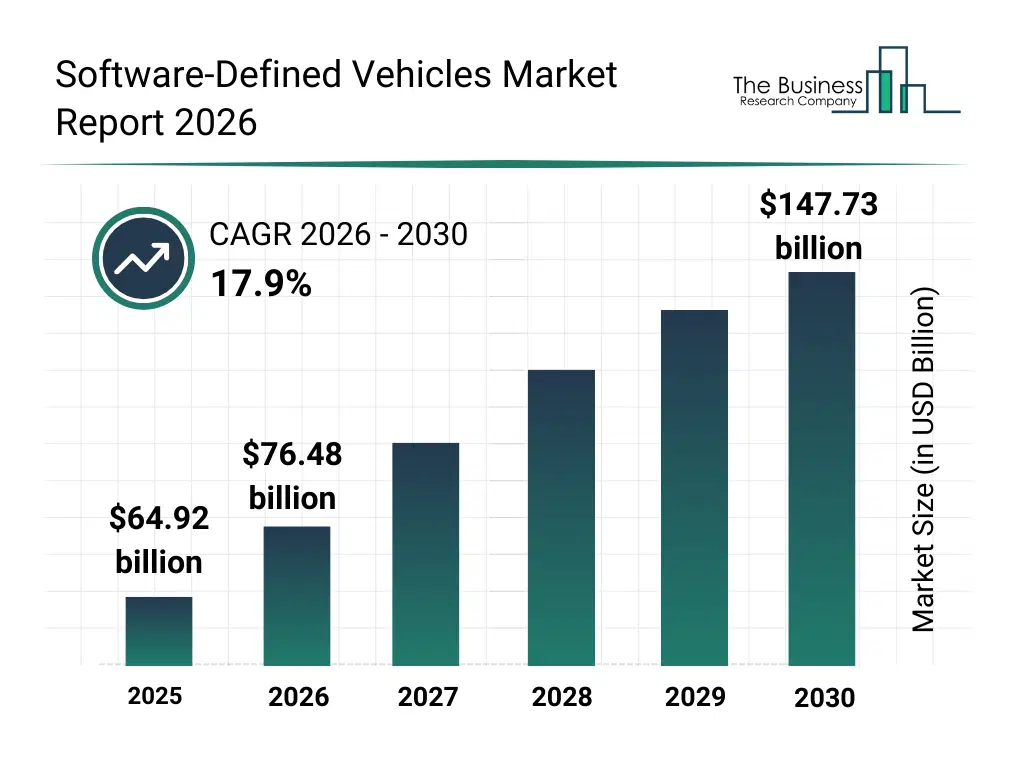
What Is The Software-Defined Vehicles Market Size and Share 2026?
The software-defined vehicles market size has grown rapidly in recent years. It will grow from $64.92 billion in 2025 to $76.48 billion in 2026 at a compound annual growth rate (CAGR) of 17.8%. The growth in the historic period can be attributed to advancements in automotive electronics, increasing integration of infotainment systems, early adoption of adas technologies, growth of connected vehicle platforms, rising software content per vehicle.What Is The Software-Defined Vehicles Market Growth Forecast?
The software-defined vehicles market size is expected to see rapid growth in the next few years. It will grow to $147.73 billion in 2030 at a compound annual growth rate (CAGR) of 17.9%. The growth in the forecast period can be attributed to increasing adoption of fully autonomous driving systems, rising focus on software monetization models, expansion of electric vehicle software platforms, growing emphasis on vehicle cybersecurity, increasing integration of cloud-based vehicle services. Major trends in the forecast period include increasing integration of centralized vehicle software architectures, rising adoption of over-the-air update capabilities, growing deployment of advanced driver assistance software, expansion of vehicle operating systems, enhanced focus on cybersecure automotive platforms.
Global Software-Defined Vehicles Market Segmentation
1) By Propulsion: ICE Vehicles, Electric Vehicles 2) By Vehicle Type: Passenger Car, Commercial Vehicles 3) By Level Of Autonomy: Level 1, Level 2, Level 3, Level 4, Level 5 4) By Application: ADAS And Safety, Connected Vehicles Services, Autonomous Driving, Body Control And Comfort System, Powertrain System Subsegments: 1) By ICE Vehicles (Internal Combustion Engine): Gasoline-Powered Vehicles, Diesel-Powered Vehicles 2) By Electric Vehicles: Battery Electric Vehicles (BEVs), Hybrid Electric Vehicles (HEVs), Plug-In Hybrid Electric Vehicles (PHEVs)What Is The Driver Of The Software-Defined Vehicles Market?
The rising demand for commercial vehicles is expected to propel the growth of the software-defined vehicle market going forward. Commercial vehicles are motor vehicles designed mainly for the transportation of goods, services, or passengers for commercial purposes, including trucks, vans, and buses. The rising demand for commercial vehicles can be attributed to several factors, including the growth of e-commerce, increasing urbanization, and supportive government initiatives. Software-defined vehicles have advanced telematics and data analytics that enable companies to monitor vehicle performance, track locations, and optimize routes in real time, resulting in improved efficiency and lower operational costs. For instance, in February 2024, according to S&P Global Mobility, a US-based financial information and analytics company, in 2023, over 1.6 million commercial vehicles were registered, marking an increase compared to 2022. Therefore, the rising demand for commercial vehicles is driving the growth of the software-defined vehicle industry.Key Players In The Global Software-Defined Vehicles Market
Major companies operating in the software-defined vehicles market are Volkswagen AG, Toyota Motor Corporation, Stellantis N.V., Mercedes-Benz Group AG, Ford Motor Company, General Motors Company, Bayerische Motoren Werke AG, Honda Motor Co. Ltd., HyundAI Motor Group, Robert Bosch GmbH, Tesla Inc., Kia Corporation, Renault Group, Volvo Group, Qualcomm Incorporated, Continental AG, Tata Motors Ltd., Suzuki Motor Corporation, Nvidia Corporation, ZF Friedrichshafen AG, BYD Co. Ltd., Valeo S.A., Aptiv Plc, Harman International Industries, BlackBerry Limited, Jaguar Land Rover Automotive PLC, Marelli Holdings Co. Ltd., Green Hills Software Inc., Airbiquity Inc., Sonatus Inc.Global Software-Defined Vehicles Market Trends and Insights
Major companies operating in software-defined vehicles are focusing on technologically advanced products like the DRIVE Thor to better meet the needs of their existing consumers. DRIVE Thor is a future-oriented system on a chip (SoC) for self-driving cars, intended to consolidate all intelligent vehicle operations on a single artificial intelligence computer. For instance, in April 2025, Intel Corporation, a US-based semiconductor firm, unveiled a second-generation AI-enhanced SDV SoC at the Auto ShanghAI 2025 event. This new SoC features the automotive industry’s first multi-process node chiplet architecture, delivers up to 10× AI performance and up to 3× graphics performance, and supports 12 camera lanes for enhanced in-vehicle imaging and compute functionality. It brings together advanced AI capabilities, graphics, sensor processing, and vehicle compute domains into one scalable architecture for next-gen software-defined vehicles.What Are Latest Mergers And Acquisitions In The Software-Defined Vehicles Market?
In August 2023, Synopsys, Inc., a U.S.-based provider of electronic design automation (EDA) software and silicon IP solutions, acquired PikeTec GmbH for an undisclosed amount. With this acquisition, Synopsys aimed to enhance its capabilities in automotive software verification and validation to address the accelerating complexity of software-defined vehicles (SDVs), enabling automotive OEMs and suppliers to bring SDV solutions to market faster and safer. PikeTec GmbH is a Germany-based provider of model-in-the-loop, software-in-the-loop, and vehicle-in-the-loop verification tools for automotive control unit and software systems.Regional Insights
North America was the largest region in the software-defined vehicles market in 2025. The regions covered in this market report are Asia-Pacific, South East Asia, Western Europe, Eastern Europe, North America, South America, Middle East, Africa. The countries covered in this market report are Australia, Brazil, China, France, Germany, India, Indonesia, Japan, Taiwan, Russia, South Korea, UK, USA, Canada, Italy, Spain.What Defines the Software-Defined Vehicles Market?
The software-defined vehicle market includes revenues earned by entities by providing services like driver assistance, real-time information, diagnostics, and telematics. The market value includes the value of related goods sold by the service provider or included within the service offering. Only goods and services traded between entities or sold to end consumers are included. The software-defined vehicle market consists of sales of operating systems, bootloaders, device drivers, hypervisors, and middleware. Values in this market are ‘factory gate’ values, that is the value of goods sold by the manufacturers or creators of the goods, whether to other entities (including downstream manufacturers, wholesalers, distributors and retailers) or directly to end customers. The value of goods in this market includes related services sold by the creators of the goods.How is Market Value Defined and Measured?
The market value is defined as the revenues that enterprises gain from the sale of goods and/or services within the specified market and geography through sales, grants, or donations in terms of the currency (in USD unless otherwise specified). The revenues for a specified geography are consumption values that are revenues generated by organizations in the specified geography within the market, irrespective of where they are produced. It does not include revenues from resales along the supply chain, either further along the supply chain or as part of other products.What Key Data and Analysis Are Included in the Software-Defined Vehicles Market Report 2026?
The software-defined vehicles market research report is one of a series of new reports from The Business Research Company that provides market statistics, including industry global market size, regional shares, competitors with the market share, detailed market segments, market trends and opportunities, and any further data you may need to thrive in the software-defined vehicles industry. The market research report delivers a complete perspective of everything you need, with an in-depth analysis of the current and future state of the industry.Software-Defined Vehicles Market Report Forecast Analysis
| Report Attribute | Details |
|---|---|
| Market Size Value In 2026 | $76.48 billion |
| Revenue Forecast In 2035 | $147.73 billion |
| Growth Rate | CAGR of 17.8% from 2026 to 2035 |
| Base Year For Estimation | 2025 |
| Actual Estimates/Historical Data | 2020-2025 |
| Forecast Period | 2026 - 2030 - 2035 |
| Market Representation | Revenue in USD Billion and CAGR from 2026 to 2035 |
| Segments Covered | Propulsion, Vehicle Type, Level Of Autonomy, Application |
| Regional Scope | Asia-Pacific, Western Europe, Eastern Europe, North America, South America, Middle East, Africa |
| Country Scope | The countries covered in the report are Australia, Brazil, China, France, Germany, India, ... |
| Key Companies Profiled | Volkswagen AG, Toyota Motor Corporation, Stellantis N.V., Mercedes-Benz Group AG, Ford Motor Company, General Motors Company, Bayerische Motoren Werke AG, Honda Motor Co. Ltd., HyundAI Motor Group, Robert Bosch GmbH, Tesla Inc., Kia Corporation, Renault Group, Volvo Group, Qualcomm Incorporated, Continental AG, Tata Motors Ltd., Suzuki Motor Corporation, Nvidia Corporation, ZF Friedrichshafen AG, BYD Co. Ltd., Valeo S.A., Aptiv Plc, Harman International Industries, BlackBerry Limited, Jaguar Land Rover Automotive PLC, Marelli Holdings Co. Ltd., Green Hills Software Inc., Airbiquity Inc., Sonatus Inc. |
| Customization Scope | Request for Customization |
| Pricing And Purchase Options | Explore Purchase Options |