
Solar Energy Storage Market Report 2026
Global Outlook – By Type (Lead Acid, Lithium Ion, Flow Battery, Other Types), By Installation (On Grid, Off Grid), By Capacity (50 Kw, 51 To 250 Kw, 251 To 500 Kw, 501 To 1,000 Kw, 1001 To 2500 Kw, 2,501 To 5,000 Kw, 5,001 To 10,000 Kw, > 10,000 Kw), By Application (Residential, Commercial And Industrial, Utility) – Market Size, Trends, Strategies, and Forecast to 2030
Solar Energy Storage Market Overview
• Solar Energy Storage market size has reached to $70.09 billion in 2025 • Expected to grow to $140.45 billion in 2030 at a compound annual growth rate (CAGR) of 14.9% • Growth Driver: Increasing Demand For Renewable Energy Fueling The Growth Of The Market Due To Environmental Concerns And Intermittency Of Solar Power • Market Trend: Technological Advancements In Utility-Scale Energy Storage Enhancing Grid Reliability And Renewable Integration • North America was the largest region in 2025 and Asia-Pacific is the fastest growing region.What Is Covered Under Solar Energy Storage Market?
Solar energy storage refers to the process of capturing and storing excess solar energy generated by solar panels for later use. This enables the use of solar power during periods without sunlight, such as at night or on cloudy days, ensuring a steady and dependable energy supply. By storing surplus energy, users can reduce dependence on the grid and lower electricity costs. The main solar energy storage types are lead acid, lithium ion, flow battery, and others. Lead-acid refers to a type of rechargeable battery using lead and sulfuric acid for energy storage. It can be installed both on grid and off grid and offers various capacities including 50 kw, 51 to 250 kw, 251 to 500 kw, 501 to 1,000 kw, 1001 to 2500 kw, 2,501 to 5,000 kw, 5,001 to 10,000 kw, and > 10,000 kw. It is applied for residential, commercial and industrial, and utility.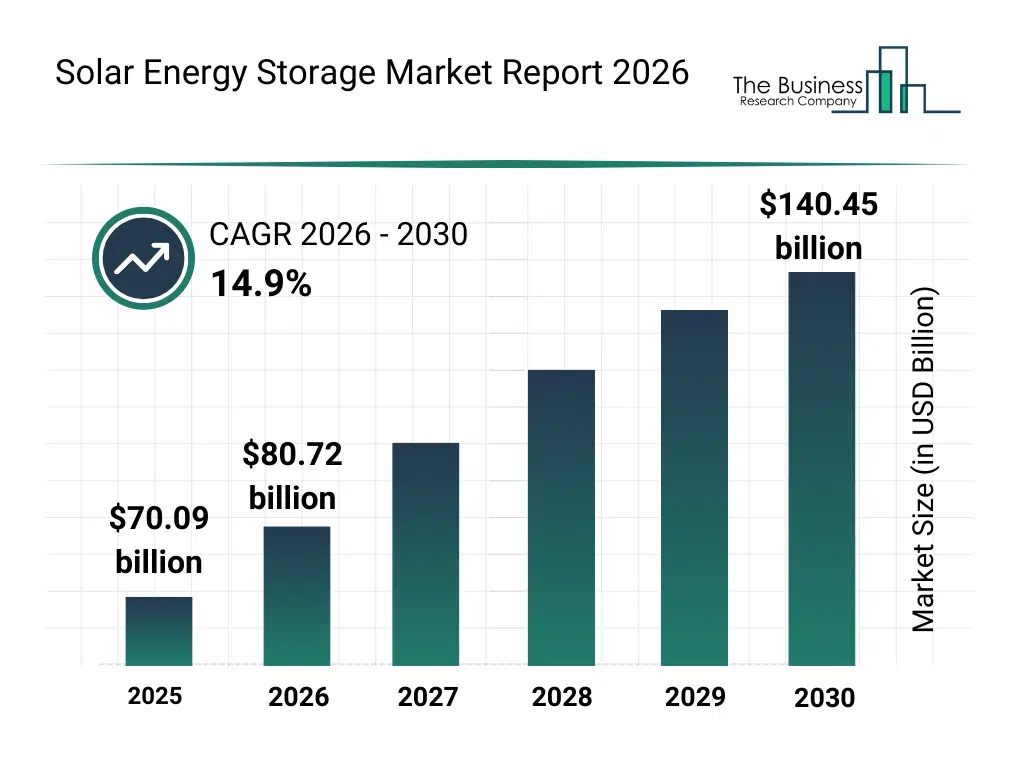
What Is The Solar Energy Storage Market Size and Share 2026?
The solar energy storage market size has grown rapidly in recent years. It will grow from $70.09 billion in 2025 to $80.72 billion in 2026 at a compound annual growth rate (CAGR) of 15.2%. The growth in the historic period can be attributed to increasing rooftop solar installations, early adoption of battery backup solutions, declining lithium-ion battery costs, grid reliability challenges, initial deployment of residential storage systems.What Is The Solar Energy Storage Market Growth Forecast?
The solar energy storage market size is expected to see rapid growth in the next few years. It will grow to $140.45 billion in 2030 at a compound annual growth rate (CAGR) of 14.9%. The growth in the forecast period can be attributed to increasing demand for renewable energy reliability, expansion of electric vehicle charging infrastructure, growing investments in grid-scale storage, rising focus on energy independence, advancement in long-duration storage technologies. Major trends in the forecast period include rising deployment of lithium-ion storage systems, increasing integration of solar plus storage solutions, expansion of utility-scale battery installations, growing adoption of off-grid storage systems, enhanced focus on grid stability support.
Global Solar Energy Storage Market Segmentation
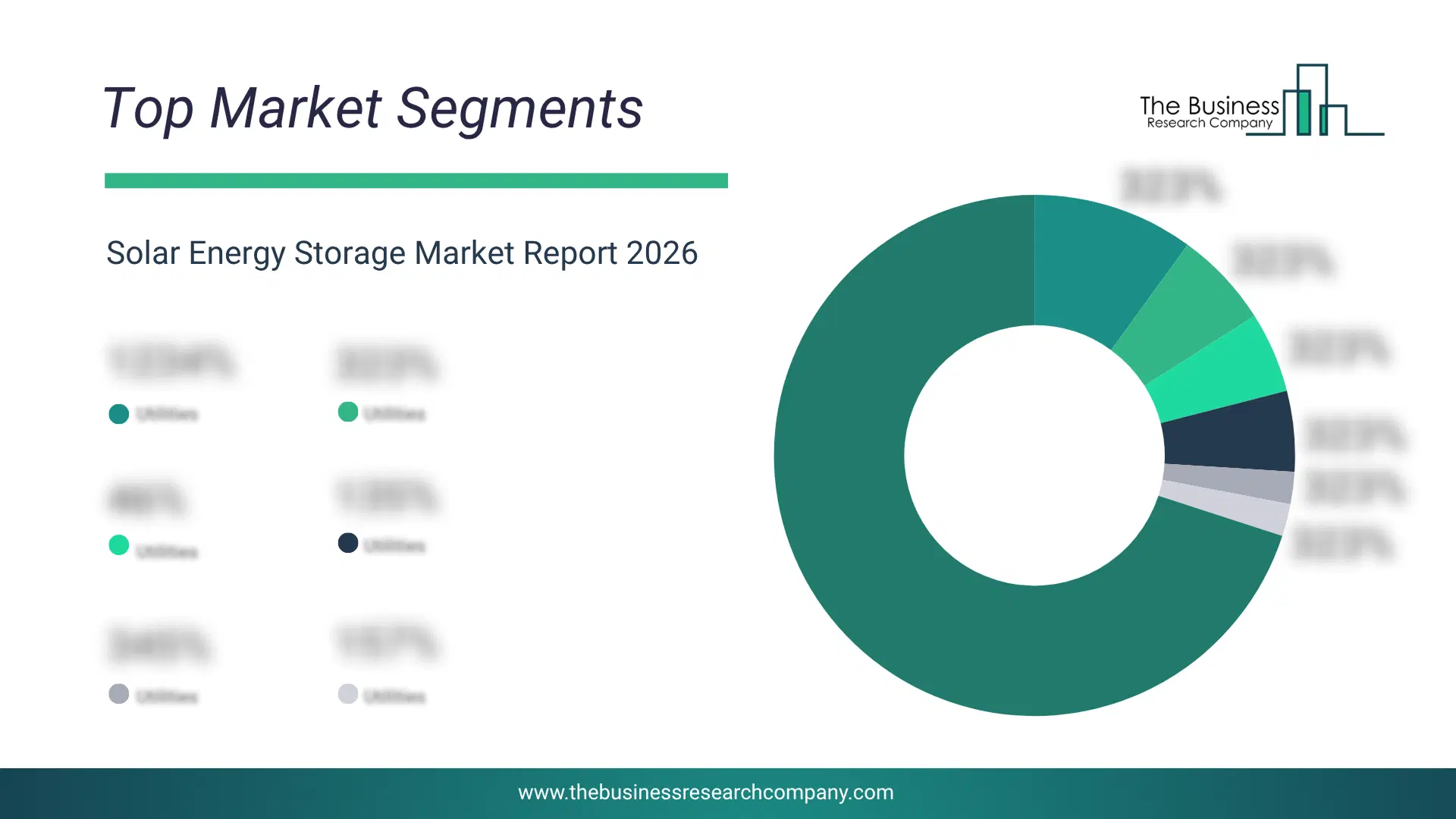
1) By Type: Lead Acid, Lithium Ion, Flow Battery, Other Types 2) By Installation: On Grid, Off Grid 3) By Capacity: 50 Kw, 51 To 250 Kw, 251 To 500 Kw, 501 To 1,000 Kw, 1001 To 2500 Kw, 2,501 To 5,000 Kw, 5,001 To 10,000 Kw, > 10,000 Kw 4) By Application: Residential, Commercial And Industrial, Utility Subsegments: 1) By Lead Acid: Sealed Lead Acid (SLA), Valve Regulated Lead Acid (VRLA), Flooded Lead Acid, Absorbent Glass Mat (AGM), Gel Batteries 2) By Lithium Ion: Lithium Iron Phosphate (LiFePO4), Lithium Nickel Manganese Cobalt Oxide (NMC), Lithium Titanate (LTO), Lithium Manganese Oxide (LMO), Lithium Cobalt Oxide (LCO) 3) By Flow Battery: Vanadium Redox Flow Battery (VRFB), Zinc-Bromine Flow Battery, Iron Flow Battery, Hybrid Flow Battery 4) By Other Types: Sodium-Sulfur (NaS) Batteries, Nickel-Cadmium (NiCd) Batteries, Nickel-Metal Hydride (NiMH) Batteries, Solid-State Batteries, SupercapacitorsWhat Is The Driver Of The Solar Energy Storage Market?
The increasing demand for renewable energy is expected to propel the growth of the solar energy storage market going forward. Renewable energy refers to energy generated from natural resources that are naturally replenished, such as sunlight, wind, water, and biomass. Rising demand for renewable energy is largely driven by growing environmental concerns, as awareness of climate change and fossil fuel impacts pushes governments and consumers toward cleaner, sustainable alternatives. Renewable energy supports solar energy storage because it ensures a steady power supply by storing excess solar energy for use during periods without sunlight, helping overcome the intermittent nature of solar generation. For instance, in December 2024, according to Eurostat, a Luxembourg-based government agency, in 2023, renewable energy accounted for 24.5% of the energy consumed in the EU, an increase from 23.0% in 2022. Therefore, the increasing demand for renewable energy is driving growth of the solar energy storage industry.Key Players In The Global Solar Energy Storage Market
Major companies operating in the solar energy storage market are Samsung Electronics Co. Ltd., Tesla Inc., LG Electronics Inc., BYD Company Ltd., Panasonic Holdings Corporation, Honeywell International Inc., Mitsubishi Heavy Industries Ltd., Enersys, Enphase Energy Inc., Delta Electronics Inc., VARTA AG, Sonnen GmbH, Trojan Battery Company LLC, Hitachi Energy Ltd., Kokam Co. Ltd., Zen Energy Pty Ltd., Adara Power Inc., Leclanché SA, Aquion Energy Inc., Pylon Technologies Co. Ltd., Zenobe Energy Ltd.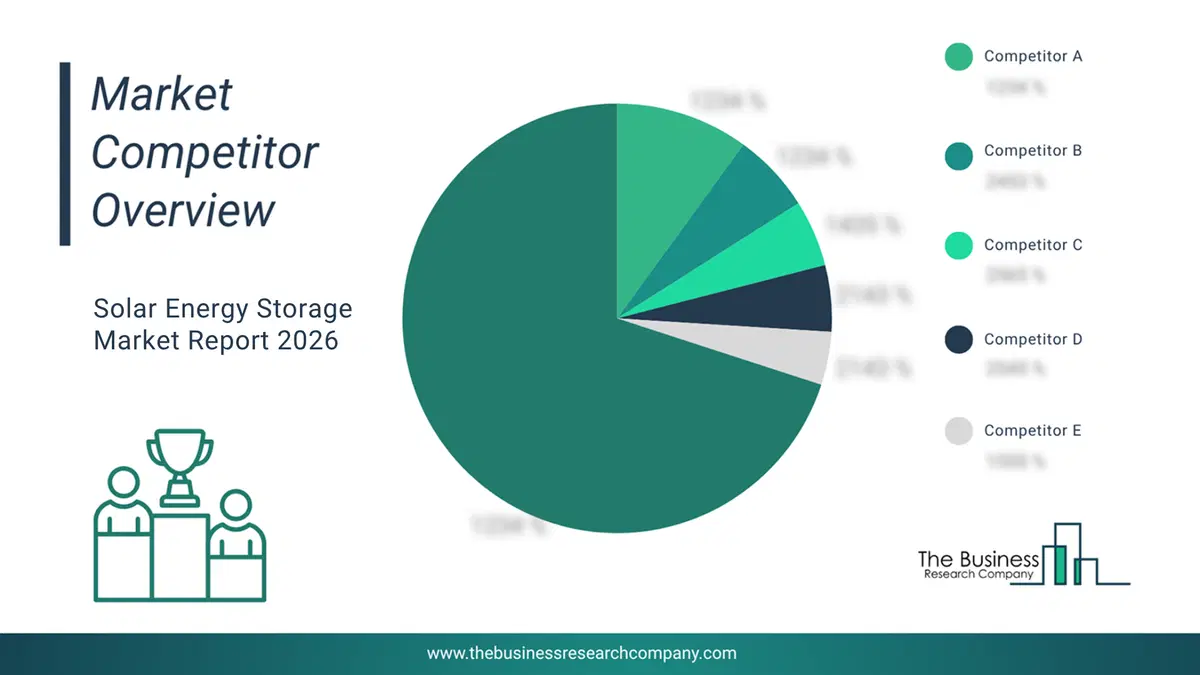
This chart is for illustrative purposes; the full report includes a detailed competitor analysis and comprehensive overview of the top 10 companies in the market.
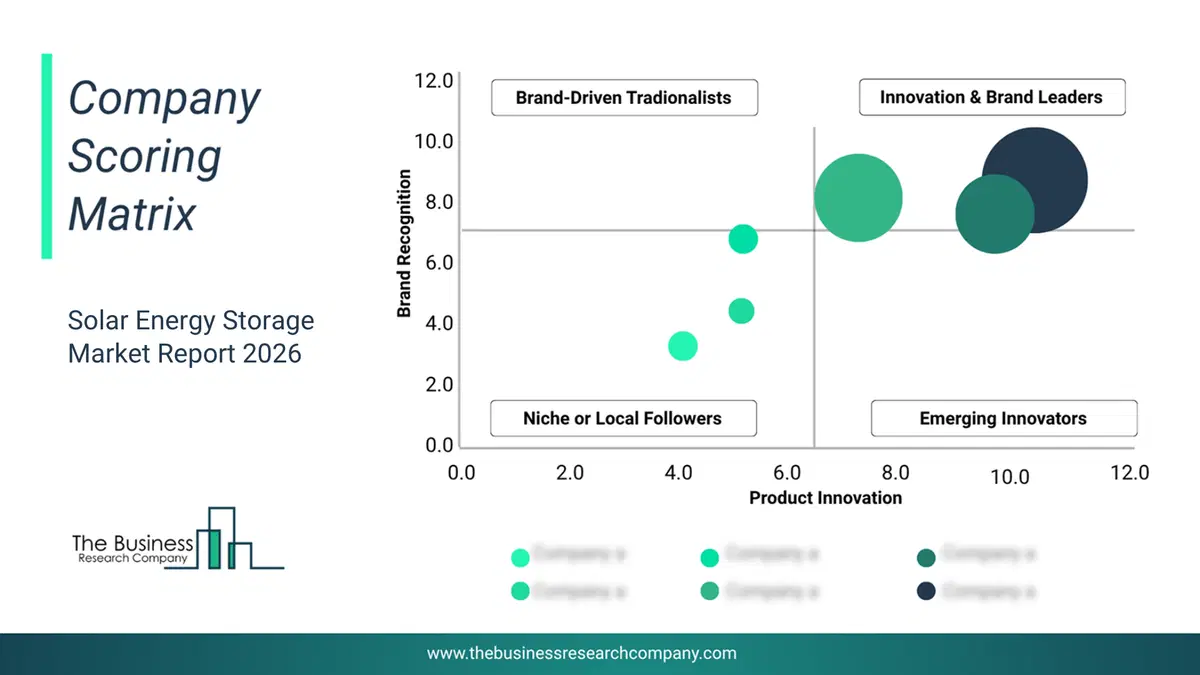
This chart maps companies by product innovation and brand strength, with bubble size indicating relative revenue, helping identify market leaders, challengers, and niche players. This is an illustrative chart; the full report provides a complete and accurate competitive analysis.
Global Solar Energy Storage Market Trends and Insights
Major companies operating in the solar energy storage market are focusing on developing technologically innovative solutions, such as utility-scale energy storage systems, to optimize energy management. A utility-scale energy storage system is a large-capacity, advanced technology solution designed to store and manage electricity at the grid level, enhancing energy reliability, efficiency, and renewable integration. For instance, in December 2023, Canadian Solar, Inc. a Canada-based renewable energy company, launched a SolBank 3.0, offering higher density and advanced safety features for utility-scale applications. SolBank 3.0 is a compact, high-performance solar energy storage system delivering 2.35 MW of power and 5 MWh capacity. It features high energy density cells, smart liquid cooling, and advanced safety systems for enhanced reliability. The system offers 45% more capacity and reduces commissioning time by 40% compared to its previous version. Its optimized thermal management also cuts auxiliary power consumption by up to 30%, boosting overall efficiency.What Are Latest Mergers And Acquisitions In The Solar Energy Storage Market?
In February 2025, Oil and Natural Gas Corporation Limited, an India-based crude oil industry company, collaborated with Tata Power Renewable Energy Limited to investigate innovative methods in the quickly developing Battery Energy Storage System (BESS). With this collaboration, aim to develop battery energy storage systems (BESS) for grid stability and clean energy integration in India. Tata Power Renewable Energy Limited is an India-based company, is developing, owning, operating, and maintaining renewable energy projects, including solar, wind, hybrid, and storage systems.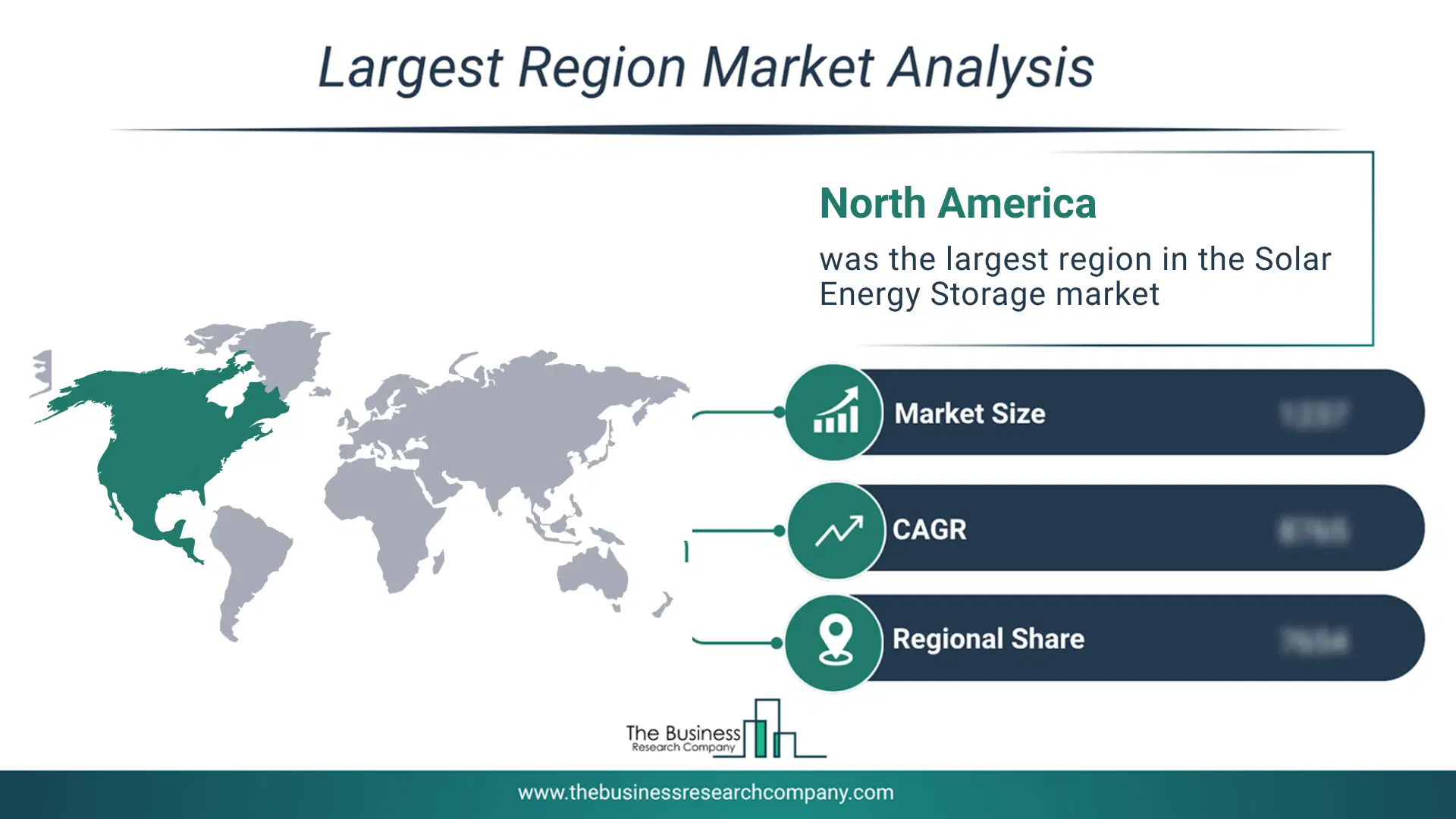
Regional Outlook
North America was the largest region in the solar energy storage market in 2025. Asia-Pacific is expected to be the fastest-growing region in the forecast period. The regions covered in this market report are Asia-Pacific, South East Asia, Western Europe, Eastern Europe, North America, South America, Middle East, Africa. The countries covered in this market report are Australia, Brazil, China, France, Germany, India, Indonesia, Japan, Taiwan, Russia, South Korea, UK, USA, Canada, Italy, SpainWhat Defines the Solar Energy Storage Market?
The solar energy storage market consists of revenues earned by entities by providing services such as battery installation, grid-connected storage, energy management, and backup power solutions. The market value includes the value of related goods sold by the service provider or included within the service offering. The solar energy storage market also consists of sales of products including solar batteries, battery inverters, energy management systems, hybrid inverters, and thermal energy storage. Values in this market are ‘factory gate’ values, that is, the value of goods sold by the manufacturers or creators of the goods, whether to other entities (including downstream manufacturers, wholesalers, distributors, and retailers) or directly to end customers. The value of goods in this market includes related services sold by the creators of the goods.How is Market Value Defined and Measured?
The market value is defined as the revenues that enterprises gain from the sale of goods and/or services within the specified market and geography through sales, grants, or donations in terms of the currency (in USD unless otherwise specified). The revenues for a specified geography are consumption values that are revenues generated by organizations in the specified geography within the market, irrespective of where they are produced. It does not include revenues from resales along the supply chain, either further along the supply chain or as part of other products.
This chart presents market attractiveness based on a quantitative evaluation of growth, competition, strategic alignment, and risk, offering a clear view of opportunity areas for decision-making. This chart is for illustrative purposes; the full report contains the complete analysis.

This chart highlights the Total Addressable Market (TAM) by estimating the maximum revenue opportunity using an assumption-driven approach, supporting strategic planning and opportunity sizing across markets. The chart is illustrative; the full report provides a more comprehensive analysis.
What Key Data and Analysis Are Included in the Solar Energy Storage Market Report 2026?
The solar energy storage market research report is one of a series of new reports from The Business Research Company that provides market statistics, including Market Report 2026?global market size, regional shares, competitors with the market share, detailed market segments, market trends and opportunities, and any further data you may need to thrive in the solar energy storage Market Report 2026? The market research report delivers a complete perspective of everything you need, with an in-depth analysis of the current and future state of the Market Report 2026?Solar Energy Storage Market Report Forecast Analysis
| Report Attribute | Details |
|---|---|
| Market Size Value In 2026 | $80.72 billion |
| Revenue Forecast In 2030 | $140.45 billion |
| Growth Rate | CAGR of 15.2% from 2026 to 2030 |
| Base Year For Estimation | 2025 |
| Actual Estimates/Historical Data | 2020-2025 |
| Forecast Period | 2026 - 2030 - 2030 |
| Market Representation | Revenue in USD Billion and CAGR from 2026 to 2030 |
| Segments Covered | Type, Installation, Capacity, Application |
| Regional Scope | Asia-Pacific, Western Europe, Eastern Europe, North America, South America, Middle East, Africa |
| Country Scope | The countries covered in the report are Australia, Brazil, China, France, Germany, India, Indonesia, Japan, Taiwan, Russia, South Korea, UK, USA, Canada, Italy, Spain. |
| Key Companies Profiled | Samsung Electronics Co. Ltd., Tesla Inc., LG Electronics Inc., BYD Company Ltd., Panasonic Holdings Corporation, Honeywell International Inc., Mitsubishi Heavy Industries Ltd., Enersys, Enphase Energy Inc., Delta Electronics Inc., VARTA AG, Sonnen GmbH, Trojan Battery Company LLC, Hitachi Energy Ltd., Kokam Co. Ltd., Zen Energy Pty Ltd., Adara Power Inc., Leclanché SA, Aquion Energy Inc., Pylon Technologies Co. Ltd., Zenobe Energy Ltd. |
| Customization Scope | Request for Customization |
| Pricing And Purchase Options | Explore Purchase Options |