
Space-Based Oceanography Market Report 2026
Global Outlook – By Technology (Satellite Altimetry, Satellite Ocean Color, Satellite Scatterometry, Satellite Radiometry, Other Technologies), By Application (Climate Monitoring, Weather Forecasting, Marine Ecosystem Monitoring, Coastal Management, Other Applications), By End-User (Government, Research Institutions, Commercial, Other End-Users) – Market Size, Trends, Strategies, and Forecast to 2030
Space-Based Oceanography Market Overview
• Space-Based Oceanography market size has reached to $3.31 billion in 2025 • Expected to grow to $4.91 billion in 2030 at a compound annual growth rate (CAGR) of 8.1% • Growth Driver: Growing Focus On Maritime Security And Environmental Monitoring Fueling The Growth Of The Market Due To Rising Threats And Demand For Real-Time Ocean Surveillance • Market Trend: Technological Advancements In Hyperspectral Imaging Fuels The Market Growth Due To Enhanced Accuracy In Ocean And Atmospheric Monitoring • North America was the largest region in 2025 and Asia-Pacific is the fastest growing region.What Is Covered Under Space-Based Oceanography Market?
Space-based oceanography refers to studying and monitoring oceanic phenomena using satellite-based remote sensing technologies. It utilizes satellite remote sensing to collect large-scale, real-time data on sea surface temperature, sea level, ocean currents, and other marine parameters. Space-based oceanography provides a global and consistent view of oceanic conditions over time. The main technologies of space-based oceanography are satellite altimetry, satellite ocean color, satellite scatterometry, satellite radiometry, and others. Satellite altimetry refers to a remote sensing technique that measures the height of the Earth's surface, particularly ocean and land elevations, by timing how long it takes radar pulses emitted from a satellite to bounce back. These are used in various applications including climate monitoring, weather forecasting, marine ecosystem monitoring, coastal management, and others, and are used by several end-users including government, research institutions, commercial, and others.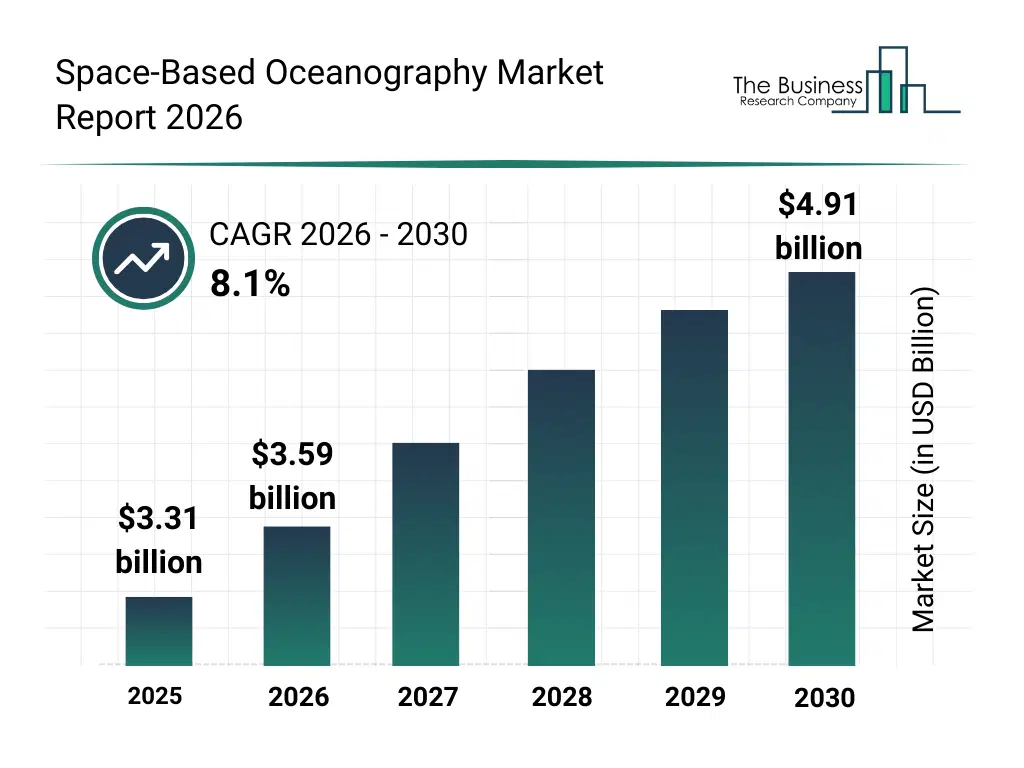
What Is The Space-Based Oceanography Market Size and Share 2026?
The space-based oceanography market size has grown strongly in recent years. It will grow from $3.31 billion in 2025 to $3.59 billion in 2026 at a compound annual growth rate (CAGR) of 8.5%. The growth in the historic period can be attributed to early deployment of ocean observation satellites, development of remote sensing sensors for sea surface monitoring, government and institutional funding for space-based oceanography research, advancements in satellite communication and data transmission systems, integration of oceanographic analytics software for large-scale data processing.What Is The Space-Based Oceanography Market Growth Forecast?
The space-based oceanography market size is expected to see strong growth in the next few years. It will grow to $4.91 billion in 2030 at a compound annual growth rate (CAGR) of 8.1%. The growth in the forecast period can be attributed to expansion of satellite constellations for continuous ocean monitoring, rising demand for real-time sea surface temperature and current data, adoption of advanced data processing and predictive ocean modeling systems, development of next-generation remote sensing sensors and communication equipment, increased collaboration between space agencies and marine research organizations for ocean resource management. Major trends in the forecast period include expanded satellite-based sea level and climate monitoring, growth in commercial satellite oceanography services, increased use of multispectral and hyperspectral ocean color imaging, rising demand for advanced altimetry and scatterometry missions, integration of real-time marine data analytics in coastal management.
Global Space-Based Oceanography Market Segmentation
1) By Technology: Satellite Altimetry, Satellite Ocean Color, Satellite Scatterometry, Satellite Radiometry, Other Technologies 2) By Application: Climate Monitoring, Weather Forecasting, Marine Ecosystem Monitoring, Coastal Management, Other Applications 3) By End-User: Government, Research Institutions, Commercial, Other End-Users Subsegments: 1) By Satellite Altimetry: Radar Altimeters, Laser Altimeters, Synthetic Aperture Radar Altimetry 2) By Satellite Ocean Color: Multispectral Imaging, Hyperspectral Imaging, Ocean Color Sensors 3) By Satellite Scatterometry: Ku-band Scatterometers, C-band Scatterometers, L-band Scatterometers 4) By Satellite Radiometry: Microwave Radiometers, Infrared Radiometers, Passive Radiometers 5) By Other Technologies: Global Navigation Satellite System Reflectometry, Lidar Systems, Gravity Field Mapping InstrumentsWhat Is Driver Of The Space-Based Oceanography Market?
The growing focus on maritime security and environmental monitoring is expected to propel the growth of the space-based oceanography market going forward. Maritime security and environmental monitoring refer to the protection of maritime interests and the systematic observation of oceanic conditions to ensure safe navigation, prevent illegal activities, and monitor the ecological health of the ocean. The growing focus on maritime security and environmental monitoring is driven by increasing threats from illegal fishing, piracy, and pollution, which necessitate advanced satellite-based tools for real-time ocean surveillance and ecosystem protection. The growing demand for ocean surveillance and ecological monitoring drives the adoption of space-based oceanography solutions. These technologies provide real-time, high-precision data that directly supports maritime security, environmental protection, and sustainable resource management. For instance, in January 2024, according to the International Maritime Bureau Piracy Reporting Centre (IMB PRC), a Malaysia-based organization, the 2023 annual report reveals that 105 vessels were boarded, 9 attempted attacks occurred, 4 vessels were hijacked, and 2 vessels were fired upon. Therefore, the growing focus on maritime security and environmental monitoring drives the space-based oceanography industry.Key Players In The Global Space-Based Oceanography Market
Major companies operating in the space-based oceanography market are Raytheon Technologies, Honeywell Aerospace Inc, Teledyne Technologies Incorporated, Thales Alenia Space SAS, Maxar Technologies Inc, OHB System AG, Airbus Defence and Space, ICEYE Ltd., Planet Labs PBC, Surrey Satellite Technology Limited, Spire Global Inc, Blacksky Technology Inc, The Tomorrow Companies Inc, Pixxel Space Technologies Pvt Ltd, AAC Clyde Space AB, HawkEye 360 Inc, Satellogic Inc, Changsha Spacety Co Ltd, Kleos Space SA, Umbra Lab Inc, GeoOptics Inc, isardSAT, Capella Space Corp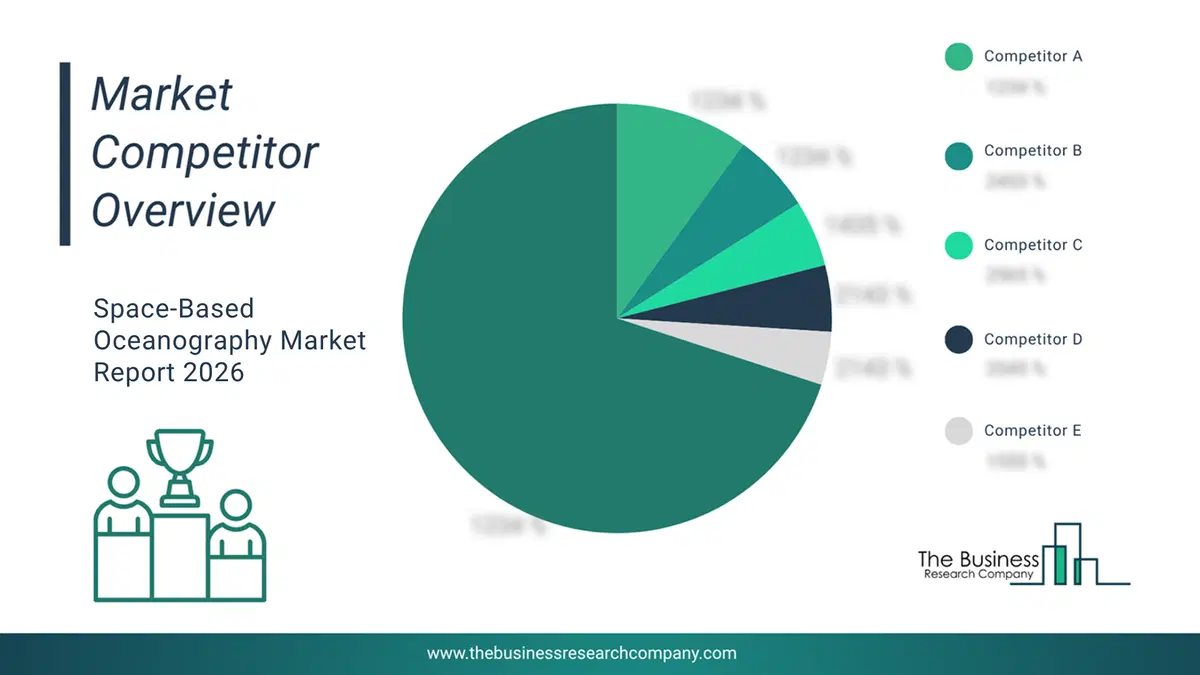
This chart is for illustrative purposes; the full report includes a detailed competitor analysis and comprehensive overview of the top 10 companies in the market.
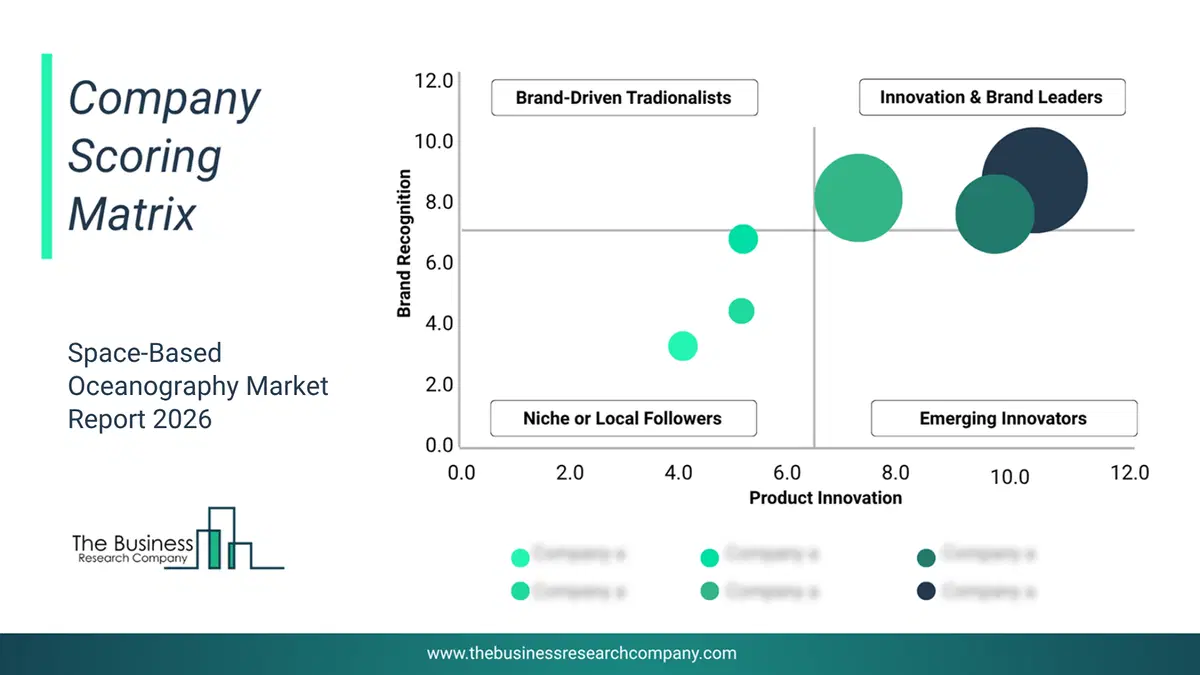
This chart maps companies by product innovation and brand strength, with bubble size indicating relative revenue, helping identify market leaders, challengers, and niche players. This is an illustrative chart; the full report provides a complete and accurate competitive analysis.
Global Space-Based Oceanography Market Trends and Insights
Major companies operating in the space-based oceanography market are focusing on developing technological advancements such as hyperspectral ocean color imaging-based satellites to enhance the accuracy of ocean and atmospheric data collection and enable better identification of marine ecosystems. A hyperspectral ocean color imaging-based satellite is an Earth observation satellite equipped with a hyperspectral sensor designed to capture detailed information about ocean color across hundreds of narrow spectral bands. For instance, in February 2024, the National Aeronautics and Space Administration (NASA), a US-based independent space agency, launched the Plankton, Aerosol, Cloud, Ocean Ecosystem (PACE) satellite aboard a SpaceX Falcon 9 rocket from the Kennedy Space Center in Florida. The satellite is designed to enhance understanding of Earth's oceans and atmosphere through advanced hyperspectral imaging and polarimetry technologies. It is equipped with instruments capable of detecting over 100 wavelengths of light. PACE enables scientists to monitor ocean health, track air pollution, and study the interactions between oceans, clouds, and atmospheric particles. The mission supports environmental monitoring, climate research, and weather forecasting by providing high-resolution global data for understanding Earth's dynamic systems.What Are Latest Mergers And Acquisitions In The Space-Based Oceanography Market? Fugro Expands Earth Observation Capabilities With Acquisition Of EOMAP For Enhanced Space-Based Oceanography
In February 2025, Fugro NV, a Netherlands-based geodata and geotechnical services company, acquired EOMAP GmbH & Co. KG for an undisclosed amount. Through this acquisition, Fugro is expanding its Earth observation capabilities by integrating EOMAP’s satellite-derived hydro spatial data expertise into its portfolio. EOMAP GmbH & Co KG is a Germany-based company specializing in optical remote sensing services for marine, coastal, and inland water environments, including space-based oceanography services.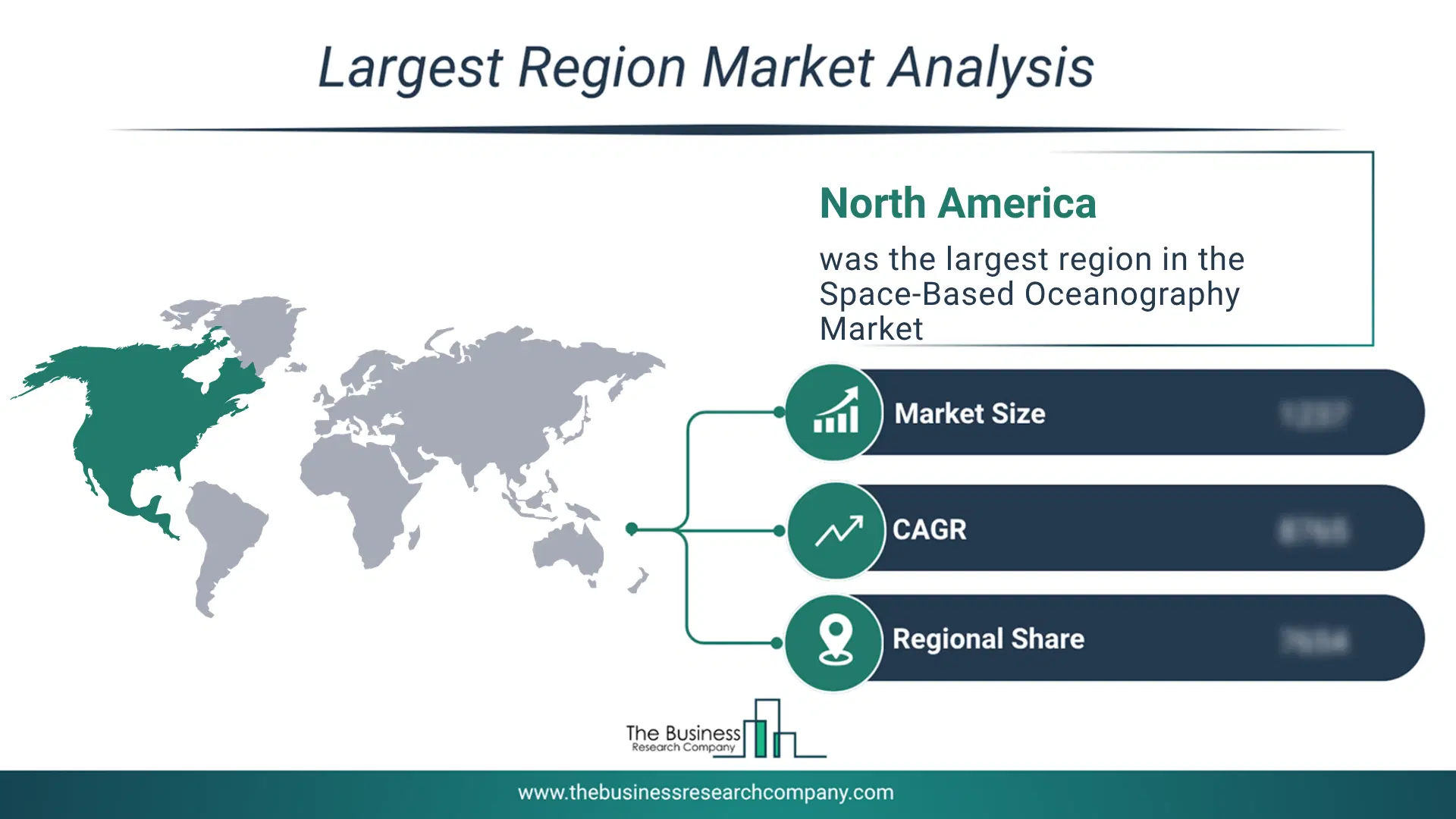
Regional Insights
North America was the largest region in the space-based oceanography market in 2025. Asia-Pacific is expected to be the fastest-growing region in the forecast period. The regions covered in this market report are Asia-Pacific, South East Asia, Western Europe, Eastern Europe, North America, South America, Middle East, Africa. The countries covered in this market report are Australia, Brazil, China, France, Germany, India, Indonesia, Japan, Taiwan, Russia, South Korea, UK, USA, Canada, Italy, SpainWhat Defines the Space-Based Oceanography Market?
The space-based oceanography market consists of revenues earned by entities providing services such as sea surface temperature monitoring, ocean current analysis, sea level and coastal observation, and marine resource management. The market value includes the value of related goods sold by the service provider or included within the service offering. The space-based oceanography market also includes sales of ocean monitoring satellites, remote sensing sensors, data processing systems, satellite communication equipment, and oceanographic analytics software. Values in this market are ‘factory gate’ values, that is the value of goods sold by the manufacturers or creators of the goods, whether to other entities (including downstream manufacturers, wholesalers, distributors and retailers) or directly to end customers. The value of goods in this market includes related services sold by the creators of the goods.How is Market Value Defined and Measured?
The market value is defined as the revenues that enterprises gain from the sale of goods and/or services within the specified market and geography through sales, grants, or donations in terms of the currency (in USD unless otherwise specified). The revenues for a specified geography are consumption values that are revenues generated by organizations in the specified geography within the market, irrespective of where they are produced. It does not include revenues from resales along the supply chain, either further along the supply chain or as part of other products.
This chart presents market attractiveness based on a quantitative evaluation of growth, competition, strategic alignment, and risk, offering a clear view of opportunity areas for decision-making. This chart is for illustrative purposes; the full report contains the complete analysis.

This chart highlights the Total Addressable Market (TAM) by estimating the maximum revenue opportunity using an assumption-driven approach, supporting strategic planning and opportunity sizing across markets. The chart is illustrative; the full report provides a more comprehensive analysis.
What Key Data and Analysis Are Included in the Space-Based Oceanography Market Report 2026?
The space-based oceanography market research report is one of a series of new reports from The Business Research Company that provides market statistics, including industry global market size, regional shares, competitors with the market share, detailed market segments, market trends and opportunities, and any further data you may need to thrive in the space-based oceanography industry. The market research report delivers a complete perspective of everything you need, with an in-depth analysis of the current and future state of the industry.Space-Based Oceanography Market Report Forecast Analysis
| Report Attribute | Details |
|---|---|
| Market Size Value In 2026 | $3.59 billion |
| Revenue Forecast In 2030 | $4.91 billion |
| Growth Rate | CAGR of 8.1% from 2026 to 2030 |
| Base Year For Estimation | 2025 |
| Actual Estimates/Historical Data | 2020-2025 |
| Forecast Period | 2026 - 2030 |
| Market Representation | Revenue in USD Billion and CAGR from 2026 to 2030 |
| Segments Covered | Technology, Application, End-User |
| Regional Scope | Asia-Pacific, Western Europe, Eastern Europe, North America, South America, Middle East, Africa |
| Country Scope | The countries covered in the space-based oceanography market report are Australia, Brazil, China, France, Germany, India, Indonesia, Japan, Taiwan, Russia, South Korea, UK, USA, Canada, Italy, Spain |
| Key Companies Profiled | Raytheon Technologies, Honeywell Aerospace Inc, Teledyne Technologies Incorporated, Thales Alenia Space SAS, Maxar Technologies Inc, OHB System AG, Airbus Defence and Space, ICEYE Ltd., Planet Labs PBC, Surrey Satellite Technology Limited, Spire Global Inc, Blacksky Technology Inc, The Tomorrow Companies Inc, Pixxel Space Technologies Pvt Ltd, AAC Clyde Space AB, HawkEye 360 Inc, Satellogic Inc, Changsha Spacety Co Ltd, Kleos Space SA, Umbra Lab Inc, GeoOptics Inc, isardSAT, Capella Space Corp |
| Customization Scope | Request for Customization |
| Pricing And Purchase Options | Explore Purchase Options |