
Space Propellant Tank Market Report 2026
Global Outlook – By Type (Liquid Propellants, Solid Propellants, Hybrid propellants), By Material (Aluminium And Titanium Alloys, Carbon Fiber, Nanomaterials, Thermoset And Thermoplastic), By Tank Design (Cylindrical Tanks, Spherical Tanks, Toroidal Tanks, Custom Designed Tanks), By Application (Launch Vehicles, Satellites And Spacecraft, Orbital Transfer Vehicles, Deep Space Missions), By End-User (Commercial, Defence) – Market Size, Trends, Strategies, and Forecast to 2030
Space Propellant Tank Market Overview
• Space Propellant Tank market size has reached to $3.53 billion in 2025 • Expected to grow to $4.82 billion in 2030 at a compound annual growth rate (CAGR) of 6.4% • Growth Driver: Growing Production And Launch Of Satellites Propelling The Growth Of The Market Due To Advancements In Satellite Technology • Market Trend: Technological Development Of Zero-Slosh Propellant Management Enhances Fuel Stability And Maneuverability In Spacecraft • North America was the largest region in 2025 and Asia-Pacific is the fastest growing region.Market Gains By 2030 – Top Opportunities By Segment
Market Gain identifies the most promising market opportunities by highlighting the segments or products expected to generate the highest incremental revenue growth over the next five years.
What Is Covered Under Space Propellant Tank Market?
A space propellant tank is a specially designed container used in spacecraft and rockets to store fuel and oxidizer required for propulsion in space. These tanks are engineered to withstand extreme temperatures, high pressures, and the vacuum of space while ensuring safe and efficient delivery of propellants to the engine. Space propellant tanks are typically made from lightweight, durable materials such as composites or aerospace-grade metals. The main types of space propellant tanks are liquid propellant tanks, solid propellant tanks, and hybrid propellant tanks. Liquid propellants are chemical substances in liquid form used in rocket engines to produce thrust through controlled combustion. These tanks are made from materials such as aluminum and titanium alloys, carbon fiber, nanomaterials, thermoset, and thermoplastic. Tank designs include cylindrical tanks, spherical tanks, toroidal tanks, and custom-designed tanks. They are used in various applications such as launch vehicles, satellites and spacecraft, orbital transfer vehicles, and deep space missions. The key end users are commercial and defense sectors.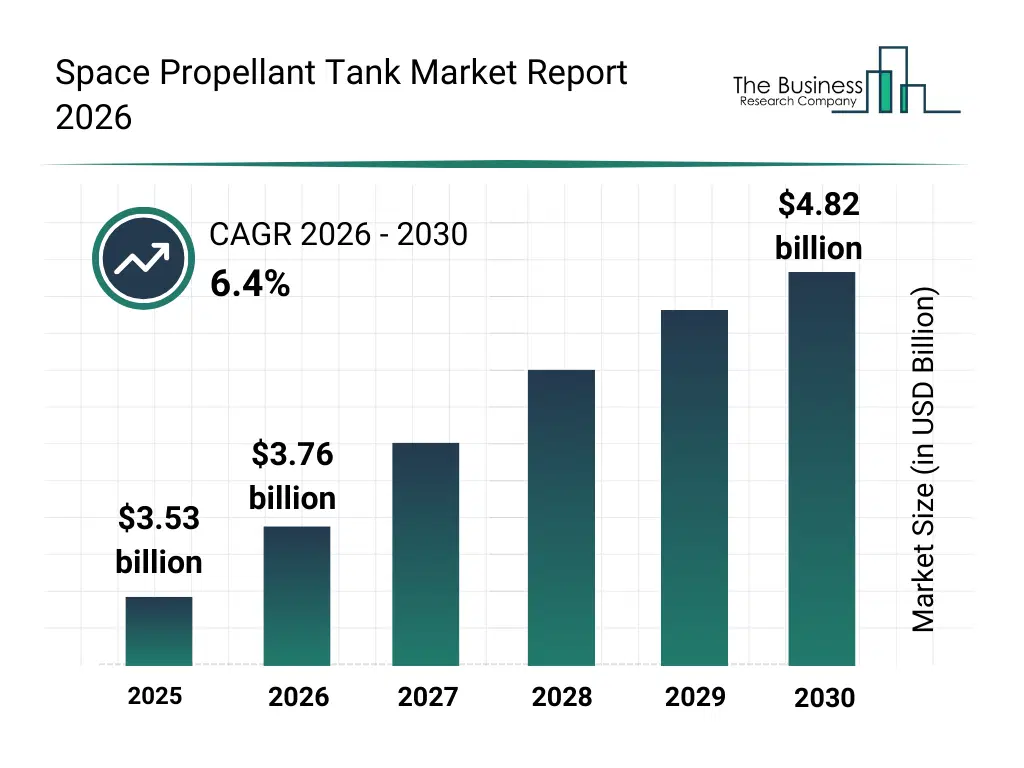
What Is The Space Propellant Tank Market Size and Share 2026?
The space propellant tank market size has grown strongly in recent years. It will grow from $3.53 billion in 2025 to $3.76 billion in 2026 at a compound annual growth rate (CAGR) of 6.5%. The growth in the historic period can be attributed to advancements in lightweight composite materials for tank construction, increasing demand for cryogenic and high-pressure propellant storage, growth in satellite launch and space exploration programs, development of reusable and multi-use propellant tank systems, rising collaboration between aerospace manufacturers and space agencies.What Is The Space Propellant Tank Market Growth Forecast?
The space propellant tank market size is expected to see strong growth in the next few years. It will grow to $4.82 billion in 2030 at a compound annual growth rate (CAGR) of 6.4%. The growth in the forecast period can be attributed to growing adoption of advanced composite and metal alloys for weight reduction, expansion of commercial and government space missions, focus on high-capacity and modular propellant storage solutions, integration of smart sensors for real-time monitoring of propellant levels, development of tanks compatible with next-generation rocket propulsion systems. Major trends in the forecast period include demand growth for lightweight composite propellant tanks, increased adoption of reusable launch platforms boosting tank durability innovations, advancements in cryogenic storage technologies for deep space exploration, rising commercial satellite deployment driving higher tank production, strategic partnerships for rapid tank qualification and testing.
Global Space Propellant Tank Market Segmentation
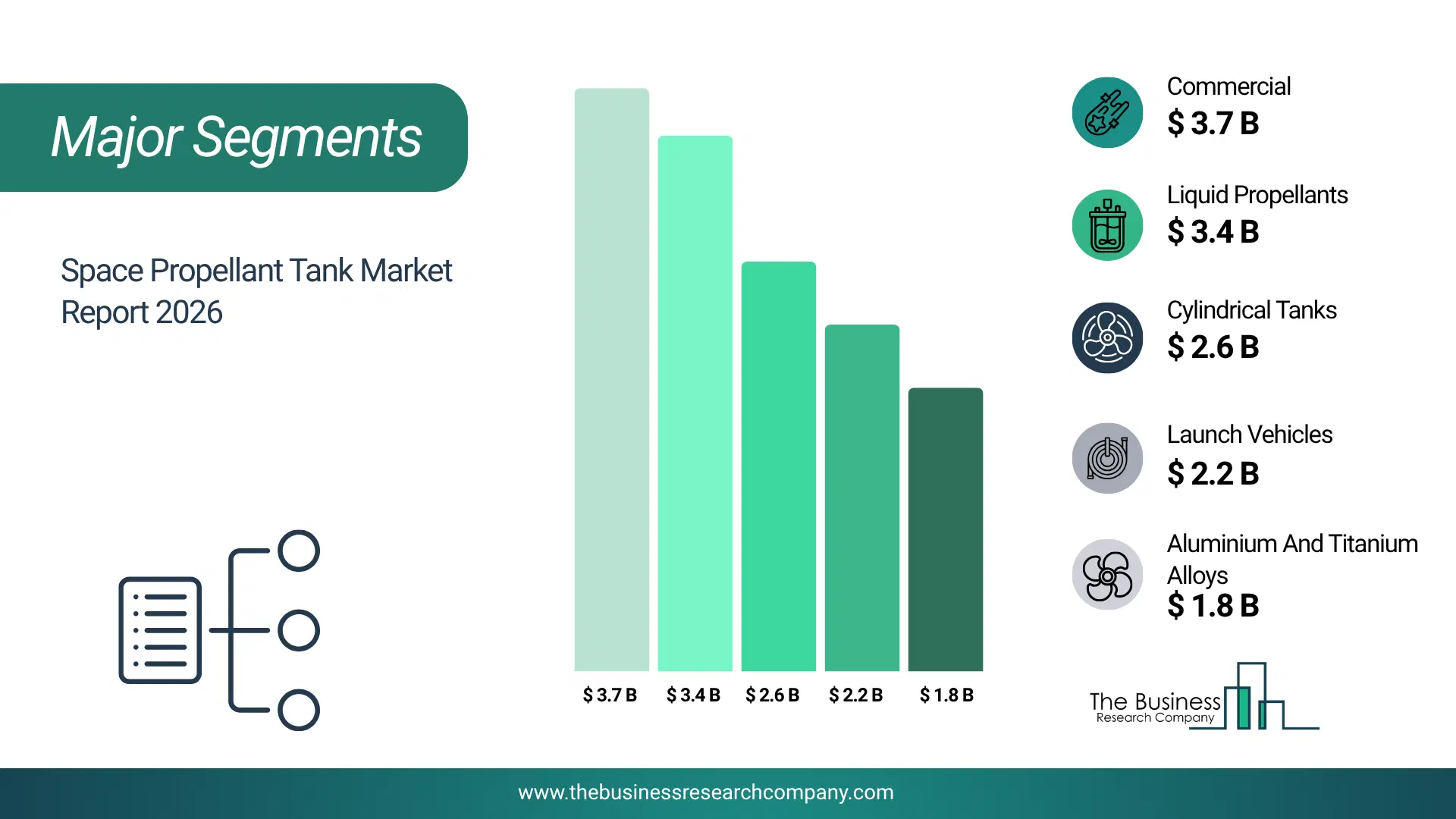
1) By Type: Liquid Propellants, Solid Propellants, Hybrid propellants 2) By Material: Aluminium And Titanium Alloys, Carbon Fiber, Nanomaterials, Thermoset And Thermoplastic 3) By Tank Design: Cylindrical Tanks, Spherical Tanks, Toroidal Tanks, Custom Designed Tanks 4) By Application: Launch Vehicles, Satellites And Spacecraft, Orbital Transfer Vehicles, Deep Space Missions 5) By End-User: Commercial, Defence Subsegments: 1) By Liquid Propellants: Bipropellant, Monopropellant, Cryogenic, Hypergolic 2) By Solid Propellants: Homogeneous, Composite, Double-Base, Composite Modified Double-Base (CMDB) 3) By Hybrid Propellants: Paraffin-Based Fuels, Hydroxyl-Terminated Polybutadiene (HTPB), Acrylonitrile Butadiene Styrene (ABS), Polyethylene-Based Fuels The top segments in the space propellant tank market will be: • Commercial will reach $3768.88 Million by 2030. • Liquid Propellants will reach $3415.4 Million by 2030. • Cylindrical Tanks will reach $2653.05 Million by 2030. • Launch Vehicles will reach $2228.17 Million by 2030. • Aluminium And Titanium Alloys will reach $1868.24 Million by 2030.What Is Driver Of The Space Propellant Tank Market?
The growing production and launch of satellites are expected to propel the growth of the space propellant tanks market going forward. The production and launch of satellites involves manufacturing spacecraft for various applications and deploying them into orbit with increasing frequency due to advancements in small satellite technology. The production and launch of satellites is increasing due to advancements in small satellite technology enabling rapid deployment for communication, earth observation, and research purposes. Space propellant tanks are essential in the production and launch of satellites, to store and manage the fuel required for propulsion, maneuvering, and maintaining orbital positions throughout the satellite's mission lifecycle. For instance, in July 2023, according to the United Nations Office for Outer Space Affairs (UNOOSA), an Austria-based organization promotes international cooperation in the peaceful use and exploration of outer space, as of June 2023, there were 11,330 individual satellites orbiting Earth, reflecting a significant 37.94% growth since January 2022. Therefore, the growing production and launch of satellites are driving the space propellant tanks industry.
Infographic Chart Showing Key Market Drivers Analysis And Restraints For Space Propellant Tank Market
The chart presents an impact analysis of key drivers and restraints, quantifying their relative influence on the market's growth rate and helping assess the balance between growth enablers and limiting factors. This chart offers a high-level perspective; the full report contains more detailed insights.
How Will The Drivers Impact Growth In The Global Space Propellant Tank Market?
• Rising Defense Spending in Space Programs (Medium) – During the forecast period, the increasing defense spending on space programs is expected to drive the growth of the space propellant tank market. defense agencies are placing greater emphasis on launch systems and spacecraft capable of supporting national security missions, ensuring operational resilience, and maintaining secure and reliable access to orbit, all of which rely on advanced propulsion and fuel storage solutions. higher investments in defense space initiatives are boosting demand for propellant tanks that provide high durability, stable pressurization, and efficient fuel management to enable mission-critical maneuvers and extended operations. as governments continue to expand funding for launch services, satellite deployments, and space infrastructure, including multibillion-dollar budgets for national security space launches—the need for robust, mission-ready propellant tank technologies is expected to increase significantly, thereby accelerating market growth. as a result, increasing defense spending on space programs is anticipated to contributing to a 2.0% annual growth in the market. • Increasing Number of Satellite Launches (Medium) – During the forecast period, the rising number of satellite launches is expected to drive the growth of the space propellant tank market. The increasing frequency of orbital missions requires advanced propulsion systems and reliable propellant tanks to support satellite deployment, precise orbital insertion, and in-orbit maneuvering throughout the spacecraft’s operational life. As commercial satellite constellations, government programs, and scientific missions expand, dependable fuel storage and delivery infrastructure becomes increasingly essential. With satellite launch activity continuing to accelerate, demand for efficient, high-performance propellant tanks capable of accommodating varied launch profiles and mission requirements is set to grow significantly, thereby fueling market expansion. The increasing number of satellites launches growth contribution during the forecast period in 2025 is 1.5%. • Adoption of Reusable Launch Vehicles (RLVs) (Medium) – During the forecast period, the growing adoption of reusable launch vehicles (rlvs) is expected to drive the growth of the space propellant tank market. rlvs lower launch costs and increase mission frequency by allowing rockets to be recovered and reflown multiple times, creating sustained demand for durable propulsion systems and reliable propellant storage solutions. this emphasis on reusability encourages space companies to scale up launch operations and broaden service offerings, placing greater importance on the performance, longevity, and reliability of propellant tanks used across both ascent and recovery phases. as reusable architectures continue to reduce per-launch costs and enable higher flight cadences, demand for advanced propellant tank technologies that support rapid turnaround, efficient fuel handling, and consistent performance will rise significantly, thereby accelerating market growth. therefore, growing adoption of reusable launch vehicles (rlvs) is projected to contributing to a 1.3% annual growth in the market. • Growth in Space Tourism (Low) – During the forecast period, the expansion of space tourism is expected to drive the growth of the space propellant tank market. The rise of commercial space travel and growing participation from private individuals and companies are increasing demand for dependable propulsion systems and propellant storage solutions that can support frequent suborbital and orbital missions. Space tourism operations require propulsion and fuel systems capable of safely transporting passengers to space and back, while maintaining stable thrust, effective pressure control, and precise maneuverability throughout each mission. In addition, as operators scale up their flight schedules and passenger volumes increase, the need for advanced and reliable propellant tank technologies becomes more critical. As space tourism continues to mature and flight frequency rises, demand for high-performance propellant tanks designed for repeated tourist missions will grow significantly, thereby supporting market expansion. The growth in space tourism growth contribution during the forecast period in 2025 is 0.5%.How Will The Restraints Impact Growth In The Global Space Propellant Tank Market?
• Thermal Instability and Boil-Off Challenges for Cryogenic Propellants (Medium) – During the forecast period, thermal instability and boil-off challenges associated with cryogenic propellants are restraining the growth of the space propellant tank market during the forecast period. cryogenic fuels such as liquid hydrogen, liquid oxygen, and methane are critical for high-performance propulsion but are highly sensitive to heat ingress and temperature variations, leading to vaporization and boil-off that reduce usable propellant mass. managing these thermal effects increases the complexity of propellant tank design, necessitating advanced insulation, active cooling systems, or zero-boil-off technologies to maintain stable storage conditions, particularly in orbit. consequently, spacecraft developers must dedicate additional mass, cost, and engineering effort to address thermal instability and boil-off risks, which limits design flexibility and slows broader adoption of cryogenic propellant tanks, thereby constraining market growth. growth affected by thermal instability and boil-off challenges for cryogenic propellants during the forecast period in 2025 is -1.5%. • Stringent Qualification and Testing Requirements (Medium) – During the forecast period, stringent qualification and testing requirements are restraining the growth of the space propellant tank market during the forecast period. propellant tanks are required to comply with strict safety, reliability, and performance standards, necessitating extensive structural, thermal, and pressure testing prior to flight approval. these processes typically involve multiple qualification cycles, comprehensive hazard assessments, and detailed documentation reviews, all of which extend development timelines and increase production costs. consequently, manufacturers face higher barriers to market entry and slower commercialization of new propellant tank technologies, limiting innovation and moderating market growth in an industry where speed, adaptability, and cost efficiency are increasingly important. growth affected by stringent qualification and testing requirements during the forecast period in 2025 is -1.0% • Impact of Trade War and Tariff (Medium) – During the forecast period, the impact of trade wars and tariffs is restraining the growth of the space propellant tank market during the forecast period. higher tariffs on industrial metals and aerospace-grade materials are increasing manufacturing costs and disrupting established procurement cycles for propellant tank manufacturers. these tanks depend heavily on high-strength alloys, aluminum, and specialty steels, which become more expensive under trade restrictions, raising overall production costs and weakening price competitiveness. consequently, aerospace and propulsion system suppliers are facing heightened cost pressures and operational challenges for critical structural components that were previously sourced through stable international trade channels. this environment is reducing manufacturing efficiency and slowing market expansion, particularly in regions where predictable material pricing and secure cross-border supply chains are vital for sustained production. growth affected by trade war and tariffs across regions during the forecast period in 2025 is -0.3%.Key Players In The Global Space Propellant Tank Market
Major companies operating in the space propellant tank market are Airbus S.A.S., Northrop Grumman Corporation, Eaton Corporation PLC, IHI Aerospace Co. Ltd., Rafael Advanced Defense Systems Ltd., Moog Inc., Blue Origin LLC, Ariane Group, MT Aerospace AG, Sierra Nevada Corporation, Nammo Space AS, European Space Agency (ESA), Dawn Aerospace, Agile Space Industries, Busek Co. Inc., Antrix Corporation Limited, Holscot Fluoropolymer Products Ltd., Infinite Composites Technologies, Firehawk Aerospace, Indian Space Research Organisation (ISRO)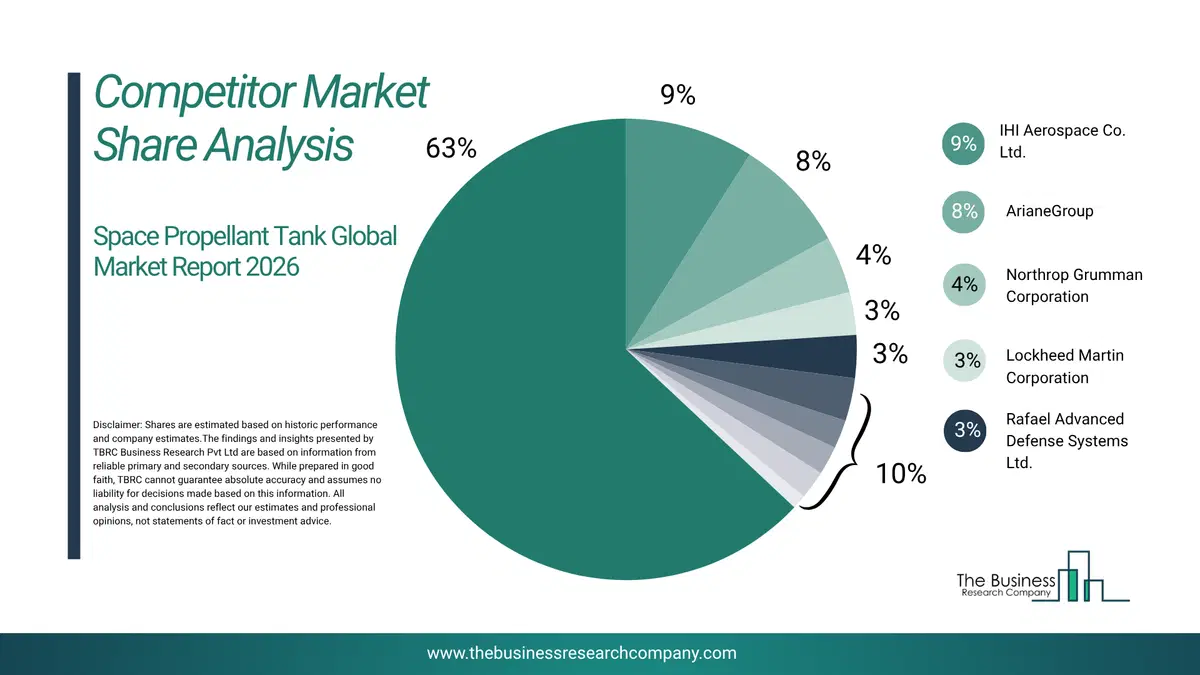
This chart is for illustrative purposes; the full report includes a detailed competitor analysis and comprehensive overview of the top 10 companies in the market.
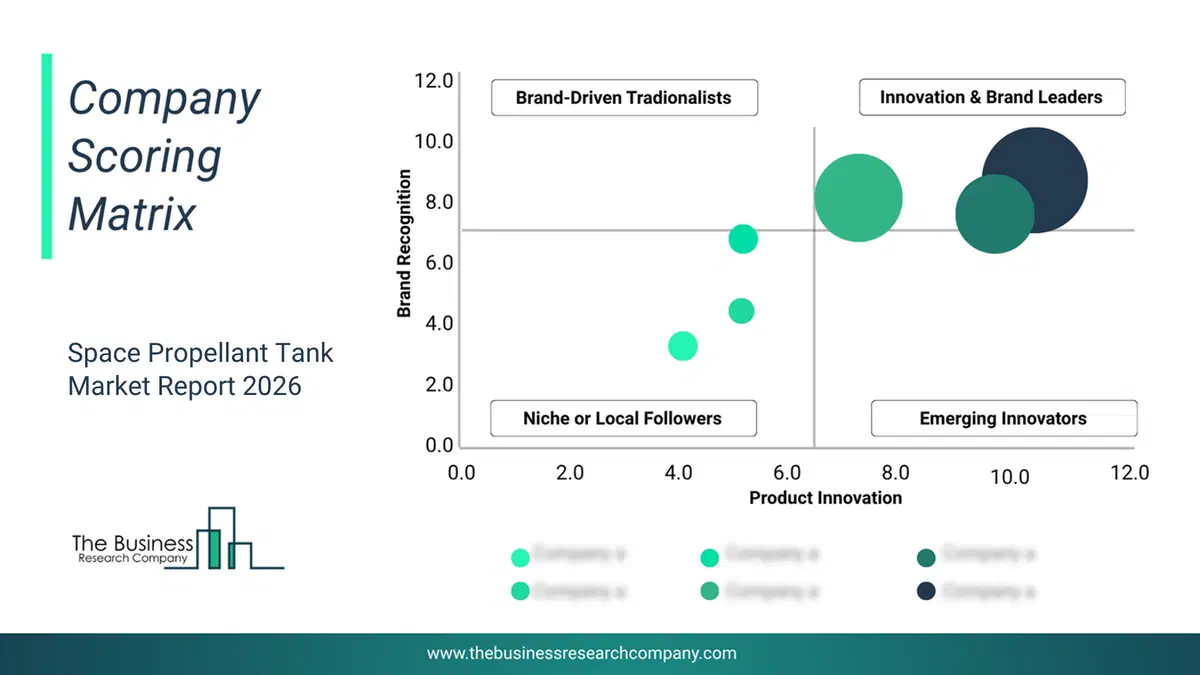
This chart maps companies by product innovation and brand strength, with bubble size indicating relative revenue, helping identify market leaders, challengers, and niche players. This is an illustrative chart; the full report provides a complete and accurate competitive analysis.
Global Space Propellant Tank Market Trends and Insights
Major companies operating in the space propellant tank market are focusing on technological developments, such as Zero-slosh propellant management, to enhance the stability and performance of spacecraft by eliminating propellant sloshing and ensuring precise fuel control during maneuvers. Zero-slosh propellant management is a technology designed to prevent the movement or 'sloshing' of liquid propellants inside tanks during space missions. It uses a rigid piston or similar mechanism to separate liquid fuel from ullage gas, ensuring stable fuel distribution and improved maneuverability in space. For instance, in August 2024, Agile Space Industries, a US-based provider of spacecraft propulsion solutions, introduced Zero-Slosh piston tanks for storable propellants. The tanks feature a rigid piston mechanism that separates liquid propellant from ullage gas, preventing sloshing. This design enhances fuel stability, improves maneuverability, and ensures precise fuel distribution during space missions, especially for small spacecraft in microgravity environments. Zero-slosh piston tanks also reduce the complexity of fuel management systems by eliminating the need for traditional anti-slosh mechanisms, leading to more efficient and cost-effective spacecraft design.What Are Latest Mergers And Acquisitions In The Space Propellant Tank Market? L3Harris Technologies Acquires Aerojet Rocketdyne To Strengthen Position In Space And Missile Defense
In July 2023, L3Harris Technologies, a US-based provider of defense and aerospace systems, communication systems, and space technologies, acquired Aerojet Rocketdyne for $4.7 billion. The acquisition aimed to strengthen L3Harris' position in the growing space and missile defense sectors by adding Aerojet Rocketdyne’s advanced propulsion technologies to its portfolio. Aerojet Rocketdyne is a US-based company that offers space propellant tank.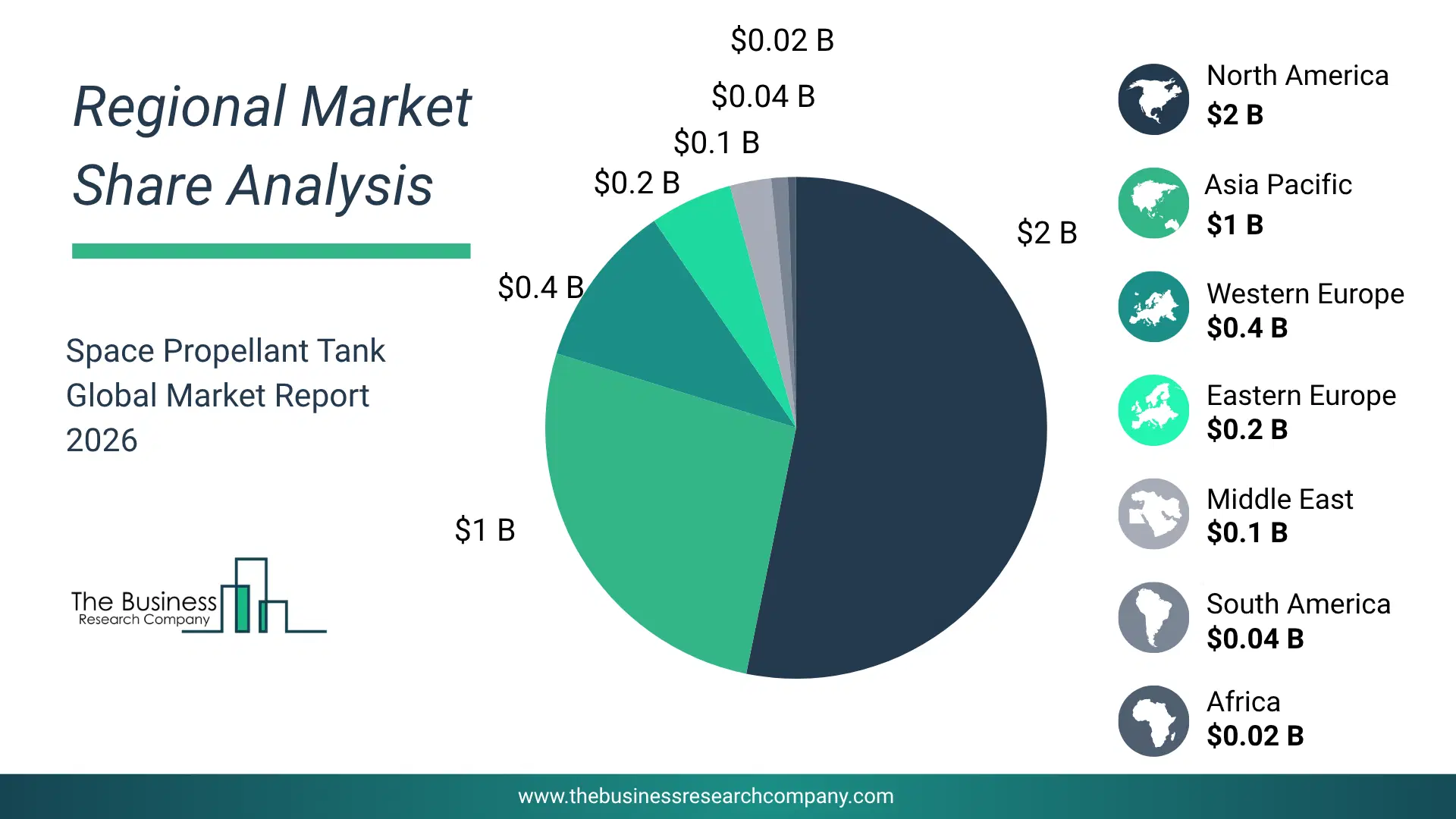
Regional Insights
North America was the largest region in the space propellant tank market in 2025. Asia-Pacific is expected to be the fastest-growing region in the forecast period. The regions covered in this market report are Asia-Pacific, South East Asia, Western Europe, Eastern Europe, North America, South America, Middle East, Africa. The countries covered in this market report are Australia, Brazil, China, France, Germany, India, Indonesia, Japan, Taiwan, Russia, South Korea, UK, USA, Canada, Italy, SpainWhat Defines the Space Propellant Tank Market?
The space propellant tank market consists of sales of cryogenic propellant tanks, composite propellant tanks, metal propellant tanks, lightweight fuel tanks, oxidizer tanks, and multi-use propellant storage systems. Values in this market are ‘factory gate’ values, that is, the value of goods sold by the manufacturers or creators of the goods, whether to other entities (including downstream manufacturers, wholesalers, distributors, and retailers) or directly to end customers. The value of goods in this market includes related services sold by the creators of the goods.How is Market Value Defined and Measured?
The market value is defined as the revenues that enterprises gain from the sale of goods and/or services within the specified market and geography through sales, grants, or donations in terms of the currency (in USD unless otherwise specified). The revenues for a specified geography are consumption values that are revenues generated by organizations in the specified geography within the market, irrespective of where they are produced. It does not include revenues from resales along the supply chain, either further along the supply chain or as part of other products.
This chart presents market attractiveness based on a quantitative evaluation of growth, competition, strategic alignment, and risk, offering a clear view of opportunity areas for decision-making. This chart is for illustrative purposes; the full report contains the complete analysis.

This chart highlights the Total Addressable Market (TAM) by estimating the maximum revenue opportunity using an assumption-driven approach, supporting strategic planning and opportunity sizing across markets. The chart is illustrative; the full report provides a more comprehensive analysis.
What Key Data and Analysis Are Included in the Space Propellant Tank Market Report 2026?
The space propellant tank market research report is one of a series of new reports from The Business Research Company that provides market statistics, including industry global market size, regional shares, competitors with the market share, detailed market segments, market trends and opportunities, and any further data you may need to thrive in the space propellant tank industry. The market research report delivers a complete perspective of everything you need, with an in-depth analysis of the current and future state of the industry.Space Propellant Tank Market Report Forecast Analysis
| Report Attribute | Details |
|---|---|
| Market Size Value In 2026 | $3.76 billion |
| Revenue Forecast In 2030 | $4.82 billion |
| Growth Rate | CAGR of 6.5% from 2026 to 2030 |
| Base Year For Estimation | 2025 |
| Actual Estimates/Historical Data | 2020-2025 |
| Forecast Period | 2026 - 2030 - 2035 |
| Market Representation | Revenue in USD Billion and CAGR from 2026 to 2030 |
| Segments Covered | Type, Material, Tank Design, Application, End-User |
| Regional Scope | Asia-Pacific, Western Europe, Eastern Europe, North America, South America, Middle East, Africa |
| Country Scope | The countries covered in the report are Australia, Brazil, China, France, Germany, India, Indonesia, Japan, Taiwan, Russia, South Korea, UK, USA, Canada, Italy, Spain. |
| Key Companies Profiled | Airbus S.A.S., Northrop Grumman Corporation, Eaton Corporation PLC, IHI Aerospace Co. Ltd., Rafael Advanced Defense Systems Ltd., Moog Inc., Blue Origin LLC, Ariane Group, MT Aerospace AG, Sierra Nevada Corporation, Nammo Space AS, European Space Agency (ESA), Dawn Aerospace, Agile Space Industries, Busek Co. Inc., Antrix Corporation Limited, Holscot Fluoropolymer Products Ltd., Infinite Composites Technologies, Firehawk Aerospace, Indian Space Research Organisation (ISRO) |
| Customization Scope | Request for Customization |
| Pricing And Purchase Options | Explore Purchase Options |