
Space Rocket Suborbital Launch Market Report 2026
Global Outlook – By Vehicle Type (Reusable, Expendable), By Payload Type (Satellite, Cargo, Human Spaceflight, Research And Development), By End-User (Commercial, Government, Defense, Academic) – Market Size, Trends, Strategies, and Forecast to 2030
Space Rocket Suborbital Launch Market Overview
• Space Rocket Suborbital Launch market size has reached to $2.46 billion in 2025 • Expected to grow to $3.81 billion in 2030 at a compound annual growth rate (CAGR) of 9.1% • Growth Driver: Growing Demand For Small Satellites Fueling The Growth Of The Market Due To Cost-Effectiveness And Rapid Deployment Capabilities • Market Trend: Reusable Launch Vehicles Enable Cost-Effective Space Access • North America was the largest region in 2025.What Is Covered Under Space Rocket Suborbital Launch Market?
Space rocket suborbital launch are spaceflights in which rockets travel beyond the Earth's atmosphere without completing a full orbit, reaching altitudes above the Kármán line (100 km) before returning to the surface. The main purpose is to conduct scientific research, technology testing, or space tourism in a microgravity environment for a short duration. They offer a cost-effective and rapid-access platform for short-duration space experiments. The main vehicle types of space rocket suborbital launch are reusable and expendable. Reusable suborbital rockets are designed to be launched, recovered, and flown again multiple times. These rockets return safely to Earth after each mission, allowing companies to save costs and reduce waste. They are commonly used for space tourism, microgravity research, and testing new space technologies. The payloads for suborbital rocket launches include satellites, cargo, human spaceflight, and research and development, serving a diverse range of end-users such as commercial, government, defense, and academic institutions.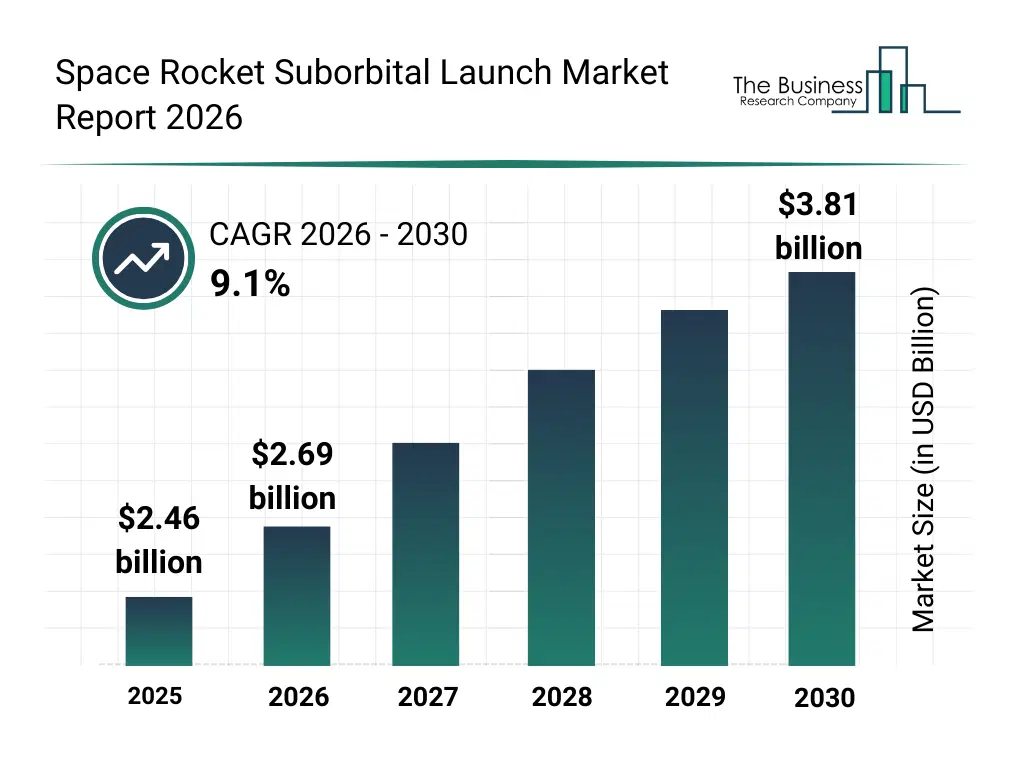
What Is The Space Rocket Suborbital Launch Market Size and Share 2026?
The space rocket suborbital launch market size has grown strongly in recent years. It will grow from $2.46 billion in 2025 to $2.69 billion in 2026 at a compound annual growth rate (CAGR) of 9.3%. The growth in the historic period can be attributed to early development and launch of sounding rockets for atmospheric and microgravity research, initial adoption of suborbital test vehicles for technology demonstration, growth of microgravity experimentation programs by academic and government institutions, emergence of hypersonic research vehicles for short-duration spaceflight, early commercial space tourism initiatives using suborbital rockets.What Is The Space Rocket Suborbital Launch Market Growth Forecast?
The space rocket suborbital launch market size is expected to see strong growth in the next few years. It will grow to $3.81 billion in 2030 at a compound annual growth rate (CAGR) of 9.1%. The growth in the forecast period can be attributed to expansion of commercial suborbital space tourism services, increasing deployment of suborbital launch vehicles for rapid scientific experimentation, development of advanced propulsion and avionics systems for improved reliability and safety, rising demand for microgravity research vehicles from pharmaceutical and materials industries, growth in integrated launch support equipment and turnkey services for suborbital payload delivery. Major trends in the forecast period include increasing demand for cost-effective suborbital research platforms, growth of space tourism and commercial suborbital flights, advancements in propulsion and avionics technologies, expansion of microgravity and atmospheric data research, government and academic collaboration on suborbital experiments,,.
Global Space Rocket Suborbital Launch Market Segmentation
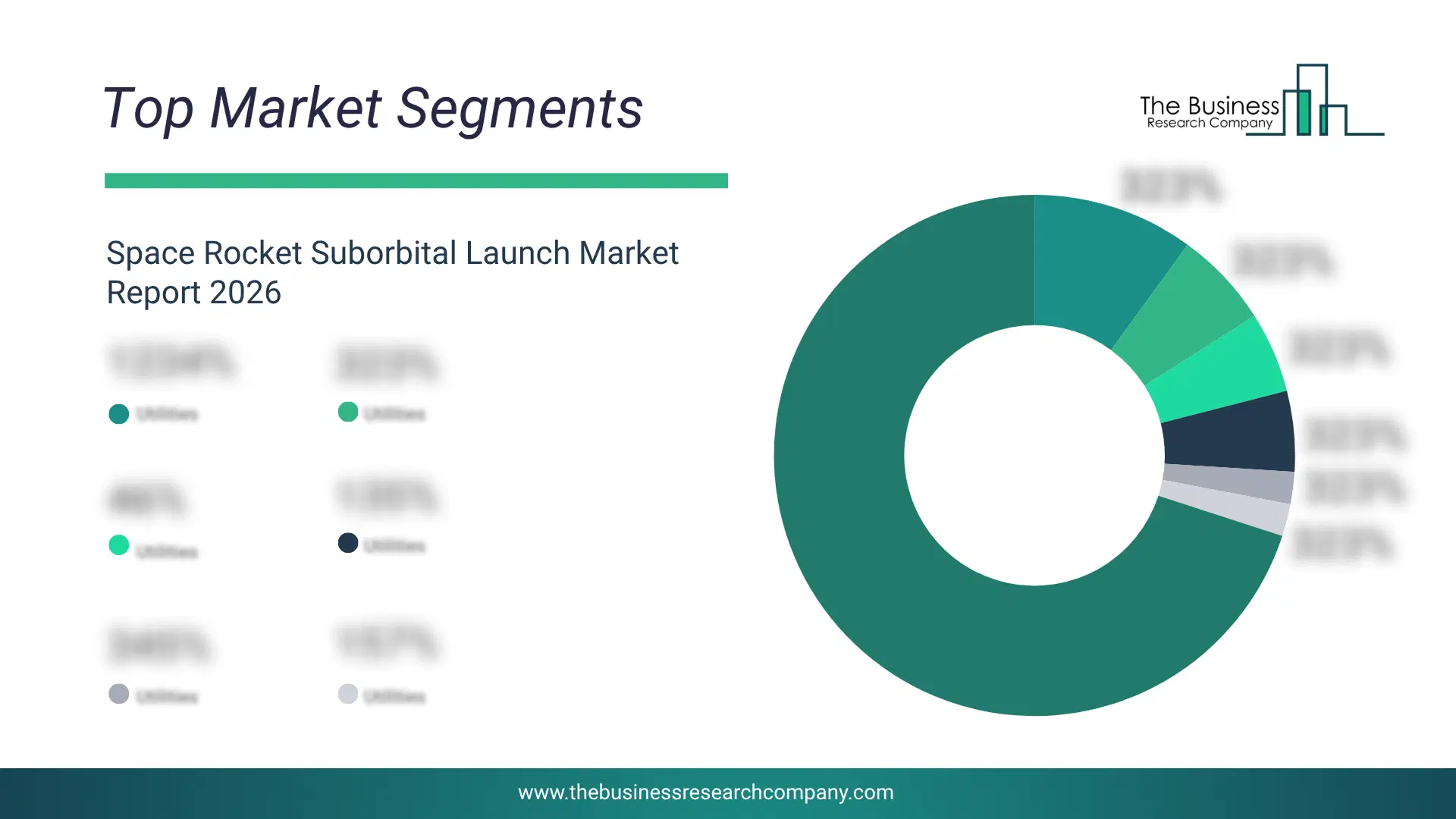
1) By Vehicle Type: Reusable, Expendable 2) By Payload Type: Satellite, Cargo, Human Spaceflight, Research And Development 3) By End-User: Commercial, Government, Defense, Academic Subsegments: 1) By Reusable: Horizontal Takeoff And Landing Vehicles, Vertical Takeoff And Landing Vehicles, Winged Suborbital Spaceplanes, Capsule-Based Reentry Vehicles, Partially Reusable Rocket Systems 2) By Expendable: Sounding Rockets, Single-Stage Rockets, Two-Stage Launch Vehicles, Payload-Dedicated Launch Vehicles, Solid-Propellant Suborbital RocketsWhat Is Driver Of The Space Rocket Suborbital Launch Market?
The growing demand for small satellites is expected to propel the growth of the space rocket suborbital launch market going forward. Small satellites are lightweight, compact spacecraft, usually under 500 kilograms, designed for missions such as Earth monitoring, communications, or testing new technologies. The growing demand for small satellites is rising due to their cost-effectiveness and versatility, as they enable faster deployment and easier customization for diverse applications. Space rocket suborbital launch enhances small satellites by providing affordable and rapid access to space, making it ideal for testing and deploying lightweight payloads. It enables short-duration missions that support technology development and scientific research, improving satellite innovation and deployment efficiency. For instance, in December 2024, according to Aerospace America, a US-based aerospace magazine, a total of 475 small satellites were deployed across 55 launches, with certain missions carrying up to 120 spacecraft in a single flight, marking the highest deployment rate compared to previous years. Therefore, the growing demand for small satellites is driving the growth of the space rocket suborbital launch industry.Key Players In The Global Space Rocket Suborbital Launch Market
Major companies operating in the space rocket suborbital launch market are The Boeing Company, Israel Aerospace Industries, Blue Origin Enterprises L.P., Rocket Lab USA Inc., Indian Space Research Organisation, AgniKul Cosmos Private Limited, Interstellar Technologies Inc., Vaya Space, Astrobotic Technology Inc., Virgin Galactic Holdings Inc., HyImpulse Technologies GmbH, PLD Space, Skyrora Ltd, Copenhagen Suborbitals, LinkSpace, PD Aerospace, Elara Aerospace, SR Space, UP Aerospace Inc., XCOR Aerospace.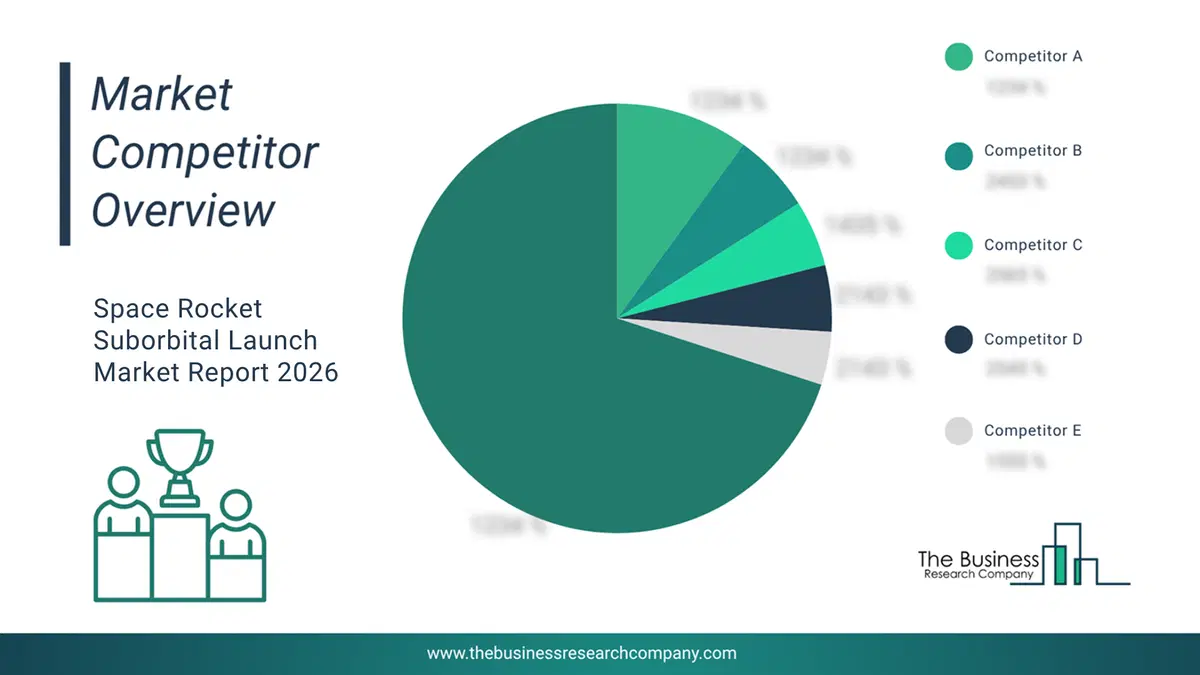
This chart is for illustrative purposes; the full report includes a detailed competitor analysis and comprehensive overview of the top 10 companies in the market.
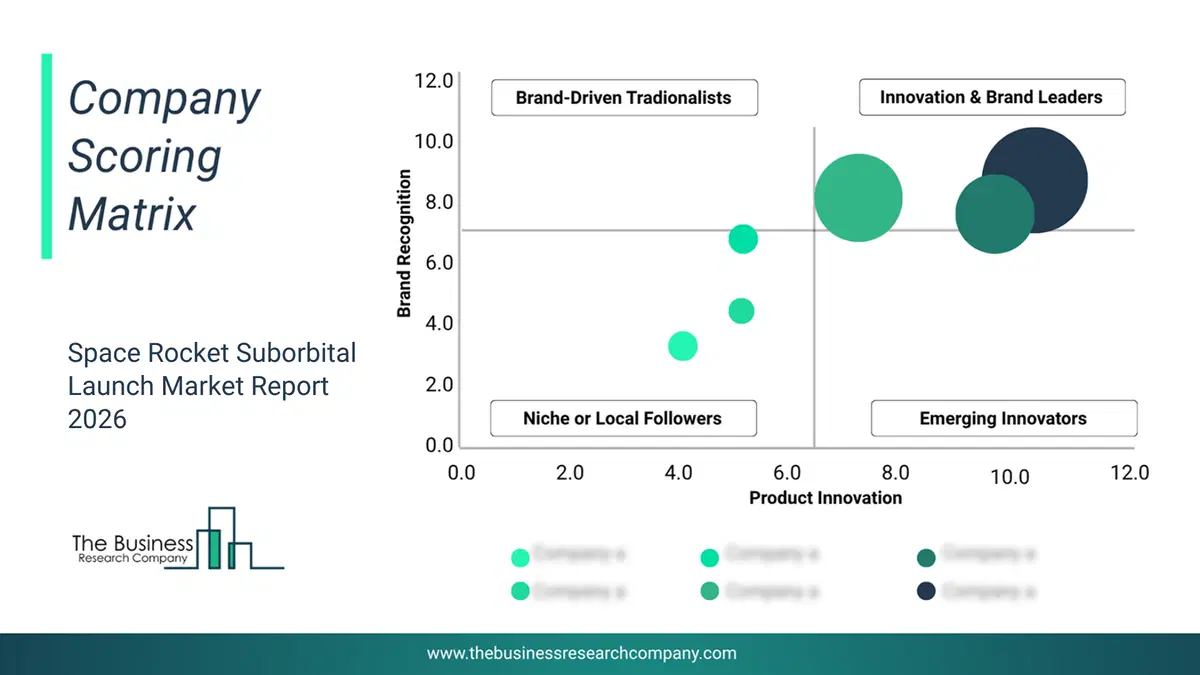
This chart maps companies by product innovation and brand strength, with bubble size indicating relative revenue, helping identify market leaders, challengers, and niche players. This is an illustrative chart; the full report provides a complete and accurate competitive analysis.
Global Space Rocket Suborbital Launch Market Trends and Insights
Major companies operating in the space rocket suborbital launch market are focusing on developing technologically advanced products, such as suborbital rockets, to offer more cost-effective solutions for space-related missions. A suborbital rocket is a rocket that reaches space but doesn't complete an orbit around Earth before returning to the surface. For instance, in October 2023, PLD Space, a Spain-based aerospace company, launched the Miura 1 rocket. It is a suborbital, reusable launch vehicle designed to carry payloads of up to 100 kilograms to suborbital altitudes, offering short periods of microgravity for scientific research and technology testing. Its innovative propulsion system and lightweight composite structure enhance performance while minimizing environmental impact.What Are Latest Mergers And Acquisitions In The Space Rocket Suborbital Launch Market? SUAS Aerospace Partners With T-Minus For Suborbital Launch
In October 2024, SUAS Aerospace, an Ireland-based aerospace company, partnered with T-Minus Engineering B.V. to perform a commercial rocket launch. This partnership aims to advance suborbital launch capabilities, support commercial access to space, and foster innovation in low-cost, reliable launch services for research and technology demonstration missions. T-Minus Engineering B.V. is a Netherlands-based aerospace company specializing in the development and launch of suborbital rockets.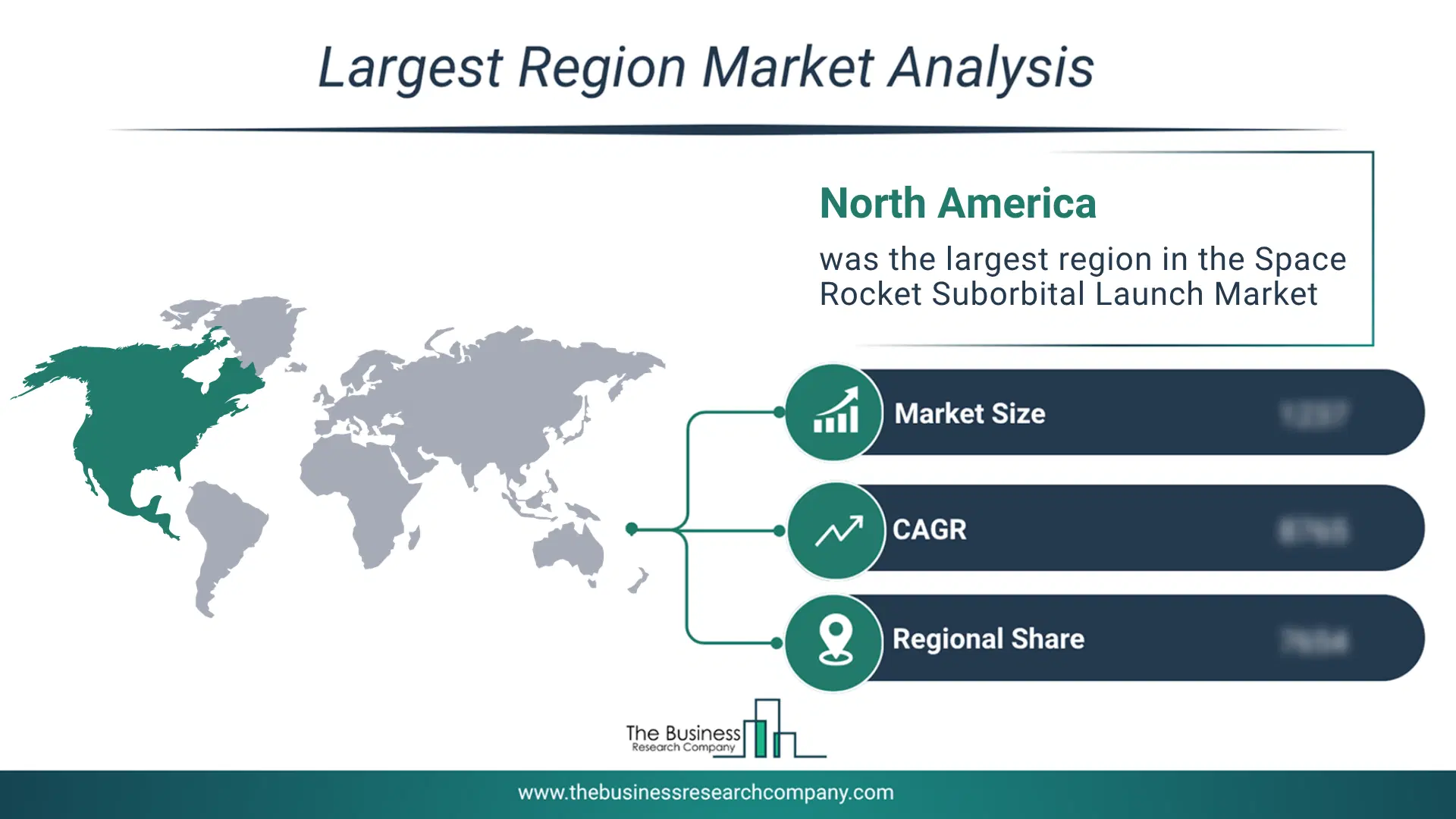
Regional Insights
North America was the largest region in the space rocket suborbital launch market in 2025. The regions covered in this market report are Asia-Pacific, South East Asia, Western Europe, Eastern Europe, North America, South America, Middle East, Africa. The countries covered in this market report are Australia, Brazil, China, France, Germany, India, Indonesia, Japan, Taiwan, Russia, South Korea, UK, USA, Canada, Italy, SpainWhat Defines the Space Rocket Suborbital Launch Market?
The space rocket suborbital launch market consists of revenues earned by entities by providing services such as scientific experimentation, microgravity research, atmospheric data collection, technology demonstration, space tourism, and suborbital payload delivery for government, commercial, and academic clients. The market value includes the value of related goods sold by the service provider or included within the service offering. The space rocket suborbital launches market also includes sales of sounding rockets, hypersonic test vehicles, microgravity research vehicles, suborbital launch vehicles, propulsion systems, avionics, launch support equipment, and related aerospace components. Values in this market are ‘factory gate’ values, that is the value of goods sold by the manufacturers or creators of the goods, whether to other entities (including downstream manufacturers, wholesalers, distributors and retailers) or directly to end customers. The value of goods in this market includes related services sold by the creators of the goods.How is Market Value Defined and Measured?
The market value is defined as the revenues that enterprises gain from the sale of goods and/or services within the specified market and geography through sales, grants, or donations in terms of the currency (in USD unless otherwise specified). The revenues for a specified geography are consumption values that are revenues generated by organizations in the specified geography within the market, irrespective of where they are produced. It does not include revenues from resales along the supply chain, either further along the supply chain or as part of other products.
This chart presents market attractiveness based on a quantitative evaluation of growth, competition, strategic alignment, and risk, offering a clear view of opportunity areas for decision-making. This chart is for illustrative purposes; the full report contains the complete analysis.

This chart highlights the Total Addressable Market (TAM) by estimating the maximum revenue opportunity using an assumption-driven approach, supporting strategic planning and opportunity sizing across markets. The chart is illustrative; the full report provides a more comprehensive analysis.
What Key Data and Analysis Are Included in the Space Rocket Suborbital Launch Market Report 2026?
The space rocket suborbital launch market research report is one of a series of new reports from The Business Research Company that provides market statistics, including industry global market size, regional shares, competitors with the market share, detailed market segments, market trends and opportunities, and any further data you may need to thrive in the space rocket suborbital launch industry. The market research report delivers a complete perspective of everything you need, with an in-depth analysis of the current and future state of the industry.Space Rocket Suborbital Launch Market Report Forecast Analysis
| Report Attribute | Details |
|---|---|
| Market Size Value In 2026 | $2.69 billion |
| Revenue Forecast In 2030 | $3.81 billion |
| Growth Rate | CAGR of 9.1% from 2026 to 2030 |
| Base Year For Estimation | 2025 |
| Actual Estimates/Historical Data | 2020-2025 |
| Forecast Period | 2026 - 2030 |
| Market Representation | Revenue in USD Billion and CAGR from 2026 to 2030 |
| Segments Covered | Vehicle Type, Payload Type, End-User |
| Regional Scope | Asia-Pacific, Western Europe, Eastern Europe, North America, South America, Middle East, Africa |
| Country Scope | The countries covered in the space rocket suborbital launch market report are Australia, Brazil, China, France, Germany, India, Indonesia, Japan, Taiwan, Russia, South Korea, UK, USA, Canada, Italy, Spain |
| Key Companies Profiled | The Boeing Company, Israel Aerospace Industries, Blue Origin Enterprises L.P., Rocket Lab USA Inc., Indian Space Research Organisation, AgniKul Cosmos Private Limited, Interstellar Technologies Inc., Vaya Space, Astrobotic Technology Inc., Virgin Galactic Holdings Inc., HyImpulse Technologies GmbH, PLD Space, Skyrora Ltd, Copenhagen Suborbitals, LinkSpace, PD Aerospace, Elara Aerospace, SR Space, UP Aerospace Inc., XCOR Aerospace. |
| Customization Scope | Request for Customization |
| Pricing And Purchase Options | Explore Purchase Options |