
Space Weather Forecasting Market Report 2026
Global Outlook – By Forecast Type (Solar Flare Forecasting, Geomagnetic Storm Forecasting, Solar Radiation Storm Forecasting, Other Forecast Types), By Forecasting Method (Ground-Based Observations, Satellite-Based Observations, Other Forecasting Methods), By Application (Aerospace, Defense, Power Grid, Satellite Communication, Other Applications), By End-User (Government, Commercial, Research Institutions) – Market Size, Trends, Strategies, and Forecast to 2030
Space Weather Forecasting Market Overview
• Space Weather Forecasting market size has reached to $1.26 billion in 2025 • Expected to grow to $2.01 billion in 2030 at a compound annual growth rate (CAGR) of 9.7% • Growth Driver: Growth In Satellite Deployments Boosts The Market Due To Increasing Need For Launch Safety And Asset Protection • Market Trend: Technological Advancements Drive Accuracy In Space Weather Forecasting Services Due To Integration Of Satellite Data And Predictive Simulations • North America was the largest region in 2025.What Is Covered Under Space Weather Forecasting Market?
Space weather forecasting refers to the process of predicting disturbances in the space environment, primarily caused by solar phenomena such as solar flares, solar wind, and geomagnetic storms. These forecasts help mitigate risks to satellites, communication networks, navigation systems, and power infrastructure on Earth and in space. The main forecast types of space weather forecasting are solar flare forecasting, geomagnetic storm forecasting, solar radiation storm forecasting, and others. Solar flare forecasting focuses on anticipating intense solar radiation bursts that can interfere with communication and navigation systems on Earth. The forecasting methods include ground-based observations, satellite-based observations, and others. These forecasts serve multiple applications, including aerospace, defense, power grids, satellite communications, and others, and are utilized by end users such as government bodies, commercial organizations, and research institutions.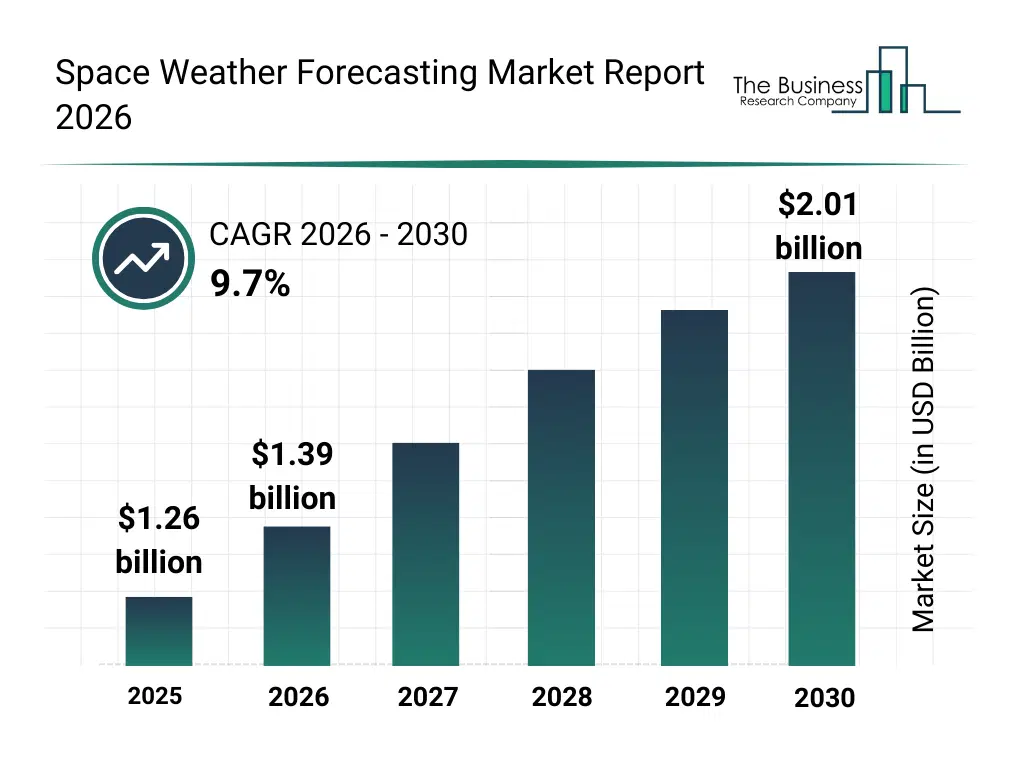
What Is The Space Weather Forecasting Market Size and Share 2026?
The space weather forecasting market size has grown rapidly in recent years. It will grow from $1.26 billion in 2025 to $1.39 billion in 2026 at a compound annual growth rate (CAGR) of 10.3%. The growth in the historic period can be attributed to increasing reliance on satellite-based communication and navigation systems, development of early solar observation satellites, growing awareness of geomagnetic storm impacts on power grids, government funding for space weather research programs, advancements in computational models for solar activity prediction.What Is The Space Weather Forecasting Market Growth Forecast?
The space weather forecasting market size is expected to see strong growth in the next few years. It will grow to $2.01 billion in 2030 at a compound annual growth rate (CAGR) of 9.7%. The growth in the forecast period can be attributed to rising demand for real-time space weather data services, integration of AI and machine learning for predictive forecasting, expansion of commercial satellite constellations requiring monitoring, adoption of space weather forecasting in insurance and risk management, increased collaboration between aerospace and energy sectors for mitigation planning. Major trends in the forecast period include rising demand for radiation storm alerts for aviation safety, increased reliance on satellite-based solar wind monitoring, growing investment in geomagnetic storm forecasting for grid resilience, expansion of commercial space operations requiring real-time insights, integration of multi-source observation networks for accuracy.
Global Space Weather Forecasting Market Segmentation
1) By Forecast Type: Solar Flare Forecasting, Geomagnetic Storm Forecasting, Solar Radiation Storm Forecasting, Other Forecast Types 2) By Forecasting Method: Ground-Based Observations, Satellite-Based Observations, Other Forecasting Methods 3) By Application: Aerospace, Defense, Power Grid, Satellite Communication, Other Applications 4) By End-User: Government, Commercial, Research Institutions Subsegments: 1) By Solar Flare Forecasting: X-Class Flare Prediction, M-Class Flare Prediction, C-Class Flare Prediction 2) By Geomagnetic Storm Forecasting: Kp-Index Prediction, Auroral Activity Modeling, Dst-Index Analysis 3) By Solar Radiation Storm Forecasting: Solar Energetic Particle (SEP) Event Prediction, Radiation Dose Estimation For Aviation And Space Missions, Proton Flux Monitoring 4) By Other Forecast Types: Coronal Mass Ejection (CME) Forecasting, Interplanetary Magnetic Field (IMF) Modeling, Solar Wind Speed And Density PredictionWhat Is Driver Of The Space Weather Forecasting Market?
The increase in satellite launches is expected to propel the growth of the space weather forecasting market going forward. Satellite launches refer to the deployment of artificial satellites into space using rockets to place them into designated orbits for communication, observation, navigation, or scientific purposes. Satellite launches are increasing due to rising demand for global internet connectivity, prompting companies to deploy large constellations of satellites in low Earth orbit. Space weather forecasting helps satellite launches by predicting solar storms and radiation levels, allowing mission planners to choose safe launch windows and protect satellites from potential damage. For instance, in November 2023, The United States International Trade Commission, a US-based Government agency, reported that in 2023, global space launches were estimated to reach 197, up from 186 recorded in 2022. Therefore, the increase in satellite launches is driving the growth of the space weather forecasting industry.Key Players In The Global Space Weather Forecasting Market
Major companies operating in the space weather forecasting market are Raytheon Technologies Corporation, Lockheed Martin Corporation, Airbus SE, Northrop Grumman Corporation, BAE Systems plc, L3Harris Technologies Inc., Met Office Space Weather Operations Centre, DTN, Rhea Group, British Antarctic Survey, Lynker Space, Japan Meteorological Agency, European Space Agency, Mission Space, Skolkovo Institute of Science and Technology, Space Environment Technologies, Ball Aerospace & Technologies Corp., Canadian Space Weather Forecast Centre, Finnish Meteorological Institute, Goddard Space Flight Center.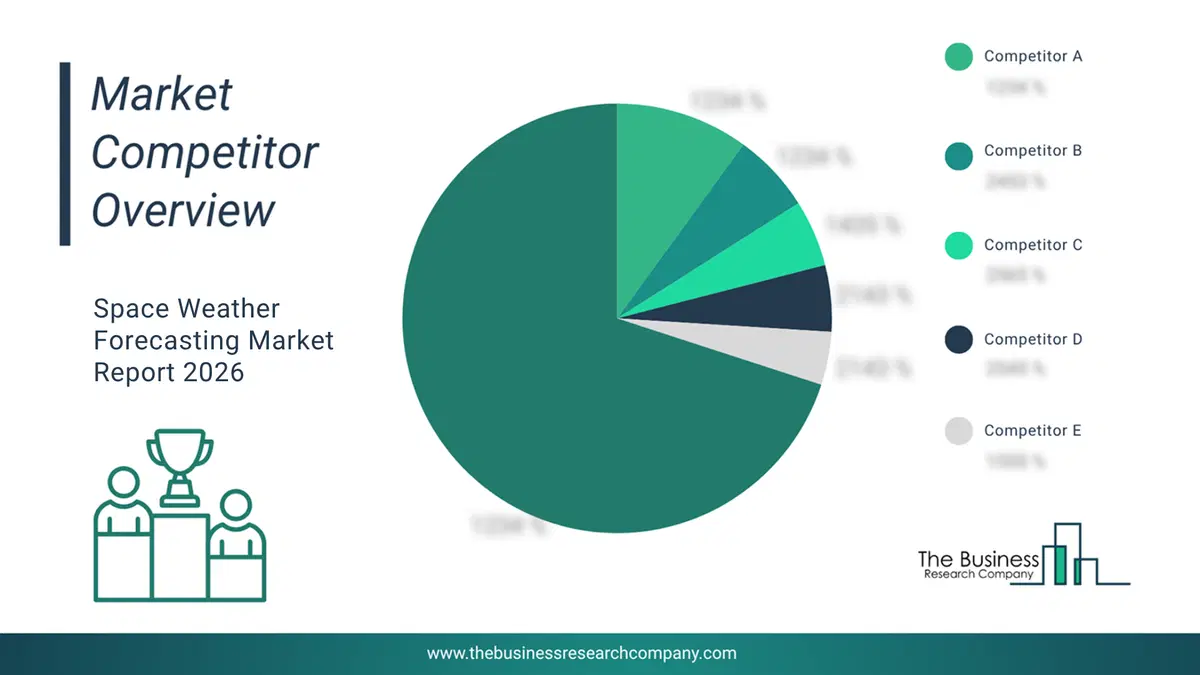
This chart is for illustrative purposes; the full report includes a detailed competitor analysis and comprehensive overview of the top 10 companies in the market.
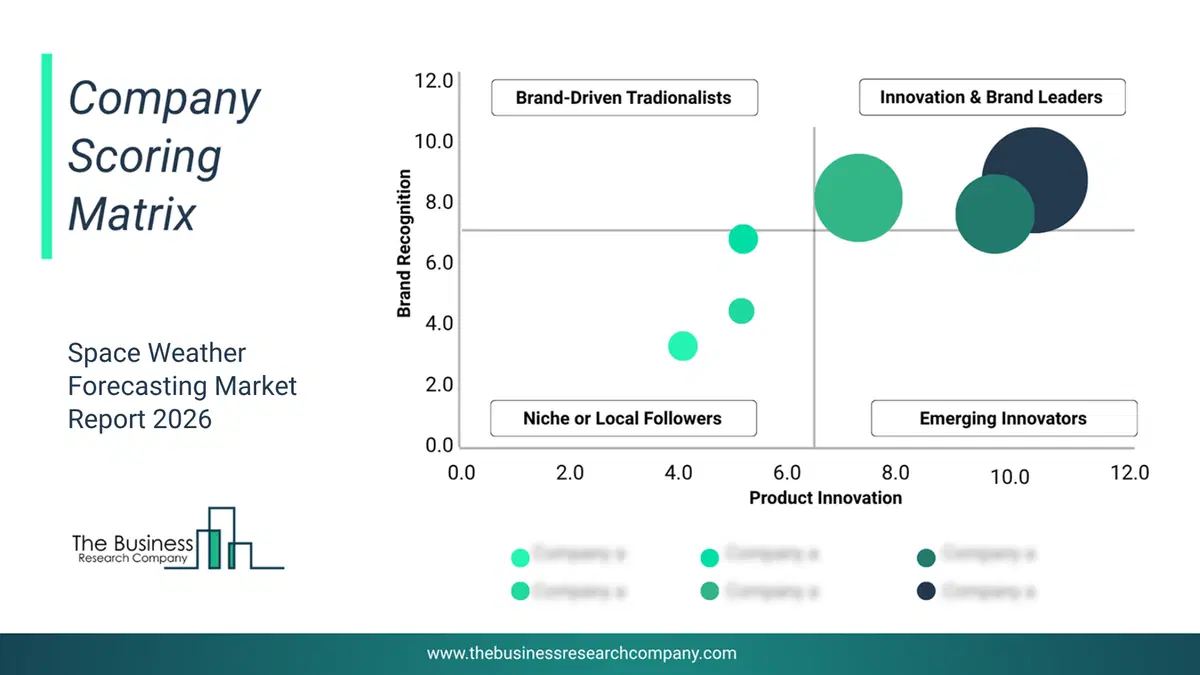
This chart maps companies by product innovation and brand strength, with bubble size indicating relative revenue, helping identify market leaders, challengers, and niche players. This is an illustrative chart; the full report provides a complete and accurate competitive analysis.
Global Space Weather Forecasting Market Trends and Insights
Major companies operating in the space weather forecasting market are focusing on developing innovative offerings, such as advanced space weather forecasting services, to enhance the accuracy and timeliness of predictions related to solar storms, geomagnetic activity, and radiation hazards. Advanced space weather forecasting services refer to high-tech systems that utilize satellite data, artificial intelligence models, and simulations to predict and monitor solar activity and its impact on Earth’s infrastructure. For instance, in August 2024, Lynker Corporation, a US-based company, launched Lynker Space, which provides highly accurate, industry-specific space weather forecasts and alerts. These services help organizations protect critical assets and maintain operational continuity in the face of solar and geomagnetic threats. Lynker Space aims to deliver actionable insights and advanced dashboards for both immediate and long-term risk mitigation across sectors such as satellite operations, aviation, and energy.What Are Latest Mergers And Acquisitions In The Space Weather Forecasting Market? Mission Space Partners With Starcloud To Integrate Real-Time Space Weather Intelligence Into Orbital Ai Data Centers
In September 2025, Mission Space, a US-based aerospace and defense company, partnered with Starcloud. The aim of the partnership between Mission Space and Starcloud is to integrate real-time, high-resolution space weather intelligence from Mission Space into Starcloud's orbital AI compute platform. Starcloud is a US-based space infrastructure startup that develops and builds data centers in orbit to support cloud computing and artificial intelligence (AI) workloads.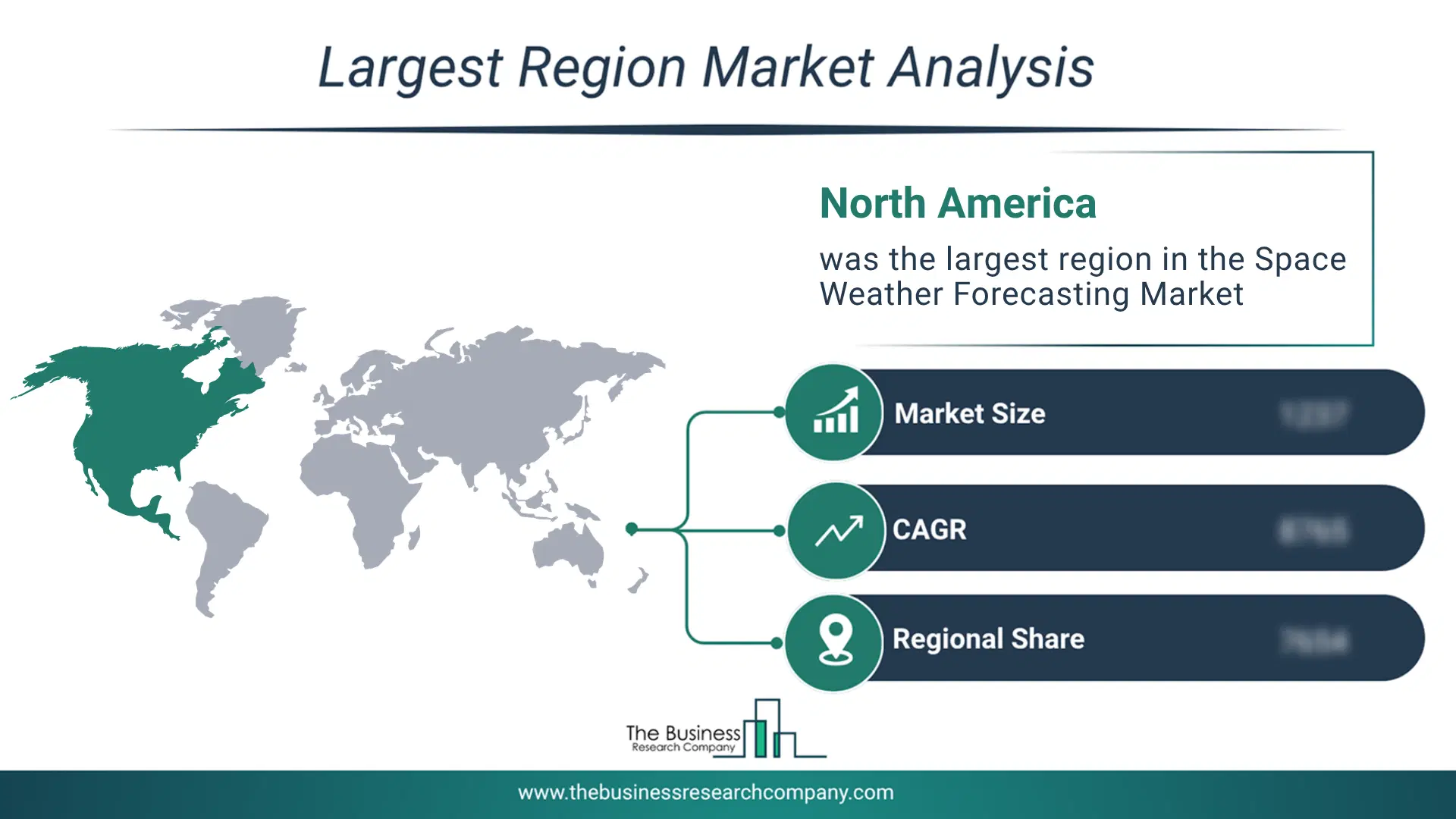
Regional Insights
North America was the largest region in the space weather forecasting market in 2025. The regions covered in this market report are Asia-Pacific, South East Asia, Western Europe, Eastern Europe, North America, South America, Middle East, Africa. The countries covered in this market report are Australia, Brazil, China, France, Germany, India, Indonesia, Japan, Taiwan, Russia, South Korea, UK, USA, Canada, Italy, SpainWhat Defines the Space Weather Forecasting Market?
The space weather forecasting market includes revenues earned by entities through polar route flight planning support, pipeline corrosion forecasting, and insurance risk assessment. The market value includes the value of related goods sold by the service provider or included within the service offering. Only goods and services traded between entities or sold to end consumers are included.How is Market Value Defined and Measured?
The market value is defined as the revenues that enterprises gain from the sale of goods and/or services within the specified market and geography through sales, grants, or donations in terms of the currency (in USD unless otherwise specified). The revenues for a specified geography are consumption values that are revenues generated by organizations in the specified geography within the market, irrespective of where they are produced. It does not include revenues from resales along the supply chain, either further along the supply chain or as part of other products.
This chart presents market attractiveness based on a quantitative evaluation of growth, competition, strategic alignment, and risk, offering a clear view of opportunity areas for decision-making. This chart is for illustrative purposes; the full report contains the complete analysis.

This chart highlights the Total Addressable Market (TAM) by estimating the maximum revenue opportunity using an assumption-driven approach, supporting strategic planning and opportunity sizing across markets. The chart is illustrative; the full report provides a more comprehensive analysis.
What Key Data and Analysis Are Included in the Space Weather Forecasting Market Report 2026?
The space weather forecasting market research report is one of a series of new reports from The Business Research Company that provides market statistics, including industry global market size, regional shares, competitors with the market share, detailed market segments, market trends and opportunities, and any further data you may need to thrive in the space weather forecasting industry. The market research report delivers a complete perspective of everything you need, with an in-depth analysis of the current and future state of the industry.Space Weather Forecasting Market Report Forecast Analysis
| Report Attribute | Details |
|---|---|
| Market Size Value In 2026 | $1.39 billion |
| Revenue Forecast In 2030 | $2.01 billion |
| Growth Rate | CAGR of 9.7% from 2026 to 2030 |
| Base Year For Estimation | 2025 |
| Actual Estimates/Historical Data | 2020-2025 |
| Forecast Period | 2026 - 2030 |
| Market Representation | Revenue in USD Billion and CAGR from 2026 to 2030 |
| Segments Covered | Forecast Type, Forecasting Method, Application, End-User |
| Regional Scope | Asia-Pacific, Western Europe, Eastern Europe, North America, South America, Middle East, Africa |
| Country Scope | The countries covered in the space weather forecasting market report are Australia, Brazil, China, France, Germany, India, Indonesia, Japan, Taiwan, Russia, South Korea, UK, USA, Canada, Italy, Spain |
| Key Companies Profiled | Raytheon Technologies Corporation, Lockheed Martin Corporation, Airbus SE, Northrop Grumman Corporation, BAE Systems plc, L3Harris Technologies Inc., Met Office Space Weather Operations Centre, DTN, Rhea Group, British Antarctic Survey, Lynker Space, Japan Meteorological Agency, European Space Agency, Mission Space, Skolkovo Institute of Science and Technology, Space Environment Technologies, Ball Aerospace & Technologies Corp., Canadian Space Weather Forecast Centre, Finnish Meteorological Institute, Goddard Space Flight Center. |
| Customization Scope | Request for Customization |
| Pricing And Purchase Options | Explore Purchase Options |