
Space-Weather Monitoring Satellite Market Report 2026
Global Outlook – By Satellite Type (Low Earth Orbit, Medium Earth Orbit, Geostationary Orbit), By Instrument Type (Magnetometers, Particle Detectors, Plasma Analyzers, Solar Telescopes, Others Instrument Types), By Application (Space Weather Forecasting, Communication, Navigation, Scientific Research, Others Applications), By End-User (Government And Defense, Commercial, Research Institutes, Other End-Users) – Market Size, Trends, Strategies, and Forecast to 2030
Space-Weather Monitoring Satellite Market Overview
• Space-Weather Monitoring Satellite market size has reached to $1.96 billion in 2025 • Expected to grow to $3.23 billion in 2030 at a compound annual growth rate (CAGR) of 10.5% • Growth Driver: Rise In Satellite Launches Driving The Growth Of The Market Due To Increasing Deployment For Global Connectivity And Enhanced Solar Activity Tracking • Market Trend: Advancements In High-Precision Instruments Strengthening Space Weather Monitoring And Forecasting • North America was the largest region in 2025 and Asia-Pacific is the fastest growing region.What Is Covered Under Space-Weather Monitoring Satellite Market?
Space-weather monitoring satellite is a spacecraft designed to observe and measure solar activity, cosmic radiation, and geomagnetic conditions to forecast space weather and protect Earth-based and orbital technologies. It is utilized to provide real-time data on solar storms, radiation, and geomagnetic activity to protect satellites, power grids, and communication systems on Earth. The main types of space-weather monitoring satellites are low Earth orbit (LEO), medium Earth orbit (MEO), and geostationary orbit (GEO). Low Earth orbit (LEO) refers to an Earth-centered orbit with an altitude typically between 160 km and 2,000 km, where satellites orbit relatively close to the planet’s surface. These satellites carry various types of instruments, such as magnetometers, particle detectors, plasma analyzers, solar telescopes, and others, which are used for different applications, including space weather forecasting, communication, navigation, scientific research, and more. The key end-users include government and defense agencies, commercial organizations, research institutes, and others.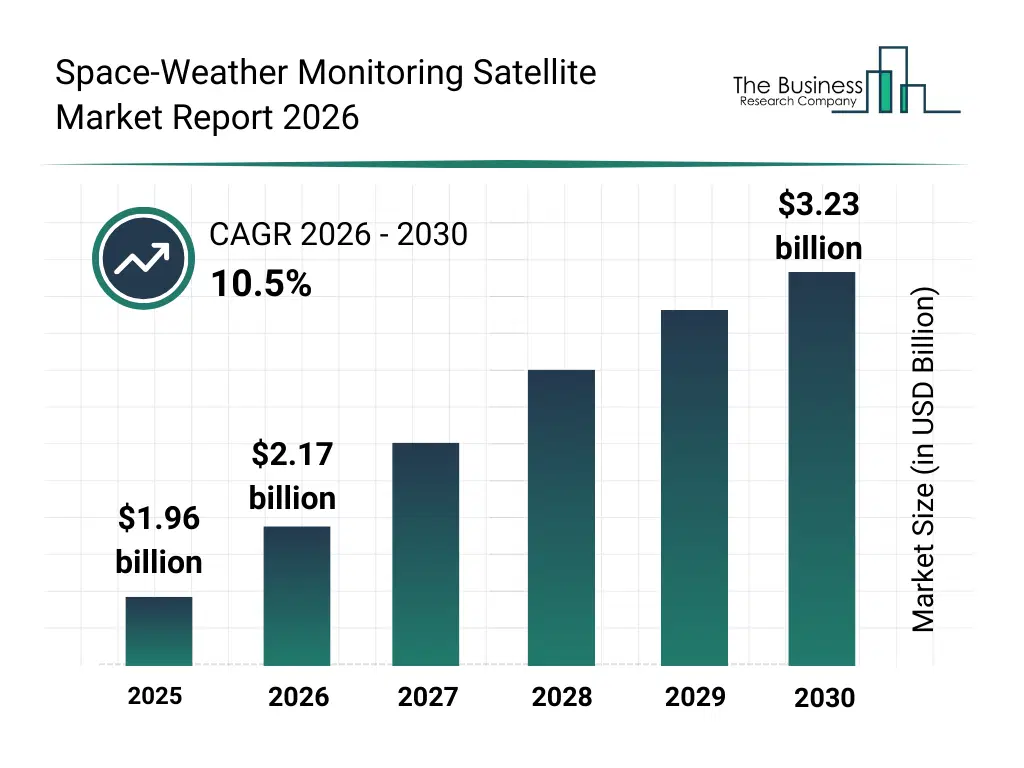
What Is The Space-Weather Monitoring Satellite Market Size and Share 2026?
The space-weather monitoring satellite market size has grown rapidly in recent years. It will grow from $1.96 billion in 2025 to $2.17 billion in 2026 at a compound annual growth rate (CAGR) of 10.7%. The growth in the historic period can be attributed to early solar observation satellite missions, advancements in radiation and particle sensors, development of geomagnetic activity forecasting tools, initial integration of satellite telemetry systems, deployment of earth-orbiting monitoring satellites.What Is The Space-Weather Monitoring Satellite Market Growth Forecast?
The space-weather monitoring satellite market size is expected to see rapid growth in the next few years. It will grow to $3.23 billion in 2030 at a compound annual growth rate (CAGR) of 10.5%. The growth in the forecast period can be attributed to growth in real-time space weather monitoring services, adoption of predictive ai analytics for solar storms, expansion of satellite constellations for continuous coverage, integration with terrestrial critical infrastructure protection, development of miniaturized high-precision payloads. Major trends in the forecast period include miniaturization of space-weather sensors, growing demand for continuous solar storm monitoring, advancements in radiation-hardened satellite components, increasing deployment of constellation-based monitoring systems, rising collaboration between defense and scientific agencies.
Global Space-Weather Monitoring Satellite Market Segmentation
1) By Satellite Type: Low Earth Orbit, Medium Earth Orbit, Geostationary Orbit 2) By Instrument Type: Magnetometers, Particle Detectors, Plasma Analyzers, Solar Telescopes, Others Instrument Types 3) By Application: Space Weather Forecasting, Communication, Navigation, Scientific Research, Others Applications 4) By End-User: Government And Defense, Commercial, Research Institutes, Other End-Users Subsegments: 1) By Low Earth Orbit: Scientific Research Satellites, Earth Observation Satellites, Remote Sensing Satellites, Small Satellites 2) By Medium Earth Orbit: Navigation Satellites, Communication Satellites, Weather Monitoring Satellites, Science And Exploration Satellites 3) By Geostationary Orbit: Weather Forecasting Satellites, Communication Satellites, Defense And Security Satellites, Broadcasting SatellitesWhat Is Driver Of The Space-Weather Monitoring Satellite Market?
The growing number of satellite launches is expected to propel the growth of the space-weather monitoring satellite market going forward. A satellite is a man-made or natural body that travels in a consistent path around a planet or celestial object. Satellite launches are rising due to the growing demand for global internet coverage, as companies and governments are increasingly deploying satellites to provide high-speed connectivity in remote and underserved regions. The increase in satellite launches enhances space-weather monitoring by allowing more dedicated satellites to continuously track solar activity and its impact on Earth’s magnetosphere, thereby improving forecasting and early-warning systems. For instance, in January 2025, according to the Space Foundation, a US-based non-profit organization, a total of 259 launches took place in 2024, averaging one launch every 34 hours, occurring five hours sooner on average than in 2023. Therefore, the growing number of satellite launches is driving the growth of the space-weather monitoring satellite industry.Key Players In The Global Space-Weather Monitoring Satellite Market
Major companies operating in the space-weather monitoring satellite market are The Boeing Company, Airbus SE, Raytheon Technologies Corporation, Lockheed Martin Corporation, Northrop Grumman Corporation, BAE Systems, National Aeronautics and Space Administration (NASA), Thales Group, L3Harris Technologies, National Oceanic and Atmospheric Administration (NOAA), Sierra Nevada Corporation, Southwest Research Institute (SwRI), European Space Agency (ESA), Japan Aerospace Exploration Agency (JAXA), University Corporation for Atmospheric Research (UCAR), Astroscale Holdings Inc., Spire Global Inc., EnduroSat, Muon Space, Mission Space, China Academy of Space Technology.
This chart is for illustrative purposes; the full report includes a detailed competitor analysis and comprehensive overview of the top 10 companies in the market.
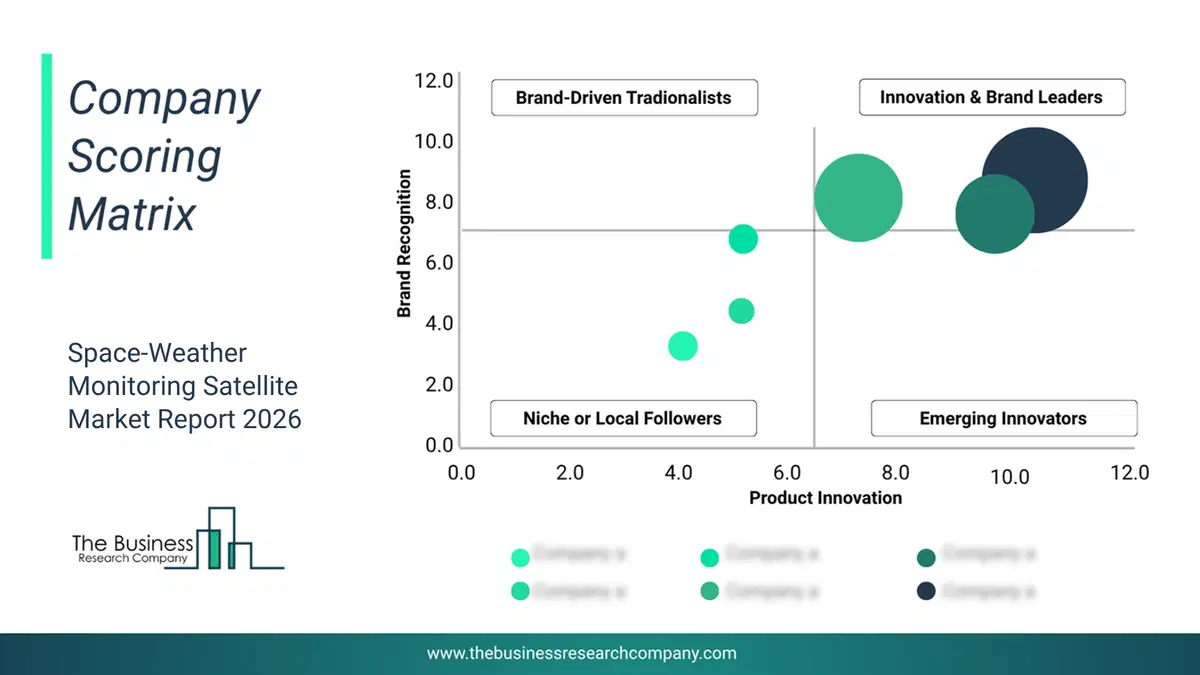
This chart maps companies by product innovation and brand strength, with bubble size indicating relative revenue, helping identify market leaders, challengers, and niche players. This is an illustrative chart; the full report provides a complete and accurate competitive analysis.
Global Space-Weather Monitoring Satellite Market Trends and Insights
Major companies operating in the space-weather monitoring satellite Market are focusing on leveraging advanced products such as high-precision magnetometers to enhance solar wind detection accuracy and improve early warning capabilities for geomagnetic storms. High-precision magnetometers are sensitive instruments that measure subtle variations in magnetic fields, helping detect and analyze changes in the Sun’s magnetic activity to predict and mitigate space-weather impacts on Earth. For instance, in September 2025, Southwest Research Institute (SwRI), a U.S.-based non-profit research and development organization, integrated its Space Weather Follow-On Magnetometer (SWFO-MAG) and Solar Wind Plasma Sensor (SWiPS) into NOAA’s Space Weather Follow-On Lagrange 1 (SWFO-L1) satellite, launched aboard a SpaceX Falcon 9 rocket as a rideshare with NASA’s Interstellar Mapping and Acceleration Probe (IMAP) mission. Operating from the Lagrange Point 1 (L1), nearly 1.5 million kilometers from Earth, these SwRI-built instruments provide continuous, real-time monitoring of solar wind and magnetic field variations to enhance the accuracy of space weather forecasts issued by NOAA’s Space Weather Prediction Center. This development reflects a broader industry trend toward deploying next-generation instruments with higher sensitivity and improved data capabilities to strengthen early-warning systems and protect critical technologies such as power grids, communication networks, and satellites from the adverse effects of solar and geomagnetic activity.What Are Latest Mergers And Acquisitions In The Space-Weather Monitoring Satellite Market? National Aeronautics And Space Administration And Laboratory For Atmospheric And Space Physics Partner To Advance Space Weather Research
In August 2024, the National Aeronautics and Space Administration (NASA), a US-based independent space exploration agency, partnered with the Laboratory for Atmospheric and Space Physics (LASP) to advance research, modeling, and innovation in the field of space weather. Through this partnership, NASA’s Goddard Space Flight Center and LASP aim to strengthen space weather research by developing advanced instruments, enhancing satellite payload capabilities, and expanding Research to Operations activities. The collaboration will also address policy, mission planning, and best practices, ultimately safeguarding astronauts, spacecraft, and Earth-based technologies while advancing heliophysics knowledge. Laboratory for Atmospheric and Space Physics (LASP) is a US-based research institute specializing in space science, atmospheric studies, solar and planetary research, and space-weather monitoring.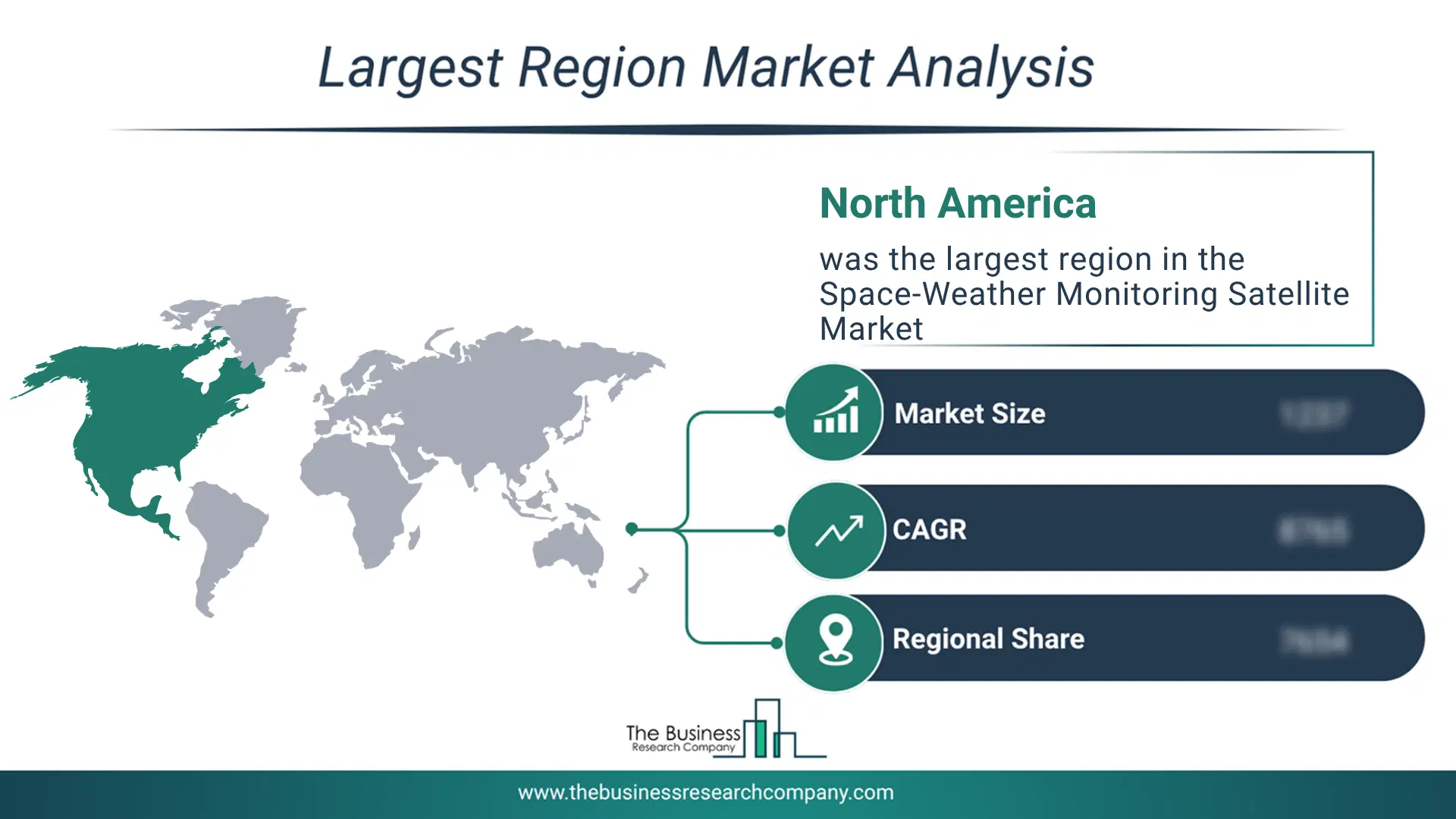
Regional Insights
North America was the largest region in the space-weather monitoring satellite market in 2025. Asia-Pacific is expected to be the fastest-growing region in the forecast period. The regions covered in this market report are Asia-Pacific, South East Asia, Western Europe, Eastern Europe, North America, South America, Middle East, Africa. The countries covered in this market report are Australia, Brazil, China, France, Germany, India, Indonesia, Japan, Taiwan, Russia, South Korea, UK, USA, Canada, Italy, SpainWhat Defines the Space-Weather Monitoring Satellite Market?
The space-weather monitoring satellite market includes of sales of satellite payloads, data receivers, satellite launch vehicles, satellite components, and subsystems. Values in this market are ‘factory gate’ values, that is, the value of goods sold by the manufacturers or creators of the goods, whether to other entities (including downstream manufacturers, wholesalers, distributors, and retailers) or directly to end customers. The value of goods in this market includes related services sold by the creators of the goods.How is Market Value Defined and Measured?
The market value is defined as the revenues that enterprises gain from the sale of goods and/or services within the specified market and geography through sales, grants, or donations in terms of the currency (in USD unless otherwise specified). The revenues for a specified geography are consumption values that are revenues generated by organizations in the specified geography within the market, irrespective of where they are produced. It does not include revenues from resales along the supply chain, either further along the supply chain or as part of other products.
This chart presents market attractiveness based on a quantitative evaluation of growth, competition, strategic alignment, and risk, offering a clear view of opportunity areas for decision-making. This chart is for illustrative purposes; the full report contains the complete analysis.

This chart highlights the Total Addressable Market (TAM) by estimating the maximum revenue opportunity using an assumption-driven approach, supporting strategic planning and opportunity sizing across markets. The chart is illustrative; the full report provides a more comprehensive analysis.
What Key Data and Analysis Are Included in the Space-Weather Monitoring Satellite Market Report 2026?
The space-weather monitoring satellite market research report is one of a series of new reports from The Business Research Company that provides market statistics, including industry global market size, regional shares, competitors with the market share, detailed market segments, market trends and opportunities, and any further data you may need to thrive in the space-weather monitoring satellite industry. The market research report delivers a complete perspective of everything you need, with an in-depth analysis of the current and future state of the industry.Space-Weather Monitoring Satellite Market Report Forecast Analysis
| Report Attribute | Details |
|---|---|
| Market Size Value In 2026 | $2.17 billion |
| Revenue Forecast In 2030 | $3.23 billion |
| Growth Rate | CAGR of 10.5% from 2026 to 2030 |
| Base Year For Estimation | 2025 |
| Actual Estimates/Historical Data | 2020-2025 |
| Forecast Period | 2026 - 2030 |
| Market Representation | Revenue in USD Billion and CAGR from 2026 to 2030 |
| Segments Covered | Satellite Type, Instrument Type, Application, End-User |
| Regional Scope | Asia-Pacific, Western Europe, Eastern Europe, North America, South America, Middle East, Africa |
| Country Scope | The countries covered in the space-weather monitoring satellite market report are Australia, Brazil, China, France, Germany, India, Indonesia, Japan, Taiwan, Russia, South Korea, UK, USA, Canada, Italy, Spain |
| Key Companies Profiled | The Boeing Company, Airbus SE, Raytheon Technologies Corporation, Lockheed Martin Corporation, Northrop Grumman Corporation, BAE Systems, National Aeronautics and Space Administration (NASA), Thales Group, L3Harris Technologies, National Oceanic and Atmospheric Administration (NOAA), Sierra Nevada Corporation, Southwest Research Institute (SwRI), European Space Agency (ESA), Japan Aerospace Exploration Agency (JAXA), University Corporation for Atmospheric Research (UCAR), Astroscale Holdings Inc., Spire Global Inc., EnduroSat, Muon Space, Mission Space, China Academy of Space Technology. |
| Customization Scope | Request for Customization |
| Pricing And Purchase Options | Explore Purchase Options |