
Spasticity Management Drugs Market Report 2026
Global Outlook – By Drug Class (Baclofen, Tizanidine, Diazepam, Dantrolene, Botulinum Toxin, Other Drug Classes), By Route Of Administration (Oral, Injectable, Other Routes Of Administration), By Patient Demographics (Pediatric, Geriatric, Adult), By Distribution Channel (Hospital Pharmacies, Retail Pharmacies, Online Pharmacies, Other Distribution Channels), By Application (Multiple Sclerosis, Cerebral Palsy, Stroke, Spinal Cord Injury, Other Applications) – Market Size, Trends, Strategies, and Forecast to 2030
Spasticity Management Drugs Market Overview
• Spasticity Management Drugs market size has reached to $3.99 billion in 2025 • Expected to grow to $5.58 billion in 2030 at a compound annual growth rate (CAGR) of 7% • Growth Driver: Rising Prevalence Of Neurological Disorders Is Fueling The Growth Of The Market Due To Increasing Demand For Muscle Spasm Control, Improved Mobility, And Long-Term Neurological Care • Market Trend: Innovations In Intrathecal Baclofen Injection Solutions Improve Spasticity Treatment And Patient Care • North America was the largest region in 2025 and Asia-Pacific is the fastest growing region.What Is Covered Under Spasticity Management Drugs Market?
Spasticity management drugs are therapeutic medications designed to alleviate muscle stiffness, involuntary muscle spasms, and excessive tightness associated with neurological conditions. They function by relaxing hyperactive muscles and regulating abnormal nerve signaling in the central nervous system or muscle pathways. Spasticity management drugs enhance mobility, reduce pain and discomfort, improve physical functionality, and support rehabilitation and everyday activities in patients experiencing spasticity. The main drug classes of spasticity management drugs include baclofen, tizanidine, diazepam, dantrolene, botulinum toxin, and other drug classes. Baclofen refers to a muscle relaxant that acts on the central nervous system to reduce muscle stiffness, spasms, and discomfort associated with spasticity. These drugs are administered through oral, injectable, and other routes of administration and are used across patient demographics including pediatric, geriatric, and adult populations. They are distributed through hospital pharmacies, retail pharmacies, online pharmacies, and other distribution channels and the key applications include multiple sclerosis, cerebral palsy, stroke, spinal cord injury, and others.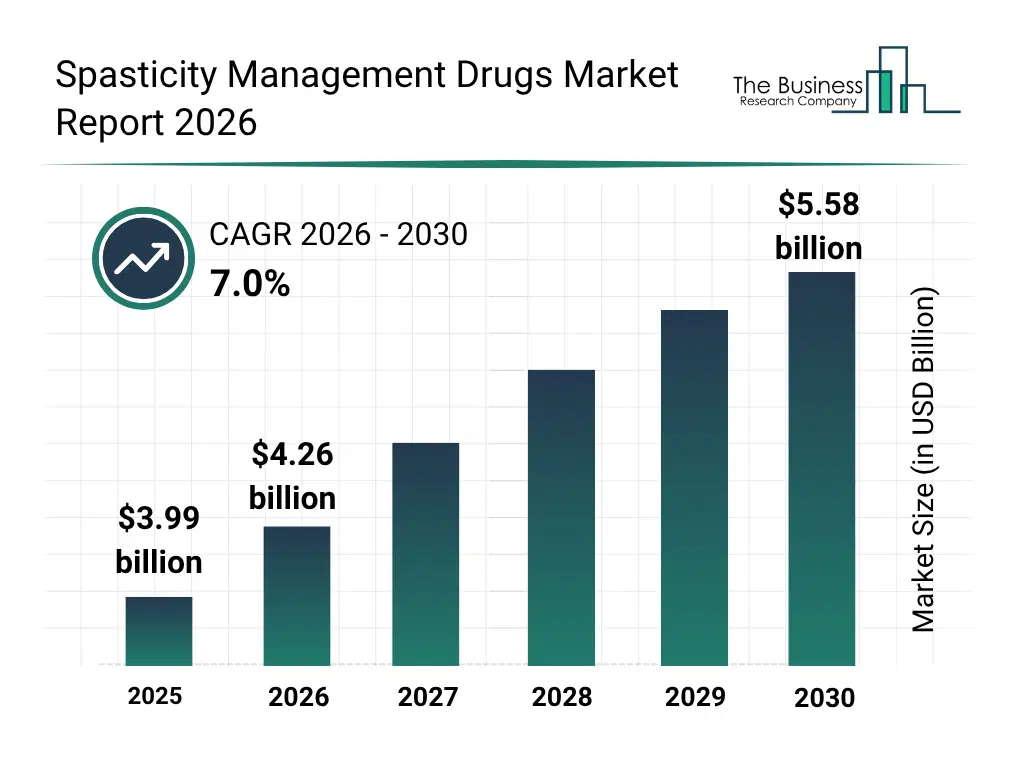
What Is The Spasticity Management Drugs Market Size and Share 2026?
The spasticity management drugs market size has grown strongly in recent years. It will grow from $3.99 billion in 2025 to $4.26 billion in 2026 at a compound annual growth rate (CAGR) of 6.8%. The growth in the historic period can be attributed to increasing prevalence of neurological disorders such as stroke and cerebral palsy, limited efficacy of conventional muscle relaxant therapies, rising geriatric population with mobility impairments, growing awareness of rehabilitation medicine, expansion of hospital-based neurology treatment adoption.What Is The Spasticity Management Drugs Market Growth Forecast?
The spasticity management drugs market size is expected to see strong growth in the next few years. It will grow to $5.58 billion in 2030 at a compound annual growth rate (CAGR) of 7.0%. The growth in the forecast period can be attributed to advancement in targeted neuro-modulating drug development, increasing adoption of botulinum toxin therapies, rising demand for minimally invasive treatment options, integration of precision medicine in neurology care, growth in rehabilitation-focused healthcare infrastructure. Major trends in the forecast period include personalized neuro-rehabilitation pharmacotherapy, advanced botulinum toxin formulations for spasticity control, combination therapy-based muscle relaxant regimens, biomarker-guided neurological spasticity treatment, long acting injectable spasticity management drugs.
Global Spasticity Management Drugs Market Segmentation
1) By Drug Class: Baclofen, Tizanidine, Diazepam, Dantrolene, Botulinum Toxin, Other Drug Classes 2) By Route Of Administration: Oral, Injectable, Other Routes Of Administration 3) By Patient Demographics: Pediatric, Geriatric, Adult 4) By Distribution Channel: Hospital Pharmacies, Retail Pharmacies, Online Pharmacies, Other Distribution Channels 5) By Application: Multiple Sclerosis, Cerebral Palsy, Stroke, Spinal Cord Injury, Other Applications Subsegments: 1) By Baclofen: Oral Baclofen, Intrathecal Baclofen, Generic Baclofen, Extended Release Baclofen 2) By Tizanidine: Tablet Formulation, Capsule Formulation, Generic Tizanidine, Combination Therapy Use 3) By Diazepam: Oral Diazepam, Injectable Diazepam, Rectal Diazepam, Generic Diazepam 4) By Dantrolene: Oral Dantrolene, Intravenous Dantrolene, Generic Dantrolene, Muscle Relaxant Therapy Use 5) By Botulinum Toxin: Botulinum Toxin Type A, Botulinum Toxin Type B, Injectable Neurotoxin Therapy, Long Acting Botulinum Formulations 6) By Other Drug Class: Gabapentin, Clonazepam, Cannabinoid Based Drugs, Cyclobenzaprine, Methocarbamol, Combination Spasticity TherapiesWhat Are The Drivers Of The Spasticity Management Drugs Market?
The rising prevalence of neurological disorders is expected to propel the growth of the spasticity management drugs market going forward. Neurological disorders are medical conditions that affect the brain, spinal cord, and nervous system, causing symptoms such as muscle stiffness, involuntary spasms, impaired movement, and loss of motor coordination. The rising prevalence of neurological disorders is primarily driven by the aging global population, as longer life expectancy increases the risk of age-related degeneration of the brain and nervous system, leading to higher demand for treatment and management. Spasticity management drugs help in neurological disorders to reduce muscle stiffness, involuntary muscle spasms, and pain, thereby improving mobility, comfort, and overall motor function in patients. For instance, in March 2024, according to the Alzheimer’s Association, a US-based nonprofit health organization, about 6.9 million Americans aged 65 years and older were living with Alzheimer’s disease in 2024, compared to 6.7 million in 2023. Therefore, the rising prevalence of neurological disorders is driving the growth of the spasticity management drugs industry. The expansion of healthcare infrastructure is expected to propel the growth of the spasticity management drugs market going forward. Healthcare infrastructure expansion refers to the growth and development of physical facilities, clinical services, and health systems that improve the delivery of medical care to patients. The healthcare infrastructure expansion is largely driven by the growing burden of neurological disorders such as multiple sclerosis, stroke, and cerebral palsy, which has compelled governments and health systems to invest in building and scaling specialized care facilities, including neurology clinics and rehabilitation centers, to meet rising patient demand. As healthcare infrastructure expands, greater numbers of patients gain access to specialist neurological care, enabling earlier diagnosis and sustained pharmacological treatment, which directly increases the uptake and utilization of drugs used to manage spasticity. For instance, in May 2023, according to the American Health Care Association, a US-based nonprofit organization, the United States had 6,129 hospitals, representing a 0.591% increase from the previous year when there were 6,093 hospitals. Therefore, the expansion of healthcare infrastructure is driving the growth of the spasticity management drugs industry.Key Players In The Global Spasticity Management Drugs Market
Major companies operating in the spasticity management drugs market are AbbVie Inc., Novartis AG, Ipsen Pharma, Merz Therapeutics GmbH, Teva Pharmaceutical Industries Ltd., Viatris Inc., Sun Pharmaceutical Industries Ltd., Eisai Co. Ltd., Aurobindo Pharma Limited, Dr. Reddy’s Laboratories Ltd., Amneal Pharmaceuticals Inc., Cipla Limited, Lupin Limited, Zydus Lifesciences Limited, Alkem Laboratories Ltd., Glenmark Pharmaceuticals Ltd., Torrent Pharmaceuticals Ltd., Mankind Pharma Ltd., Emcure Pharmaceuticals Ltd., Alembic Pharmaceuticals Limited, Pfizer Inc.Global Spasticity Management Drugs Market Trends and Insights
Major companies operating in the spasticity management drugs market are focusing on developing advanced products such as intrathecal administration sterile solutions to improve targeted drug delivery and enhance spasticity symptom control. Intrathecal administration of sterile solutions is a special formulation of medications delivered directly into the spinal fluid to provide targeted and long-lasting relief from severe spasticity while reducing systemic side effects. For instance, in March 2024, Nexus Pharmaceuticals, a US-based pharmaceutical manufacturing company, launched Baclofen Injection USP, a sterile intrathecal administration solution designed as a muscle relaxant and antispasmodic treatment. The product is used for patients with multiple sclerosis, cerebral palsy, spinal cord injuries, and other neurological conditions causing severe muscle spasms. The injection helps relieve flexor spasms, clonus, and associated pain while also improving sleep quality and supporting patients who are unable to tolerate oral baclofen formulations.Regional Outlook
North America was the largest region in the spasticity management drugs market in 2025. Asia-Pacific is expected to be the fastest-growing region in the forecast period. The regions covered in this market report are Australia, Brazil, China, France, Germany, India, Indonesia, Japan, Taiwan, Russia, South Korea, UK, USA, Canada, Italy, Spain. The countries covered in this market report are Australia, Brazil, China, France, Germany, India, Indonesia, Japan, Taiwan, Russia, South Korea, UK, USA, Canada, Italy, Spain.What Defines the Spasticity Management Drugs Market?
The spasticity management drugs market consists of sales of muscle relaxants, antispastic medications, and supportive therapeutic drugs. values in this market are ‘factory gate’ values, that is the value of goods sold by the manufacturers or creators of the goods, whether to other entities (including downstream manufacturers, wholesalers, distributors and retailers) or directly to end customers. The value of goods in this market includes related services sold by the creators0 of the goods.How is Market Value Defined and Measured?
The market value is defined as the revenues that enterprises gain from the sale of goods and/or services within the specified market and geography through sales, grants, or donations in terms of the currency (in USD unless otherwise specified). The revenues for a specified geography are consumption values that are revenues generated by organizations in the specified geography within the market, irrespective of where they are produced. It does not include revenues from resales along the supply chain, either further along the supply chain or as part of other products.What Key Data and Analysis Are Included in the Spasticity Management Drugs Market Report 2026?
The spasticity management drugs market research report is one of a series of new reports from The Business Research Company that provides spasticity management drugs market statistics, including spasticity management drugs industry global market size, regional shares, competitors with a spasticity management drugs market share, detailed spasticity management drugs market segments, market trends and opportunities, and any further data you may need to thrive in the spasticity management drugs industry. This spasticity management drugs market research report delivers a complete perspective of everything you need, with an in-depth analysis of the current and future scenario of the industry.Spasticity Management Drugs Market Report Forecast Analysis
| Report Attribute | Details |
|---|---|
| Market Size Value In 2026 | $4.26 billion |
| Revenue Forecast In 2030 | $5.58 billion |
| Growth Rate | CAGR of 7% from 2026 to 2030 |
| Base Year For Estimation | 2025 |
| Actual Estimates/Historical Data | 2020-2025 |
| Forecast Period | 2026 - 2030 |
| Market Representation | Revenue in USD Billion and CAGR from 2026 to 2030 |
| Segments Covered | Drug Class, Route Of Administration, Patient Demographics, Distribution Channel, Application |
| Regional Scope | Asia-Pacific, Western Europe, Eastern Europe, North America, South America, Middle East, Africa |
| Country Scope | The countries covered in the spasticity management drugs market report are Australia, Brazil, China, France, Germany, India, Indonesia, Japan, Taiwan, Russia, South Korea, UK, USA, Canada, Italy, Spain. |
| Key Companies Profiled | AbbVie Inc., Novartis AG, Ipsen Pharma, Merz Therapeutics GmbH, Teva Pharmaceutical Industries Ltd., Viatris Inc., Sun Pharmaceutical Industries Ltd., Eisai Co. Ltd., Aurobindo Pharma Limited, Dr. Reddy’s Laboratories Ltd., Amneal Pharmaceuticals Inc., Cipla Limited, Lupin Limited, Zydus Lifesciences Limited, Alkem Laboratories Ltd., Glenmark Pharmaceuticals Ltd., Torrent Pharmaceuticals Ltd., Mankind Pharma Ltd., Emcure Pharmaceuticals Ltd., Alembic Pharmaceuticals Limited, Pfizer Inc. |
| Customization Scope | Request for Customization |
| Pricing And Purchase Options | Explore Purchase Options |