

Specimen Sorting Systems Market Report 2026
Global Outlook – By Product Type (Automated Specimen Sorting Systems, Semi Automated Specimen Sorting Systems, Manual Specimen Sorting Systems), By Technology (Barcode Based Sorting Systems, Radio Frequency Identification Based Sorting Systems, Artificial Intelligence Based Sorting Systems, Robotic Sorting Systems), By Application (Clinical Laboratories, Research Laboratories, Blood Banks, Hospitals, Other Applications) – Market Size, Trends, Strategies, and Forecast to 2030
Specimen Sorting Systems Market Overview
• Specimen Sorting Systems market size has reached to $1.63 billion in 2025 • Expected to grow to $2.6 billion in 2030 at a compound annual growth rate (CAGR) of 9.9% • Growth Driver: Growing Volume of Diagnostic Testing Driving The Market Growth Due To Rising Prevalence of Chronic and Infectious Diseases • Market Trend: Full Laboratory Automation Solutions Strengthen Efficiency And Workflow Optimization In Specimen Processing Laboratories • North America was the largest region in 2025 and Asia-Pacific is the fastest growing region.What Is Covered Under Specimen Sorting Systems Market?
Specimen sorting systems are automated solutions designed to organize, identify, and route biological samples efficiently within laboratory environments. These systems improve specimen handling accuracy, reduce manual intervention, and enhance workflow efficiency. They help laboratories streamline sample processing, minimize identification errors, maintain traceability, and support faster diagnostic and testing operations. The main product types of specimen sorting systems include automated specimen sorting systems, semi automated specimen sorting systems, and manual specimen sorting systems. Automated specimen sorting systems refer to laboratory solutions that automatically identify, classify, and route biological samples for efficient workflow management. These systems are based on technologies including barcode based sorting systems, radio frequency identification based sorting systems, artificial intelligence based sorting systems, and robotic sorting systems and the various applications involved are clinical laboratories, research laboratories, blood banks, hospitals, and others.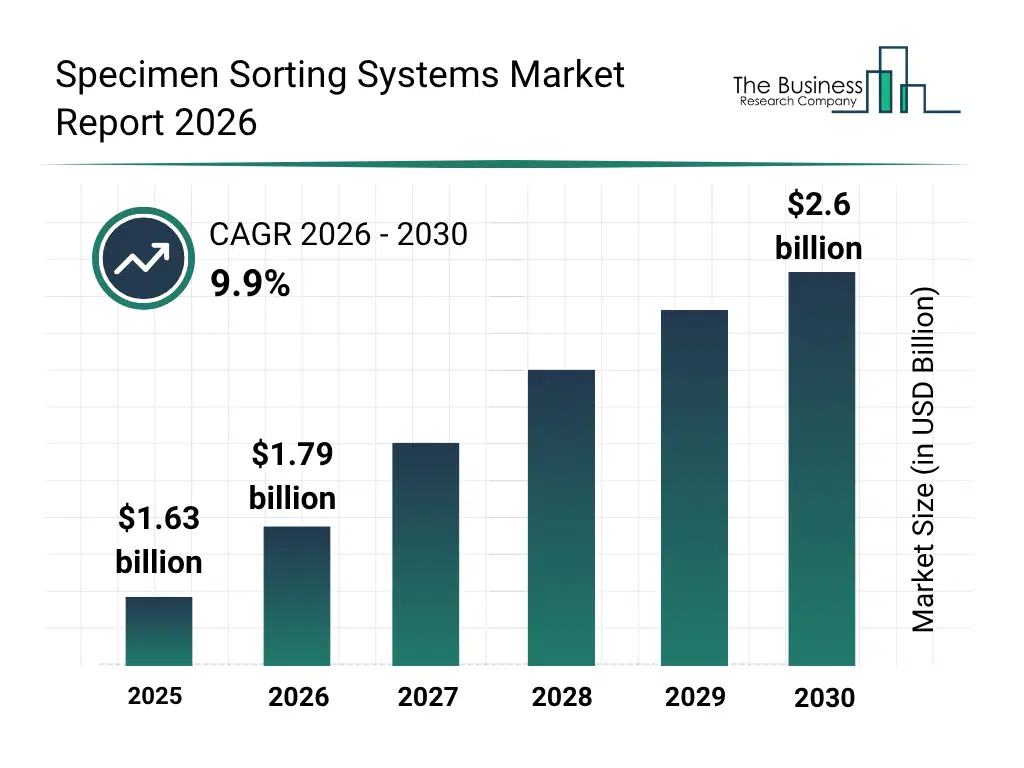
What Is The Specimen Sorting Systems Market Size and Share 2026?
The specimen sorting systems market size has grown strongly in recent years. It will grow from $1.63 billion in 2025 to $1.79 billion in 2026 at a compound annual growth rate (CAGR) of 9.6%. The growth in the historic period can be attributed to rising diagnostic testing volumes in clinical laboratories, increasing demand for laboratory automation, high error rates in manual specimen handling, growing need for faster diagnostic turnaround times, expansion of hospital and diagnostic lab infrastructure.What Is The Specimen Sorting Systems Market Growth Forecast?
The specimen sorting systems market size is expected to see strong growth in the next few years. It will grow to $2.6 billion in 2030 at a compound annual growth rate (CAGR) of 9.9%. The growth in the forecast period can be attributed to adoption of AI driven laboratory automation systems, increasing integration of robotics in specimen handling, rising demand for high throughput diagnostic workflows, expansion of smart laboratory ecosystems, growing focus on precision and traceability in diagnostics. Major trends in the forecast period include AI powered laboratory automation systems, robotic specimen handling and routing platforms, barcode and rfid enabled sample tracking systems, cloud integrated laboratory workflow management, error reduction and traceability focused sample processing systems.
Global Specimen Sorting Systems Market Segmentation
1) By Product Type: Automated Specimen Sorting Systems, Semi Automated Specimen Sorting Systems, Manual Specimen Sorting Systems 2) By Technology: Barcode Based Sorting Systems, Radio Frequency Identification Based Sorting Systems, Artificial Intelligence Based Sorting Systems, Robotic Sorting Systems 3) By Application: Clinical Laboratories, Research Laboratories, Blood Banks, Hospitals, Other Applications Subsegments: 1) By Automated Specimen Sorting Systems: High Throughput Automated Specimen Sorting Systems, Integrated Laboratory Automation Sorting Systems, Standalone Automated Specimen Sorting Units, Robotic Arm Based Specimen Sorting Systems, Conveyor Based Automated Sorting Systems 2) By Semi Automated Specimen Sorting Systems: Assisted Specimen Loading Sorting Systems, Operator Guided Sorting Systems, Partially Automated Conveyor Sorting Systems, Barcode Assisted Sorting Systems, Hybrid Manual Automated Sorting Systems 3) By Manual Specimen Sorting Systems: Manual Visual Identification Sorting Systems, Hand Operated Specimen Sorting Systems, Gravity Based Manual Sorting Systems, Manual Rack Based Sorting Systems, Paper Label Based Sorting SystemsWhat Are The Drivers Of The Specimen Sorting Systems Market?
The growing volume of diagnostic testing is expected to propel the growth of the specimen sorting systems market going forward. Diagnostic testing refers to the use of laboratory analyses on biological specimens to detect, identify, or monitor diseases and health conditions in patients. The growing volume of diagnostic testing due to the rising prevalence of chronic and infectious diseases is increasing the need for regular laboratory evaluations and efficient high-volume specimen processing to support accurate diagnosis and disease management. Specimen sorting systems support diagnostic testing by automatically organizing and routing biological samples with high accuracy, helping laboratories improve workflow efficiency, reduce manual errors, and manage large testing volumes with faster turnaround times. For instance, in December 2024, according to the U.S. Department of Health and Human Services Office of Inspector General (OIG), a US-based federal oversight agency that monitors healthcare programs and spending, the volume of genetic tests reimbursed under Medicare Part B increased by 41% from 2022 to 2023, reflecting a substantial rise in laboratory blood test demand across the country. Therefore, the growing volume of diagnostic testing is driving the growth of the specimen sorting systems industry. The growing burden of chronic and infectious diseases is expected to propel the growth of the specimen sorting systems market going forward. Chronic and infectious diseases refer to long-term conditions and diseases caused by infectious agents (such as bacteria, viruses, or parasites) that together significantly contribute to illness and mortality. The growing burden of chronic and infectious diseases is driven by population aging, as longer life expectancy increases the prevalence of long-term conditions and susceptibility to infections. Specimen sorting systems help in managing chronic and infectious diseases by enabling rapid, accurate, and automated classification of patient samples, which improves diagnostic efficiency and supports timely disease detection and monitoring. For instance, in March 2024, according to the Centers for Disease Control and Prevention, a US-based government agency, the number of tuberculosis cases increased from 8,320 in 2022 to 9,615 in 2023, representing a rise of 1,295 cases. Therefore, the growing burden of chronic and infectious diseases is driving the growth of the specimen sorting systems industry.Key Players In The Global Specimen Sorting Systems Market
Major companies operating in the specimen sorting systems market are F. Hoffmann-La Roche Ltd, Danaher Corporation, Abbott Laboratories, Siemens Healthineers AG, Thermo Fisher Scientific Inc., Becton Dickinson and Company, bioMérieux, Sysmex Corporation, QuidelOrtho, Mindray, Hitachi High-Tech, QIAGEN N.V., Bio-Rad Laboratories Inc., Inpeco SA, Horiba, Tecan Group Ltd., Hamilton Company, Sarstedt AG & Co. KG, Copan Diagnostics Inc., SPT Labtech Ltd., LiCONiC AGGlobal Specimen Sorting Systems Market Trends and Insights
Major companies operating in the specimen sorting systems market are focusing on developing advanced automation solutions, such as full laboratory automation (FLA) lines and intelligent sample processing systems, to enhance diagnostic accuracy, improve workflow efficiency, and enable faster turnaround times in clinical microbiology and pathology laboratories. Full Laboratory Automation (FLA) lines and intelligent sample processing systems refer to integrated laboratory setups that automate end-to-end specimen handling, processing, and analysis to improve speed, accuracy, traceability, and workflow efficiency. For instance, in February 2025, Copan Diagnostics, a US-based manufacturer of pre-analytical microbiology tools, celebrated the installation of the first WASPLab full laboratory automation line in Latin America at Hospital Ángeles Pedregal. It is designed to support improved laboratory efficiency and diagnostic performance. The system enables automated specimen handling, standardized culture processing, and optimized workflow management, strengthening microbiology laboratory operations and accelerating clinical decision-making.Regional Outlook
North America was the largest region in the specimen sorting systems market in 2025. Asia-Pacific is expected to be the fastest-growing region in the forecast period. The regions covered in this market report are Australia, Brazil, China, France, Germany, India, Indonesia, Japan, Taiwan, Russia, South Korea, UK, USA, Canada, Italy, Spain. The countries covered in this market report are Australia, Brazil, China, France, Germany, India, Indonesia, Japan, Taiwan, Russia, South Korea, UK, USA, Canada, Italy, Spain.What Defines the Specimen Sorting Systems Market?
The specimen sorting systems market consists of revenues earned by entities by providing services such as sample tracking and routing, barcode scanning and identification, laboratory workflow automation, and specimen data integration. The market value includes the value of related goods sold by the service provider or included within the service offering. The specimen sorting systems market also includes sales of sorting control panels, laboratory conveyor belts, robotic grippers, and specimen input modules. Values in this market are ‘factory gate’ values, that is, the value of goods sold by the manufacturers or creators of the goods, whether to other entities (including downstream manufacturers, wholesalers, distributors, and retailers) or directly to end customers. The value of goods in this market includes related services sold by the creators of the goods.How is Market Value Defined and Measured?
The market value is defined as the revenues that enterprises gain from the sale of goods and/or services within the specified market and geography through sales, grants, or donations in terms of the currency (in USD unless otherwise specified). The revenues for a specified geography are consumption values that are revenues generated by organizations in the specified geography within the market, irrespective of where they are produced. It does not include revenues from resales along the supply chain, either further along the supply chain or as part of other products.What Key Data and Analysis Are Included in the Specimen Sorting Systems Market Report 2026?
The specimen sorting systems market research report is one of a series of new reports from The Business Research Company that provides specimen sorting systems market statistics, including specimen sorting systems industry global market size, regional shares, competitors with a specimen sorting systems market share, detailed specimen sorting systems market segments, market trends and opportunities, and any further data you may need to thrive in the specimen sorting systems industry. This specimen sorting systems market research report delivers a complete perspective of everything you need, with an in-depth analysis of the current and future scenario of the industry.Specimen Sorting Systems Market Report Forecast Analysis
| Report Attribute | Details |
|---|---|
| Market Size Value In 2026 | $1.79 billion |
| Revenue Forecast In 2030 | $2.6 billion |
| Growth Rate | CAGR of 9.9% from 2026 to 2030 |
| Base Year For Estimation | 2025 |
| Actual Estimates/Historical Data | 2020-2025 |
| Forecast Period | 2026 - 2030 |
| Market Representation | Revenue in USD Billion and CAGR from 2026 to 2030 |
| Segments Covered | Product Type, Technology, Application |
| Regional Scope | Asia-Pacific, Western Europe, Eastern Europe, North America, South America, Middle East, Africa |
| Country Scope | The countries covered in the specimen sorting systems market report are Australia, Brazil, China, France, Germany, India, Indonesia, Japan, Taiwan, Russia, South Korea, UK, USA, Canada, Italy, Spain. |
| Key Companies Profiled | F. Hoffmann-La Roche Ltd, Danaher Corporation, Abbott Laboratories, Siemens Healthineers AG, Thermo Fisher Scientific Inc., Becton Dickinson and Company, bioMérieux, Sysmex Corporation, QuidelOrtho, Mindray, Hitachi High-Tech, QIAGEN N.V., Bio-Rad Laboratories Inc., Inpeco SA, Horiba, Tecan Group Ltd., Hamilton Company, Sarstedt AG & Co. KG, Copan Diagnostics Inc., SPT Labtech Ltd., LiCONiC AG |
| Customization Scope | Request for Customization |
| Pricing And Purchase Options | Explore Purchase Options |