
Sports Drug Testing Market Report 2026
Global Outlook – By Product Type (Equipment, Urine Testing Devices, Rapid Testing Devices, Oral Fluid Testing Devices, Immunoassay Analyzers, Consumables, Chromatography Instruments, Assay Kits, Alcohol Breath Analyzers), By Sample Type (Urine, Oral Fluid, Hair, Breath, Blood, Other Sample Types), By End User (Drug Testing Laboratories, Pain Management Centers, Hospitals, Government Departments, Drug Rehabilitation Centers, Other End-Users) – Market Size, Trends, Strategies, and Forecast to 2030
Sports Drug Testing Market Overview
• Sports Drug Testing market size has reached to $18.89 billion in 2025 • Expected to grow to $41.16 billion in 2030 at a compound annual growth rate (CAGR) of 16.8% • Growth Driver: Rising Demand For Athlete Safety And Health Monitoring Fueling The Growth Of The Market Due To Increasing Focus On Performance Optimization And Anti-Doping Compliance • Market Trend: Advanced Blood Spot Systems Enhance User Experience And Consistency • North America was the largest region in 2025 and Asia-Pacific is the fastest growing region.What Is Covered Under Sports Drug Testing Market?
Sports drug testing is the process of analyzing biological samples to detect the presence of prohibited substances and performance-enhancing drugs in athletes. It ensures fairness and integrity in sports by identifying doping and preventing its use. The process involves scientific methods and protocols to accurately monitor and report any violations of anti-doping regulations. The main product types of the sports drug testing include equipment, urine testing devices, rapid testing devices, oral fluid testing devices, immunoassay analyzers, consumables, chromatography instruments, assay kits, and alcohol breath analyzers. Equipment refers to devices such as urine testing devices, rapid testing devices, oral fluid testing devices, immunoassay analyzers, chromatography instruments, assay kits, and alcohol breath analyzers, which are used to detect the presence of banned substances in athletes. There are sample types such as urine, oral fluid, hair, breath, blood, and others, and they are used by several end-users such as drug testing laboratories, pain management centers, hospitals, government departments, drug rehabilitation centers, and others.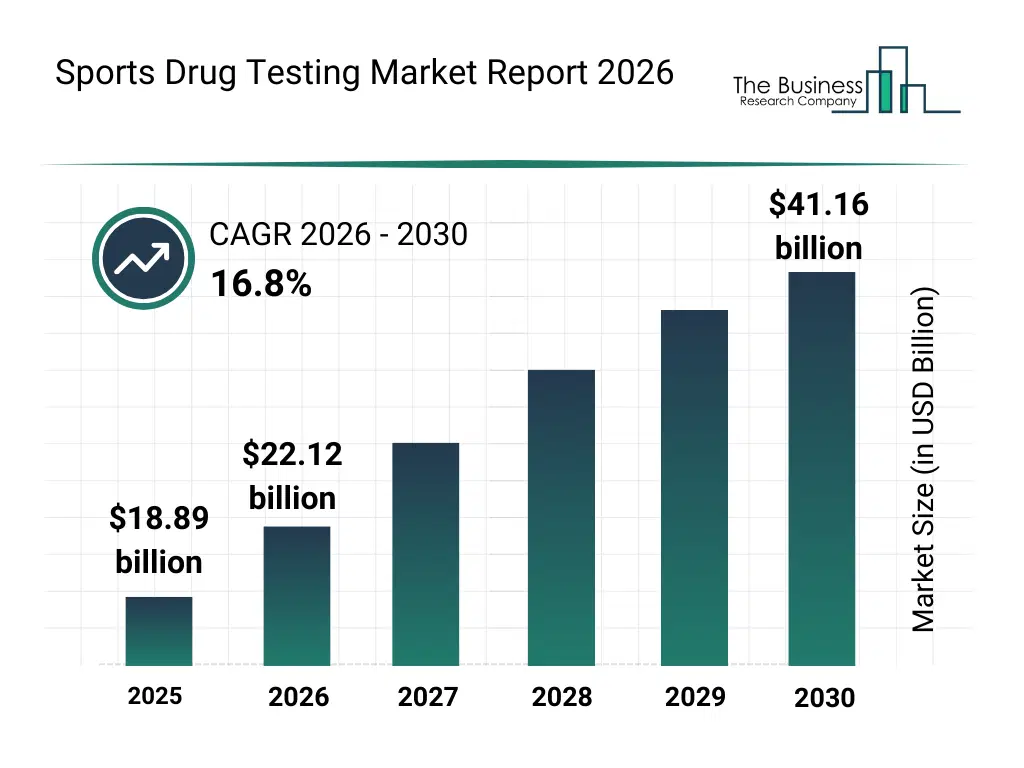
What Is The Sports Drug Testing Market Size and Share 2026?
The sports drug testing market size has grown rapidly in recent years. It will grow from $18.89 billion in 2025 to $22.12 billion in 2026 at a compound annual growth rate (CAGR) of 17.1%. The growth in the historic period can be attributed to increasing awareness of anti-doping regulations, increasing participation in international sporting events, increasing emphasis on fair play across professional sports, rising number of doping violations worldwide, and rising investment in sports infrastructure and athlete programs.What Is The Sports Drug Testing Market Growth Forecast?
The sports drug testing market size is expected to see rapid growth in the next few years. It will grow to $41.16 billion in 2030 at a compound annual growth rate (CAGR) of 16.8%. The growth in the forecast period can be attributed to rising demand for accurate and rapid testing methods, growing adoption of biological passport programs, growing government support for anti-doping initiatives, growing media attention on athlete performance integrity, and growing collaboration between sports federations and testing agencies. Major trends in the forecast period include advancement in high-sensitivity testing technologies, advancement in portable on-site testing devices, advancement in long-term biomarker monitoring methods, innovation in ai-based result analysis, and innovation in genetic and molecular detection techniques.
Global Sports Drug Testing Market Segmentation
1) By Product Type: Equipment, Urine Testing Devices, Rapid Testing Devices, Oral Fluid Testing Devices, Immunoassay Analyzers, Consumables, Chromatography Instruments, Assay Kits, Alcohol Breath Analyzers 2) By Sample Type: Urine, Oral Fluid, Hair, Breath, Blood, Other Sample Types 3) By End User: Drug Testing Laboratories, Pain Management Centers, Hospitals, Government Departments, Drug Rehabilitation Centers, Other End-Users Subsegments: 1) By Equipment: Analytical Instruments, Mass Spectrometers, PCR Instruments, Centrifuges 2) By Urine Testing Devices: Urine Collection Cups, Urine Sample Analyzers, Dip Cards for Urine Testing, Urine Drug Screening Panels 3) By Rapid Testing Devices: Single-Panel Rapid Test Kits, Multi-Panel Rapid Test Kits, Saliva-Based Rapid Tests, Urine-Based Rapid Tests 4) By Oral Fluid Testing Devices: Oral Swab Collection Kits, Oral Fluid Analyzers, Lab-Based Oral Fluid Test Systems, Portable Oral Fluid Screening Devices 5) By Immunoassay Analyzers: ELISA Analyzers, CLIA Analyzers, Automated Immunoassay Systems, Benchtop Immunoassay Analyzers 6) By Consumables: Reagents, Buffers and Controls, Sample Collection Tubes, Test Cartridges 7) By Chromatography Instruments: Gas Chromatography Systems, Liquid Chromatography Systems, High-Performance Liquid Chromatography (HPLC), Ultra-High-Performance Liquid Chromatography (UHPLC) 8) By Assay Kits: Drug Detection Assay Kits, Hormone Detection Kits, Performance-Enhancing Drug Kits, Multi-Drug Screening Kits 9) By Alcohol Breath Analyzers: Fuel Cell Breathalyzers, Semiconductor Breathalyzers, Portable Breathalyzers, Professional-Grade Breath Testing SystemsWhat Is The Driver Of The Sports Drug Testing Market?
The rising demand for athlete safety and health monitoring is expected to propel the growth of the sports drug testing market going forward. Athlete safety and health monitoring refers to the systematic evaluation of athletes’ physiological, biochemical, and metabolic parameters to ensure safe participation, prevent injuries, and detect prohibited substances that may enhance performance unfairly. The rising demand for athlete safety and health monitoring is due to increasing awareness of performance-enhancing drug abuse and sports-related health risks, as organizations and athletes aim to ensure fair competition and prevent injuries. Sports drug testing helps athlete safety and health monitoring by detecting and preventing the use of performance-enhancing drugs, ensuring integrity in competitive sports while supporting athletes’ health and well-being. For instance, in June 2025, according to the International Testing Agency, a Switzerland-based independent organization, over 44,400 urine and blood samples were collected from athletes of 216 nationalities in 2024, an increase of more than 10% compared to 2023, with 4.6% out-of-competition and 45.4% during 1,100 international sports events. Therefore, the rising demand for athlete safety and health monitoring is driving the growth of the sports drug testing industry.Key Players In The Global Sports Drug Testing Market
Major companies operating in the sports drug testing market are UCLA Health, Kings College London, China Anti-Doping Agency (CHINADA), LGC Assure, Psychemedics Corporation, United States Anti-Doping Agency (USADA), Seibersdorf Laboratories GmbH, International Doping Test And Management AB, Qatar Anti-Doping Laboratory (QADL), Canadian Centre for Ethics in Sport (CCES), Sports Medicine Research And Testing Laboratory, Drug Free Sport International Inc., Aegis Sciences Corporation, Comprehensive Drug Testing Inc., Any Lab Test Now LLC, Clearidium Inc., Australian Sports Drug Testing Laboratory (ASDTL), Turkish Doping Control Centre, Japan Anti-Doping Agency (JADA), Brazilian Doping Control Laboratory (LBCD)
This chart is for illustrative purposes; the full report includes a detailed competitor analysis and comprehensive overview of the top 10 companies in the market.
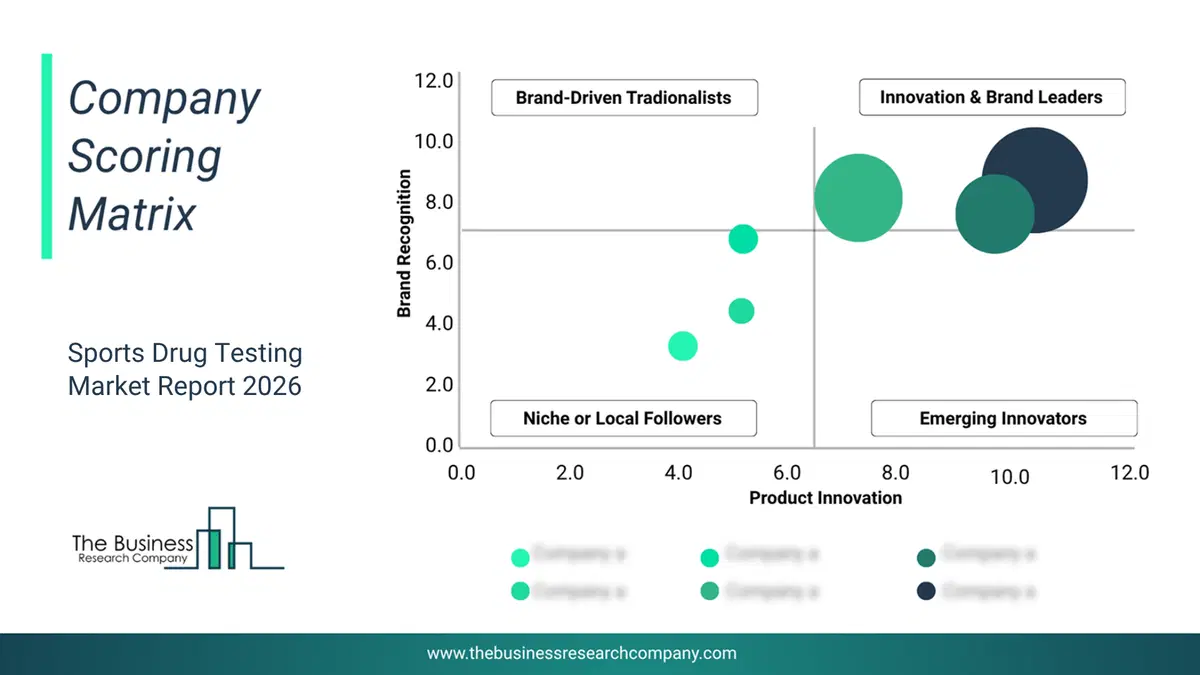
This chart maps companies by product innovation and brand strength, with bubble size indicating relative revenue, helping identify market leaders, challengers, and niche players. This is an illustrative chart; the full report provides a complete and accurate competitive analysis.
Global Sports Drug Testing Market Trends and Insights
Major companies operating in the sports drug testing market are focusing on developing advanced products, such as next-generation dried blood spot (DBS) technology, to boost efficiency, enhance user experience, and improve sample quality. Next-generation dried blood spot (DBS) technology refers to advanced systems designed to simplify and standardize the collection of capillary blood samples for diagnostic testing, minimizing pre-analytical errors. For instance, in February 2025, Tasso Inc., a US-based healthcare technology company, launched the next-generation technology for dried blood spot sample collection. The new product line features a compact, all-in-one device designed for virtually painless self-collection. It includes a simplified, two-step process that aims to reduce user error and improve sample consistency. It also incorporates advanced sample stabilization chemistry and integrated tracking capabilities, ensuring high-quality specimens for clinical trials, remote monitoring, and decentralized diagnostics.What Are Latest Mergers And Acquisitions In The Sports Drug Testing Market?
In January 2024, CPC LLC, a US-based risk mitigation and compliance solutions provider, acquired Drug Free Sport International (DFSI) for an undisclosed amount. Through this acquisition, CPC aims to strengthen its athlete health, safety, and compliance portfolio by integrating Drug Free Sport International's (DFSI) end-to-end drug-testing administration, intelligence-driven testing protocols, and comprehensive athlete-wellness programs. Drug Free Sport International is a US-based company specializing in sports drug testing and anti-doping services.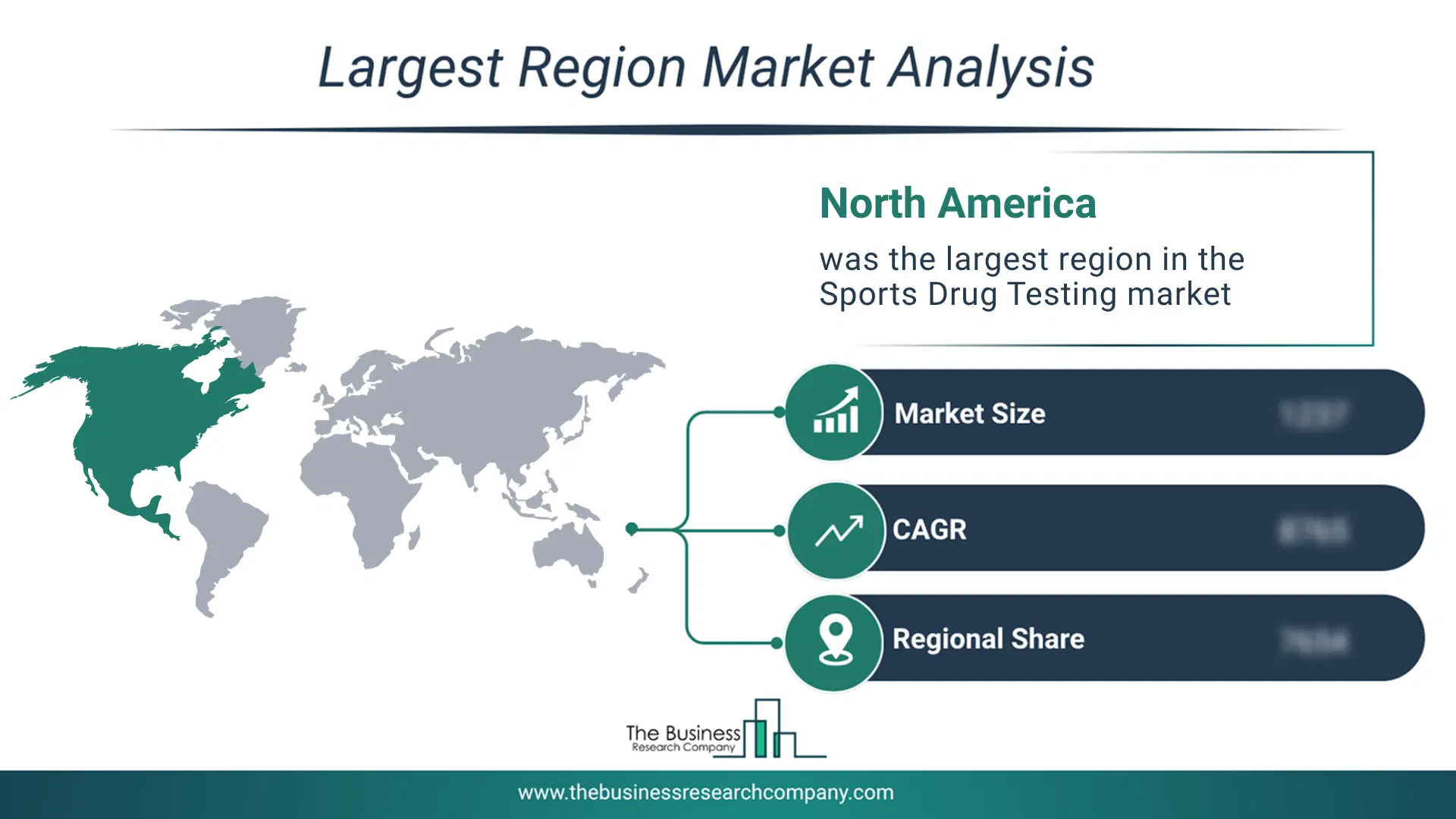
Regional Insights
North America was the largest region in the sports drug testing market in 2025. Asia-Pacific is expected to be the fastest-growing region in the forecast period. The regions covered in this market report are Asia-Pacific, South East Asia, Western Europe, Eastern Europe, North America, South America, Middle East, Africa. The countries covered in this market report are Australia, Brazil, China, France, Germany, India, Indonesia, Japan, Taiwan, Russia, South Korea, UK, USA, Canada, Italy, Spain.What Defines the Sports Drug Testing Market?
The sports drug testing market includes revenues earned by entities through result reporting, doping control management, and athlete education and training. The market value includes the value of related goods sold by the service provider or included within the service offering. Only goods and services traded between entities or sold to end consumers are included.How is Market Value Defined and Measured?
The market value is defined as the revenues that enterprises gain from the sale of goods and/or services within the specified market and geography through sales, grants, or donations in terms of the currency (in USD unless otherwise specified). The revenues for a specified geography are consumption values that are revenues generated by organizations in the specified geography within the market, irrespective of where they are produced. It does not include revenues from resales along the supply chain, either further along the supply chain or as part of other products.
This chart presents market attractiveness based on a quantitative evaluation of growth, competition, strategic alignment, and risk, offering a clear view of opportunity areas for decision-making. This chart is for illustrative purposes; the full report contains the complete analysis.

This chart highlights the Total Addressable Market (TAM) by estimating the maximum revenue opportunity using an assumption-driven approach, supporting strategic planning and opportunity sizing across markets. The chart is illustrative; the full report provides a more comprehensive analysis.
What Key Data and Analysis Are Included in the Sports Drug Testing Market Report 2026?
The sports drug testing market research report is one of a series of new reports from The Business Research Company that provides market statistics, including industry global market size, regional shares, competitors with the market share, detailed market segments, market trends and opportunities, and any further data you may need to thrive in the sports drug testing industry. The market research report delivers a complete perspective of everything you need, with an in-depth analysis of the current and future state of the industry.Sports Drug Testing Market Report Forecast Analysis
| Report Attribute | Details |
|---|---|
| Market Size Value In 2026 | $22.12 billion |
| Revenue Forecast In 2030 | $41.16 billion |
| Growth Rate | CAGR of 16.8% from 2026 to 2030 |
| Base Year For Estimation | 2025 |
| Actual Estimates/Historical Data | 2020-2025 |
| Forecast Period | 2026 - 2030 |
| Market Representation | Revenue in USD Billion and CAGR from 2026 to 2030 |
| Segments Covered | Product Type, Sample Type, End User |
| Regional Scope | Asia-Pacific, Western Europe, Eastern Europe, North America, South America, Middle East, Africa |
| Country Scope | The countries covered in the report are Australia, Brazil, China, France, Germany, India, Indonesia, Japan, Taiwan, Russia, South Korea, UK, USA, Canada, Italy, Spain |
| Key Companies Profiled | UCLA Health, Kings College London, China Anti-Doping Agency (CHINADA), LGC Assure, Psychemedics Corporation, United States Anti-Doping Agency (USADA), Seibersdorf Laboratories GmbH, International Doping Test And Management AB, Qatar Anti-Doping Laboratory (QADL), Canadian Centre for Ethics in Sport (CCES), Sports Medicine Research And Testing Laboratory, Drug Free Sport International Inc., Aegis Sciences Corporation, Comprehensive Drug Testing Inc., Any Lab Test Now LLC, Clearidium Inc., Australian Sports Drug Testing Laboratory (ASDTL), Turkish Doping Control Centre, Japan Anti-Doping Agency (JADA), Brazilian Doping Control Laboratory (LBCD) |
| Customization Scope | Request for Customization |
| Pricing And Purchase Options | Explore Purchase Options |