

Stack Damper Retrofit Market Report 2026
Global Outlook – By Product Type (Manual Stack Dampers, Motorized Stack Dampers, Pneumatic Stack Dampers, Other Product Types), By Retrofit Type (Partial Retrofit, Full System Retrofit, Performance Optimization Retrofit), By Distribution Channel (Direct Sales, Distributors Or Wholesalers, System Integrators Or Engineering, Procurement, And Construction (EPC) Contractors, Online Retail And Procurement Platforms, Other Distribution Channels), By Application (Power Plants, Industrial Furnaces And Boilers, Refineries And Petrochemical Plants, Heating, Ventilation, And Air Conditioning (HVAC) And Building Exhaust Systems, Other Applications), By End-User (Industrial, Commercial, Residential, Other End-Users) – Market Size, Trends, Strategies, and Forecast to 2030
Stack Damper Retrofit Market Overview
• Stack Damper Retrofit market size has reached to $1.29 billion in 2025 • Expected to grow to $1.83 billion in 2030 at a compound annual growth rate (CAGR) of 7.1% • Growth Driver: Increasing Regulatory Pressure On Emissions Control Fueling The Growth Of The Market Due To The Need For Enhanced Combustion Efficiency And Compliance • Market Trend: Empowering Enterprises With Precise Airflow Control, Energy Efficiency, And Advanced Digital Operations • North America was the largest region in 2025 and Asia-Pacific is the fastest growing region.What Is Covered Under Stack Damper Retrofit Market?
Stack damper retrofit is the process of installing, upgrading, or adapting vibration-damping devices and related structural modifications on industrial stacks, chimneys or large ducts to reduce wind- or flow-induced vibrations and associated stresses. Its purpose is to reduce vibration-induced fatigue and noise, improve structural integrity and operational reliability, and help the facility meet safety and environmental compliance requirements. The main product types of stack damper retrofit include manual stack dampers, motorized stack dampers, and pneumatic stack dampers. Manual stack dampers are devices used to regulate airflow and emissions in industrial stacks and ducts. Different retrofit types are partial retrofit, full system retrofit, and performance optimization retrofit. Multiple distribution channels include direct sales, distributors or wholesalers, system integrators or engineering, procurement, and construction (EPC) contractors, online retail and procurement platforms, and others. Various applications include power plants, industrial furnaces and boilers, refineries and petrochemical plants, heating, ventilation, and air conditioning (HVAC) and building exhaust systems, and others, and they are used by several end-users such as industrial, commercial, residential sectors, and others.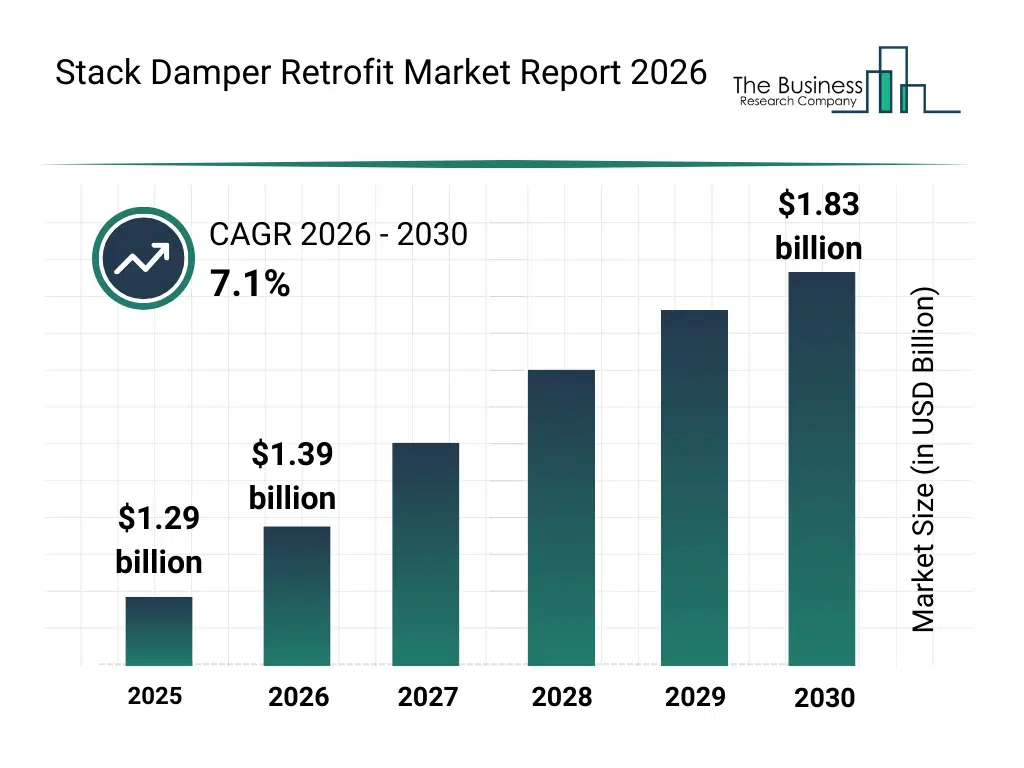
What Is The Stack Damper Retrofit Market Size and Share 2026?
The stack damper retrofit market size has grown strongly in recent years. It will grow from $1.29 billion in 2025 to $1.39 billion in 2026 at a compound annual growth rate (CAGR) of 7.4%. The growth in the historic period can be attributed to increasing industrial modernization efforts, growing adoption of motorized damper systems, rising need for energy-efficient exhaust management, expansion of retrofit activities in aging power plants, and increasing regulatory pressure for emissions control.What Is The Stack Damper Retrofit Market Growth Forecast?
The stack damper retrofit market size is expected to see strong growth in the next few years. It will grow to $1.83 billion in 2030 at a compound annual growth rate (CAGR) of 7.1%. The growth in the forecast period can be attributed to growing demand for automation and smart retrofits, increasing shift toward heat-loss reduction solutions, rising adoption of actuator upgrade programs, expansion of retrofitting in emerging industrial economies, and increasing focus on operational safety and reliability. Major trends in the forecast period include advancements in IoT-enabled damper monitoring, innovations in high-temperature sealing materials, developments in automated actuator technologies, growing research and development in lightweight damper designs, and increasing adoption of digital twin simulation for retrofit planning.
Global Stack Damper Retrofit Market Segmentation
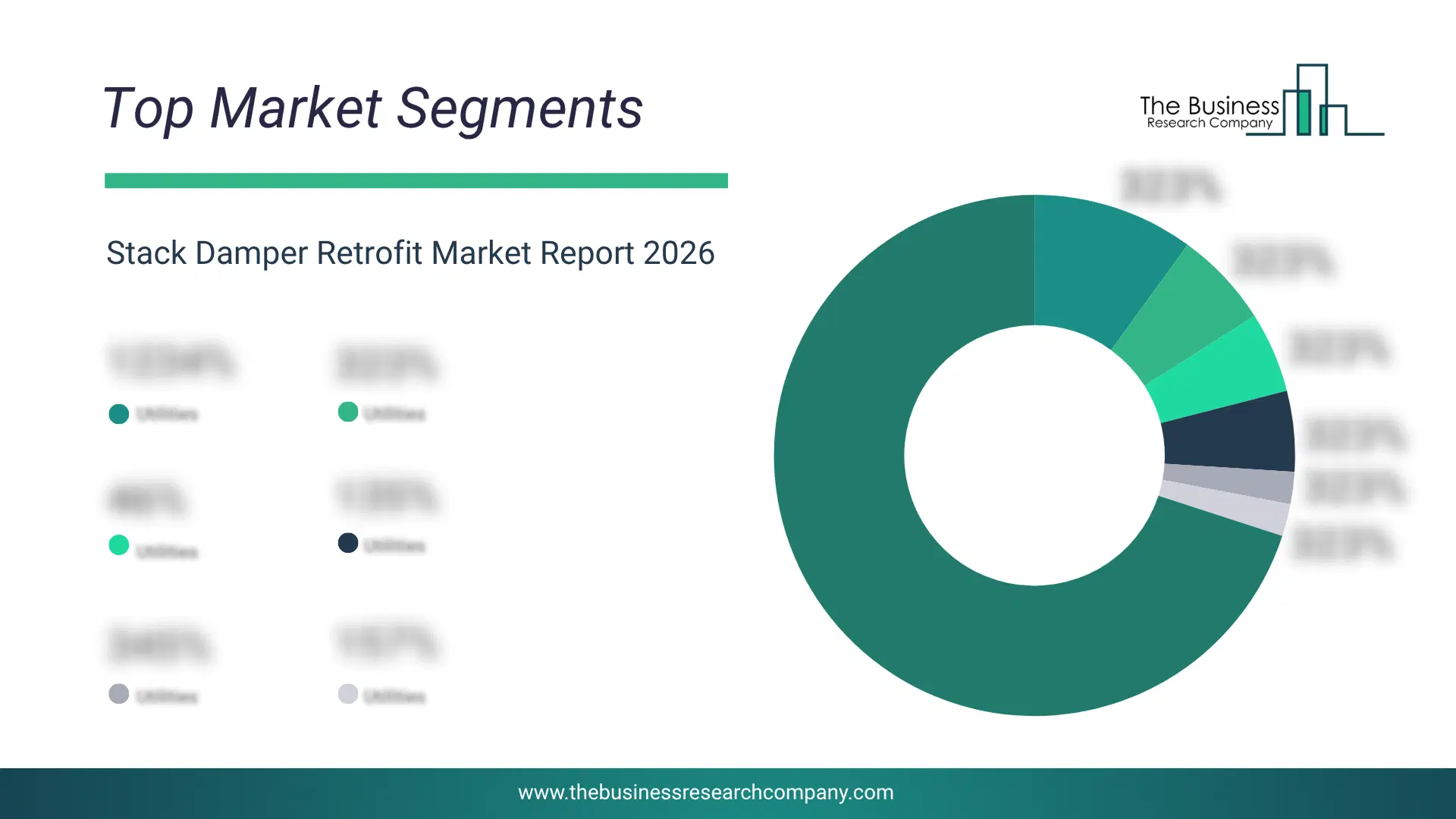
1) By Product Type: Manual Stack Dampers, Motorized Stack Dampers, Pneumatic Stack Dampers, Other Product Types 2) By Retrofit Type: Partial Retrofit, Full System Retrofit, Performance Optimization Retrofit 3) By Distribution Channel: Direct Sales, Distributors Or Wholesalers, System Integrators Or Engineering, Procurement, And Construction (EPC) Contractors, Online Retail And Procurement Platforms, Other Distribution Channels 4) By Application: Power Plants, Industrial Furnaces And Boilers, Refineries And Petrochemical Plants, Heating, Ventilation, And Air Conditioning (HVAC) And Building Exhaust Systems, Other Applications 5) By End-User: Industrial, Commercial, Residential, Other End-Users Subsegments: 1) By Manual Stack Dampers: Single Blade Dampers, Multi Blade Dampers, Round Stack Dampers, Rectangular Stack Dampers 2) By Motorized Stack Dampers: Electric Actuated Dampers, Modulating Control Dampers, Automatic Control Dampers, Remote Operated Dampers 3) By Pneumatic Stack Dampers: Air Actuated Dampers, Spring Return Dampers, Pressure Controlled Dampers, Fail Safe Dampers 4) By Other Product Types: Gravity Operated Dampers, Counterweight Dampers, Custom Designed Dampers, High Temperature DampersWhat Is The Driver Of The Stack Damper Retrofit Market?
The rising regulatory pressure on emissions control is expected to accelerate the growth of the stack damper retrofit market going forward. Emissions-control regulations require industrial facilities and power plants to limit pollutants and improve combustion performance to meet environmental standards. The rise in regulatory pressure on emissions control is due to growing evidence of the harmful impacts of air pollution and greenhouse gases on public health ecosystems and climate stability driving governments. Stack damper retrofits support emissions control by improving draft control and heat utilization, which helps facilities fine-tune combustion conditions and reduce stack losses while staying within regulatory limits. For instance, in January 2025, according to the International Energy Agency, a Paris-based intergovernmental energy policy organization, emissions from light?duty vehicles must decline by about 6% annually through 2030, given that nearly 80% of cars and vans on the road that year will still use internal combustion engines, making it essential for all new car and van sales to be zero?emission by 2035. Therefore, increasing regulatory pressure on emissions control is encouraging industrial facilities to adopt stack damper retrofit solutions.Key Players In The Global Stack Damper Retrofit Market
Major companies operating in the stack damper retrofit market are Greenheck Fan Corporation, CECO Environmental, Ruskin Company, Cleaver-Brooks, Nooter Eriksen, Forney Corporation, GERB Schwingungsisolierungen GmbH & Co. KG, AeroDynamix Inc., Damper Technology Ltd, Enidine Corporation, Meca Enterprises, Steelcon Chimney and Stacks, Warren Environmental, Fox Equipment, TVS Acoustics, Flow Engineering B.V., Parth Valve and Hoses LLP, Effox-Flextor-Mader, Multitech Damper Solutions, EFM Equipment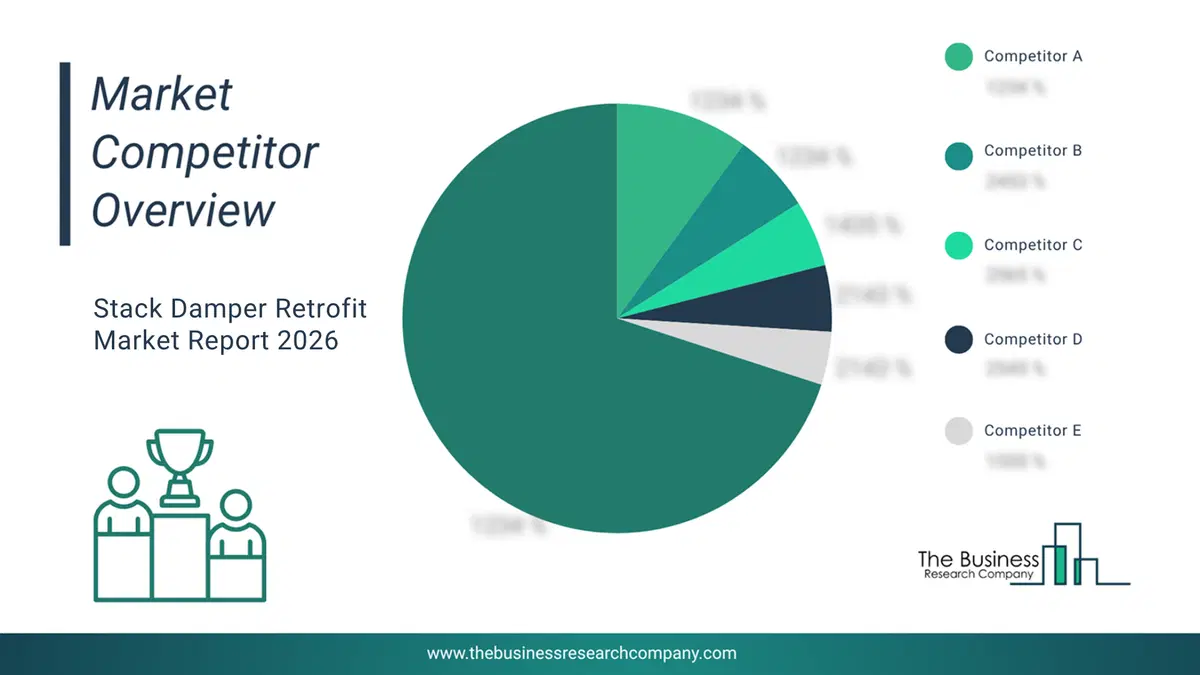
This chart is for illustrative purposes; the full report includes a detailed competitor analysis and comprehensive overview of the top 10 companies in the market.
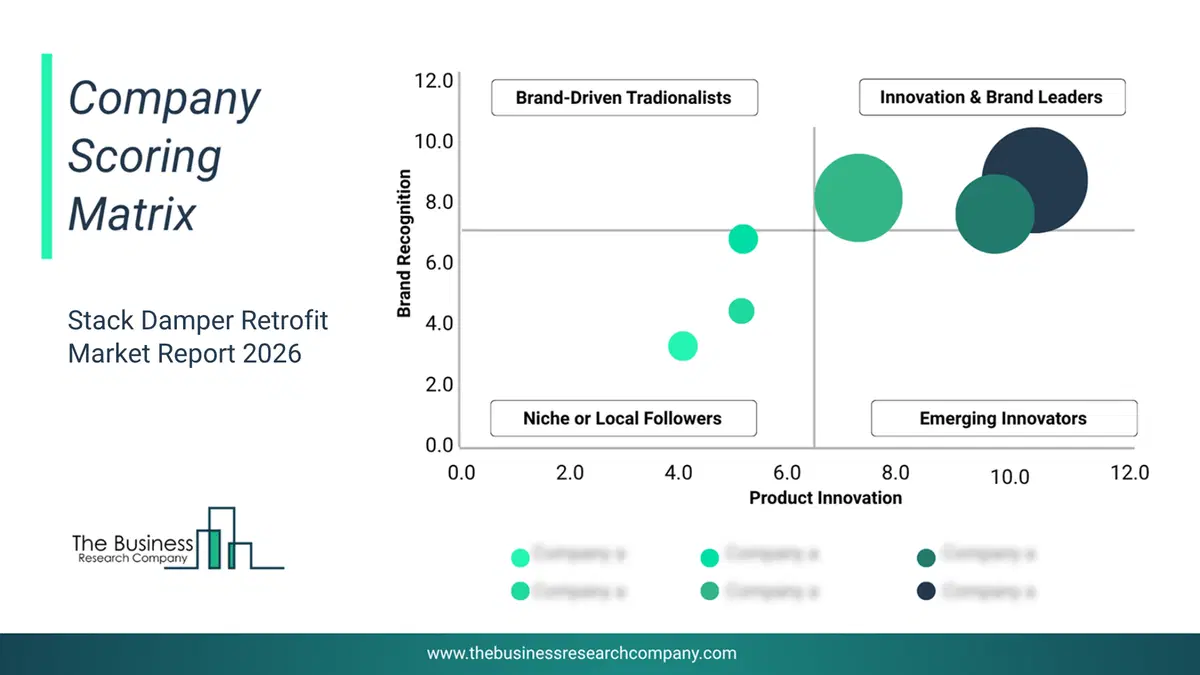
This chart maps companies by product innovation and brand strength, with bubble size indicating relative revenue, helping identify market leaders, challengers, and niche players. This is an illustrative chart; the full report provides a complete and accurate competitive analysis.
Global Stack Damper Retrofit Market Trends and Insights
Major companies operating in the stack damper retrofit market are focusing on technological advancements, such as energy-efficient damper actuators with advanced digital controls, to optimize airflow management, reduce operational costs, and simplify building automation for commercial and industrial facilities. Energy-efficient damper actuators are capable of delivering precise control of airflow while minimizing power consumption, enabling facility managers to maintain indoor environmental quality and reduce energy use as demand grows. For instance, in November 2025, Belimo Holding AG, a Switzerland-based smart building solutions provider, launched the 40 Newton Meter Non-Fail-Safe GM Damper Actuator, featuring high energy efficiency and advanced control capabilities. The actuator consumes only 2 watts during operation and 0.2 watts in standby mode, cutting energy use by 75 percent compared to previous models. Setup is streamlined via Belimo Assistant 2, which allows quick adjustments to control signals, running times, and integrated auxiliary switches, while the M600 Microchip enables live trending and other advanced operations. The actuator provides precise airflow regulation, making it ideal for retrofitting large air dampers in commercial and industrial applications.What Are Latest Mergers And Acquisitions In The Stack Damper Retrofit Market?
In February 2024, Caligo Industria Oy, a Finland-based provider of flue gas cleaning and heat recovery systems for the energy and process industries, merged with Sammet Dampers Oy. With this merger, the companies sought to integrate their complementary portfolios of industrial dampers and energy efficiency technologies to achieve synergistic operational benefits, expand their service capabilities, and enhance their competitive presence in the international cleantech market. Sammet Dampers Oy is a Finland-based manufacturer of industrial stack damper retrofit systems and flow control solutions designed for power plants, marine vessels, and industrial facilities.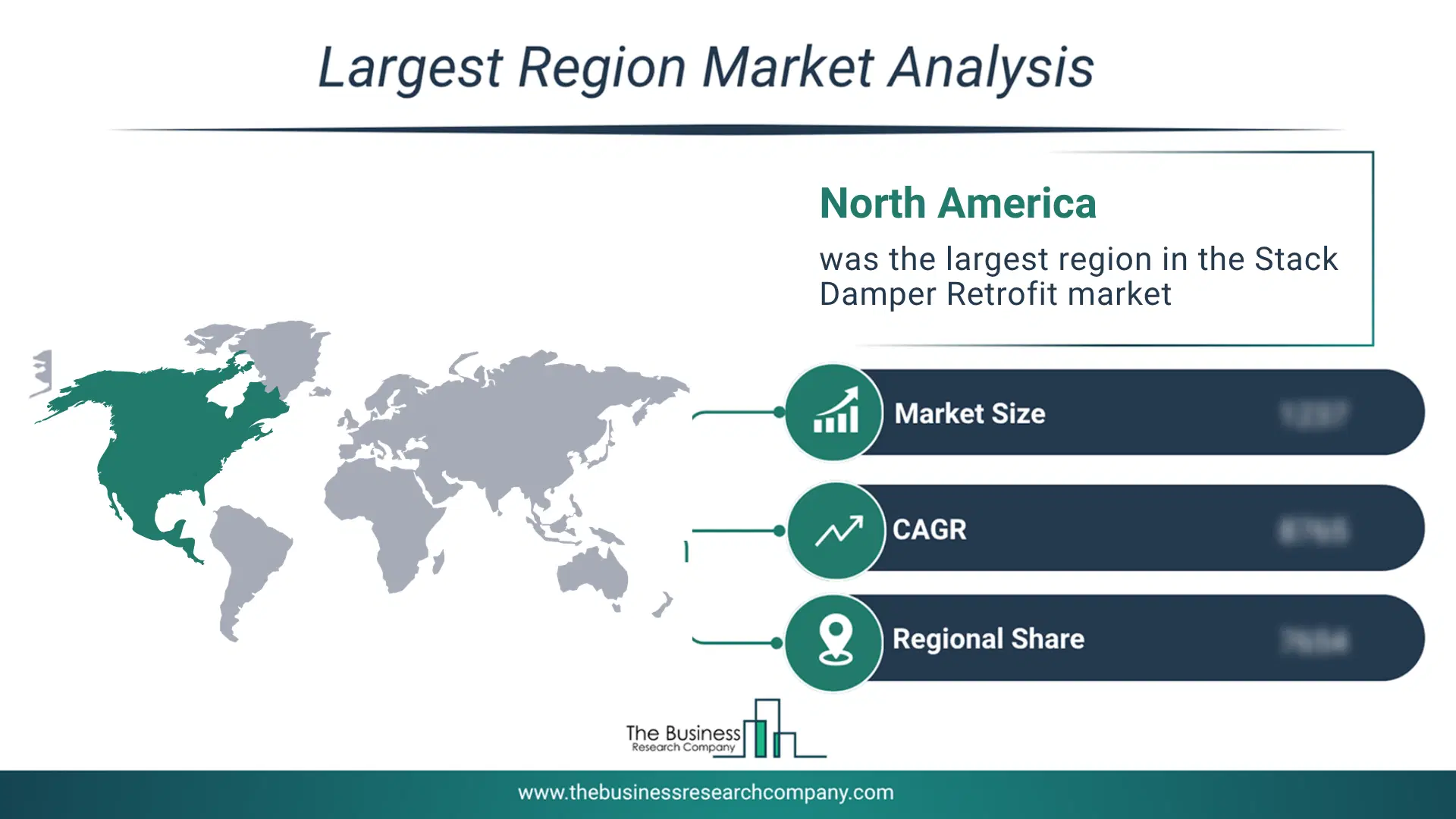
Regional Insights
North America was the largest region in the stack damper retrofit market in 2025. Asia-Pacific is expected to be the fastest-growing region in the forecast period. The regions covered in this market report are Asia-Pacific, South East Asia, Western Europe, Eastern Europe, North America, South America, Middle East, Africa. The countries covered in this market report are Australia, Brazil, China, France, Germany, India, Indonesia, Japan, Taiwan, Russia, South Korea, UK, USA, Canada, Italy, Spain.What Defines the Stack Damper Retrofit Market?
The stack damper retrofit market includes revenues earned by providing services such as structural assessment and site surveys, custom damper design and engineering, on-site installation and commissioning, preventive maintenance and inspection, and performance testing and vibration monitoring. The market value includes the value of related goods sold by the service provider or included within the service offering. Only goods and services traded between entities or sold to end consumers are included.How is Market Value Defined and Measured?
The market value is defined as the revenues that enterprises gain from the sale of goods and/or services within the specified market and geography through sales, grants, or donations in terms of the currency (in USD unless otherwise specified). The revenues for a specified geography are consumption values that are revenues generated by organizations in the specified geography within the market, irrespective of where they are produced. It does not include revenues from resales along the supply chain, either further along the supply chain or as part of other products.
This chart presents market attractiveness based on a quantitative evaluation of growth, competition, strategic alignment, and risk, offering a clear view of opportunity areas for decision-making. This chart is for illustrative purposes; the full report contains the complete analysis.

This chart highlights the Total Addressable Market (TAM) by estimating the maximum revenue opportunity using an assumption-driven approach, supporting strategic planning and opportunity sizing across markets. The chart is illustrative; the full report provides a more comprehensive analysis.
What Key Data and Analysis Are Included in the Stack Damper Retrofit Market Report 2026?
The stack damper retrofit market research report is one of a series of new reports from The Business Research Company that provides market statistics, including industry global market size, regional shares, competitors with the market share, detailed market segments, market trends and opportunities, and any further data you may need to thrive in the stack damper retrofit industry. The market research report delivers a complete perspective of everything you need, with an in-depth analysis of the current and future state of the industry.Stack Damper Retrofit Market Report Forecast Analysis
| Report Attribute | Details |
|---|---|
| Market Size Value In 2026 | $1.39 billion |
| Revenue Forecast In 2030 | $1.83 billion |
| Growth Rate | CAGR of 7.4% from 2026 to 2030 |
| Base Year For Estimation | 2025 |
| Actual Estimates/Historical Data | 2020-2025 |
| Forecast Period | 2026 - 2030 - 2030 |
| Market Representation | Revenue in USD Billion and CAGR from 2026 to 2030 |
| Segments Covered | Product Type, Retrofit Type, Distribution Channel, Application, End-User |
| Regional Scope | Asia-Pacific, Western Europe, Eastern Europe, North America, South America, Middle East, Africa |
| Country Scope | The countries covered in the report are Australia, Brazil, China, France, Germany, India, Indonesia, Japan, Taiwan, Russia, South Korea, UK, USA, Canada, Italy, Spain. |
| Key Companies Profiled | Greenheck Fan Corporation, CECO Environmental, Ruskin Company, Cleaver-Brooks, Nooter Eriksen, Forney Corporation, GERB Schwingungsisolierungen GmbH & Co. KG, AeroDynamix Inc., Damper Technology Ltd, Enidine Corporation, Meca Enterprises, Steelcon Chimney and Stacks, Warren Environmental, Fox Equipment, TVS Acoustics, Flow Engineering B.V., Parth Valve and Hoses LLP, Effox-Flextor-Mader, Multitech Damper Solutions, EFM Equipment |
| Customization Scope | Request for Customization |
| Pricing And Purchase Options | Explore Purchase Options |