
Stationary Battery Storage Market Report 2026
Global Outlook – By Type Of Energy Storage ( Hydrogen And Ammonia Storage, Gravitational Energy Storage, Compressed Air Energy Storage, Liquid Air Storage, Thermal Energy Storage), By Battery ( Lithium Ion, Sodium Sulphur, Lead Acid, Flow Battery, Other Batteries), By Application ( Grid Services, Behind The Meter, Off Grid) – Market Size, Trends, Strategies, and Forecast to 2030
Stationary Battery Storage Market Overview
• Stationary Battery Storage market size has reached to $56.06 billion in 2025 • Expected to grow to $146.62 billion in 2030 at a compound annual growth rate (CAGR) of 21.2% • Growth Driver: Rapid Renewable Energy Deployment Fuels Growth In The Stationary Battery Storage Market • Market Trend: Embrace Next-Generation Technologies Like Rimac Energy For Enhanced Efficiency And Performance • North America was the largest region in 2025 and Asia-Pacific is the fastest growing region.Market Gains By 2030 – Top Opportunities By Segment
Market Gain identifies the most promising market opportunities by highlighting the segments or products expected to generate the highest incremental revenue growth over the next five years.
What Is Covered Under Stationary Battery Storage Market?
Stationary battery storage is a system that stores electrical energy and can release it when needed to supply power to static or fixed applications. It plays a vital role in the transition to a more sustainable, reliable, and flexible energy infrastructure by providing solutions for grid management, renewable energy integration, and backup power supply in various sectors. The main types of stationary battery storage are hydrogen and ammonia storage, gravitational energy storage, compressed air energy storage, liquid air storage, and thermal energy storage. Hydrogen and ammonia storage refers to the methods and technologies used to store hydrogen gas (H2) and ammonia (NH3) for various applications, particularly as energy carriers or feedstocks in industries. Various batteries, such as lithium ion, sodium sulfur, lead acid, flow batteries, and others, are incorporated in stationary battery storage applications, including grid services, behind-the-meter, and off-grid.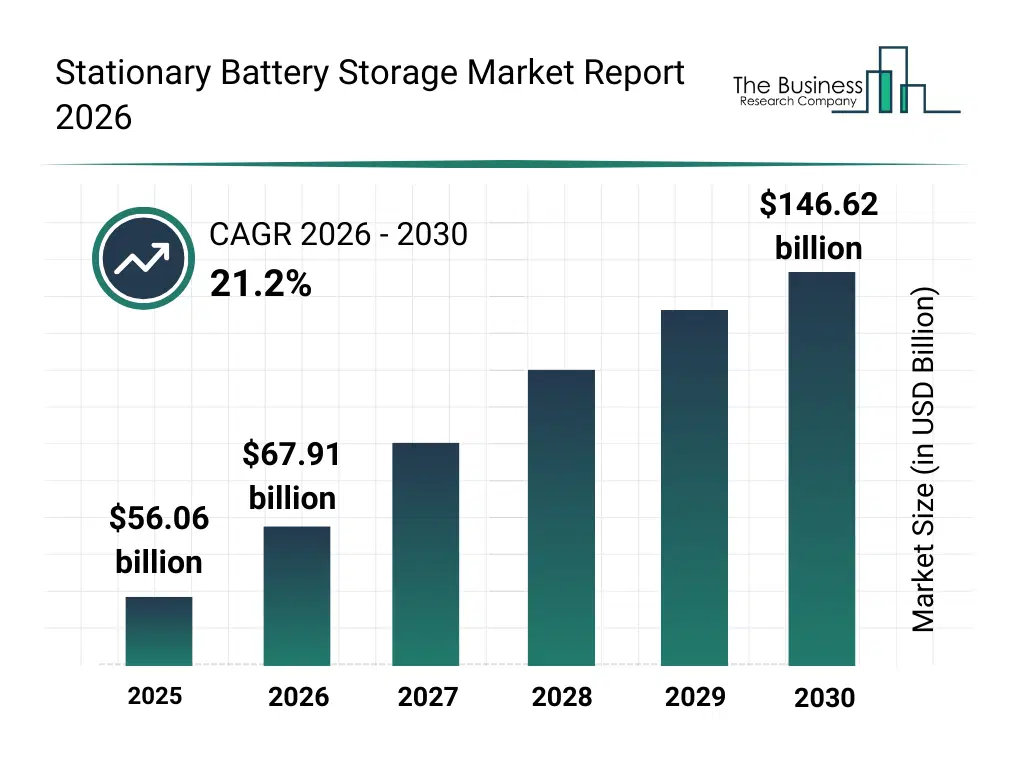
What Is The Stationary Battery Storage Market Size 2026 And Growth Rate?
The stationary battery storage market size has grown exponentially in recent years. It will grow from $56.06 billion in 2025 to $67.91 billion in 2026 at a compound annual growth rate (CAGR) of 21.1%. The growth in the historic period can be attributed to growth in renewable energy penetration driving grid balancing needs, rising demand for peak shaving and load shifting, early adoption of utility scale battery storage pilots, increasing need for backup power in critical facilities, declining battery costs enabling wider deployment.What Is The Stationary Battery Storage Market Growth Forecast?
The stationary battery storage market size is expected to see exponential growth in the next few years. It will grow to $146.62 billion in 2030 at a compound annual growth rate (CAGR) of 21.2%. The growth in the forecast period can be attributed to expansion of virtual power plants and distributed energy systems, rising need for grid stability with higher renewable mix, development of next generation battery chemistries, growing investment in energy resilience infrastructure, increasing focus on decarbonization and electrification goals. Major trends in the forecast period include rising deployment of long duration stationary storage solutions, increasing adoption of hybrid energy storage configurations, growing integration of battery storage into renewable microgrids, expansion of advanced safety and thermal management systems, growing demand for modular and scalable stationary storage units.
Global Stationary Battery Storage Market Segmentation
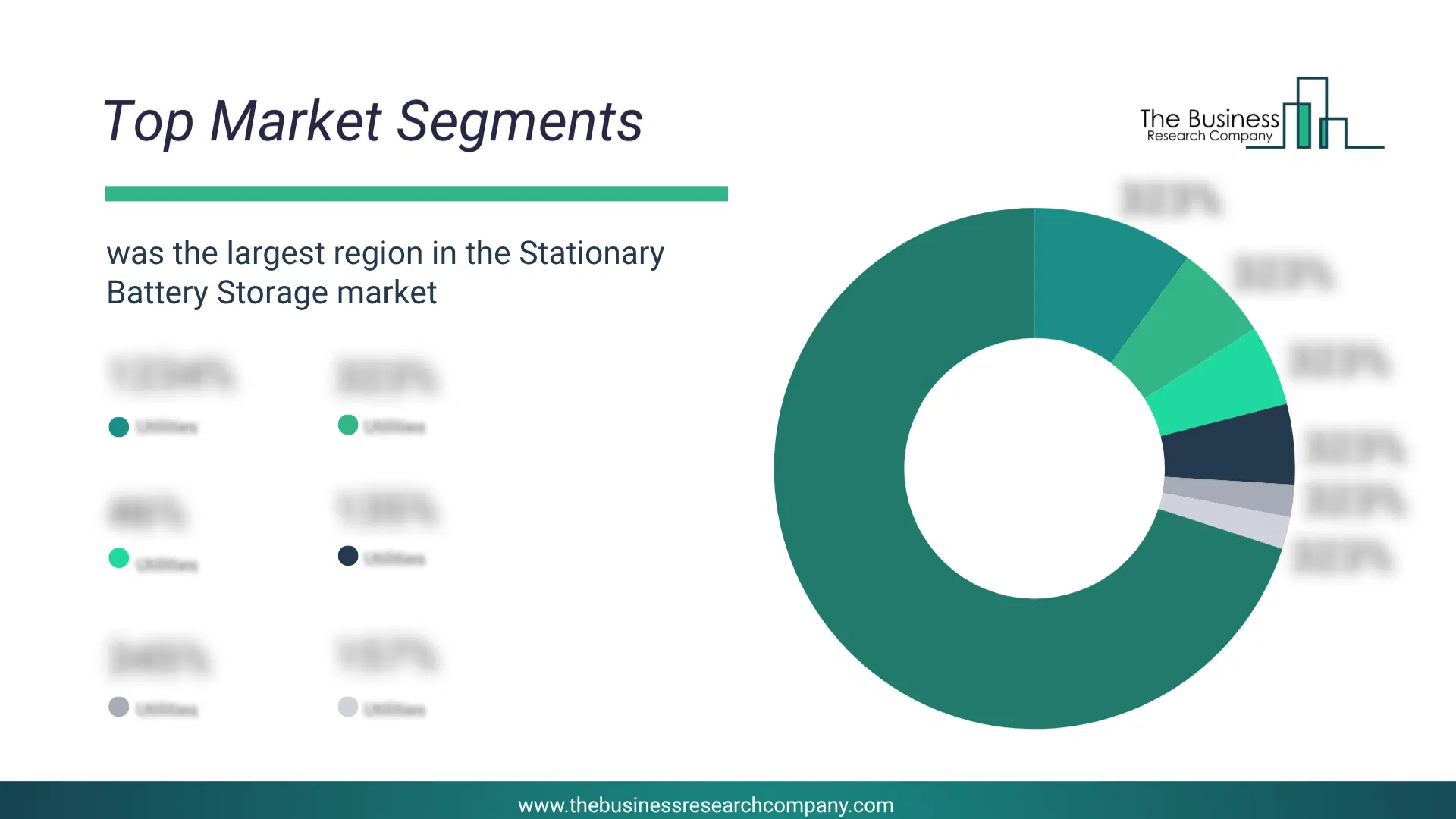
1) By Type Of Energy Storage: Hydrogen And Ammonia Storage, Gravitational Energy Storage, Compressed Air Energy Storage, Liquid Air Storage, Thermal Energy Storage 2) By Battery: Lithium Ion, Sodium Sulphur, Lead Acid, Flow Battery, Other Batteries 3) By Application: Grid Services, Behind The Meter, Off Grid Subsegments: 1) By Hydrogen And Ammonia Storage: Hydrogen Fuel Cells, Ammonia Storage Systems 2) By Gravitational Energy Storage: Pumped Storage Hydropower, Gravity-Based Energy Storage Systems 3) By Compressed Air Energy Storage: Underground Storage Systems, Above-Ground Storage Systems 4) By Liquid Air Storage: Cryogenic Energy Storage Systems, Liquid Air Energy Storage (LAES) Technologies 5) By Thermal Energy Storage: Sensible Heat Storage, Latent Heat Storage The top segments in the stationary battery storage market will be: • Lithium Ion will reach $43358.05 Million by 2025. • Grid Services will reach $35627.5 Million by 2025. • Small-scale (<100 kWh) will reach $24436.17 Million by 2025. • Medium-scale (100 kWh – 1 MWh) will reach $18952.91 Million by 2025. • Behind The Meter will reach $17783.4 Million by 2025.What Is The Driver Of The Stationary Battery Storage Market?
The rapid deployment of renewable energy is expected to propel the growth of the stationary battery storage market going forward. The deployment of renewable energy refers to the implementation of renewable energy sources, such as solar, wind, hydropower, and geothermal energy, to generate electricity and meet various energy needs. The rapid expansion of renewable energy sources necessitates efficient energy storage solutions to ensure grid stability and reliability, and stationary battery storage is becoming a crucial component in the evolving energy landscape by offering grid operators increased flexibility and control while mitigating the need for expensive grid infrastructure upgrades. For instance, in January 2024, according to the the International Energy Agency, a France-based an intergovernmental organization, in 2023, global renewable energy capacity additions surged by 50%, reaching nearly 510 gigawatts (GW), with solar PV contributing about three-quarters of the total new installations worldwide. China's annual PV installations surged by 57%, accounting for 42% of global demand, primarily driven by distributed PV, while annual installations are forecast to exceed 300 GW by 2023 and surpass 400 GW by 2025. Therefore, the rapid deployment of renewable energy will drive the growth of the stationary battery storage industry.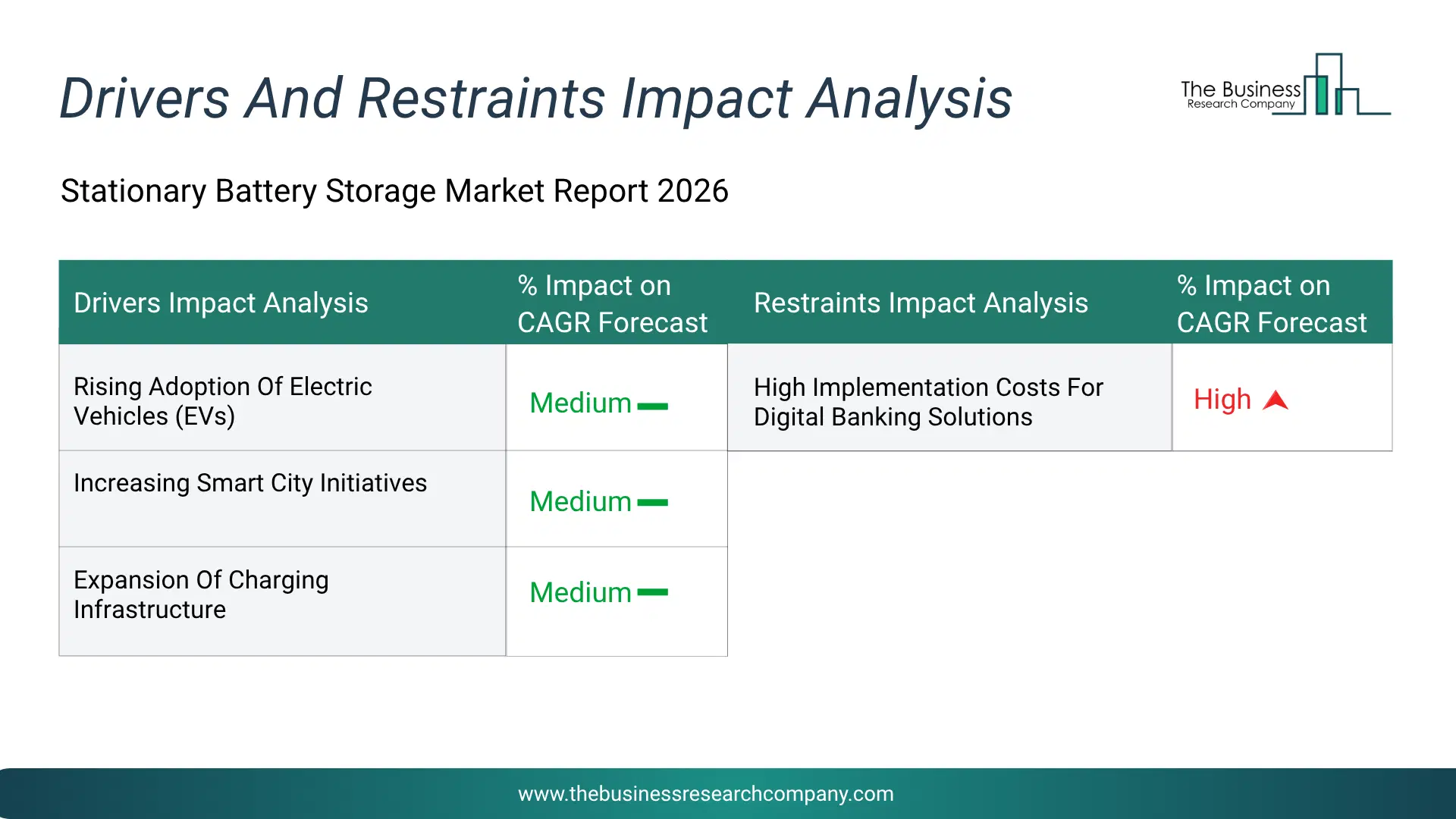
Infographic Chart Showing Key Market Drivers Analysis And Restraints For Stationary Battery Storage Market
The chart presents an impact analysis of key drivers and restraints, quantifying their relative influence on the market's growth rate and helping assess the balance between growth enablers and limiting factors. This chart offers a high-level perspective; the full report contains more detailed insights.
How Will The Drivers Impact Growth In The Global Stationary Battery Storage Market?
• Rising Adoption Of Electric Vehicles (EVs) (Medium) – The rising adoption of electric vehicles (EVs) will become a key driver of growth in the stationary battery storage market by 2030. With more EVs on the road, the electricity load on grids is surging, requiring solutions to balance supply and demand. Stationary battery storage plays a crucial role by storing excess energy during off-peak hours and supplying it during peak demand, reducing grid stress. As a result, the rising adoption of electric vehicles (EVs) is anticipated to contributing to a 1.8% annual growth in the market. • Increasing Smart City Initiatives (Medium) – The increasing smart city initiatives will emerge as a major factor driving the expansion of the stationary battery storage market by 2030. Smart cities rely on renewable energy integration, IoT-based energy management and advanced grid systems, all of which require reliable energy storage solutions. Stationary battery storage helps balance energy supply and demand, enabling efficient use of solar and wind power while reducing dependence on fossil fuels. Consequently, the increasing smart city initiatives is projected to contributing to a 1.5% annual growth in the market. • Expansion Of Charging Infrastructure (Medium) – The expansion of charging infrastructure within digital manufacturing processes will serve as a key growth catalyst for the stationary battery storage market by 2030. Charging stations, especially fast chargers, place significant load on the grid, leading to fluctuations in power demand. Stationary battery storage helps mitigate these challenges by storing excess energy during low-demand periods and supplying it during peak usage, reducing grid strain and enhancing reliability. Therefore, this expansion of charging infrastructure is projected to supporting to a 1.3% annual growth in the market.How Will The Restraints Impact Growth In The Global Stationary Battery Storage Market?
• Supply Chain Disruptions (Medium) – Supply Chain Disruptions will restrict the growth of the Stationary Battery Storage market during the forecast period. Stationary battery production depends on supply chains for lithium, cobalt, nickel, and other critical materials. Supply disruptions can affect production capacity, lead to cost increases, and create product availability issues. Geopolitical tensions and trade restrictions on battery materials impact market stability and growth. • Limited Availability Of Skilled Personnel And Technical Expertise (Medium) – Limited Availability Of Skilled Personnel And Technical Expertise will restrict the growth of the Stationary Battery Storage market during the forecast period. Stationary battery system design, installation, and maintenance require specialized skills in energy storage, power electronics, and grid integration. The shortage of qualified engineers and technicians with battery storage expertise limits project execution capacity. Skill gaps can affect system performance and reliability, impacting market growth.Key Players In The Global Stationary Battery Storage Market
Major companies operating in the stationary battery storage market are Uniper SE, Hitachi Ltd., Tesla Inc., Siemens AG, General Electric Company, Lockheed Martin Corporation, Panasonic Corporation, BYD Company Ltd, LG Chem Ltd., Toshiba Corporation, Johnson Controls International plc, Samsung SDI Co. Ltd., Furukawa Battery Co. Ltd., GS Yuasa International Ltd., Exide Technologies, East Penn Manufacturing Co. Inc., Narada Power Source Co. Ltd., Saft Groupe S.A., Duracell Inc., Fluence Energy LLC, Schmid Group, Hoppecke Batteries, HydraRedox, CMBlu Energy AG, Durapower Group, JenaBatteries GmbH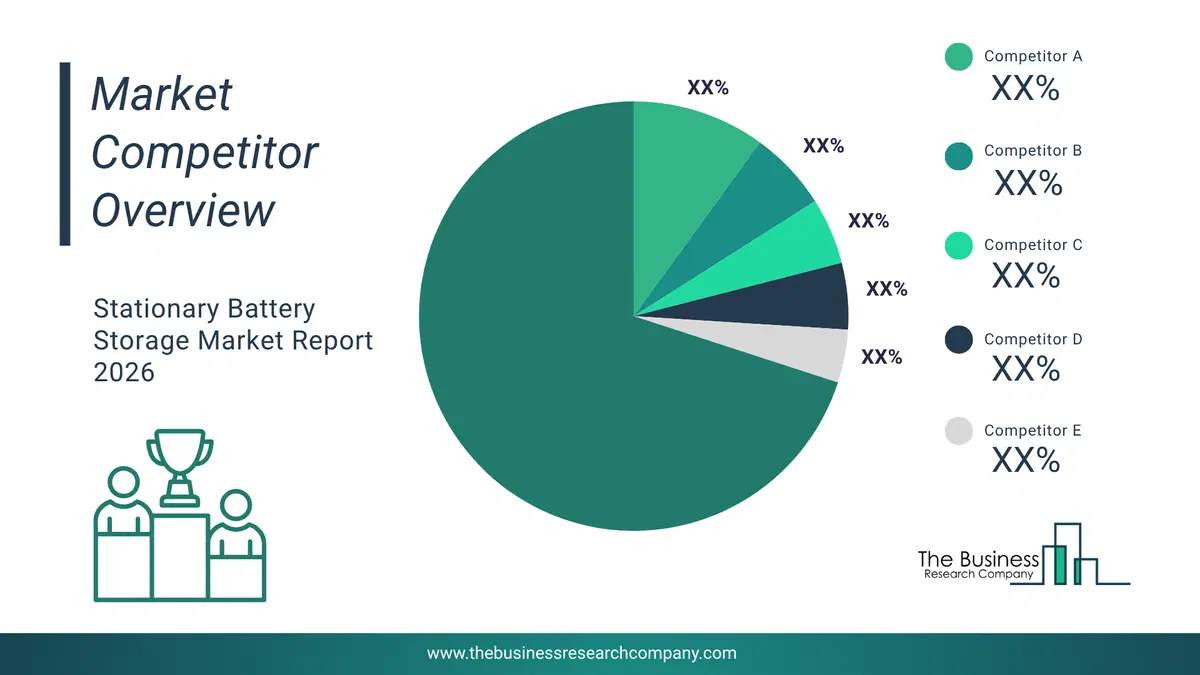
This chart is for illustrative purposes; the full report includes a detailed competitor analysis and comprehensive overview of the top 10 companies in the market.
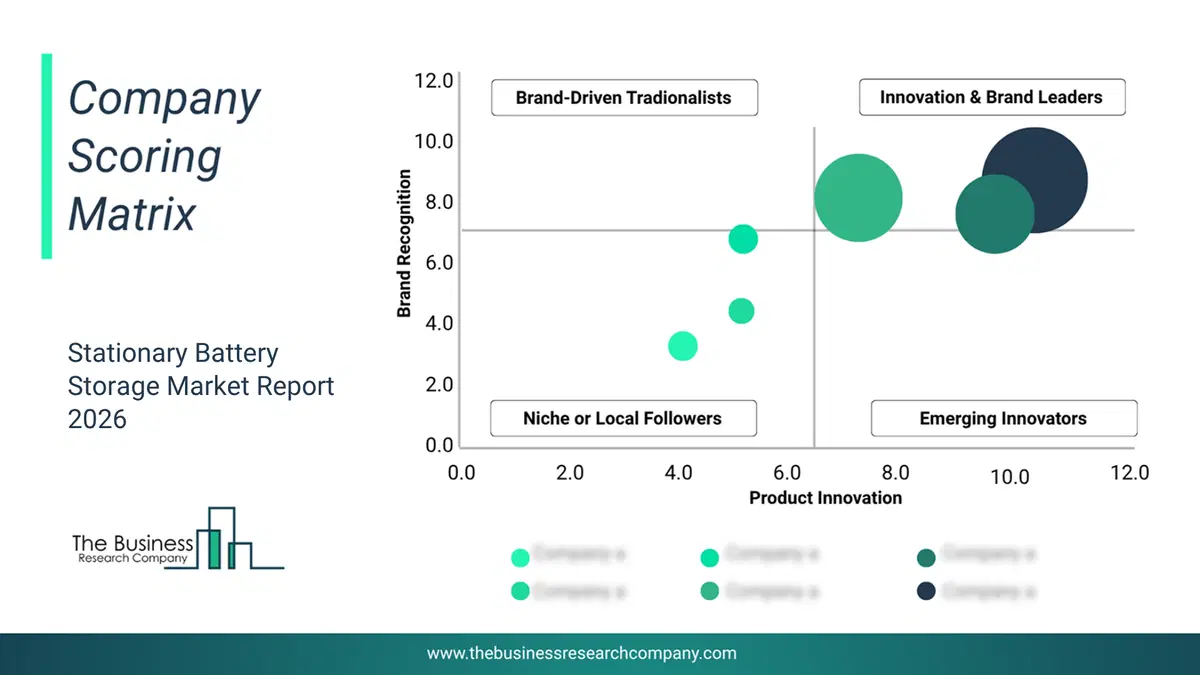
This chart maps companies by product innovation and brand strength, with bubble size indicating relative revenue, helping identify market leaders, challengers, and niche players. This is an illustrative chart; the full report provides a complete and accurate competitive analysis.
Global Stationary Battery Storage Market Trends and Insights
Major companies operating in the stationary battery storage market are developing advanced technologies, such as Rimac Energy stationary energy storage systems, to increase profitability in the market. Rimac Energy is a technologically advanced battery architecture that achieves a remarkable 50% reduction in efficiency losses and shrinks the system's footprint by up to 40%, outperforming current industry-leading solutions. For instance, in May 2023, Rimac Technology, a Croatia-based automotive manufacturer, launched Rimac Energy, a stationary energy storage technology. This system develops the next generation of stationary energy storage systems (ESS) by utilizing its expertise in developing market-defining electric vehicle technology. The innovative electrical structure that supports Rimac Energy's ESS gives it considerable performance, safety, and availability advantages, including up to 50% lower energy losses and a 40% smaller system footprint.What Are Latest Mergers And Acquisitions In The Stationary Battery Storage Market?
In October 2023, Hitachi Energy, a Switzerland-based energy technology company, acquired eks Energy for an undisclosed amount. With this acquisition, Hitachi Energy aims to strengthen its renewable energy solutions, expand its global footprint, and integrate eks Energy’s advanced energy management technologies to deliver more efficient, sustainable, and innovative energy solutions. eks Energy is a Spain-based energy company specializing in stationary battery storage solutions.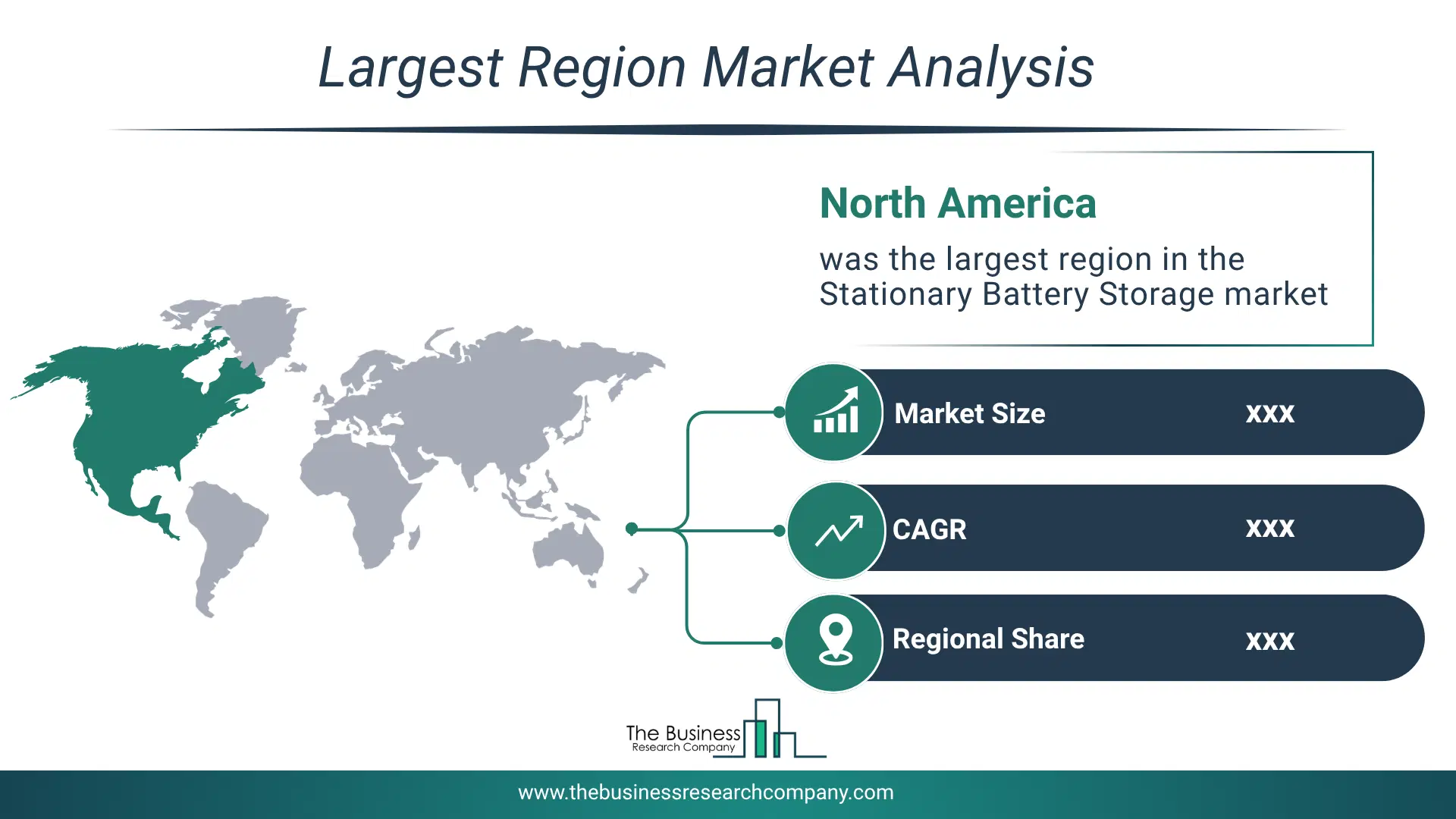
Regional Outlook
North America was the largest region in the stationary battery storage market in 2025. Asia-Pacific is expected to be the fastest-growing region in the forecast period. The regions covered in this market report are Asia-Pacific, South East Asia, Western Europe, Eastern Europe, North America, South America, Middle East, Africa. The countries covered in this market report are Australia, Brazil, China, France, Germany, India, Indonesia, Japan, Taiwan, Russia, South Korea, UK, USA, Canada, Italy, Spain.What Defines the Stationary Battery Storage Market?
The stationary battery storage market consists of sales of microgrid battery systems, residential battery storage systems, utility-scale battery storage systems, and containerized battery storage units. Values in this market are ‘factory gate’ values, that is the value of goods sold by the manufacturers or creators of the goods, whether to other entities (including downstream manufacturers, wholesalers, distributors and retailers) or directly to end customers. The value of goods in this market includes related services sold by the creators of the goods.How is Market Value Defined and Measured?
The market value is defined as the revenues that enterprises gain from the sale of goods and/or services within the specified market and geography through sales, grants, or donations in terms of the currency (in USD unless otherwise specified). The revenues for a specified geography are consumption values that are revenues generated by organizations in the specified geography within the market, irrespective of where they are produced. It does not include revenues from resales along the supply chain, either further along the supply chain or as part of other products.
This chart presents market attractiveness based on a quantitative evaluation of growth, competition, strategic alignment, and risk, offering a clear view of opportunity areas for decision-making. This chart is for illustrative purposes; the full report contains the complete analysis.

This chart highlights the Total Addressable Market (TAM) by estimating the maximum revenue opportunity using an assumption-driven approach, supporting strategic planning and opportunity sizing across markets. The chart is illustrative; the full report provides a more comprehensive analysis.
What Key Data and Analysis Are Included in the Stationary Battery Storage Market Report 2026?
The stationary battery storage market research report is one of a series of new reports from The Business Research Company that provides market statistics, including industry global market size, regional shares, competitors with the market share, detailed market segments, market trends and opportunities, and any further data you may need to thrive in the stationary battery storage industry. The market research report delivers a complete perspective of everything you need, with an in-depth analysis of the current and future state of the industry.Stationary Battery Storage Market Report 2026 Market Report Forecast Analysis
| Report Attribute | Details |
|---|---|
| Market Size Value In 2026 | $67.91 billion |
| Revenue Forecast In 2030 | $146.62 billion |
| Growth Rate | CAGR of 21.1% from 2026 to 2030 |
| Base Year For Estimation | 2025 |
| Actual Estimates/Historical Data | 2020-2025 |
| Forecast Period | 2026 - 2030 |
| Market Representation | Revenue in USD Billion and CAGR from 2026 to 2030 |
| Segments Covered | Type Of Energy Storage, Battery, Application |
| Regional Scope | Asia-Pacific, Western Europe, Eastern Europe, North America, South America, Middle East, Africa |
| Country Scope | The countries covered in the report are Australia, Brazil, China, France, Germany, India, Indonesia, Japan, Taiwan, Russia, South Korea, UK, USA, Canada, Italy, Spain. |
| Key Companies Profiled | Uniper SE, Hitachi Ltd., Tesla Inc., Siemens AG, General Electric Company, Lockheed Martin Corporation, Panasonic Corporation, BYD Company Ltd, LG Chem Ltd., Toshiba Corporation, Johnson Controls International plc, Samsung SDI Co. Ltd., Furukawa Battery Co. Ltd., GS Yuasa International Ltd., Exide Technologies, East Penn Manufacturing Co. Inc., Narada Power Source Co. Ltd., Saft Groupe S.A., Duracell Inc., Fluence Energy LLC, Schmid Group, Hoppecke Batteries, HydraRedox, CMBlu Energy AG, Durapower Group, JenaBatteries GmbH |
| Customization Scope | Request for Customization |
| Pricing And Purchase Options | Explore Purchase Options |