
Storage-Class Memory-Display Market Report 2026
Global Outlook – By Type (Dynamic Random-Access Memory (Dram), Negative-And (Nand) Flash Memory (Nand), Three-Dimensional Cross Point (3D Xpoint), Phase-Change Memory (Pcm), Magnetoresistive Random-Access Memory (Mram), Resistive Random-Access Memory (Rram Or Reram), Other Types), By Offering (Hardware, Software, Services), By Technology (Non-Volatile, Volatile), By Deployment Model (Public Cloud, Private Cloud, Hybrid Cloud), By End User (Information Technology And Telecommunication, Healthcare, Automotive, Consumer Goods, Manufacturing, Other End-Users) – Market Size, Trends, Strategies, and Forecast to 2030
Storage-Class Memory-Display Market Overview
• Storage-Class Memory-Display market size has reached to $7.43 billion in 2025 • Expected to grow to $24.74 billion in 2030 at a compound annual growth rate (CAGR) of 27.3% • Growth Driver: Rise In Adoption Of Artificial Intelligence (AI) And Machine Learning Workloads Driving The Market Growth Due To Increasing Demand For High-Performance And Low-Latency Data Processing • Market Trend: Advancements In Crossbar Memory Architecture Enhancing High-Speed, Scalable Storage • North America was the largest region in 2025 and Asia-Pacific is the fastest growing region.Market Gains By 2030 – Top Opportunities By Segment
Market Gain identifies the most promising market opportunities by highlighting the segments or products expected to generate the highest incremental revenue growth over the next five years.
What Is Covered Under Storage-Class Memory-Display Market?
Storage-class memory-display is a type of memory technology that combines the speed of DRAM with the persistence of traditional storage. It enables faster data access while retaining information even when power is lost. This allows systems to handle larger datasets more efficiently and reduces latency in memory-intensive operations. The main types in the storage-class memory-display market include dynamic random-access memory (DRAM), negative-and (NAND) flash memory (NAND), three-dimensional cross point (3D XPoint), phase-change memory (PCM), magnetoresistive random-access memory (MRAM), resistive random-access memory (RRAM or ReRAM), and others. Dynamic random-access memory (DRAM) is a semiconductor memory that stores each bit of data in a tiny capacitor within an integrated circuit and requires continuous refreshing to preserve information. The offerings comprise hardware, software, and services. The technologies include both non-volatile and volatile. Deployment models cover public cloud, private cloud, and hybrid cloud. The different end users encompass information technology and telecommunication, healthcare, automotive, consumer goods, manufacturing, and others.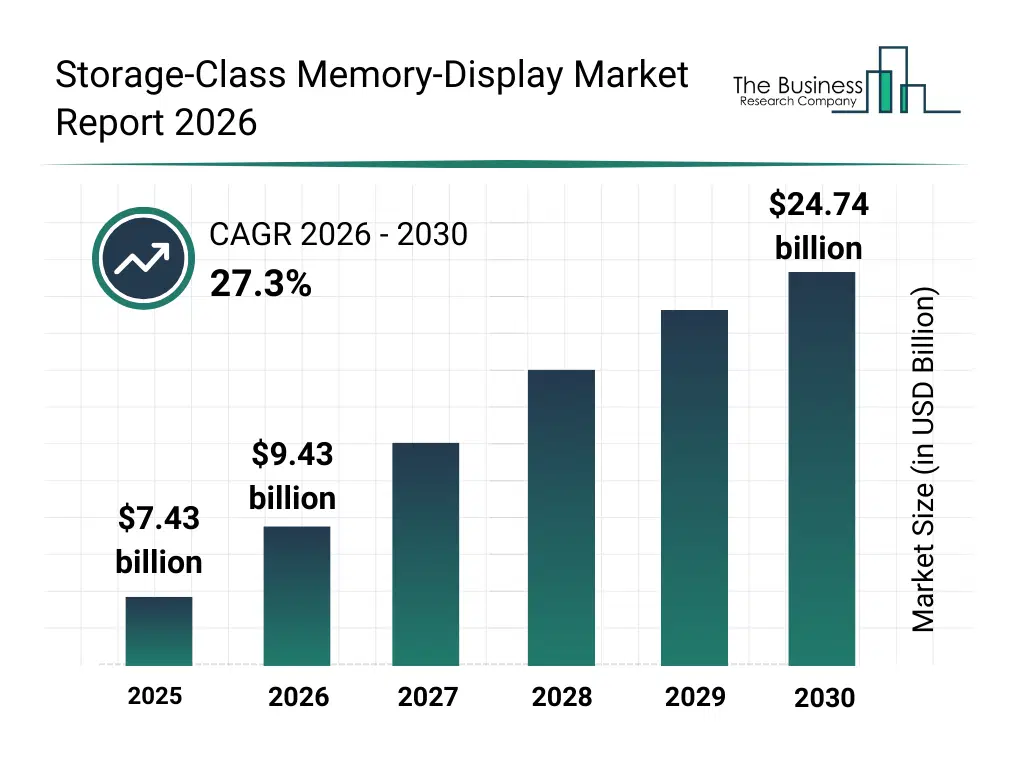
What Is The Storage-Class Memory-Display Market Size and Share 2026?
The storage-class memory-display market size has grown exponentially in recent years. It will grow from $7.43 billion in 2025 to $9.43 billion in 2026 at a compound annual growth rate (CAGR) of 26.9%. The growth in the historic period can be attributed to growth of data center workloads, increasing demand for low latency storage, expansion of enterprise virtualization, need for faster database processing, rising adoption of high performance computing.What Is The Storage-Class Memory-Display Market Growth Forecast?
The storage-class memory-display market size is expected to see exponential growth in the next few years. It will grow to $24.74 billion in 2030 at a compound annual growth rate (CAGR) of 27.3%. The growth in the forecast period can be attributed to growth of AI inference workloads, demand for memory tiering architectures, expansion of real-time analytics systems, increasing adoption of nvme standards, need for energy efficient memory solutions. Major trends in the forecast period include adoption of persistent memory in data centers, low-latency memory for AI workloads, integration with nvme-based architectures, hybrid memory tiering deployments, enterprise storage acceleration demand.
Global Storage-Class Memory-Display Market Segmentation
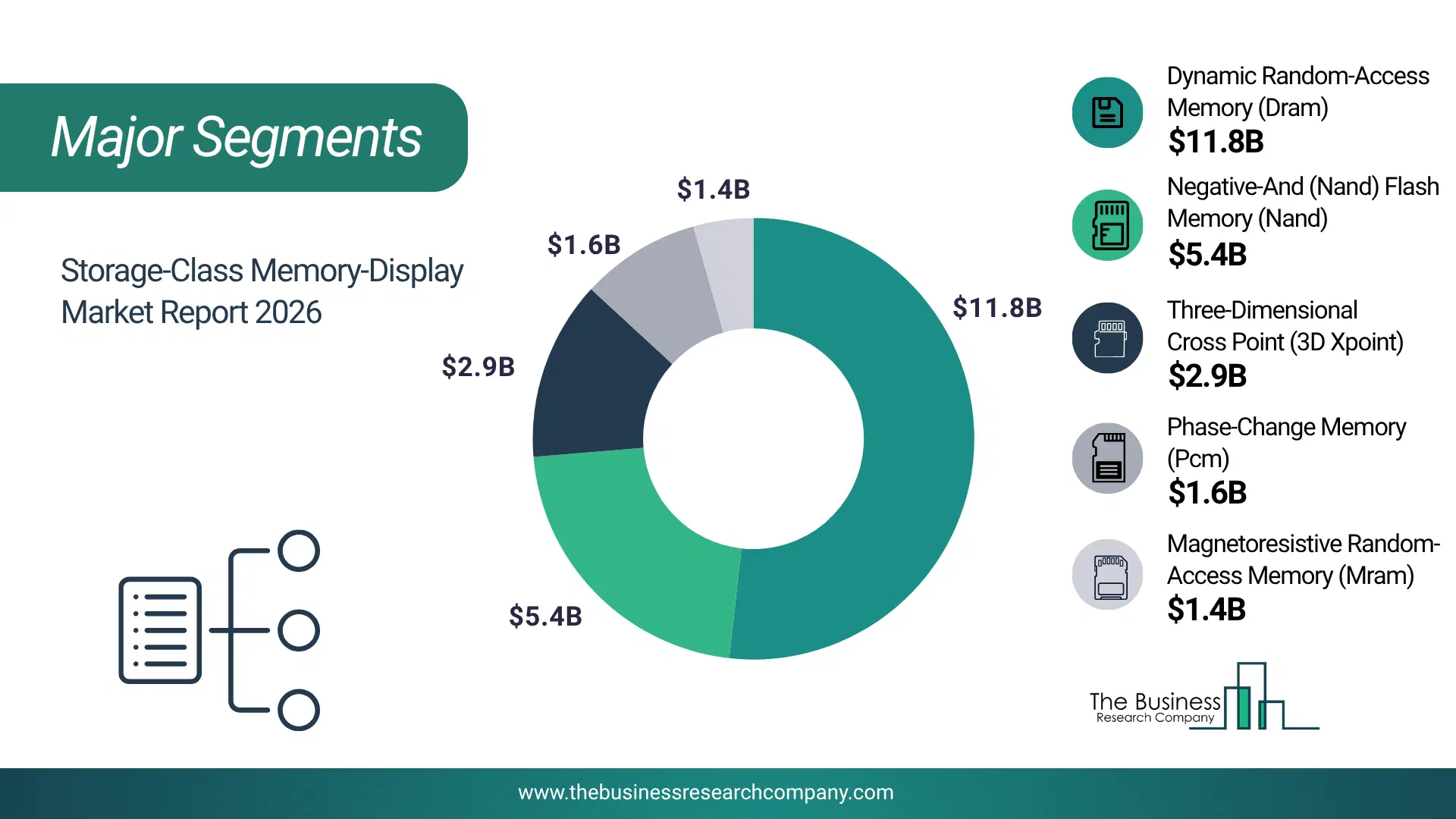
1) By Type: Dynamic Random-Access Memory (Dram), Negative-And (Nand) Flash Memory (Nand), Three-Dimensional Cross Point (3D Xpoint), Phase-Change Memory (Pcm), Magnetoresistive Random-Access Memory (Mram), Resistive Random-Access Memory (Rram Or Reram), Other Types 2) By Offering: Hardware, Software, Services 3) By Technology: Non-Volatile, Volatile 4) By Deployment Model: Public Cloud, Private Cloud, Hybrid Cloud 5) By End User: Information Technology And Telecommunication, Healthcare, Automotive, Consumer Goods, Manufacturing, Other End-Users Subsegments: 1) By Dynamic Random-Access Memory (DRAM) Type: Synchronous DRAM (SDRAM), Double Data Rate DRAM (DDR), Low Power DRAM (LPDRAM), Registered DRAM (RDRAM) 2) By NAND Flash Memory Type: Single-Level Cell (SLC), Multi-Level Cell (MLC), Triple-Level Cell (TLC), Quad-Level Cell (QLC) 3) By Three-Dimensional Cross Point (3D XPoint) Type: Intel Optane Memory, Micron XPoint Modules, Hybrid Memory Modules 4) By Phase-Change Memory (PCM) Type: Single-Level Cell (SLC) Phase-Change Memory, Multi-Level Cell (MLC) Phase-Change Memory, Embedded Phase-Change Memory (PCM) 5) By Magnetoresistive Random-Access Memory (MRAM) Type: Spin-Transfer Torque MRAM (STT-MRAM), Toggle MRAM, Embedded MRAM 6) By Resistive Random-Access Memory (RRAM or ReRAM) Type: Filament-Based Resistive Random Access Memory, Oxide-Based Resistive Random Access Memory, Three-Dimensional (3D) Resistive Random Access Memory 7) By Other Types: Ferroelectric Random-Access Memory (FeRAM), Storage-Class Hybrid Memory, Non-Volatile Memory Express (NVMe) The top segments in the storage-class memory-display market will be: • Dynamic Random-Access Memory (Dram) will reach $11.71 billion by 2030. • Negative-And (Nand) Flash Memory (Nand) will reach $5.31 billion by 2030. • Three-Dimensional Cross Point (3D Xpoint) will reach $2.81 billion by 2030. • Phase-Change Memory (Pcm) will reach $1.57 billion by 2030. • Magnetoresistive Random-Access Memory (Mram) will reach $1.36 billion by 2030.What Are The Drivers Of The Storage-Class Memory-Display Market?
The rise in adoption of artificial intelligence (AI) and machine learning workloads is expected to propel the growth of the storage-class memory-display market going forward. Artificial intelligence (AI) and machine learning workloads refer to the computational tasks and processes required to train, validate, and deploy AI models, such as data processing, model training, inference, and optimization. The adoption of AI and machine learning workloads is rising as large datasets enable accurate models that help businesses and researchers gain insights, automate processes, and improve decisions. Adoption of AI and machine learning workloads drives the need for storage-class memory because these workloads generate massive volumes of data and require ultra-fast, low-latency, and high-endurance memory solutions to process, analyze, and retrieve information efficiently, ensuring seamless performance and reliability for real-time and large-scale computational tasks. For instance, in March 2025, according to Flexera, a US-based software development company, AI adoption is rising, with 76% using data warehouses to support models and 72% leveraging generative AI in 2025, up from 47% in 2024. Therefore, the rise in adoption of artificial intelligence (AI) and machine learning workloads is driving the growth of the storage-class memory market. The surge in digital transformation across sectors is expected to propel the growth of the storage-class memory-display market going forward. The surge in digital transformation across sectors is driven by the adoption of cloud computing. By providing scalable, cost-efficient, and remote access to IT resources, cloud solutions enable businesses to modernize operations, enhance collaboration, and accelerate innovation across industries. Storage-class memory (SCM) displays can significantly enhance digital transformation by bridging the gap between high-speed memory and persistent storage. For instance, according to the China Macro Group, a China-based specialized European management company, China aims to grow its digital economy from 7.8% to 10% of gross domestic product (GDP) by 2025, focusing on information infrastructure, software and information technology services. Thus, the surge in digital transformation across sectors is driving the growth of the storage-class memory-display industry.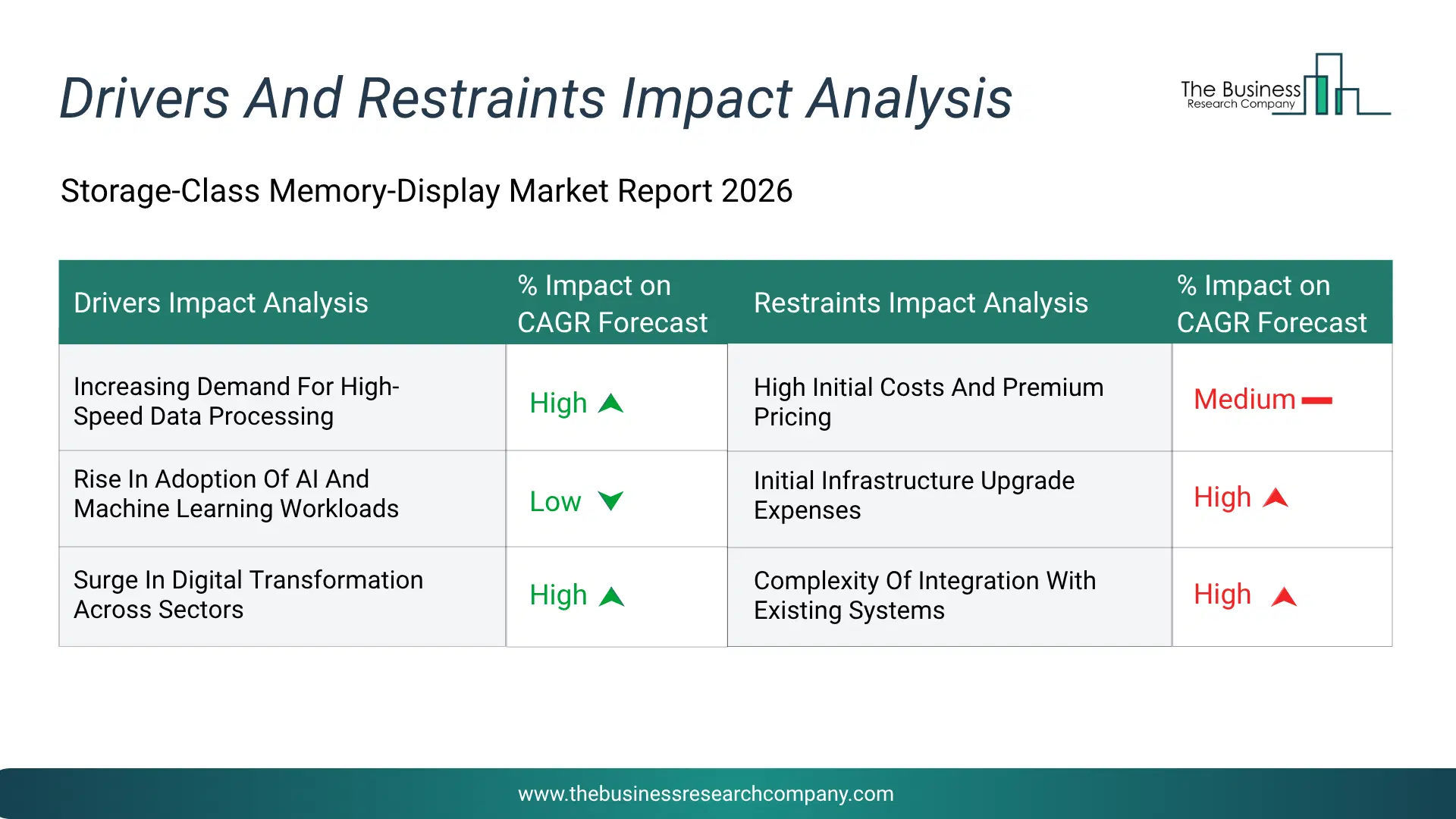
Infographic Chart Showing Key Market Drivers Analysis And Restraints For Storage-Class Memory-Display Market
The chart presents an impact analysis of key drivers and restraints, quantifying their relative influence on the market's growth rate and helping assess the balance between growth enablers and limiting factors. This chart offers a high-level perspective; the full report contains more detailed insights.
How Will The Drivers Impact Growth In The Global Storage-Class Memory-Display Market?
• Increasing Demand For High-Speed Data Processing (High) – During the forecast period, the increasing demand for high-speed data processing is expected to emerge as a key growth driver for the storage-class memory-display market by 2030. The storage-class memory-display market is being significantly driven by the rising need for faster data processing across multiple industries. Conventional memory and storage solutions often create latency challenges, while scm enables faster access and persistence, effectively bridging the gap between dram and nand. This capability is essential for managing workloads in areas such as ai, financial analytics, and real-time data visualization, where speed and reliability are critical. As data volumes continue to grow, the demand for such advanced memory technologies is expected to increase further. • Rise In Adoption Of AI And Machine Learning Workloads (Low) – During the forecast period, the rise in adoption of ai and machine learning workloads is expected to emerge as a major factor driving the expansion of the storage-class memory-display market by 2030. The growing adoption of ai and machine learning is a key driver for the storage-class memory-display market. These workloads require processing massive datasets with extremely low latency and high speed, which conventional memory solutions often struggle to support efficiently. Storage-class memory provides the persistence and performance necessary to accelerate model training, real-time inference, and data-intensive analytics. As industries increasingly integrate ai into applications ranging from healthcare to autonomous systems, demand for scm-enabled displays and memory solutions is expected to grow steadily. • Surge In Digital Transformation Across Sectors (High) – During the forecast period, the surge in digital transformation across sectors is expected to act as a major growth catalyst for the storage -class memory -display market by 2030. The rapid expansion of digital transformation across industries is significantly increasing the demand for storage -class memory displays. As organizations modernize operations through cloud computing, big data analytics, iot, and virtualization, the requirement for faster, more reliable, and persistent memory solutions becomes increasingly important. Storage -class memory enables enterprises to manage real -time data processing and analytics efficiently, ensuring seamless performance in digital -first environments. This positions it as a critical enabler of enterprise -wide digital transformation and innovation.How Will The Restraints Impact Growth In The Global Storage-Class Memory-Display Market?
• High Initial Costs And Premium Pricing (Medium) – During the forecast period, the high initial costs and premium pricing act as a major restraint for the storage-class memory-display market. Since these technologies are still emerging, production involves advanced processes and specialized materials, which make them more expensive than traditional memory solutions. This cost barrier limits adoption among small and medium enterprises, as well as in price-sensitive markets. Until large-scale manufacturing brings down costs, affordability will remain a challenge for wider deployment. • Initial Infrastructure Upgrade Expenses (High) – During the forecast period, the initial infrastructure upgrade expenses present a significant challenge for the storage-class memory-display market. Integrating these advanced memory solutions often requires new hardware, software adjustments, and system redesigns, leading to substantial upfront investments. Many organizations hesitate to adopt due to the financial burden and potential downtime during upgrades. This slows down large-scale implementation despite the long-term performance benefits. • Complexity Of Integration With Existing Systems (High) – During the forecast period, the complexity of integration with existing systems is a key restraint for the storage-class memory-display market. Legacy infrastructures are often not designed to support advanced memory technologies, making compatibility a major challenge. Organizations may face technical difficulties, higher deployment costs, and longer implementation timelines when upgrading. This integration barrier discourages rapid adoption, particularly in industries with large, established it ecosystems.Key Players In The Global Storage-Class Memory-Display Market
Major companies operating in the storage-class memory-display market are Intel Corporation, Micron Technology Inc., Kioxia Holdings Corporation (Toshiba Memory Holding Corporation), SK Hynix Inc., Weebit Nano Ltd., 4DS Memory Limited, Hewlett Packard Enterprise (HPE), Marvell Technology Group, Fujitsu Limited, Renesas Electronics Corporation, Everspin Technologies Inc., International Business Machines Corp., Netlist Inc., NVIDIA Corporation, Nantero Inc., Avalanche Technology Inc., Spin Memory Inc., STMicroelectronics NV, Sandisk Corporation (Fusion-io), Seagate Technology Holdings Public Limited Company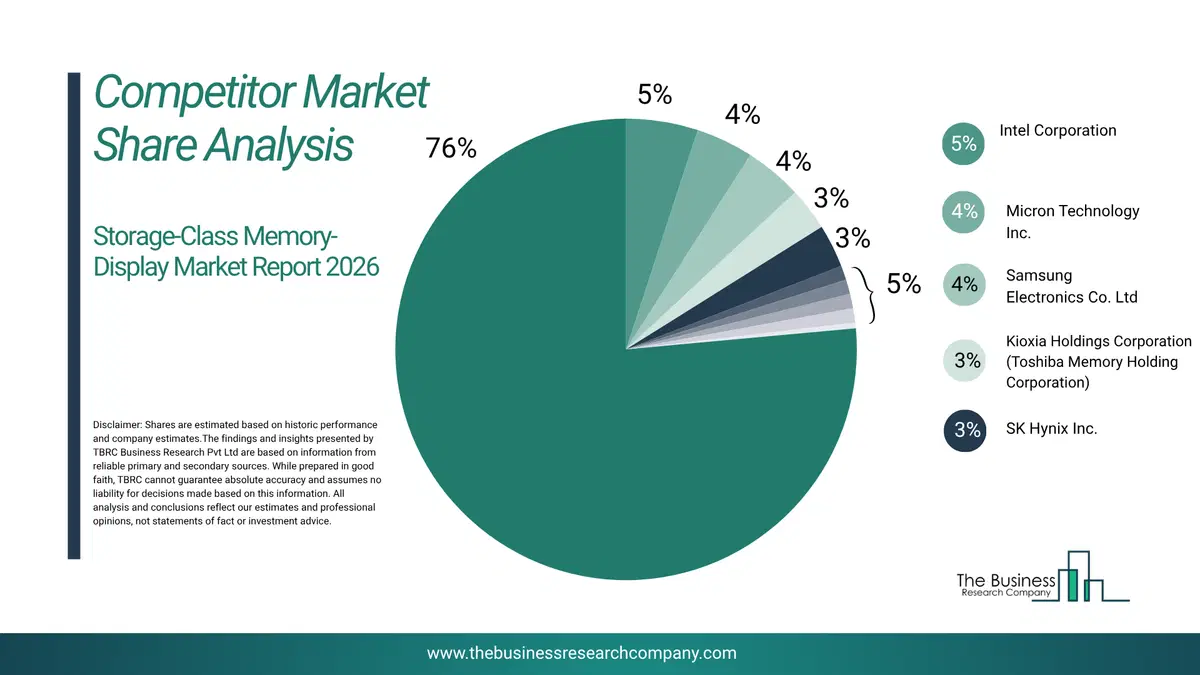
This chart is for illustrative purposes; the full report includes a detailed competitor analysis and comprehensive overview of the top 10 companies in the market.
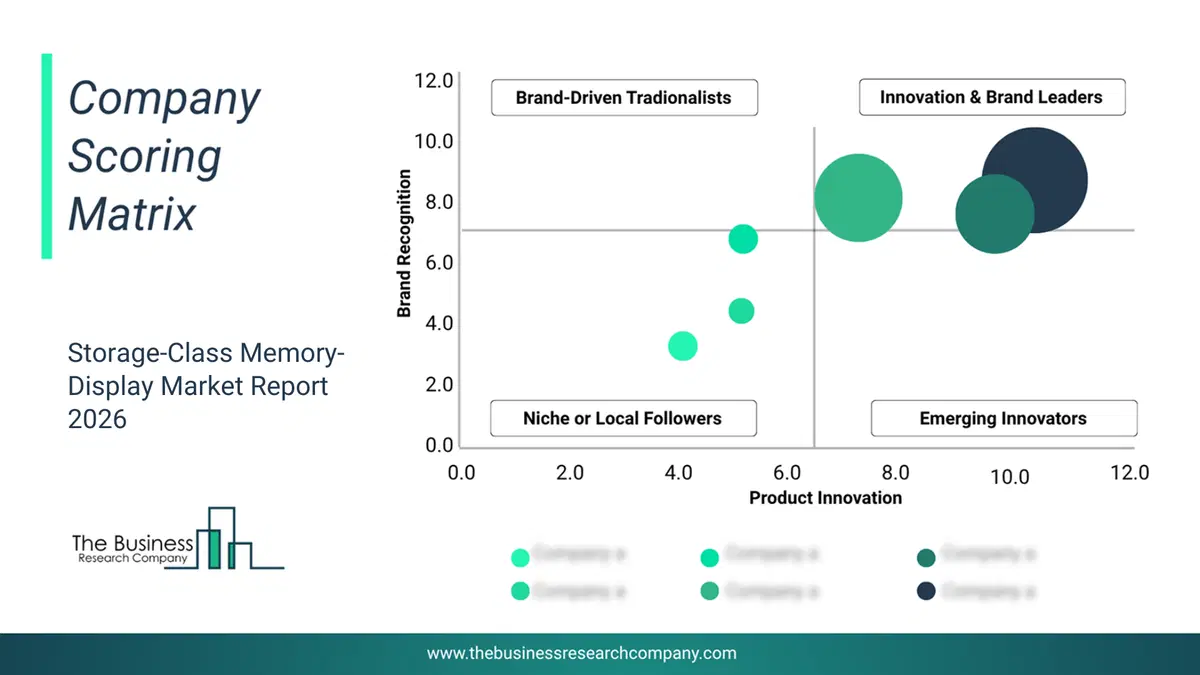
This chart maps companies by product innovation and brand strength, with bubble size indicating relative revenue, helping identify market leaders, challengers, and niche players. This is an illustrative chart; the full report provides a complete and accurate competitive analysis.
Global Storage-Class Memory-Display Market Trends and Insights
Major companies operating in the storage-class memory-display market are focusing on developing crossbar technology-integrated memory modules to enable easier scalability for larger memory capacities. Crossbar technology-integrated memory modules are memory units that employ a crossbar grid structure to achieve compact, high-speed, and low-power data storage and access. For instance, in February 2025, Numemory, a China-based manufacturer of next-generation memory chips, launched the NM101, a 64 Gb storage-class memory module. The device features a 3D selector-only memory design with crossbar architecture, enabling high-performance storage-class memory with transfer rates up to 3200 MT/s. Each cross-point in the array is controlled by a single selector. Leveraging 3D stacking and an X8 bus at 1.2 V, it delivers read/write speeds up to ten times faster than conventional NAND flash.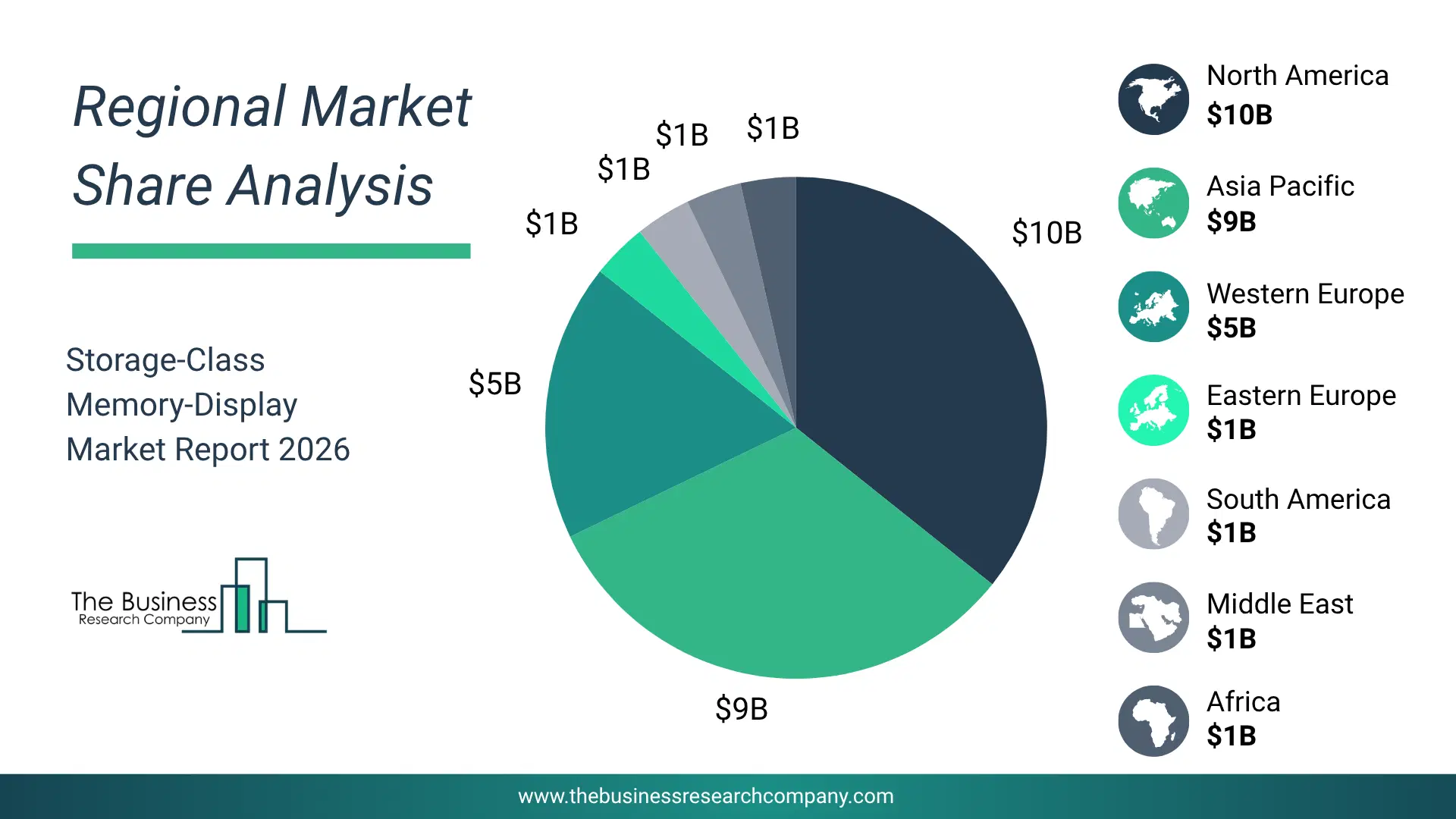
Regional Insights
North America was the largest region in the storage-class memory-display market in 2025. Asia-Pacific is expected to be the fastest-growing region in the forecast period. The regions covered in this market report are Asia-Pacific, South East Asia, Western Europe, Eastern Europe, North America, South America, Middle East, Africa. The countries covered in this market report are Australia, Brazil, China, France, Germany, India, Indonesia, Japan, Taiwan, Russia, South Korea, UK, USA, Canada, Italy, Spain.What Defines the Storage-Class Memory-Display Market?
The storage-class memory-display market consists of revenues earned by entities by providing services such as system integration, consulting, maintenance, data management, and performance optimization. The market value includes the value of related goods sold by the service provider or included within the service offering. The storage-class memory-display market also includes sales of memory modules, storage servers, interface controllers, and expansion cards. Values in this market are ‘factory gate’ values, that is the value of goods sold by the manufacturers or creators of the goods, whether to other entities (including downstream manufacturers, wholesalers, distributors and retailers) or directly to end customers. The value of goods in this market includes related services sold by the creators of the goods.How is Market Value Defined and Measured?
The market value is defined as the revenues that enterprises gain from the sale of goods and/or services within the specified market and geography through sales, grants, or donations in terms of the currency (in USD unless otherwise specified). The revenues for a specified geography are consumption values that are revenues generated by organizations in the specified geography within the market, irrespective of where they are produced. It does not include revenues from resales along the supply chain, either further along the supply chain or as part of other products.
This chart presents market attractiveness based on a quantitative evaluation of growth, competition, strategic alignment, and risk, offering a clear view of opportunity areas for decision-making. This chart is for illustrative purposes; the full report contains the complete analysis.

This chart highlights the Total Addressable Market (TAM) by estimating the maximum revenue opportunity using an assumption-driven approach, supporting strategic planning and opportunity sizing across markets. The chart is illustrative; the full report provides a more comprehensive analysis.
What Key Data and Analysis Are Included in the Storage-Class Memory-Display Market Report 2026?
The storage-class memory-display market research report is one of a series of new reports from The Business Research Company that provides market statistics, including industry global market size, regional shares, competitors with the market share, detailed market segments, market trends and opportunities, and any further data you may need to thrive in the storage-class memory-display industry. The market research report delivers a complete perspective of everything you need, with an in-depth analysis of the current and future state of the industry.Storage-Class Memory-Display Market Report Forecast Analysis
| Report Attribute | Details |
|---|---|
| Market Size Value In 2026 | $9.43 billion |
| Revenue Forecast In 2030 | $24.74 billion |
| Growth Rate | CAGR of 27.3% from 2026 to 2030 |
| Base Year For Estimation | 2025 |
| Actual Estimates/Historical Data | 2020-2025 |
| Forecast Period | 2026 - 2030 |
| Market Representation | Revenue in USD Billion and CAGR from 2026 to 2030 |
| Segments Covered | Type, Offering, Technology, Deployment Model, End User |
| Regional Scope | Asia-Pacific, Western Europe, Eastern Europe, North America, South America, Middle East, Africa |
| Country Scope | The countries covered in the report are Australia, Brazil, China, France, Germany, India, ... |
| Key Companies Profiled | Intel Corporation, Micron Technology Inc., Kioxia Holdings Corporation (Toshiba Memory Holding Corporation), SK Hynix Inc., Weebit Nano Ltd., 4DS Memory Limited, Hewlett Packard Enterprise (HPE), Marvell Technology Group, Fujitsu Limited, Renesas Electronics Corporation, Everspin Technologies Inc., International Business Machines Corp., Netlist Inc., NVIDIA Corporation, Nantero Inc., Avalanche Technology Inc., Spin Memory Inc., STMicroelectronics NV, Sandisk Corporation (Fusion-io), Seagate Technology Holdings Public Limited Company |
| Customization Scope | Request for Customization |
| Pricing And Purchase Options | Explore Purchase Options |