
Storage Class Memory Market Report 2026
Global Outlook – By Product Type (Persistent Memory, Non-Volatile Memory, Hybrid Memory), By Memory Type (Dynamic Random Access Memory (DRAM), Flash Memory, Ferroelectric Random Access Memory (FeRAM), Magnetoresistive Random Access Memory (MRAM), Phase Change Memory (PCM)), By Storage Capacity (Low-Capacity Storage Class Memory, Medium-Capacity Storage Class Memory, High-Capacity Storage Class Memory), By Application (Big Data Analytics, Cloud Computing, Artificial Intelligence (AI), Internet Of Things (IoT) Applications, Virtualization), By End-User (Information Technology And Telecommunication, Consumer Electronics, Automotive, Healthcare, Aerospace And Defense, Other End-Users) – Market Size, Trends, Strategies, and Forecast to 2030
Storage Class Memory Market Overview
• Storage Class Memory market size has reached to $5.3 billion in 2025 • Expected to grow to $17.26 billion in 2030 at a compound annual growth rate (CAGR) of 26.6% • Growth Driver: Rising Demand For Data Centers Driving The Growth Of The Market Due To Need For High-Speed, Reliable, And Scalable Data Management • Market Trend: Innovations In Persistent Storage-Class Memory Drive High-Speed, Low-Latency Solutions • North America was the largest region in 2025 and Asia-Pacific is the fastest growing region.Market Gains By 2030 – Top Opportunities By Segment
Market Gain identifies the most promising market opportunities by highlighting the segments or products expected to generate the highest incremental revenue growth over the next five years.
What Is Covered Under Storage Class Memory Market?
Storage class memory (SCM) is a type of non-volatile memory that bridges the gap between high-speed DRAM and traditional NAND flash storage, offering both fast access times and persistent data retention. It combines the low latency and high endurance of memory with the persistence of storage, making it ideal for accelerating data-intensive applications, enabling faster caching, tiered storage, and memory expansion in modern computing environments. The main types of products in storage class memory are persistent memory, non-volatile memory, and hybrid memory. Persistent memory is a type of computer memory that retains data even when power is lost, combining the speed of traditional RAM with the durability of storage. It includes various memory types, such as dynamic random access memory (DRAM), flash memory, ferroelectric random access memory (FRAM), magnetoresistive random access memory (MRAM), and phase change memory (PCM), and storage capacities include low-capacity storage class memory, medium-capacity storage class memory, and high-capacity storage class memory. It finds applications in big data analytics, cloud computing, artificial intelligence (AI), Internet of Things (IoT) applications, virtualization, and serving end-users, such as information technology and telecommunication, consumer electronics, automotive, healthcare, aerospace and defense, and others.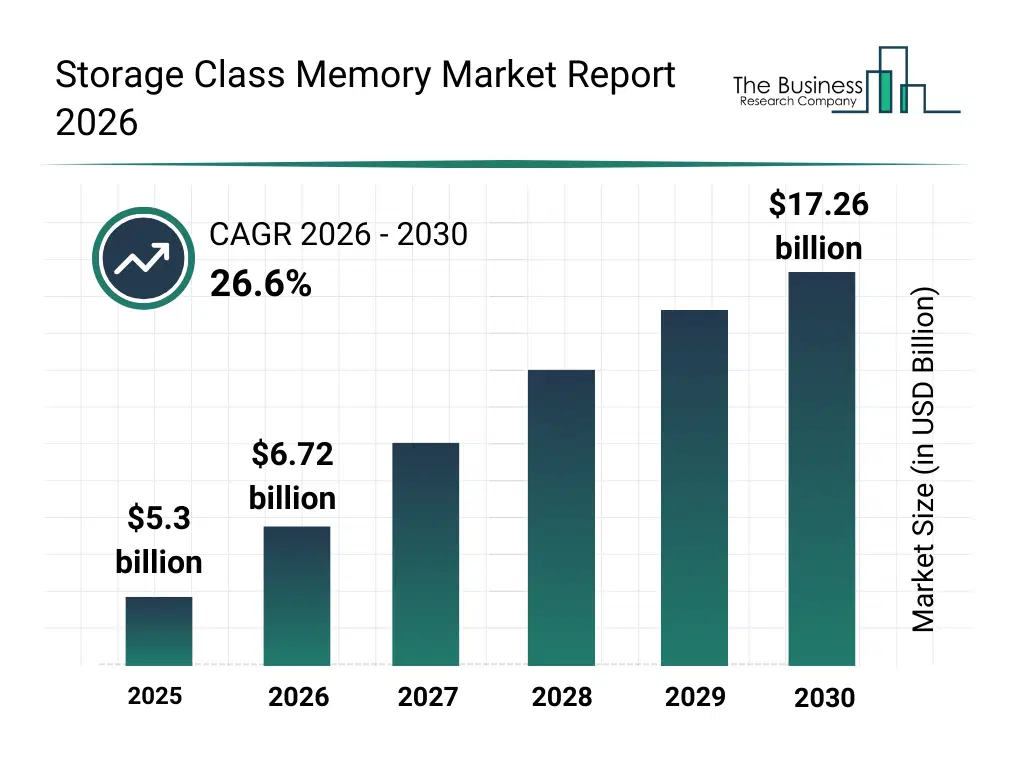
What Is The Storage Class Memory Market Size and Share 2026?
The storage class memory market size has grown exponentially in recent years. It will grow from $5.3 billion in 2025 to $6.72 billion in 2026 at a compound annual growth rate (CAGR) of 26.9%. The growth in the historic period can be attributed to rising demand for faster memory solutions, adoption of phase change and magnetoresistive ram, growth in big data and cloud computing applications, need for memory expansion in enterprise computing, early implementation in AI and virtualization environments.What Is The Storage Class Memory Market Growth Forecast?
The storage class memory market size is expected to see exponential growth in the next few years. It will grow to $17.26 billion in 2030 at a compound annual growth rate (CAGR) of 26.6%. The growth in the forecast period can be attributed to increasing integration of hybrid memory solutions, rising adoption in AI and iot applications, expansion of high-capacity scm modules, development of energy-efficient persistent memory, growing demand in automotive and aerospace sectors. Major trends in the forecast period include low-latency persistent memory, high-endurance memory solutions, hybrid memory architectures, memory tiering optimization, accelerated data-intensive computing.
Global Storage Class Memory Market Segmentation
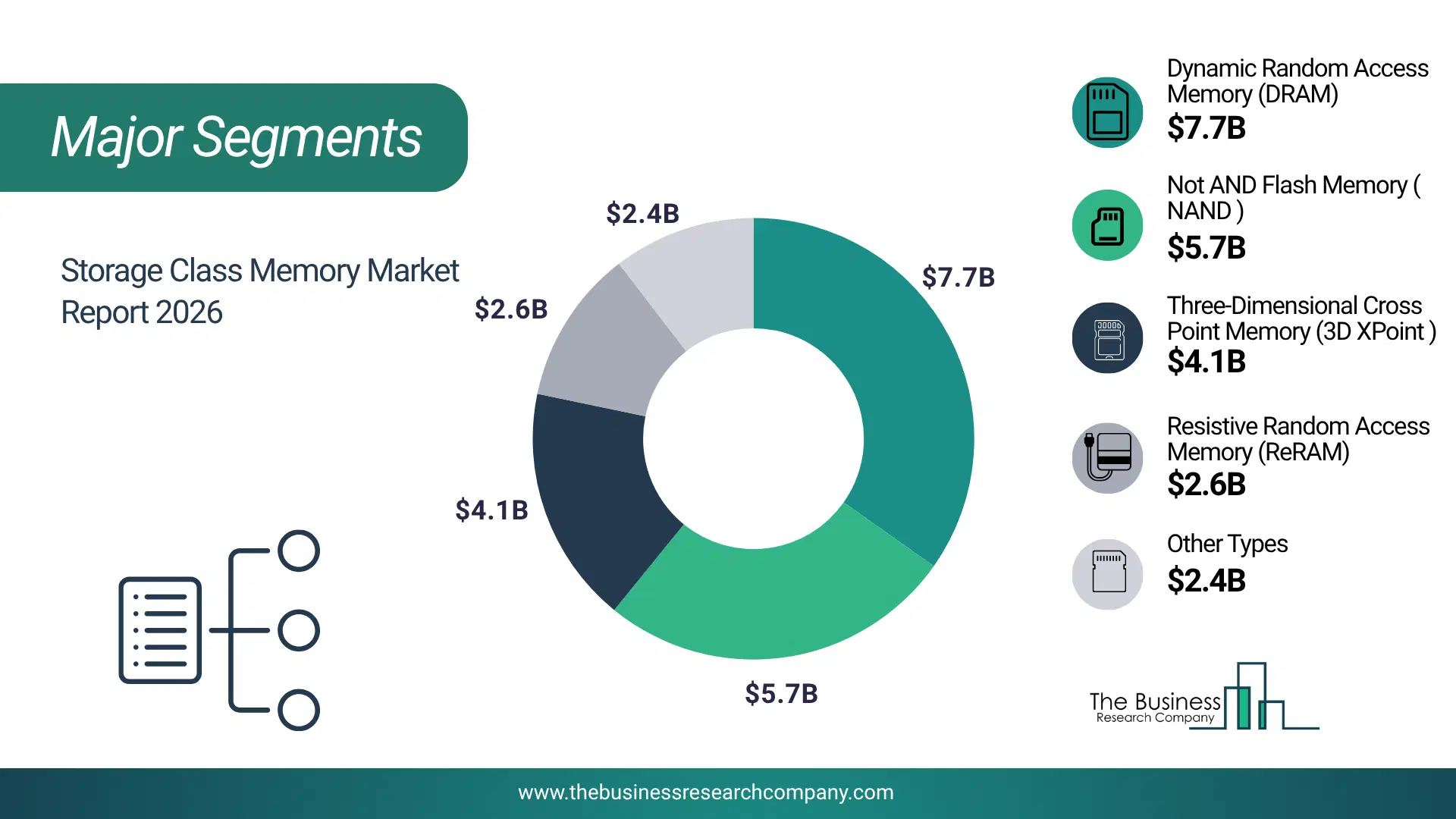
1) By Product Type: Persistent Memory, Non-Volatile Memory, Hybrid Memory 2) By Memory Type: Dynamic Random Access Memory (DRAM), Flash Memory, Ferroelectric Random Access Memory (FeRAM), Magnetoresistive Random Access Memory (MRAM), Phase Change Memory (PCM) 3) By Storage Capacity: Low-Capacity Storage Class Memory, Medium-Capacity Storage Class Memory, High-Capacity Storage Class Memory 4) By Application: Big Data Analytics, Cloud Computing, Artificial Intelligence (AI), Internet Of Things (IoT) Applications, Virtualization 5) By End-User: Information Technology And Telecommunication, Consumer Electronics, Automotive, Healthcare, Aerospace And Defense, Other End-Users Subsegments: 1) By Persistent Memory: Phase Change Memory, Magnetoresistive Random Access Memory, Ferroelectric Random Access Memory, Dynamic Random Access Memory 2) By Non-Volatile Memory: Flash Memory, Read Only Memory, Electrically Erasable Programmable Read Only Memory 3) By Hybrid Memory: Dynamic Random Access Memory With Flash, Phase Change Memory With Flash, Magnetoresistive Random Access Memory With Flash The top segments in the storage class memory market will be: • Dynamic Random Access Memory (DRAM) will reach $7.64 billion by 2030. • Not AND Flash Memory ( NAND ) will reach $5.63 billion by 2030. • Three-Dimensional Cross Point Memory (3D XPoint ) will reach $4.08 billion by 2030. • Resistive Random Access Memory (ReRAM) will reach $2.55 billion by 2030. • Other Types will reach $2.38 billion by 2030.What Is The Driver Of The Storage Class Memory Market?
The growing demand for data centers is expected to propel the growth of the storage class memory market going forward. A data center refers to a facility equipped with servers, storage, networking, and power systems that organizations use to store, manage, and process large volumes of data. The demand for data centers is increasing as more businesses adopt cloud computing to enhance scalability, ensure secure data management, and support the growing need for seamless digital services across industries. Storage class memory enhances data centers by providing high-speed, persistent storage that bridges the gap between DRAM and traditional storage, improving performance, reducing latency, and supporting demanding workloads. For instance, in September 2024, according to the National Telecommunications and Information Administration, a US-based government department, the United States has over 5,000 data centers, and their demand is expected to grow at an annual rate of 9% through 2030. Therefore, the growing demand for data centers is driving the growth of the storage class memory industry.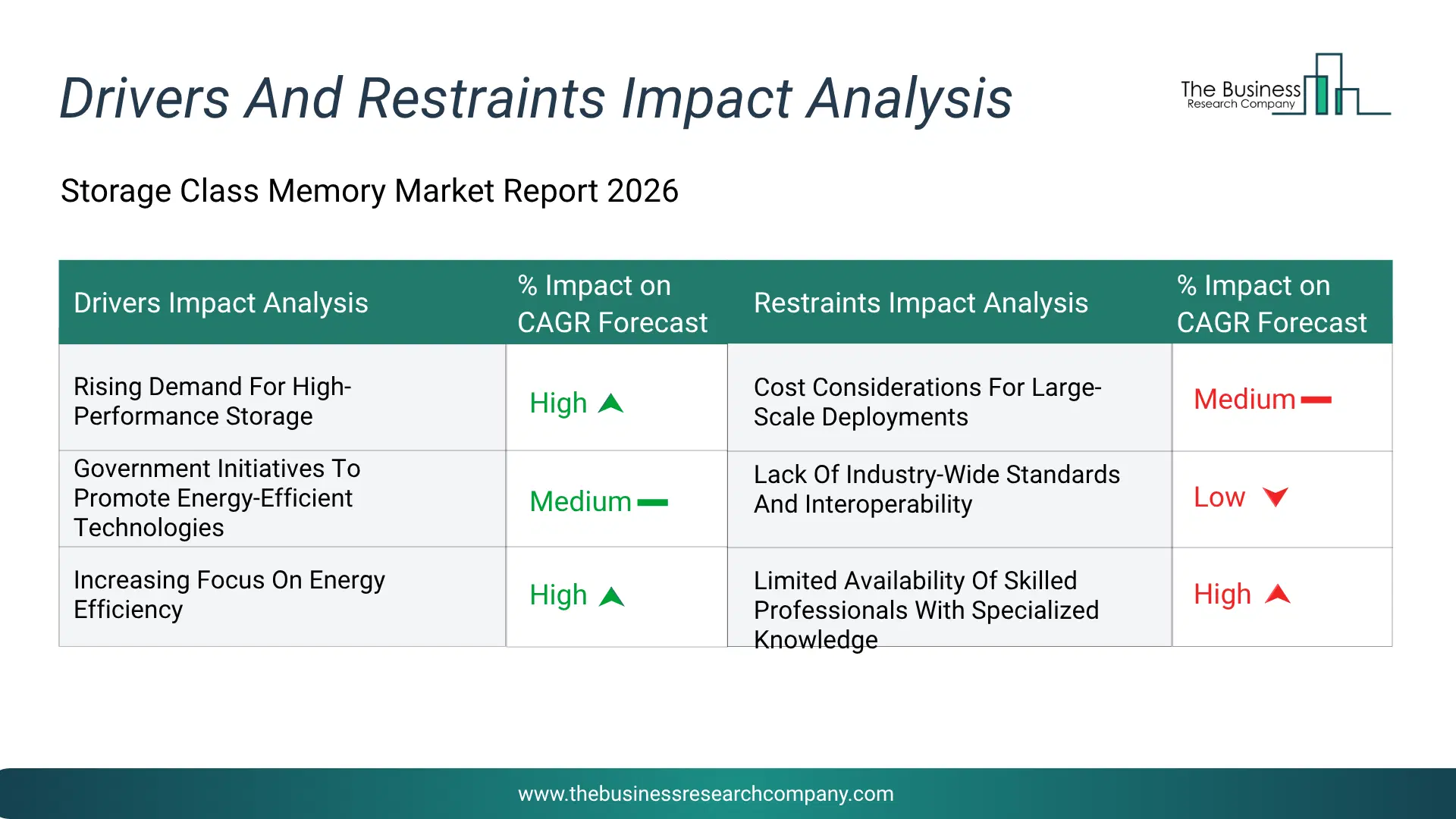
Infographic Chart Showing Key Market Drivers Analysis And Restraints For Storage Class Memory Market
The chart presents an impact analysis of key drivers and restraints, quantifying their relative influence on the market's growth rate and helping assess the balance between growth enablers and limiting factors. This chart offers a high-level perspective; the full report contains more detailed insights.
How Will The Drivers Impact Growth In The Global Storage Class Memory Market?
• Rising Demand For High-Performance Storage (High) – During the forecast period, the rising demand for high-performance storage is expected to become a key growth driver for the storage class memory market by 2030. The rising demand for high-performance storage acts as a major driver for storage-class memory (scm) as enterprises seek faster data processing and reduced latency. Scm bridges the gap between traditional dram and nand flash, delivering superior speed and endurance for data-intensive workloads. With the increasing use of artificial intelligence, big data analytics, and cloud computing, organizations require storage solutions that can handle massive data volumes efficiently. Scm’s ability to provide rapid access and persistent memory makes it ideal for high-performance computing environments. Consequently, its adoption is accelerating across data centers and enterprise storage systems. • Government Initiatives To Promote Energy-Efficient Technologies (Medium) – During the forecast period, the government initiatives to promote energy-efficient technologies is expected to emerge as a major factor driving the expansion of the storage class memory market by 2030. Government initiatives to promote energy-efficient technologies act as a major driver for storage class memory (scm) adoption. Scm offers faster data access with lower power consumption compared to traditional storage solutions, aligning with global energy efficiency goals. Subsidies, tax incentives, and funding for green it infrastructure encourage organizations to invest in energy-saving memory technologies. Such policies accelerate research, development, and large-scale deployment of scm in data centers and enterprise systems. Consequently, government support enhances scm market growth by fostering innovation and sustainable computing practices. • Increasing Focus On Energy Efficiency (High) – During the forecast period, the increasing focus on energy efficiency is expected to act as a key growth catalyst for the storage class memory market by 2030. The increasing focus on energy efficiency acts as a major driver for storage class memory (scm) adoption because it offers lower power consumption compared to traditional dram and nand technologies. Scm reduces energy usage by enabling faster data access and minimizing the need for frequent data transfers between memory and storage. Its non-volatile nature allows systems to retain data without continuous power, further enhancing energy savings. As data centers and enterprises aim to meet sustainability goals, scm helps cut operational costs and carbon emissions. This growing demand for greener, high-performance computing solutions is propelling the scm market forward.How Will The Restraints Impact Growth In The Global Storage Class Memory Market?
• Cost Considerations For Large-Scale Deployments (Medium) – During the forecast period, the cost considerations for large-scale deployments act as a major restraint for storage class memory (scm) adoption. Scm technologies, while offering high performance and low latency, involve significantly higher costs compared to traditional storage solutions like ssds and hdds. Implementing scm across large data centers or enterprise infrastructures requires substantial upfront investment in hardware and system integration. Additionally, maintenance and compatibility upgrades further increase total ownership costs. As a result, many organizations limit scm use to critical applications rather than full-scale deployments. • Lack Of Industry-Wide Standards And Interoperability (Low) – During the forecast period, the lack of industry-wide standards and interoperability acts as a major restraint for storage class memory (scm) adoption. Without common protocols and interfaces, integrating scm with existing memory and storage architectures becomes complex and inconsistent across vendors. This incompatibility limits scalability and discourages enterprises from widespread deployment. Additionally, it increases development costs and hinders collaboration between hardware and software ecosystems. As a result, the absence of unified standards slows market growth and reduces the overall efficiency of scm solutions. • Limited Availability Of Skilled Professionals With Specialized Knowledge (High) – During the forecast period, the limited availability of skilled professionals with specialized knowledge acts as a major restraint for the storage class memory (scm) market. Scm technology requires expertise in advanced memory architecture, system integration, and data management, which are not widely available. The shortage of trained engineers and researchers delays product development and increases operational costs for companies. This talent gap also slows innovation and hinders large-scale adoption across industries. Consequently, organizations face challenges in fully leveraging the performance and efficiency benefits of scm solutions.Key Players In The Global Storage Class Memory Market
Major companies operating in the storage class memory market are Samsung Electronics Co Ltd, SK hynix Inc, Micron Technology Inc, Intel Corporation, IBM Corporation, Everspin Technologies Inc, Avalanche Technology Inc, Crossbar Inc, Weebit Nano Ltd, Western Digital Corporation, Kioxia Holdings Corporation, Fujitsu Ltd, Hewlett Packard Enterprise, Sony Corporation, Winbond Electronics Corporation, Macronix International Co Ltd, ChangXin Memory Technologies Inc, Smart IOPS Inc, Xincun Technology, FLexxon Pte Ltd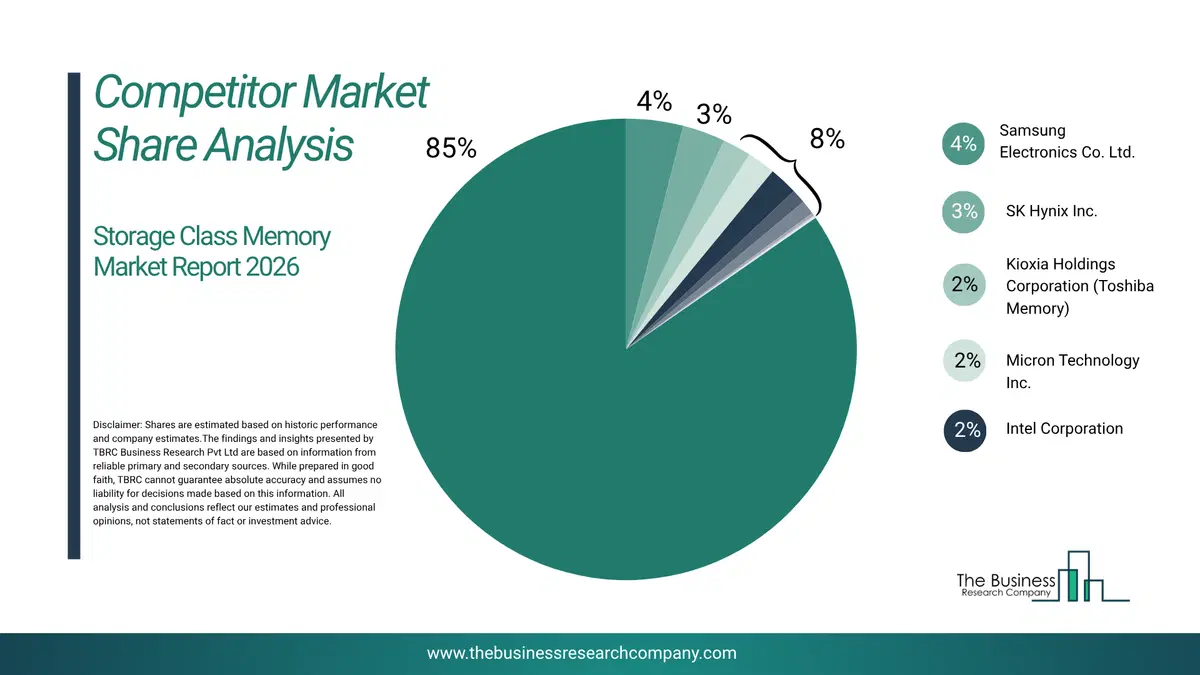
This chart is for illustrative purposes; the full report includes a detailed competitor analysis and comprehensive overview of the top 10 companies in the market.
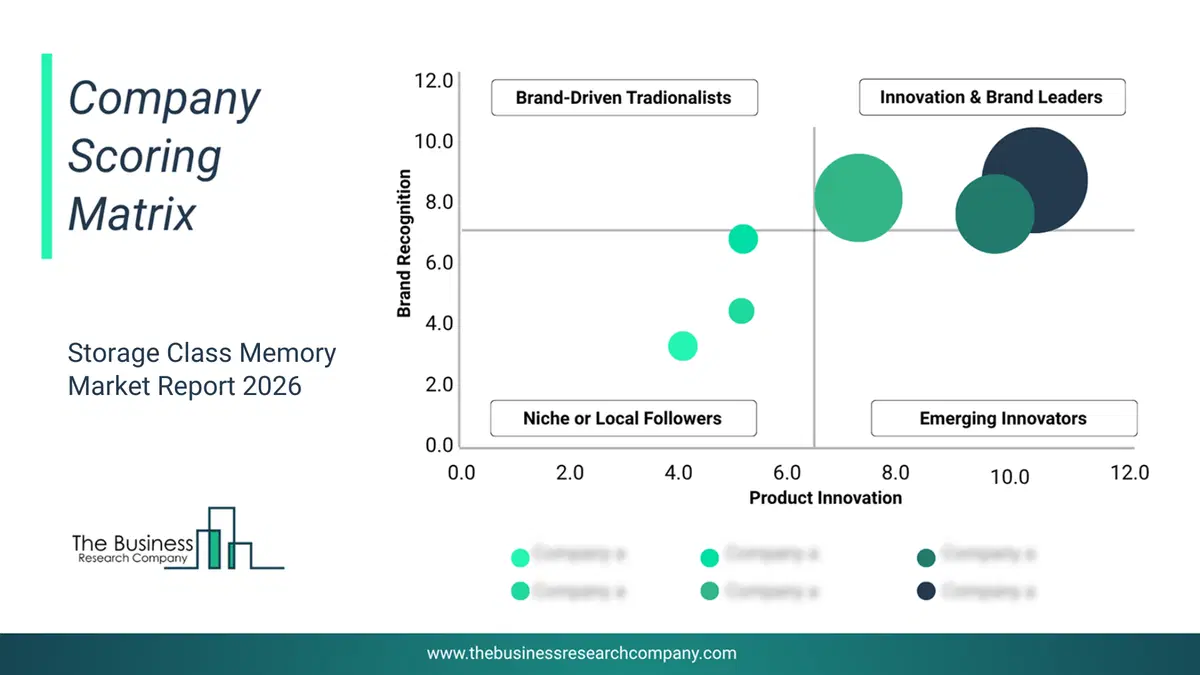
This chart maps companies by product innovation and brand strength, with bubble size indicating relative revenue, helping identify market leaders, challengers, and niche players. This is an illustrative chart; the full report provides a complete and accurate competitive analysis.
Global Storage Class Memory Market Trends and Insights
Major companies operating in the storage class memory market are focusing on developing innovations in memory technology products, such as persistent storage-class memory chips, to enhance data access speeds, reduce latency, and increase system efficiency. Persistent storage-class memory chips are a type of memory that combines the speed of RAM with the ability to retain data like storage, enabling fast, low-latency, and non-volatile data access. For instance, in October 2024, Xincun Technology, a China-based semiconductor start-up, launched a storage-class memory chip called NM102, designed to combine the speed of DRAM with the persistence of NAND flash. This Optane-like memory uses phase-change technology and a standard NAND interface to achieve microsecond-level response times, offering performance that bridges the gap between traditional DRAM and NAND storage. By launching this chip, Numemory aims to fill the void left by Intel's Optane exit, targeting the high-end storage market with a scalable and high-speed solution. This advancement represents a significant stride toward China's semiconductor self-reliance.What Are Latest Mergers And Acquisitions In The Storage Class Memory Market?
In March 2025, SK hynix, a South Korea-based provider of NAND flash memory, DRAM, and enterprise solid-state storage solutions, completed the acquisition of Intel's NAND flash and SSD business (Solidigm) for $8.84 billion. With this acquisition, SK hynix aims to strengthen its competitiveness in high-capacity enterprise storage, enhance its controller and firmware capabilities, and expand its position in the global NAND and Storage Class Memory-adjacent markets. Solidigm is a United States-based provider of advanced NAND flash technologies, enterprise SSDs, storage controllers, and optimization firmware.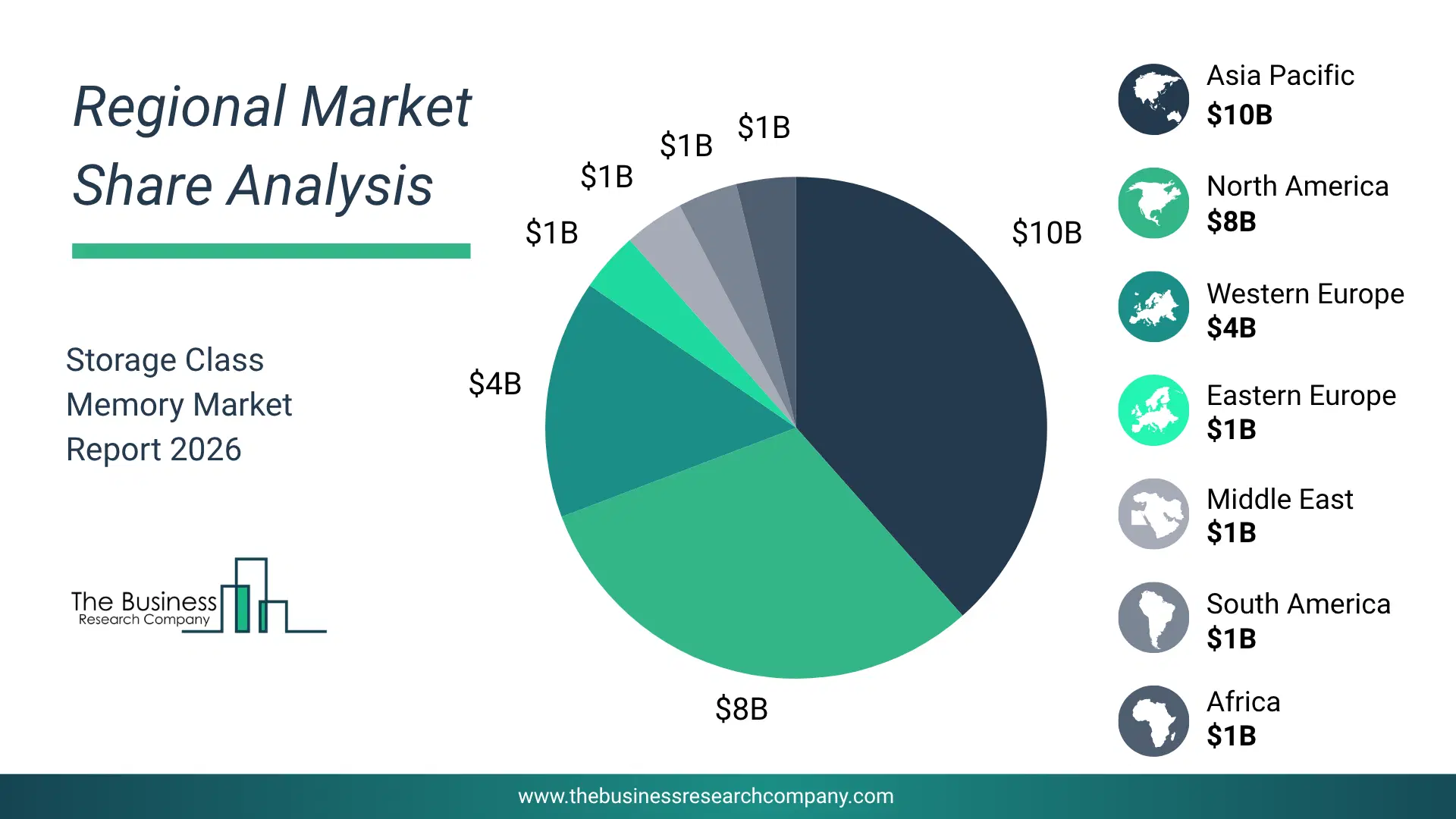
Regional Insights
North America was the largest region in the storage class memory market in 2025. Asia-Pacific is expected to be the fastest-growing region in the forecast period. The regions covered in this market report are Asia-Pacific, South East Asia, Western Europe, Eastern Europe, North America, South America, Middle East, Africa. The countries covered in this market report are Australia, Brazil, China, France, Germany, India, Indonesia, Japan, Taiwan, Russia, South Korea, UK, USA, Canada, Italy, Spain.What Defines the Storage Class Memory Market?
The storage class memory market consists of sales of persistent memory modules, memory expansion cards, caching and tiered storage solutions, byte-addressable SCM devices, and block-addressable devices. Values in this market are 'factory gate' values, that is, the value of goods sold by the manufacturers or creators of the goods, whether to other entities (including downstream manufacturers, wholesalers, distributors, and retailers) or directly to end customers. The value of goods in this market includes related services sold by the creators of the goods.How is Market Value Defined and Measured?
The market value is defined as the revenues that enterprises gain from the sale of goods and/or services within the specified market and geography through sales, grants, or donations in terms of the currency (in USD unless otherwise specified). The revenues for a specified geography are consumption values that are revenues generated by organizations in the specified geography within the market, irrespective of where they are produced. It does not include revenues from resales along the supply chain, either further along the supply chain or as part of other products.
This chart presents market attractiveness based on a quantitative evaluation of growth, competition, strategic alignment, and risk, offering a clear view of opportunity areas for decision-making. This chart is for illustrative purposes; the full report contains the complete analysis.

This chart highlights the Total Addressable Market (TAM) by estimating the maximum revenue opportunity using an assumption-driven approach, supporting strategic planning and opportunity sizing across markets. The chart is illustrative; the full report provides a more comprehensive analysis.
What Key Data and Analysis Are Included in the Storage Class Memory Market Report 2026?
The storage class memory market research report is one of a series of new reports from The Business Research Company that provides market statistics, including industry global market size, regional shares, competitors with the market share, detailed market segments, market trends and opportunities, and any further data you may need to thrive in the storage class memory industry. The market research report delivers a complete perspective of everything you need, with an in-depth analysis of the current and future state of the industry.Storage Class Memory Market Report Forecast Analysis
| Report Attribute | Details |
|---|---|
| Market Size Value In 2026 | $6.72 billion |
| Revenue Forecast In 2030 | $17.26 billion |
| Growth Rate | CAGR of 26.6% from 2026 to 2030 |
| Base Year For Estimation | 2025 |
| Actual Estimates/Historical Data | 2020-2025 |
| Forecast Period | 2026 - 2030 |
| Market Representation | Revenue in USD Billion and CAGR from 2026 to 2030 |
| Segments Covered | Product Type, Memory Type, Storage Capacity, Application, End-User |
| Regional Scope | Asia-Pacific, Western Europe, Eastern Europe, North America, South America, Middle East, Africa |
| Country Scope | The countries covered in the report are Australia, Brazil, China, France, Germany, India, ... |
| Key Companies Profiled | Samsung Electronics Co Ltd, SK hynix Inc, Micron Technology Inc, Intel Corporation, IBM Corporation, Everspin Technologies Inc, Avalanche Technology Inc, Crossbar Inc, Weebit Nano Ltd, Western Digital Corporation, Kioxia Holdings Corporation, Fujitsu Ltd, Hewlett Packard Enterprise, Sony Corporation, Winbond Electronics Corporation, Macronix International Co Ltd, ChangXin Memory Technologies Inc, Smart IOPS Inc, Xincun Technology, FLexxon Pte Ltd |
| Customization Scope | Request for Customization |
| Pricing And Purchase Options | Explore Purchase Options |