
Supersonic Jet Market Report 2026
Global Outlook – By Type (Commercial Supersonic Jet, Military Supersonic Jet, Experimental Or Research Supersonic Jet), By Speed Range (1 Mach – 2 Mach, 2 Mach – 3 Mach), By System Analysis (Airframe, Engine, Avionics, Landing Gear System, Weapon System) – Market Size, Trends, Strategies, and Forecast to 2030
Supersonic Jet Market Overview
• Supersonic Jet market size has reached to $28.89 billion in 2025 • Expected to grow to $38.53 billion in 2030 at a compound annual growth rate (CAGR) of 5.7% • Growth Driver: Surging Air Passenger Traffic Boosts Supersonic Jet Market • Market Trend: Colorado Advances As Hub For Next-Generation Supersonic Engine Testing • North America was the largest region in 2025 and Asia-Pacific is the fastest growing region.What Is Covered Under Supersonic Jet Market?
Supersonic jets refer to supersonic aircraft powered by jet engines and travelling at speeds higher than the speed of sound. Supersonic jets typically travel at speeds greater than 750 mph but less than 1500 mph. The supersonic jet are used for transporting passengers or military applications. The main types of the supersonic jet include commercial supersonic jets, military supersonic jets, and experimental or research supersonic jets. Commercial supersonic jets are designed to transport passengers at speeds exceeding the speed of sound, offering reduced travel times on long-haul routes while incorporating advanced aerodynamics, noise reduction technologies, and fuel-efficient engines for civil aviation. There are speed ranges such as 1 Mach – 2 Mach and 2 Mach – 3 Mach, and they are used by several systems such as airframe, engine, avionics, landing gear system, and weapon system.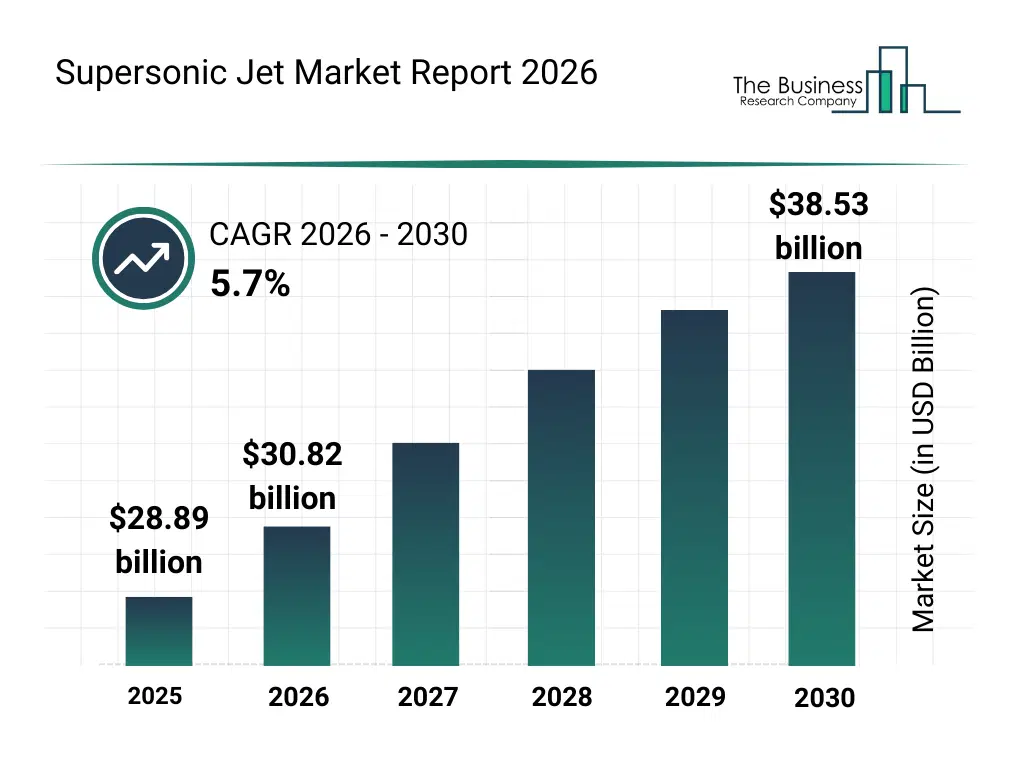
What Is The Supersonic Jet Market Size and Share 2026?
The supersonic jet market size has grown strongly in recent years. It will grow from $28.89 billion in 2025 to $30.82 billion in 2026 at a compound annual growth rate (CAGR) of 6.7%. The growth in the historic period can be attributed to development of early turbine bypass and turbojet propulsion systems enabling sustained supersonic flight, increased military demand for high-speed aircraft to enhance strategic and tactical capabilities, advancements in aerodynamic design to reduce drag at transonic and supersonic speeds, growth in government-funded research for next-generation supersonic propulsion technologies, initial exploration of commercial supersonic travel concepts despite regulatory and cost constraints.What Is The Supersonic Jet Market Growth Forecast?
The supersonic jet market size is expected to see strong growth in the next few years. It will grow to $38.53 billion in 2030 at a compound annual growth rate (CAGR) of 5.7%. The growth in the forecast period can be attributed to growing investment in quieter and more fuel-efficient supersonic engines such as flade configurations, rising interest in commercial supersonic passenger travel driven by reduced flight times, advancements in thermal management and high-temperature materials for sustained high-speed operation, increasing collaboration between aerospace manufacturers and regulators to address sonic-boom and environmental compliance, development of modular propulsion technologies to support both military and civil supersonic platforms. Major trends in the forecast period include development of next-generation supersonic propulsion systems, integration of lightweight composite airframes for improved efficiency, adoption of noise-reduction technologies for commercial supersonic jets, enhancement of thermal management systems for high-speed flight, expansion of military supersonic jet applications for reconnaissance and tactical operations.
Global Supersonic Jet Market Segmentation
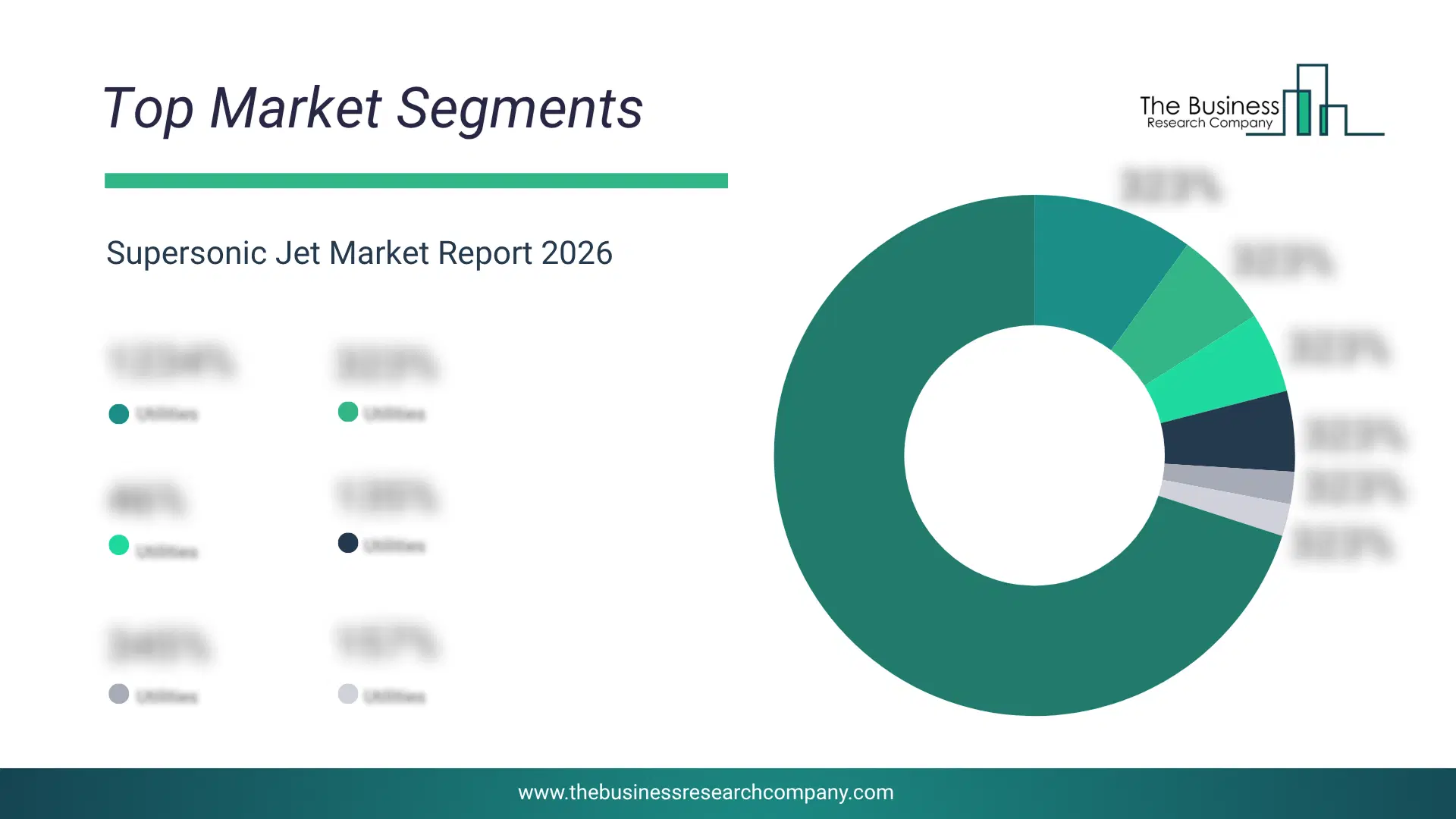
1) By Type: Commercial Supersonic Jet, Military Supersonic Jet, Experimental Or Research Supersonic Jet 2) By Speed Range: 1 Mach – 2 Mach, 2 Mach – 3 Mach 3) By System Analysis: Airframe, Engine, Avionics, Landing Gear System, Weapon System Subsegments: 1) By Commercial Supersonic Jet: Business Supersonic Jets, Commercial Passenger Supersonic Jets, Transport And Charter Supersonic Jets 2) By Military Supersonic Jet: Fighter Jets, Interceptor Aircraft, Strike And Attack Aircraft, Reconnaissance Aircraft, Unmanned Supersonic Military JetsWhat Is Driver Of The Supersonic Jet Market?
The increase in air passenger traffic is expected to propel the growth of the supersonic jet market going forward. Air passenger traffic refers to the number of passengers traveling on scheduled commercial flights within a defined period. The growing prevalence of air passenger traffic is due to increased global travel, as more people fly for tourism, business, and personal reasons, connecting countries and regions more frequently than ever before. The rising air passenger traffic drives demand for advanced aircraft technologies, including supersonic jets, as airlines seek faster, more efficient solutions to meet growing passenger volumes and premium travel expectations. For instance, in April 2023, the International Air Transport Association (IATA), a Cuba-based trade association of the world's airlines, reported that global air travel continued to grow in February 2023, with total traffic measured in revenue passenger kilometers rising 55.5% compared to February 2022. Therefore, the rise in air passenger traffic is driving the supersonic jet industry.Key Players In The Global Supersonic Jet Market
Major companies operating in the supersonic jet market are Boom Technology Inc., Spike Aerospace Inc., Aerion Corporation, Exosonic Inc., Hermeus Corp., Hypermach Europe Aeronautics Ltd., Lockheed Martin Corporation, Boeing Company, Airbus SAS, BAE Systems, Northrop Grumman, Saab AB, Dassault Aviation, Tupolev PJSC, United Aircraft Corporation, The JSC Sukhoi Company, Aviation Industry Corporation of China, Gulfstream Aerospace Corp., Mitsubishi Heavy Industries Ltd., Kawasaki Heavy Industries Ltd., Embraer SA, TsAGI, Reaction Engines Ltd.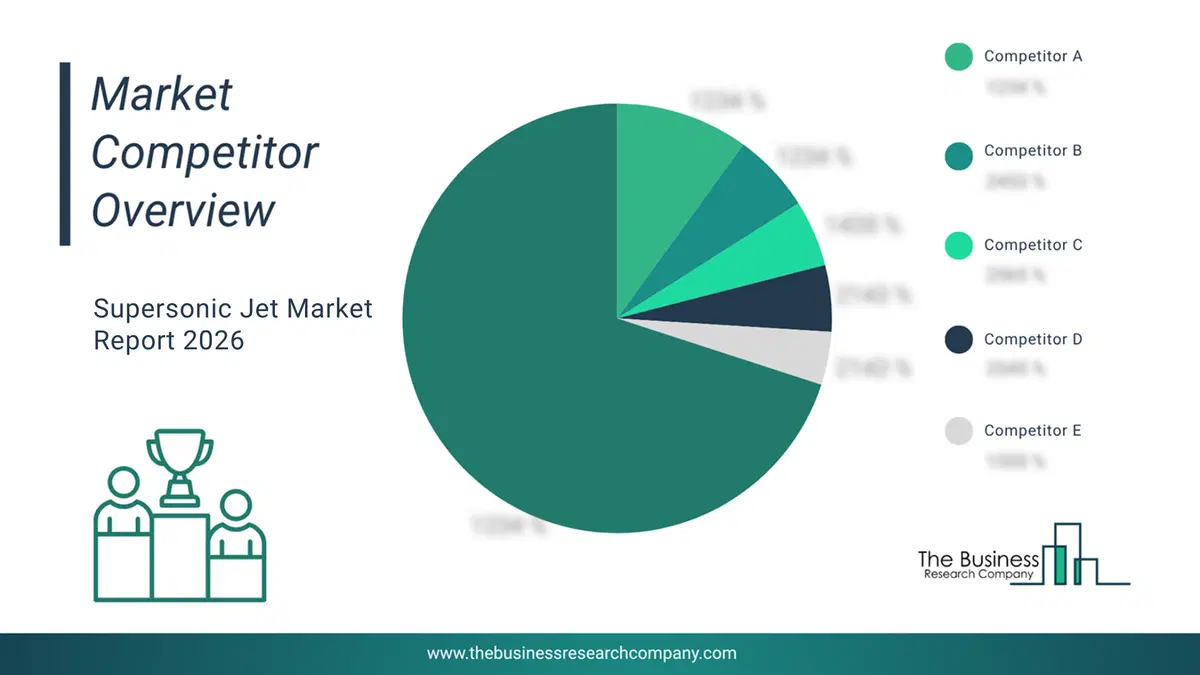
This chart is for illustrative purposes; the full report includes a detailed competitor analysis and comprehensive overview of the top 10 companies in the market.
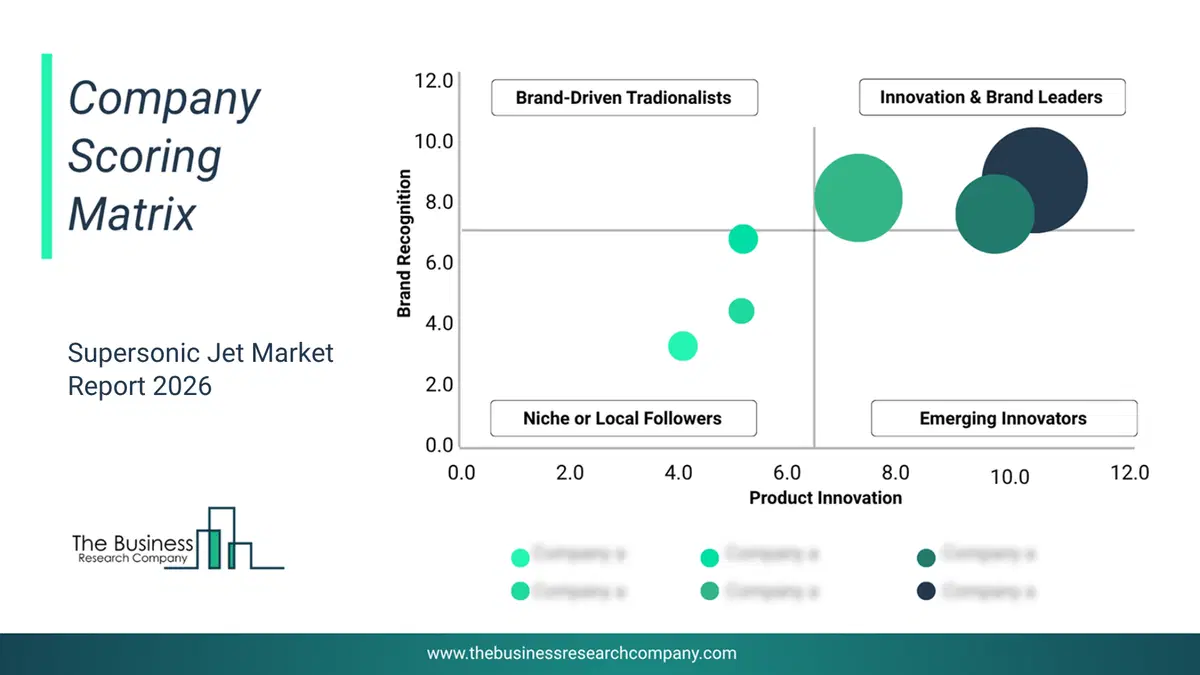
This chart maps companies by product innovation and brand strength, with bubble size indicating relative revenue, helping identify market leaders, challengers, and niche players. This is an illustrative chart; the full report provides a complete and accurate competitive analysis.
Global Supersonic Jet Market Trends and Insights
Major companies operating in the supersonic jet market are focusing on developing innovative solutions, such as quiet supersonic engines to enable overland supersonic travel without sonic booms. Quiet supersonic engines are jet engines designed to reduce or eliminate the loud sonic boom produced when an aircraft exceeds the speed of sound. They help by allowing supersonic flights over land without disturbing people on the ground, making faster travel more practical and widely acceptable. For instance, in May 2025, Boom Supersonic Inc., a U.S.-based aerospace company, launched testing of its Symphony engine at the Colorado Air and Space Port, marking a significant milestone in the development of its supersonic airliner, Overture. The Symphony engine, designed specifically for supersonic commercial flight, aims to enable Boomless Cruise, allowing aircraft to travel at supersonic speeds without producing a ground-detectable sonic boom. Boom Supersonic, Inc. repurposed a former hypersonic testing site at the facility and invested $3–5 million to prepare for prototype engine core testing, generating critical data for the full-scale engine slated for production in 2026. This initiative accelerates the company’s propulsion development while strengthening Colorado’s position as a hub for next-generation aerospace innovation.What Are Latest Mergers And Acquisitions In The Supersonic Jet Market? Northrop Grumman And Boom Technology Collaborate To Enhance Supersonic Airliner For Government Applications
In July 2023, Northrop Grumman Corporation, a US-based aerospace and defense technology company, partnered with Boom Technology Inc. This collaboration aims to leverage Northrop Grumman's extensive experience in aerospace and defense technology to enhance the design and capabilities of Overture, particularly in creating a special mission variant for U.S. government and allied applications. Boom Technology, Inc., a US-based manufacturer of supersonic airliners.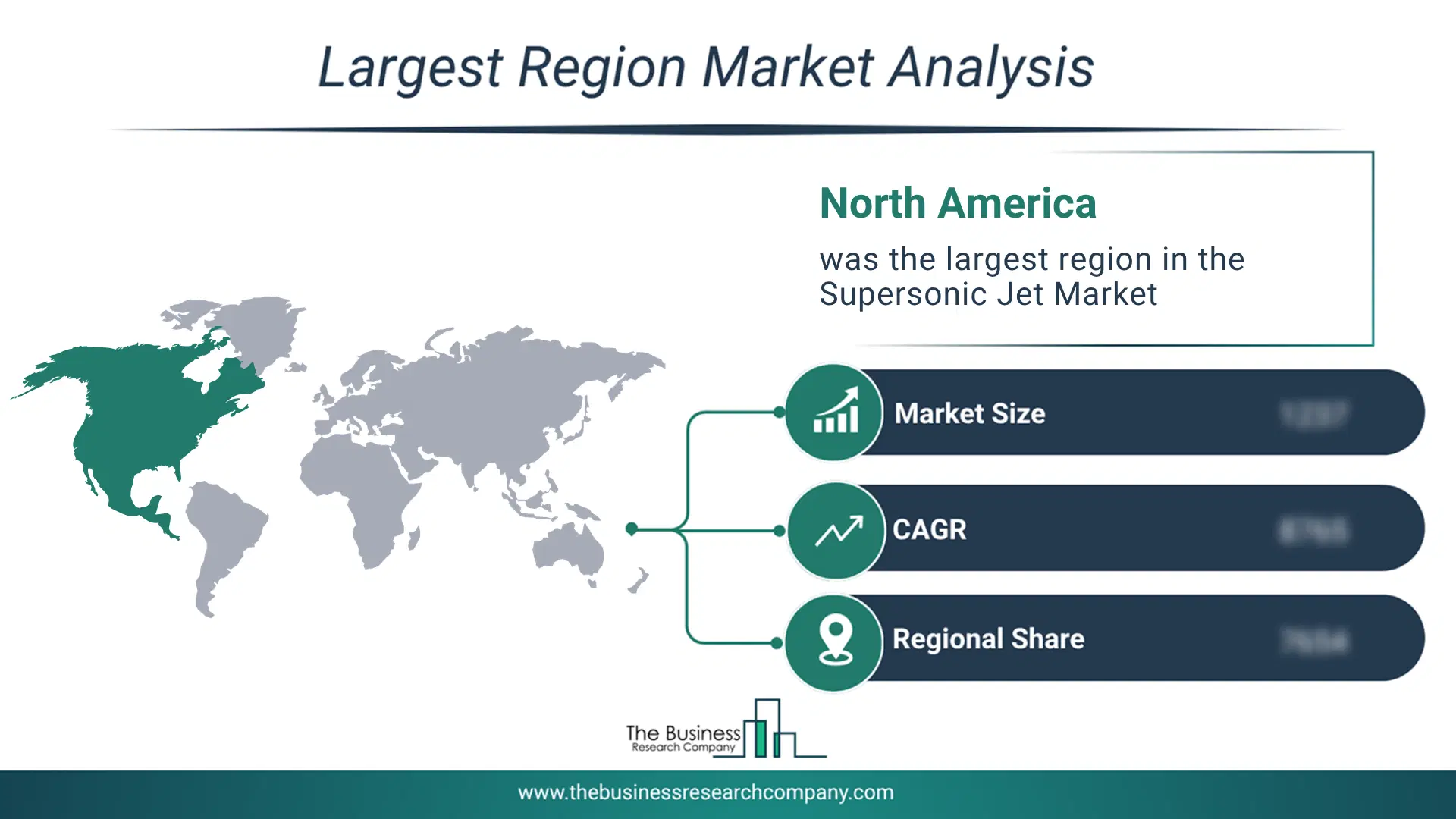
Regional Insights
North America was the largest region in the supersonic jet market in 2025. Asia-Pacific is expected to be the fastest-growing region in the forecast period. The regions covered in this market report are Asia-Pacific, South East Asia, Western Europe, Eastern Europe, North America, South America, Middle East, Africa. The countries covered in this market report are Australia, Brazil, China, France, Germany, India, Indonesia, Japan, Taiwan, Russia, South Korea, UK, USA, Canada, Italy, SpainWhat Defines the Supersonic Jet Market?
The supersonic jet market consists of sales of propulsion systems for supersonic jets including turbine bypass, flade and turbojet. Values in this market are ‘factory gate’ values, that is the value of goods sold by the manufacturers or creators of the goods, whether to other entities (including downstream manufacturers, wholesalers, distributors, and retailers) or directly to end customers. The value of goods in this market includes related services sold by the creators of the goods.How is Market Value Defined and Measured?
The market value is defined as the revenues that enterprises gain from the sale of goods and/or services within the specified market and geography through sales, grants, or donations in terms of the currency (in USD unless otherwise specified). The revenues for a specified geography are consumption values that are revenues generated by organizations in the specified geography within the market, irrespective of where they are produced. It does not include revenues from resales along the supply chain, either further along the supply chain or as part of other products.
This chart presents market attractiveness based on a quantitative evaluation of growth, competition, strategic alignment, and risk, offering a clear view of opportunity areas for decision-making. This chart is for illustrative purposes; the full report contains the complete analysis.

This chart highlights the Total Addressable Market (TAM) by estimating the maximum revenue opportunity using an assumption-driven approach, supporting strategic planning and opportunity sizing across markets. The chart is illustrative; the full report provides a more comprehensive analysis.
What Key Data and Analysis Are Included in the Supersonic Jet Market Report 2026?
The supersonic jet market research report is one of a series of new reports from The Business Research Company that provides market statistics, including industry global market size, regional shares, competitors with the market share, detailed market segments, market trends and opportunities, and any further data you may need to thrive in the supersonic jet industry. The market research report delivers a complete perspective of everything you need, with an in-depth analysis of the current and future state of the industry.Supersonic Jet Market Report Forecast Analysis
| Report Attribute | Details |
|---|---|
| Market Size Value In 2026 | $30.82 billion |
| Revenue Forecast In 2030 | $38.53 billion |
| Growth Rate | CAGR of 5.7% from 2026 to 2030 |
| Base Year For Estimation | 2025 |
| Actual Estimates/Historical Data | 2020-2025 |
| Forecast Period | 2026 - 2030 |
| Market Representation | Revenue in USD Billion and CAGR from 2026 to 2030 |
| Segments Covered | Type, Speed Range, System Analysis |
| Regional Scope | Asia-Pacific, Western Europe, Eastern Europe, North America, South America, Middle East, Africa |
| Country Scope | The countries covered in the supersonic jet market report are Australia, Brazil, China, France, Germany, India, Indonesia, Japan, Taiwan, Russia, South Korea, UK, USA, Canada, Italy, Spain |
| Key Companies Profiled | Boom Technology Inc., Spike Aerospace Inc., Aerion Corporation, Exosonic Inc., Hermeus Corp., Hypermach Europe Aeronautics Ltd., Lockheed Martin Corporation, Boeing Company, Airbus SAS, BAE Systems, Northrop Grumman, Saab AB, Dassault Aviation, Tupolev PJSC, United Aircraft Corporation, The JSC Sukhoi Company, Aviation Industry Corporation of China, Gulfstream Aerospace Corp., Mitsubishi Heavy Industries Ltd., Kawasaki Heavy Industries Ltd., Embraer SA, TsAGI, Reaction Engines Ltd. |
| Customization Scope | Request for Customization |
| Pricing And Purchase Options | Explore Purchase Options |