
Sustainable Aviation Fuel (SAF) Offtake Agreement Market Report 2026
Global Outlook – By Contract Type (Long Term Offtake Agreements, Short Term Offtake Agreements, Spot Purchase Agreements, Framework Agreements, Strategic Partnership Agreements), By Fuel Type (Hydroprocessed Esters And Fatty Acids Based Sustainable Aviation Fuel, Fischer Tropsch Sustainable Aviation Fuel, Alcohol To Jet Sustainable Aviation Fuel, Power To Liquid Sustainable Aviation Fuel, Synthetic Sustainable Aviation Fuel, Bio Based Sustainable Aviation Fuel), By Feedstock (Used Cooking Oil, Animal Fat, Municipal Solid Waste, Agricultural Residue, Other Feedstocks), By End User (Commercial Airlines, Cargo Airlines, Business Aviation Operators, Defense And Military Aviation, Airport Fuel Operator) – Market Size, Trends, Strategies, and Forecast to 2030
Sustainable Aviation Fuel (SAF) Offtake Agreement Market Overview
• Sustainable Aviation Fuel (SAF) Offtake Agreement market size has reached to $4.93 billion in 2025 • Expected to grow to $17.62 billion in 2030 at a compound annual growth rate (CAGR) of 29.1% • Growth Driver: Rising Crude Oil Prices Driving Growth In The Market Due To Increasing Fuel Cost Volatility • Market Trend: Sustainable Aviation Fuel (SAF) Offtake Agreements Support Aviation Decarbonization And Long-Term Clean Fuel Supply • North America was the largest region in 2025 and Asia-Pacific is the fastest growing region.What Is Covered Under Sustainable Aviation Fuel (SAF) Offtake Agreement Market?
A sustainable aviation fuel (SAF) offtake agreement is a long-term contract in which a SAF producer agrees to supply a specified volume of fuel to a buyer such as an airline or fuel distributor at predetermined terms. It provides revenue certainty for producers while ensuring buyers secure a future low-carbon fuel supply to meet decarbonization and regulatory targets. The main contract types of sustainable aviation fuel (SAF) offtake agreements include long term offtake agreements, short term offtake agreements, spot purchase agreements, framework agreements, and strategic partnership agreements. Long term offtake agreements refer to contractual arrangements under which buyers commit to purchasing specified volumes of sustainable aviation fuel over an extended period. These agreements cover fuel types including hydroprocessed esters and fatty acids based sustainable aviation fuel, Fischer Tropsch sustainable aviation fuel, alcohol to jet sustainable aviation fuel, power to liquid sustainable aviation fuel, synthetic sustainable aviation fuel, and bio based sustainable aviation fuel. They are supported by feedstocks such as used cooking oil, animal fat, municipal solid waste, agricultural residue, and other feedstocks and they are utilized by end users including commercial airlines, cargo airlines, business aviation operators, defense and military aviation, and airport fuel operators.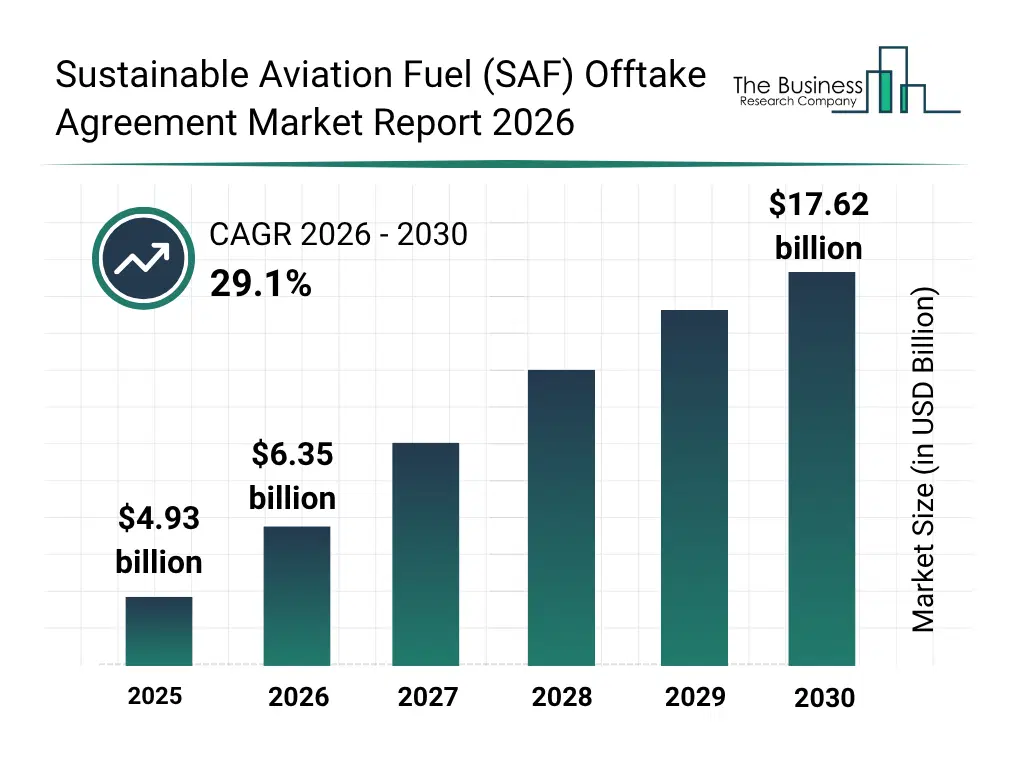
What Is The Sustainable Aviation Fuel (SAF) Offtake Agreement Market Size and Share 2026?
The sustainable aviation fuel (SAF) offtake agreement market size has grown exponentially in recent years. It will grow from $4.93 billion in 2025 to $6.35 billion in 2026 at a compound annual growth rate (CAGR) of 28.8%. The growth in the historic period can be attributed to aviation sector emission awareness and sustainability initiatives, early stage biofuel blending trials in commercial aviation, crude oil price volatility driving alternative fuel interest, regulatory introduction of icao corsia framework, initial airline voluntary net zero commitments.What Is The Sustainable Aviation Fuel (SAF) Offtake Agreement Market Growth Forecast?
The sustainable aviation fuel (SAF) offtake agreement market size is expected to see exponential growth in the next few years. It will grow to $17.62 billion in 2030 at a compound annual growth rate (CAGR) of 29.1%. The growth in the forecast period can be attributed to global mandatory saf blending mandates expansion, carbon pricing and emissions trading system strengthening, scaling of e saf and power to liquid technologies, increasing long term offtake agreement penetration across airlines, rapid investment growth in saf production infrastructure and capacity. Major trends in the forecast period include long term airline decarbonization procurement commitments, sustainable aviation fuel credit trading and book and claim systems expansion, indexed pricing and risk sharing structures in saf offtake contracts, feedstock traceability and certification driven contract standardization, airline producer strategic partnership and co investment models in saf production.
Global Sustainable Aviation Fuel (SAF) Offtake Agreement Market Segmentation
1) By Contract Type: Long Term Offtake Agreements, Short Term Offtake Agreements, Spot Purchase Agreements, Framework Agreements, Strategic Partnership Agreements 2) By Fuel Type: Hydroprocessed Esters And Fatty Acids Based Sustainable Aviation Fuel, Fischer Tropsch Sustainable Aviation Fuel, Alcohol To Jet Sustainable Aviation Fuel, Power To Liquid Sustainable Aviation Fuel, Synthetic Sustainable Aviation Fuel, Bio Based Sustainable Aviation Fuel 3) By Feedstock: Used Cooking Oil, Animal Fat, Municipal Solid Waste, Agricultural Residue, Other Feedstocks 4) By End User: Commercial Airlines, Cargo Airlines, Business Aviation Operators, Defense And Military Aviation, Airport Fuel Operator Subsegments: 1) By Long Term Offtake Agreements: Fixed Price Long Term Supply Contracts, Indexed Price Contracts, Volume Committed Multi Year Contracts 2) By Short Term Offtake Agreements: Annual Supply Contracts, Seasonal Demand Based Contracts, Rolling Six To Twelve Month Supply Agreements 3) By Spot Purchase Agreements: One Time Bulk Sustainable Aviation Fuel Purchases, Immediate Delivery Contracts Based On Availability, Market Price Driven Spot Trading Agreements 4) By Framework Agreements: Master Supply Agreements With Multiple Drawdowns, Pre Approved Pricing And Volume Band Agreements, Multi Supplier Framework Procurement Contracts 5) By Strategic Partnership Agreements: Airline Producer Joint Development Agreements, Co Investment Agreements In Sustainable Aviation Fuel Production Facilities, Technology Collaboration And Feedstock Sourcing PartnershipsWhat Is The Driver Of The Sustainable Aviation Fuel (SAF) Offtake Agreement Market?
The rising crude oil prices are expected to propel the growth of the sustainable aviation fuel (SAF) offtake agreement market going forward. Crude oil prices are the prevailing rates at which raw petroleum is bought and sold in global markets, usually quoted on a per-barrel basis. Crude oil prices are often driven by supply disruptions, such as reduced production or geopolitical conflicts in major oil-producing regions, which limit global supply and push market prices higher. Sustainable aviation fuel (SAF) offtake agreements help reduce dependence on crude oil by securing long-term adoption of alternative aviation fuels, thereby lowering exposure to volatile crude oil price fluctuations in the aviation sector. For instance, in January 2026, according to the U.S. Energy Information Administration, a U.S.-based semi-independent agency, crude oil first purchase prices rose from $58.44 per barrel in January to $62.44 per barrel in February. Therefore, the rising crude oil prices are driving the growth of the sustainable aviation fuel (SAF) offtake agreement industry.Key Players In The Global Sustainable Aviation Fuel (SAF) Offtake Agreement Market
Major companies operating in the sustainable aviation fuel (saf) offtake agreement market are Shell plc, TotalEnergies SE, BP plc, Neste Oyj, World Energy LLC, Eni S.p.A, OMV Aktiengesellschaft, Gevo Inc., Avfuel Corporation, SkyNRG B.V., Aemetis Inc., International Consolidated Airlines Group S.A., Southwest Airlines Co., Alaska Air Group Inc., easyJet plc, JetBlue Airways Corporation, Virgin Atlantic Airways Limited, LanzaJet Inc., AIR COMPANY Holdings Inc., Haffner Energy SA, Twelve Benefit Corporation, Sora Fuel Corporation, USA BioEnergy LLC, ATOBA Energy SAS, Chevron Corporation, Honeywell International Inc., Axens, Trafigura Group.Global Sustainable Aviation Fuel (SAF) Offtake Agreement Market Trends and Insights
Major companies operating in the sustainable aviation fuel (SAF) offtake agreement market are focusing on establishing long-term fuel supply partnerships to accelerate aviation decarbonization, strengthen regional SAF infrastructure, and support corporate sustainability targets. Long-term fuel supply partnerships are strategic agreements between fuel suppliers and buyers that ensure stable fuel availability over extended periods while reducing supply risks and supporting long-term operational planning. For instance, in May 2026, DHL Express, a Germany-based international logistics company, signed a 10-year SAF offtake agreement with SAF One, a UAE-based sustainable aviation fuel developer, to secure 25,000 metric tons of unblended SAF annually from SAF One’s Bahrain production facility beginning in 2028. The agreement integrates the Middle East’s first SAF production plant into DHL’s global SAF supply network and supports the company’s goal of increasing SAF usage to 30% by 2030 while enabling measurable lifecycle CO₂ emission reductions across its regional and international air transport operations.What Are Latest Mergers And Acquisitions In The Sustainable Aviation Fuel (SAF) Offtake Agreement Market?
In February 2025, Haffner Energy SA, a France-based engineering company, partnered with ATOBA Energ SAS to strengthen and scale the sustainable aviation fuel (SAF) value chain by enabling bankable long-term offtake agreements and accelerating SAF project development. With this partnership, companies aim to de-risk sustainable aviation fuel (SAF) production and accelerate market scale-up by securing structured, bankable offtake agreements across the SAF value chain. ATOBA Energy SAS is a France-based energy manufacturing company that offers SAF offtake agreements.Regional Outlook
North America was the largest region in the sustainable aviation fuel (SAF) offtake agreement market in 2025. Asia-Pacific is expected to be the fastest-growing region in the forecast period. The regions covered in this market report are Australia, Brazil, China, France, Germany, India, Indonesia, Japan, Taiwan, Russia, South Korea, UK, USA, Canada, Italy, Spain. The countries covered in this market report are Australia, Brazil, China, France, Germany, India, Indonesia, Japan, Taiwan, Russia, South Korea, UK, USA, Canada, Italy, Spain.What Defines the Sustainable Aviation Fuel (SAF) Offtake Agreement Market?
The sustainable aviation fuel (SAF) offtake agreement market includes revenues earned by providing services such as supply chain coordination and logistics management, fuel scheduling and delivery planning, and storage and handling support at terminals and airports. The market value includes the value of related goods sold by the service provider or included within the service offering. Only goods and services traded between entities or sold to end consumers are included.How is Market Value Defined and Measured?
The market value is defined as the revenues that enterprises gain from the sale of goods and/or services within the specified market and geography through sales, grants, or donations in terms of the currency (in USD unless otherwise specified). The revenues for a specified geography are consumption values that are revenues generated by organizations in the specified geography within the market, irrespective of where they are produced. It does not include revenues from resales along the supply chain, either further along the supply chain or as part of other products.What Key Data and Analysis Are Included in the Sustainable Aviation Fuel (SAF) Offtake Agreement Market Report 2026?
The sustainable aviation fuel (SAF) offtake agreement market research report is one of a series of new reports from The Business Research Company that provides sustainable aviation fuel (SAF) offtake agreement market statistics, including sustainable aviation fuel (SAF) offtake agreement industry global market size, regional shares, competitors with a sustainable aviation fuel (SAF) offtake agreement market share, detailed sustainable aviation fuel (SAF) offtake agreement market segments, market trends and opportunities, and any further data you may need to thrive in the sustainable aviation fuel (SAF) offtake agreement industry. This sustainable aviation fuel (SAF) offtake agreement market research report delivers a complete perspective of everything you need, with an in-depth analysis of the current and future scenario of the industry.Sustainable Aviation Fuel (SAF) Offtake Agreement Market Report Forecast Analysis
| Report Attribute | Details |
|---|---|
| Market Size Value In 2026 | $6.35 billion |
| Revenue Forecast In 2030 | $17.62 billion |
| Growth Rate | CAGR of 29.1% from 2026 to 2030 |
| Base Year For Estimation | 2025 |
| Actual Estimates/Historical Data | 2020-2025 |
| Forecast Period | 2026 - 2030 |
| Market Representation | Revenue in USD Billion and CAGR from 2026 to 2030 |
| Segments Covered | Contract Type, Fuel Type, Feedstock, End User |
| Regional Scope | Asia-Pacific, Western Europe, Eastern Europe, North America, South America, Middle East, Africa |
| Country Scope | The countries covered in the sustainable aviation fuel (SAF) offtake agreement market report are Australia, Brazil, China, France, Germany, India, Indonesia, Japan, Taiwan, Russia, South Korea, UK, USA, Canada, Italy, Spain. |
| Key Companies Profiled | Shell plc, TotalEnergies SE, BP plc, Neste Oyj, World Energy LLC, Eni S.p.A, OMV Aktiengesellschaft, Gevo Inc., Avfuel Corporation, SkyNRG B.V., Aemetis Inc., International Consolidated Airlines Group S.A., Southwest Airlines Co., Alaska Air Group Inc., easyJet plc, JetBlue Airways Corporation, Virgin Atlantic Airways Limited, LanzaJet Inc., AIR COMPANY Holdings Inc., Haffner Energy SA, Twelve Benefit Corporation, Sora Fuel Corporation, USA BioEnergy LLC, ATOBA Energy SAS, Chevron Corporation, Honeywell International Inc., Axens, Trafigura Group. |
| Customization Scope | Request for Customization |
| Pricing And Purchase Options | Explore Purchase Options |