
Synthetic Driving Scene Generator Market Report 2026
Global Outlook – By Component (Software Platforms, Services), By Deployment Mode (On-Premises, Cloud-Based, Hybrid Deployment), By Generation Type (Artificial Intelligence-Generated Synthetic Scenes, Rule-Based and Procedural Scene Generation, Hybrid Scene Generation), By Application (Autonomous Vehicle Training, ADAS Testing and Validation, Simulation for Regulatory Compliance, Driver Behavior Modeling, Robotics and Smart Mobility Research, Digital Twin Environments), By End-User (Automotive OEMs, Autonomous Vehicle Developers, Tier 1 Suppliers, Simulation Platform Providers, Research and Academic Institutes, Testing and Certification Agencies, Government and Regulatory Bodies) – Market Size, Trends, Strategies, and Forecast to 2030
Synthetic Driving Scene Generator Market Overview
• Synthetic Driving Scene Generator market size has reached to $1.60 billion in 2025 • Expected to grow to $4.77 billion in 2030 at a compound annual growth rate (CAGR) of 24.4% • Growth Driver: Rising Adoption Of Electric Vehicles Fueling The Growth Of The Market Due To Increasing Need For Virtual Testing And Optimization Of EV Systems • Market Trend: • North America was the largest region in 2025 and Asia-Pacific is the fastest growing region.What Is Covered Under Synthetic Driving Scene Generator Market?
A synthetic driving scene generator is a system that produces artificial yet realistic driving environments for simulation. It replicates roads, vehicles, weather, and traffic interactions using computer graphics or generative models. These tools are used to train, test, and validate autonomous driving and advanced driver-assistance systems. The main components of the synthetic driving scene generator include software platforms and services. Software platforms refer to advanced tools and engines used to create realistic and scalable synthetic driving environments, including roads, traffic participants, weather conditions, and edge-case scenarios, to support autonomous driving development, testing, and validation. There are deployment modes such as on-premises, cloud-based, and hybrid deployment. The generation types include artificial intelligence generated synthetic scenes, rule-based and procedural scene generation, and hybrid scene generation. The applications cover autonomous vehicle training, ADAS testing and validation, simulation for regulatory compliance, driver behavior modeling, robotics and smart mobility research, and digital twin environments, and the end-users include automotive OEMs, autonomous vehicle developers, Tier 1 suppliers, simulation platform providers, research and academic institutes, testing and certification agencies, and government and regulatory bodies.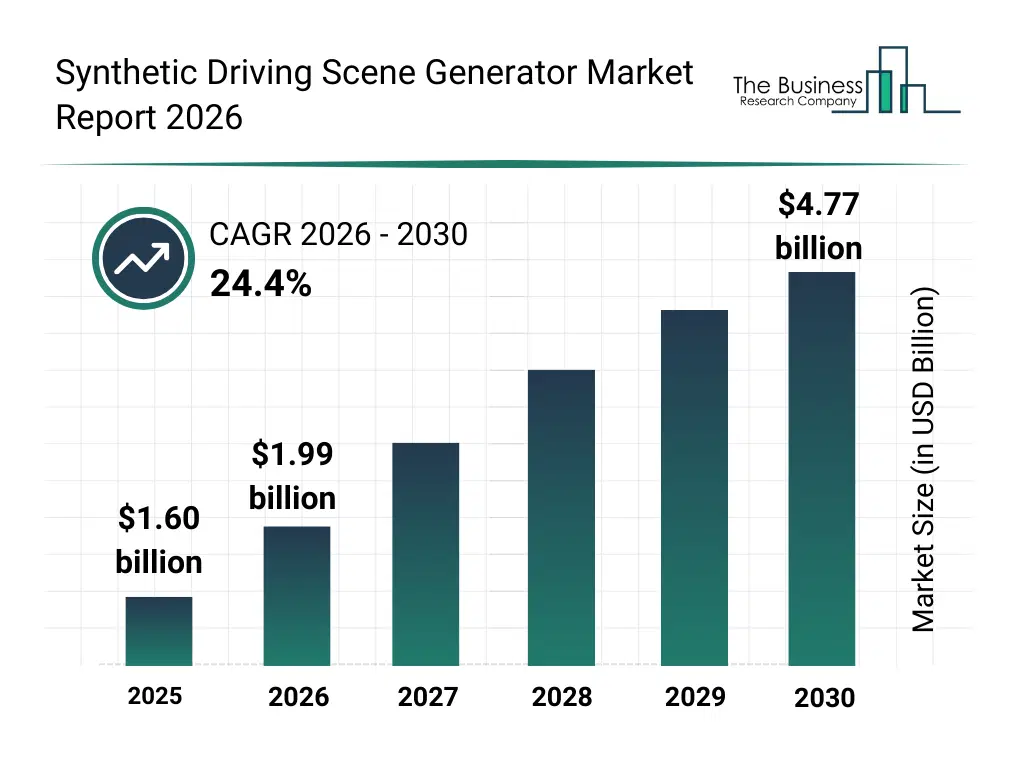
What Is The Synthetic Driving Scene Generator Market Size and Share 2026?
The synthetic driving scene generator market size has grown exponentially in recent years. It will grow from $1.60 billion in 2025 to $1.99 billion in 2026 at a compound annual growth rate (CAGR) of 24.7%. The growth in the historic period can be attributed to increasing demand for autonomous vehicle testing, growing adoption of advanced driver assistance systems, rising need for safe urban mobility solutions, expansion of simulation-based training programs, increasing investment in automotive r&d.What Is The Synthetic Driving Scene Generator Market Growth Forecast?
The synthetic driving scene generator market size is expected to see exponential growth in the next few years. It will grow to $4.77 billion in 2030 at a compound annual growth rate (CAGR) of 24.4%. The growth in the forecast period can be attributed to rising adoption of ai-powered simulation tools, growing focus on corner-case scenario testing, increasing integration of lidar and radar simulation, expansion of cloud-based synthetic data platforms, rising demand for scalable training datasets for perception systems. Major trends in the forecast period include technology advancements in neural rendering, innovations in generative scene synthesis, developments in multi-sensor simulation, research and developments in hybrid simulator-generative frameworks, advancements in high-fidelity scenario generation.
Global Synthetic Driving Scene Generator Market Segmentation
1) By Component: Software Platforms, Services 2) By Deployment Mode: On-Premises, Cloud-Based, Hybrid Deployment 3) By Generation Type: Artificial Intelligence-Generated Synthetic Scenes, Rule-Based and Procedural Scene Generation, Hybrid Scene Generation 4) By Application: Autonomous Vehicle Training, ADAS Testing and Validation, Simulation for Regulatory Compliance, Driver Behavior Modeling, Robotics and Smart Mobility Research, Digital Twin Environments 5) By End-User: Automotive OEMs, Autonomous Vehicle Developers, Tier 1 Suppliers, Simulation Platform Providers, Research and Academic Institutes, Testing and Certification Agencies, Government and Regulatory Bodies Subsegments: 1) By Software Platforms: Data-Generative Scene Synthesizers, Full 3D Physics-Based Simulators 2) By Services: Simulation Integration Services, Custom Scenario Development Services, Training and Support Services, Managed Simulation Services, Data Generation Consultancy ServicesWhat Are The Drivers Of The Synthetic Driving Scene Generator Market?
The growth in electric vehicles is expected to propel the growth of the synthetic driving scene generator market going forward. Electric vehicles are automobiles that use one or more electric motors powered by rechargeable batteries or other onboard electrical energy storage systems instead of internal combustion engines. Electric vehicles are rising due to growing government regulations and incentives promoting low-emission transportation, which encourage manufacturers and consumers to shift away from fossil fuel–based vehicles to reduce carbon emissions and meet climate targets. Synthetic driving scene generators benefit electric vehicles by enabling virtual testing and optimization of battery management, energy consumption, and ADAS performance across diverse driving scenarios, which reduces development time and cost while improving vehicle efficiency and safety. For instance, in May 2025, according to the International Energy Agency, a France-based government agency, global electric car sales exceeded 17 million units in 2024, reflecting growth of over 25%, with approximately 3.5 million more vehicles sold compared with the previous year. Therefore, the growth in electric vehicles is driving the growth of the synthetic driving scene generator industry. The growing adoption of autonomous vehicles is expected to propel the growth of the synthetic driving scene generator market going forward. Autonomous vehicles are self driving or driver assist vehicles that can navigate roads using sensors, AI, and connectivity rather than relying exclusively on human input. The adoption is rising as regulators and companies continue to grant permits for AV testing and deployment, enabling more real world AVs to be on the roads. Synthetic driving scene generators benefit autonomous vehicles by enabling large-scale, risk-free simulation of rare, complex, and hazardous driving scenarios, allowing AV systems to be trained and validated more quickly and safely than through real-world testing alone. For instance, in January 2025, according to the California Department of Motor Vehicles (DMV), a US-based government department, autonomous vehicles under testing permits logged 4,498,066 test miles on California’s public roads between December 2023 and November 2024. Therefore, the growing adoption of autonomous vehicles is driving the growth of the synthetic driving scene generator industry. The rising adoption of cloud platforms is expected to propel the growth of the synthetic driving scene generator market going forward. Cloud platforms are centralized, internet-based computing environments that provide on-demand access to scalable infrastructure, software, data storage, and analytics for deploying and managing applications and services remotely. Cloud platforms are rising as they enable organizations to scale computing resources on demand without large upfront capital investment, allowing faster deployment, lower IT costs, and greater operational flexibility. Cloud platforms benefit synthetic driving scene generators by providing scalable, high-performance computing resources that enable rapid generation, execution, and analysis of large volumes of complex driving scenarios, thereby accelerating simulation cycles and reducing infrastructure costs. For instance, in September 2025, according to Eurostat, a Luxembourg-based statistical office, 45% of businesses in the EU bought cloud computing services in 2023. Large businesses are more likely to opt for cloud solutions compared with SMEs. In 2023, 78% of large businesses bought cloud services, while SMEs bought 44%. Therefore, the rising adoption of cloud platforms is driving the growth of the synthetic driving scene generator industry.Key Players In The Global Synthetic Driving Scene Generator Market
Major companies operating in the synthetic driving scene generator market are Tencent Holdings Limited, NVIDIA Corporation, Baidu Inc., Dassault Systèmes SE, Siemens Digital Industries Software, Autodesk Inc., Keysight Technologies Inc., AVL List GmbH, Ansys Inc., Unity Software Inc., MathWorks Inc., dSPACE GmbH, IPG Automotive GmbH, Foretellix Ltd., Applied Intuition Inc., 51World Technology Co. Ltd., Parallel Domain Inc., AVSimulation SAS, Cognata Ltd., rFpro Limited
This chart is for illustrative purposes; the full report includes a detailed competitor analysis and comprehensive overview of the top 10 companies in the market.
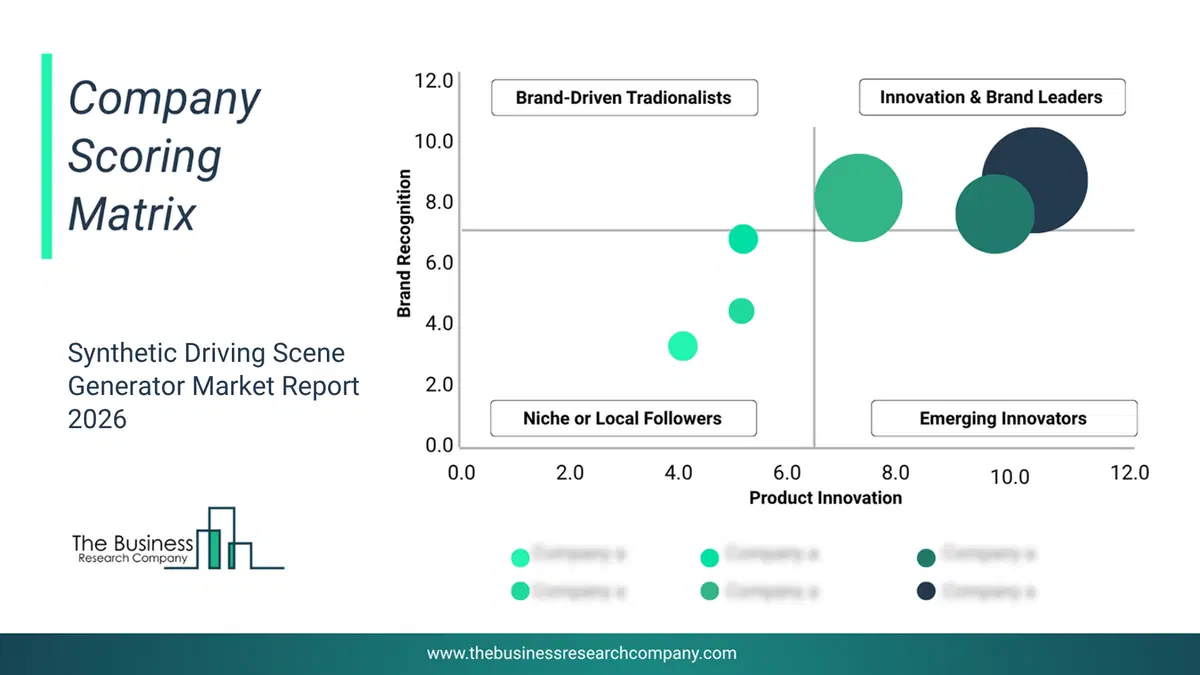
This chart maps companies by product innovation and brand strength, with bubble size indicating relative revenue, helping identify market leaders, challengers, and niche players. This is an illustrative chart; the full report provides a complete and accurate competitive analysis.
Regional Insights
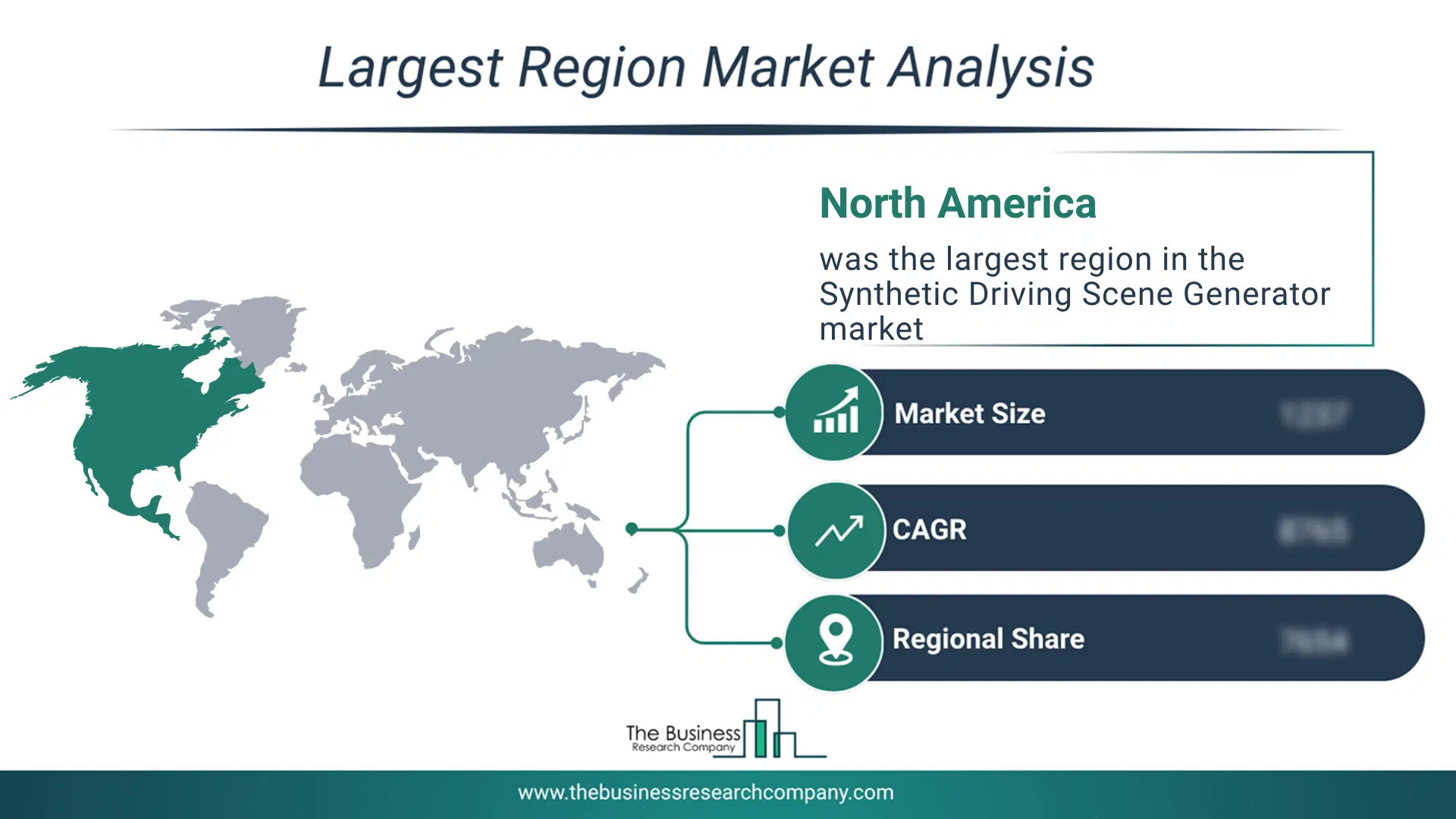
North America was the largest region in the synthetic driving scene generator market in 2025. Asia-Pacific is expected to be the fastest-growing region in the forecast period. The regions covered in this market report are Asia-Pacific, South East Asia, Western Europe, Eastern Europe, North America, South America, Middle East, Africa. The countries covered in this market report are Australia, Brazil, China, France, Germany, India, Indonesia, Japan, Taiwan, Russia, South Korea, UK, USA, Canada, Italy, Spain.What Defines the Synthetic Driving Scene Generator Market?
The synthetic driving scene generator market consists of revenues earned by entities by providing services such as scenario design and customization services, synthetic image and video generation services, sensor data simulation services, environment and map reconstruction services, data annotation and labeling services. The market value includes the value of related goods sold by the service provider or included within the service offering. The synthetic driving scene generator market also includes sales of simulation engines, sensor data generation tools, 3d environment creation platforms, high-fidelity rendering tools, autonomous driving test suites. Values in this market are ‘factory gate’ values, that is, the value of goods sold by the manufacturers or creators of the goods, whether to other entities (including downstream manufacturers, wholesalers, distributors, and retailers) or directly to end customers. The value of goods in this market includes related services sold by the creators of the goods.How is Market Value Defined and Measured?
The market value is defined as the revenues that enterprises gain from the sale of goods and/or services within the specified market and geography through sales, grants, or donations in terms of the currency (in USD unless otherwise specified). The revenues for a specified geography are consumption values that are revenues generated by organizations in the specified geography within the market, irrespective of where they are produced. It does not include revenues from resales along the supply chain, either further along the supply chain or as part of other products.
This chart presents market attractiveness based on a quantitative evaluation of growth, competition, strategic alignment, and risk, offering a clear view of opportunity areas for decision-making. This chart is for illustrative purposes; the full report contains the complete analysis.

This chart highlights the Total Addressable Market (TAM) by estimating the maximum revenue opportunity using an assumption-driven approach, supporting strategic planning and opportunity sizing across markets. The chart is illustrative; the full report provides a more comprehensive analysis.
What Key Data and Analysis Are Included in the Synthetic Driving Scene Generator Market Report 2026?
The synthetic driving scene generator market research report is one of a series of new reports from The Business Research Company that provides market statistics, including industry global market size, regional shares, competitors with the market share, detailed market segments, market trends and opportunities, and any further data you may need to thrive in the synthetic driving scene generator industry. The market research report delivers a complete perspective of everything you need, with an in-depth analysis of the current and future state of the industry.Synthetic Driving Scene Generator Market Report Forecast Analysis
| Report Attribute | Details |
|---|---|
| Market Size Value In 2026 | $1.99 billion |
| Revenue Forecast In 2030 | $4.77 billion |
| Growth Rate | CAGR of 24.4% from 2026 to 2030 |
| Base Year For Estimation | 2025 |
| Actual Estimates/Historical Data | 2020-2025 |
| Forecast Period | 2026 - 2030 |
| Market Representation | Revenue in USD Billion and CAGR from 2026 to 2030 |
| Segments Covered | Component, Deployment Mode, Generation Type, Application, End-User |
| Regional Scope | Asia-Pacific, Western Europe, Eastern Europe, North America, South America, Middle East, Africa |
| Country Scope | The Countries Covered In This Market Report Are Australia, Brazil, China, France, Germany, India, Indonesia, Japan, Taiwan, Russia, South Korea, Uk, Usa, Canada, Italy, Spain. |
| Key Companies Profiled | Tencent Holdings Limited, NVIDIA Corporation, Baidu Inc., Dassault Systèmes SE, Siemens Digital Industries Software, Autodesk Inc., Keysight Technologies Inc., AVL List GmbH, Ansys Inc., Unity Software Inc., MathWorks Inc., dSPACE GmbH, IPG Automotive GmbH, Foretellix Ltd., Applied Intuition Inc., 51World Technology Co. Ltd., Parallel Domain Inc., AVSimulation SAS, Cognata Ltd., rFpro Limited |
| Customization Scope | Request for Customization |
| Pricing And Purchase Options | Explore Purchase Options |