
Synthetic Lab Data Generation Market Report 2026
Global Outlook – By Component (Software, Services), By Deployment Mode (On-Premises, Cloud), By Data Type (Clinical Data, Genomic Data, Imaging Data, Laboratory Test Data, Other Data Types), By Application (Healthcare Research, Drug Discovery, Diagnostics, Medical Training), By End-User (Pharmaceutical And Biotechnology Companies, Hospitals And Clinics, Academic And Research Institutes, Other End-Users) – Market Size, Trends, Strategies, and Forecast to 2030
Synthetic Lab Data Generation Market Overview
• Synthetic Lab Data Generation market size has reached to $1.99 billion in 2025 • Expected to grow to $7.80 billion in 2030 at a compound annual growth rate (CAGR) of 31.4% • Growth Driver: Rising Adoption Of AI-Powered Decision-Making Tools Fueling The Growth Of The Market Due To Increasing Enterprise Digitalization And Need For Data-Driven Insights • Market Trend: • North America was the largest region in 2025 and Asia-Pacific is the fastest growing region.What Is Covered Under Synthetic Lab Data Generation Market?
Synthetic lab data generation refers to the creation of artificial, statistically accurate laboratory datasets using advanced AI/ML models such as generative adversarial networks (GANs), variational autoencoders (VAEs), and large language models (LLMs). These datasets mimic real experimental, clinical, toxicological, chemical, and biological data while removing sensitive information. The primary goal is to enable safe data sharing, accelerate research and development workflows, support model training, and reduce dependency on costly or privacy-sensitive real-world laboratory data. It supports enhanced research efficiency, regulatory compliance, and innovation in life sciences. The main components of synthetic lab data generation include software and services. Software refers to programs and applications that perform specific tasks, automate processes, and provide solutions for users in various industries and research areas. These systems are deployed through on-premises or cloud environments and generate synthetic clinical, genomic, imaging, laboratory test, and other data types for secure and scalable use. The various applications involved are healthcare research, drug discovery, diagnostics, and medical training and are used by several end-users such as pharmaceutical and biotechnology companies, hospitals and clinics, academic and research institutes, and others.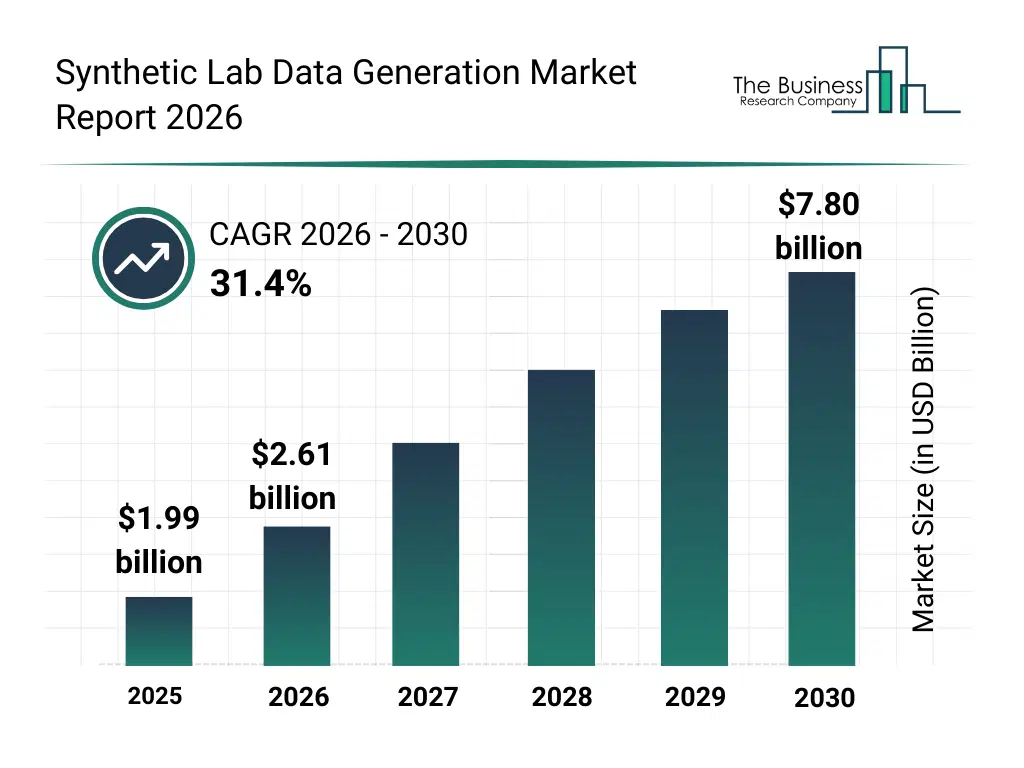
What Is The Synthetic Lab Data Generation Market Size and Share 2026?
The synthetic lab data generation market size has grown exponentially in recent years. It will grow from $1.99 billion in 2025 to $2.61 billion in 2026 at a compound annual growth rate (CAGR) of 31.6%. The growth in the historic period can be attributed to early adoption of rule-based data simulators, limited access to real clinical or lab datasets, rising compliance pressure around patient privacy, cost constraints in manual data collection processes, and academic demand for controlled benchmark datasets.What Is The Synthetic Lab Data Generation Market Growth Forecast?
The synthetic lab data generation market size is expected to see exponential growth in the next few years. It will grow to $7.80 billion in 2030 at a compound annual growth rate (CAGR) of 31.4%. The growth in the forecast period can be attributed to advancements in generative ai architectures for structured scientific data, increasing investment in digital twins for laboratory environments, regulatory encouragement of privacy-preserving data generation, expansion of automated lab robotics requiring synthetic test inputs, and commercial push for scalable r&d simulation platforms. Major trends in the forecast period include integration of synthetic data into lab information management systems, growth of hybrid datasets combining real and synthetic lab outputs, adoption of quality-scoring frameworks for synthetic lab datasets, rising use of multimodal lab data generators, and partnerships between biotech firms and ai vendors for synthetic data solutions.
Global Synthetic Lab Data Generation Market Segmentation
1) By Component: Software, Services 2) By Deployment Mode: On-Premises, Cloud 3) By Data Type: Clinical Data, Genomic Data, Imaging Data, Laboratory Test Data, Other Data Types 4) By Application: Healthcare Research, Drug Discovery, Diagnostics, Medical Training 5) By End-User: Pharmaceutical And Biotechnology Companies, Hospitals And Clinics, Academic And Research Institutes, Other End-Users Subsegments: 1) By Software: Data Generation Platforms, Data Simulation Tools, Data Integration Software, Data Quality Enhancement Tools, Data Validation Software 2) By Services: Consulting Services, Implementation Services, Training Services, Support And Maintenance Services, Managed ServicesWhat Are The Drivers Of The Synthetic Lab Data Generation Market?
The rising adoption of AI-powered decision-making tools is expected to propel the growth of the synthetic lab data generation market going forward. AI-powered decision-making tools are software systems that use artificial intelligence, such as machine learning and predictive analytics, to automate and enhance business decisions and insights. The rise in adoption is due to increasing enterprise digitalization and the need for data-driven strategic decision-making. Synthetic lab data generation enhances AI-powered decision-making tools adoption by providing high-quality, privacy-preserving datasets, enabling faster and more accurate model training. It reduces dependency on scarce or sensitive real-world lab data, improving efficiency and reliability of AI-driven insights in healthcare, research, and laboratory operations. For instance, in January 2025, according to Eurostat, a Luxembourg-based statistical office of the European Union, in 2024, 13.5% of enterprises with 10 or more employees used AI technologies, up from 8.0% in 2023, marking a 5.5 percentage-point increase. Therefore, the rising adoption of AI-powered decision-making tools is driving the growth of the synthetic lab data generation industry. The increasing unstructured data volume from internet of things (IoT) is expected to propel the growth of the synthetic test data generation market going forward. Increasing unstructured data volume refers to the expanding amount of schema-less outputs such as sensor logs, telemetry data, images, and free-form device signals generated continuously by IoT systems. This volume is increasing because global broadband usage has expanded sharply, driven by growing numbers of connected devices producing high-velocity data streams. Synthetic test data generation enhances AI and analytics capabilities by leveraging the increasing unstructured data volume from the Internet of Things. It enables organizations to generate realistic, privacy-preserving datasets from sensor logs, telemetry, images, and device signals, improving testing, validation, and decision-making for IoT-scale systems. For instance, in May 2025, according to the Organisation for Economic Co-operation and Development, a France-based intergovernmental body, the average monthly data usage per mobile broadband subscription in OECD countries surged 65% in one year and more than doubled over two years, increasing from 8?GB in June 2022 to 17?GB by June 2024. Therefore, the increasing unstructured data volume from internet of things (IoT) is driving the growth of the synthetic lab data generation industry.Key Players In The Global Synthetic Lab Data Generation Market
Major companies operating in the synthetic lab data generation market are Amazon Web Services Inc., Databricks Inc., Owkin Inc., Insilico Medicine Inc., K2View Data Management Ltd., Recursion Pharmaceuticals Inc., Ultromics Ltd., Parallel Domain Inc., Arzeda Corp., PostEra Inc., Sky Engine AI Ltd., MDClone Ltd., Synthesized Ltd., Mostly AI GmbH, Nabla Bio Inc., Rendered.ai Inc., GenRocket Inc., Anyverse Inc., Syntegra Private Limited, Synthetrial Inc.
This chart is for illustrative purposes; the full report includes a detailed competitor analysis and comprehensive overview of the top 10 companies in the market.
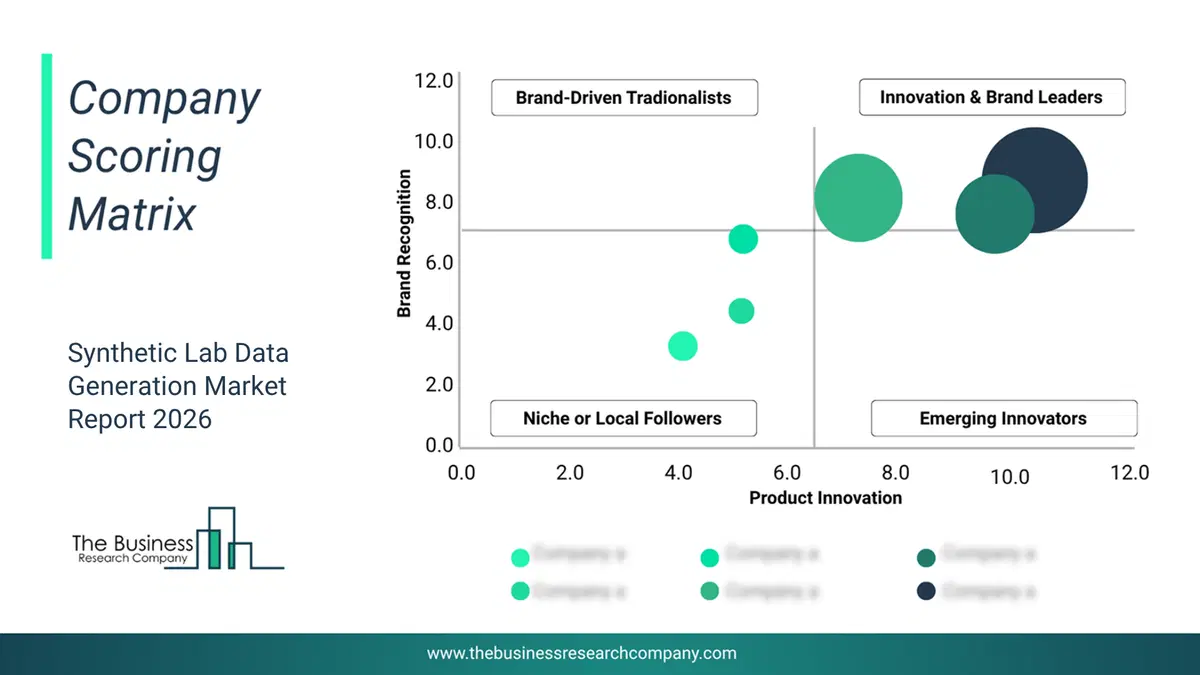
This chart maps companies by product innovation and brand strength, with bubble size indicating relative revenue, helping identify market leaders, challengers, and niche players. This is an illustrative chart; the full report provides a complete and accurate competitive analysis.
What Are Latest Mergers And Acquisitions In The Synthetic Lab Data Generation Market?
In March 2025, NVIDIA Corporation, a US-based provider of hardware and AI developer platforms, acquired Gretel.ai Inc. for an undisclosed amount. With this acquisition, NVIDIA intends to strengthen its synthetic-data engine capabilities for developer workflows, enabling scalable synthetic dataset generation and privacy-enhanced pipelines for training and testing. Gretel.ai Inc. is a US-based software company specializing in synthetic data generation for AI, analytics, and privacy-preserving applications.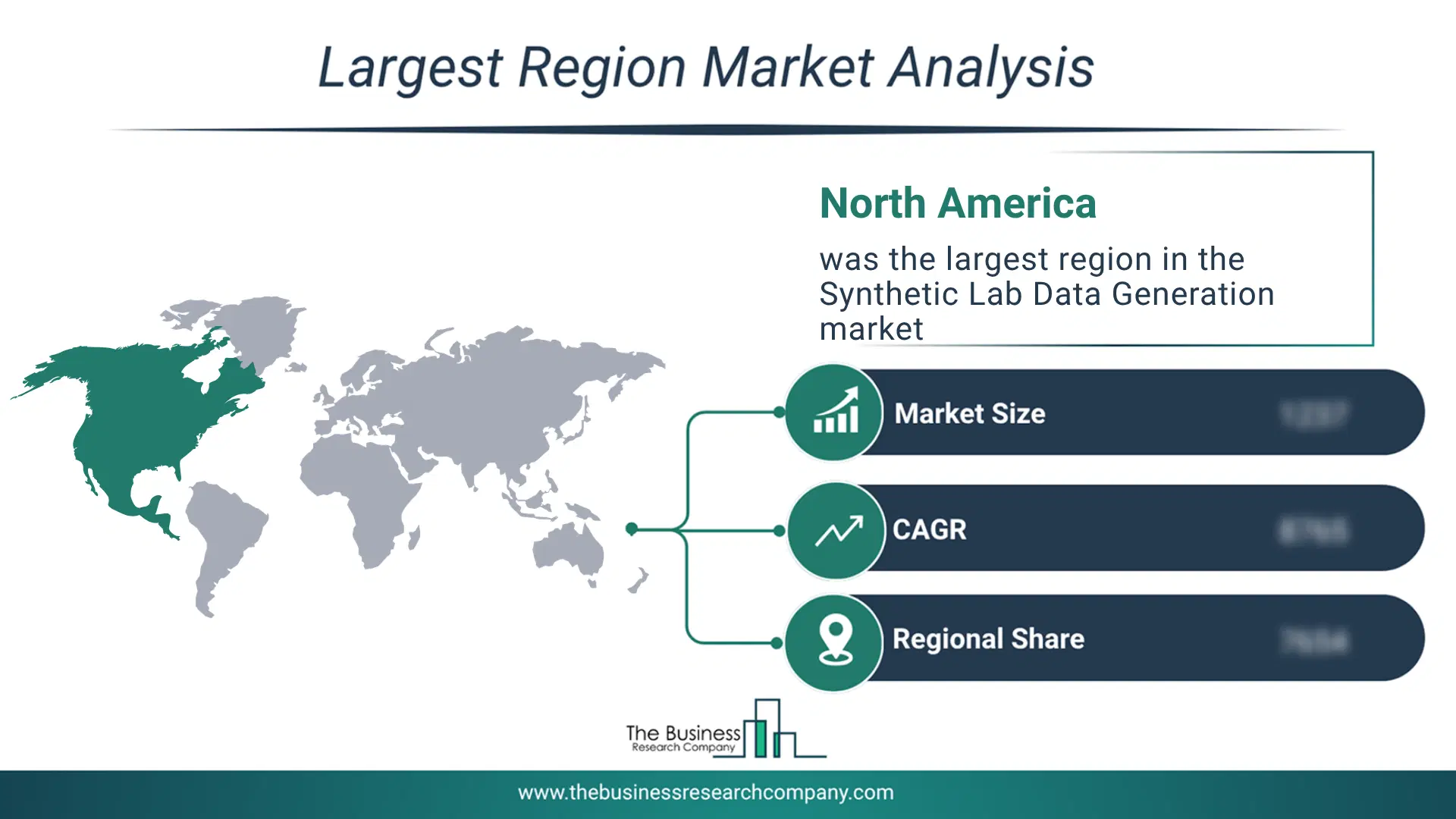
Regional Insights
North America was the largest region in the synthetic lab data generation market in 2025. Asia-Pacific is expected to be the fastest-growing region in the forecast period. The regions covered in this market report are Asia-Pacific, South East Asia, Western Europe, Eastern Europe, North America, South America, Middle East, Africa. The countries covered in this market report are Australia, Brazil, China, France, Germany, India, Indonesia, Japan, Taiwan, Russia, South Korea, UK, USA, Canada, Italy, Spain.What Defines the Synthetic Lab Data Generation Market?
The synthetic lab data generation market consists of revenues earned by entities that provide solutions such as synthetic data generation platforms, laboratory data simulation tools, AI-based modeling engines, privacy-preserving data pipelines, and validation frameworks. The market value includes related services such as dataset customization, domain-specific modeling, data quality evaluation, and integration with laboratory information systems (LIS/LIMS). It also includes sales of supporting software components and tools used for generating tabular, time-series, imaging, and molecular datasets. Values in this market are ‘factory gate’ values, meaning the value of goods sold by the manufacturers or creators of the tools—whether to other organizations (LIMS vendors, CROs, pharma companies, healthcare institutions) or directly to end users. The value includes associated services provided by the creators of these solutions.How is Market Value Defined and Measured?
The market value is defined as the revenues that enterprises gain from the sale of goods and/or services within the specified market and geography through sales, grants, or donations in terms of the currency (in USD unless otherwise specified). The revenues for a specified geography are consumption values that are revenues generated by organizations in the specified geography within the market, irrespective of where they are produced. It does not include revenues from resales along the supply chain, either further along the supply chain or as part of other products.
This chart presents market attractiveness based on a quantitative evaluation of growth, competition, strategic alignment, and risk, offering a clear view of opportunity areas for decision-making. This chart is for illustrative purposes; the full report contains the complete analysis.

This chart highlights the Total Addressable Market (TAM) by estimating the maximum revenue opportunity using an assumption-driven approach, supporting strategic planning and opportunity sizing across markets. The chart is illustrative; the full report provides a more comprehensive analysis.
What Key Data and Analysis Are Included in the Synthetic Lab Data Generation Market Report 2026?
The synthetic lab data generation market research report is one of a series of new reports from The Business Research Company that provides market statistics, including industry global market size, regional shares, competitors with the market share, detailed market segments, market trends and opportunities, and any further data you may need to thrive in the synthetic lab data generation industry. The market research report delivers a complete perspective of everything you need, with an in-depth analysis of the current and future state of the industry.Synthetic Lab Data Generation Market Report Forecast Analysis
| Report Attribute | Details |
|---|---|
| Market Size Value In 2026 | $2.61 billion |
| Revenue Forecast In 2030 | $7.80 billion |
| Growth Rate | CAGR of 31.4% from 2026 to 2030 |
| Base Year For Estimation | 2025 |
| Actual Estimates/Historical Data | 2020-2025 |
| Forecast Period | 2026 - 2030 |
| Market Representation | Revenue in USD Billion and CAGR from 2026 to 2030 |
| Segments Covered | Component, Deployment Mode, Data Type, Application, End-User |
| Regional Scope | Asia-Pacific, Western Europe, Eastern Europe, North America, South America, Middle East, Africa |
| Country Scope | The Countries Covered In This Market Report Are Australia, Brazil, China, France, Germany, India, Indonesia, Japan, Taiwan, Russia, South Korea, Uk, Usa, Canada, Italy, Spain. |
| Key Companies Profiled | Amazon Web Services Inc., Databricks Inc., Owkin Inc., Insilico Medicine Inc., K2View Data Management Ltd., Recursion Pharmaceuticals Inc., Ultromics Ltd., Parallel Domain Inc., Arzeda Corp., PostEra Inc., Sky Engine AI Ltd., MDClone Ltd., Synthesized Ltd., Mostly AI GmbH, Nabla Bio Inc., Rendered.ai Inc., GenRocket Inc., Anyverse Inc., Syntegra Private Limited, Synthetrial Inc. |
| Customization Scope | Request for Customization |
| Pricing And Purchase Options | Explore Purchase Options |