

Telepresence Robot Market Report 2026
Global Outlook – By Robot Type (Mobile Telepresence Robots, Stationary Or Desktop Telepresence Robots, Humanoid Telepresence Robots, Specialized Form Factors), By Interface (Hardware, Software), By Navigation Capability (Manually Controlled Telepresence Robots, Semi Autonomous Telepresence Robots, Fully Autonomous Telepresence Robots), By Connectivity (Wi Fi Enabled, Ethernet Connection, Cellular Connectivity), By End Use Industry (Healthcare, Education, Corporate And Enterprise, Manufacturing And Industrial Facilities, Retail And Hospitality, Government And Public Sector, Other End Use Industries) – Market Size, Trends, Strategies, and Forecast to 2035
Telepresence Robot Market Overview
• Telepresence Robot market size has reached to $0.26 billion in 2025 • Expected to grow to $0.6 billion in 2030 at a compound annual growth rate (CAGR) of 18.4% • Growth Driver: Rising Adoption Of Remote Work Models Is Fueling The Growth Of The Market Due To Increasing Demand For Flexible Work Arrangements And Hybrid Collaboration • Market Trend: Innovations In Artificial Intelligence (AI) Technology Enhance Remote Patient Care And Clinical Efficiency In Telepresence Robots Market • North America was the largest region in 2025 and Asia-Pacific is the fastest growing region.What Is Covered Under Telepresence Robot Market?
A telepresence robot is a mobile robotic system integrated with communication technologies that allows users to remotely interact with a physical environment. It enables real-time audio-visual communication and navigation, enhancing remote collaboration, monitoring, and virtual presence by allowing individuals to move, observe, and communicate from a distance. The main robot types of telepresence robot include mobile telepresence robots, stationary or desktop telepresence robots, humanoid telepresence robots, and specialized form factors. Mobile telepresence robots refer to remotely controlled robotic systems equipped with mobility features that allow users to navigate and interact within distant environments. These robots utilize interfaces such as hardware and software, and are categorized by navigation capability including manually controlled telepresence robots, semi autonomous telepresence robots, and fully autonomous telepresence robots. They are operating through connectivity options such as wi fi enabled, ethernet connection, and cellular connectivity and are utilized by end use industries including healthcare, education, corporate and enterprise, manufacturing and industrial facilities, retail and hospitality, government and public sector, and other end use industries.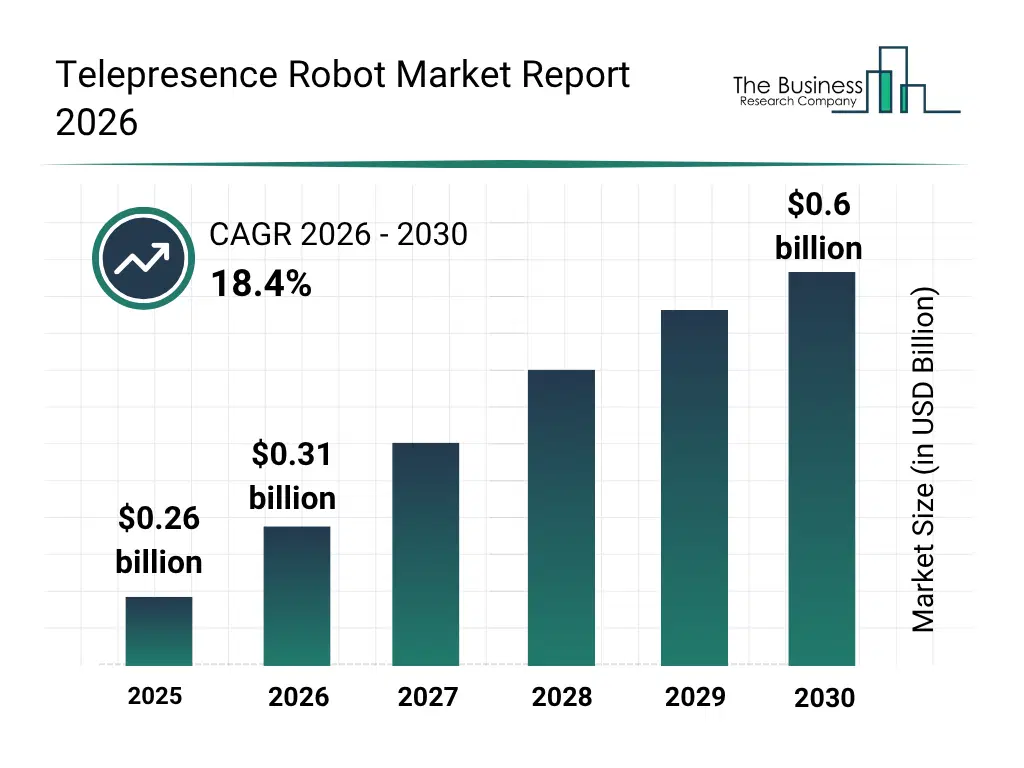
What Is The Telepresence Robot Market Size and Share 2026?
The telepresence robot market size has grown rapidly in recent years.It will grow from $0.26 billion in 2025 to $0.31 billion in 2026 at a compound annual growth rate (CAGR) of 18.1%. The growth in the historic period can be attributed to rise in remote communication technologies, increasing adoption of robotics in enterprises, growth in high-speed internet connectivity, demand for remote monitoring solutions, expansion of digital workplaces.What Is The Telepresence Robot Market Growth Forecast?
The telepresence robot market size is expected to see rapid growth in the next few years.It will grow to $0.6 billion by 2030 at a compound annual growth rate (CAGR) of 18.4%. The growth in the forecast period can be attributed to increasing demand for hybrid work environments, rising adoption in telehealth and remote diagnostics, advancements in autonomous navigation capabilities, growing investment in robotics innovation, expansion of applications in industrial and public sectors.Major trends in the forecast period include increasing adoption of remote collaboration tools in enterprises, growing demand for virtual presence in healthcare consultations, rising use of telepresence robots in education and remote learning, expansion of telepresence in security and surveillance applications, development of compact and user-friendly telepresence robot designs.
Global Telepresence Robot Market Segmentation
1) By Robot Type: Mobile Telepresence Robots, Stationary Or Desktop Telepresence Robots, Humanoid Telepresence Robots, Specialized Form Factors 2) By Interface: Hardware, Software 3) By Navigation Capability: Manually Controlled Telepresence Robots, Semi Autonomous Telepresence Robots, Fully Autonomous Telepresence Robots 4) By Connectivity: Wi Fi Enabled, Ethernet Connection, Cellular Connectivity 5) By End Use Industry: Healthcare, Education, Corporate And Enterprise, Manufacturing And Industrial Facilities, Retail And Hospitality, Government And Public Sector, Other End Use Industries Subsegments: 1) By Mobile Telepresence Robots: Wheeled Navigation Robots, Autonomous Navigation Robots, Remote Controlled Navigation Robots, Indoor Mobility Robots, Outdoor Mobility Robots, Multi Floor Mobility Robots 2) By Stationary Or Desktop Telepresence Robots: Desk Mounted Communication Robots, Tabletop Conferencing Robots, Wall Mounted Telepresence Robots, Kiosk Based Telepresence Robots, Podium Integrated Telepresence Robots 3) By Humanoid Telepresence Robots: Bipedal Humanoid Telepresence Robots, Service Oriented Humanoid Robots, Social Interaction Humanoid Robots, Reception Assistance Humanoid Robots, Caregiving Support Humanoid Robots 4) By Specialized Form Factors: Compact Inspection Telepresence Robots, Rugged Industrial Telepresence Robots, Security Patrol Telepresence Robots, Medical Assistance Telepresence Robots, Educational Engagement Telepresence Robots, Custom Application Telepresence RobotsWhat Is The Driver Of The Telepresence Robot Market?
The rising adoption of remote work models is expected to propel the growth of the telepresence robot industry going forward.Remote work models refer to the growing transition of employees and organizations toward performing job responsibilities from remote or distributed locations using digital communication technologies.The rising adoption of remote work models is driven by the increasing demand for flexible work arrangements that improve work–life balance and organizational productivity.A telepresence robot enables remote employees to move, interact, and collaborate in real time within physical office or industrial environments, thereby strengthening participation and operational continuity in hybrid workplaces.For instance, in December 2024, according to the U.S.Office of Personnel Management, a US-based federal government agency, remote work eligibility in the federal government rose from 52% of employees in fiscal year 2022 to 57% in fiscal year 2023.Therefore, the rising adoption of remote work models is driving the growth of the telepresence robot industry.Key Players In The Global Telepresence Robot Market
Major companies operating in the telepresence robot market are Kompai Robotics SAS, Endurance Robots LLC, Orbis Robotics Pty Ltd., Blue Ocean Robotics ApS, Anybots Inc., Swivl Inc., Vecna Technologies Inc., Awabot SAS, Mantaro Networks Inc., FutureRobot Co. Ltd., Temi Global Ltd., Ava Robotics Inc., Double Robotics Inc., SuperDroid Robots Inc., AXYN Robotique Inc., Enova Robotics S. A., Collaborate i/o LLC, Xaxxon Technologies LLC, Inbot Technology Ltd., Shenzhen Paibot Technology Co. Ltd.Global Telepresence Robot Market Trends and Insights
Major companies operating in the telepresence robot market are focusing on developing advanced solutions, such as autonomous AI-powered telehealth robots, to improve remote patient monitoring, enhance clinical workflows, and expand access to healthcare services. Autonomous AI telehealth robots refer to intelligent robotic systems capable of independently navigating healthcare environments while facilitating virtual consultations between patients and healthcare providers. For instance, in March 2026, VSee, a US-based digital health and telemedicine company, introduced VSee Robot, the world's first autonomous AI telehealth robot, designed to streamline virtual care delivery by combining telepresence capabilities with artificial intelligence-driven navigation and interaction features. The solution enables healthcare professionals to remotely assess, communicate with, and monitor patients more efficiently, thereby improving accessibility and operational productivity in clinical settings.What Are Latest Mergers And Acquisitions In The Telepresence Robot Market?
In December 2024, Symbotic, Inc., a US-based robotics and software company, acquired OhmniLabs for an undisclosed amount. With this acquisition, Symbotic aims to strengthen its automation and healthcare robotics portfolio by expanding technological capabilities and accelerating innovation in next-generation mobile and telepresence robot solutions. OhmniLabs, Inc. is a US-based healthcare robotics company that develops telepresence robots.Regional Insights
North America was the largest region in the telepresence robots market in 2025. Asia-Pacific is expected to be the fastest-growing region in the forecast period. The regions covered in this market report are Asia-Pacific, South East Asia, Western Europe, Eastern Europe, North America, South America, Middle East and Africa. The countries covered in this market report are Australia, Brazil, China, France, Germany, India, Indonesia, Japan, Taiwan, Russia, South Korea, UK, USA, Canada, Italy, Spain.What Defines the Telepresence Robot Market?
A telepresence robot market consists of revenues earned by entities by providing services such as remote inspection and surveillance, telemedicine support and patient interaction, virtual training and education delivery, remote customer assistance, and retail engagement. The market value includes the value of related goods sold by the service provider or included within the service offering. The telepresence robot market also includes sales of telepresence robot base, robotic arm, camera module, microphone array, speaker system, touchscreen display, wheels, motors, battery pack, sensors, docking station, and control panel. Values in this market are ‘factory gate’ values, that is, the value of goods sold by the manufacturers or creators of the goods, whether to other entities (including downstream manufacturers, wholesalers, distributors, and retailers) or directly to end customers. The value of goods in this market includes related services sold by the creators of the goods.What is the Market Assessment and Strategic Outlook for the Telepresence Robot Industry?
The telepresence robot market research report is one of a series of new reports from The Business Research Company that provides market statistics, including industry global market size, regional shares, competitors with the market share, detailed market segments, market trends and opportunities, and any further data you may need to thrive in the telepresence robot industry. The market research report delivers a complete perspective of everything you need, with an in-depth analysis of the current and future state of the industry.What is the Market Assessment and Strategic Outlook for the Telepresence Robot Market Report 2026?
The telepresence robot market research report is one of a series of new reports from The Business Research Company that provides telepresence robot market statistics, including telepresence robot industry global market size, regional shares, competitors with a telepresence robot market share, detailed telepresence robot market segments, market trends and opportunities, and any further data you may need to thrive in the telepresence robot industry. This telepresence robot market research report delivers a complete perspective of everything you need, with an in-depth analysis of the current and future scenario of the industry.Telepresence Robot Market Report Forecast Analysis
| Report Attribute | Details |
|---|---|
| Market Size Value In 2026 | $0.31 billion |
| Revenue Forecast In 2035 | $0.6 billion |
| Growth Rate | CAGR of 18.4% from 2026 to 2035 |
| Base Year For Estimation | 2025 |
| Actual Estimates/Historical Data | 2020-2025 |
| Forecast Period | 2026 - 2030 - 2035 |
| Market Representation | Revenue in USD Billion and CAGR from 2026 to 2035 |
| Segments Covered | Robot Type, Interface, Navigation Capability, Connectivity, End Use Industry |
| Regional Scope | Asia-Pacific, Western Europe, Eastern Europe, North America, South America, Middle East, Africa |
| Country Scope | The countries covered in the report are Australia, Brazil, China, France, Germany, India, Indonesia, Japan, Taiwan, Russia, South Korea, UK, USA, Canada, Italy, Spain. |
| Key Companies Profiled | Kompai Robotics SAS, Endurance Robots LLC, Orbis Robotics Pty Ltd., Blue Ocean Robotics ApS, Anybots Inc., Swivl Inc., Vecna Technologies Inc., Awabot SAS, Mantaro Networks Inc., FutureRobot Co. Ltd., Temi Global Ltd., Ava Robotics Inc., Double Robotics Inc., SuperDroid Robots Inc., AXYN Robotique Inc., Enova Robotics S. A., Collaborate i/o LLC, Xaxxon Technologies LLC, Inbot Technology Ltd., Shenzhen Paibot Technology Co. Ltd. |
| Customization Scope | Request for Customization |
| Pricing And Purchase Options | Explore Purchase Options |