

Thermal Solutions Market Report 2026
Global Outlook – By Product Type (Heat Sinks, Thermal Interface Materials, Heat Pipes, Vapor Chambers, Fans And Blowers, Liquid Cooling Systems, Thermoelectric Cooling Devices, Cold Plates), By Electronic Component (Central Processing Units, Graphics Processing Units, Power Management Integrated Circuits, Memory And Storage Modules, Light Emitting Diode Modules, Radio Frequency Communication Chips), By Material Type (Aluminum, Copper, Graphite, Ceramics, Advanced Polymers, Phase Change Materials), By Cooling Method (Passive Cooling, Active Cooling, Hybrid Cooling, Liquid Cooling), By End-Use Industry (Consumer Electronics, Automotive Electronics, Telecommunications, Data Centers, Industrial Equipment, Aerospace And Defense, Healthcare Electronics) – Market Size, Trends, Strategies, and Forecast to 2030
Thermal Solutions Market Overview
• Thermal Solutions market size has reached to $15.76 billion in 2025 • Expected to grow to $17.06 billion in 2030 at a compound annual growth rate (CAGR) of 8.5% • Growth Driver: Expansion Of Consumer Electronics Manufacturing Worldwide Fueling The Growth Of The Market Due To Rising Demand For Connected Devices • Market Trend: Advancements In Artificial Intelligence (AI)-Driven Liquid Cooling Technologies Enhance Data Center Efficiency And Thermal Management • Asia-Pacific was the largest region in 2025 and North America is the fastest growing region.What Is Covered Under Thermal Solutions Market?
Thermal solutions refer to technologies, materials, and systems designed to regulate, control, and dissipate heat in devices, equipment, and surrounding environments. Their primary purpose is to ensure optimal operating temperatures, enhance performance and energy efficiency, prevent overheating and potential damage, and prolong the lifespan of components across various industries. The main product types of thermal solutions are heat sinks, thermal interface materials, heat pipes, vapor chambers, fans and blowers, liquid cooling systems, thermoelectric cooling devices, and cold plates. Heat sinks are passive cooling devices that dissipate heat from electronic components by increasing surface area and improving heat transfer to the surrounding environment. They are designed for various electronic components, including central processing units (CPUs), graphics processing units (GPUs), power management integrated circuits, memory and storage modules, light-emitting diode (LED) modules, and radio frequency communication chips with different material types such as aluminum, copper, graphite, ceramics, advanced polymers, and phase change materials. They operate through several cooling methods, including passive cooling, active cooling, hybrid cooling, and liquid cooling, and are used across end-use industries such as consumer electronics, automotive electronics, telecommunications, data centers, industrial equipment, aerospace and defense, and healthcare electronics.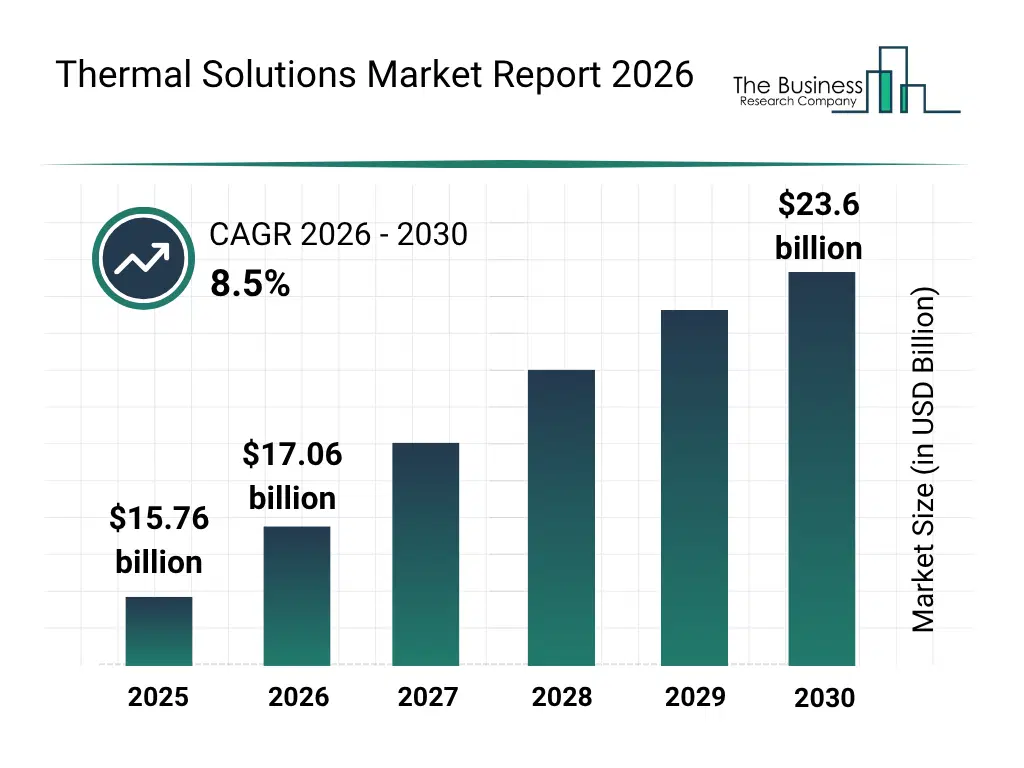
What Is The Thermal Solutions Market Size and Share 2026?
The thermal solutions market size has grown strongly in recent years. It will grow from $15.76 billion in 2025 to $17.06 billion in 2026 at a compound annual growth rate (CAGR) of 8.2%. The growth in the historic period can be attributed to growing demand for air cooling systems in legacy electronics, rising thermal challenges in early high power computing systems, expansion of basic heat sink manufacturing in electronics industry, increasing use of copper and aluminum in thermal management, growth of fan-based cooling in traditional devices.What Is The Thermal Solutions Market Growth Forecast?
The thermal solutions market size is expected to see strong growth in the next few years. It will grow to $23.6 billion by 2030 at a compound annual growth rate (CAGR) of 8.5%. The growth in the forecast period can be attributed to increasing chip power density and miniaturization driving advanced cooling solutions, rising adoption of liquid cooling in data centers and high performance computing, expansion of advanced materials like graphene and phase change materials in thermal systems, growing demand for direct chip cooling in ai and cloud infrastructure, increasing integration of predictive thermal management and smart cooling systems. Major trends in the forecast period include rising heat density in high performance semiconductor and chip architectures, increasing adoption of vapor chambers and heat pipes in compact electronic devices, shift toward hybrid cooling architectures combining passive and active methods, growing integration of thermal-aware chip packaging and system design, expansion of high-efficiency cooling demand in miniaturized consumer electronics.
Global Thermal Solutions Market Segmentation
1) By Product Type: Heat Sinks, Thermal Interface Materials, Heat Pipes, Vapor Chambers, Fans And Blowers, Liquid Cooling Systems, Thermoelectric Cooling Devices, Cold Plates 2) By Electronic Component: Central Processing Units, Graphics Processing Units, Power Management Integrated Circuits, Memory And Storage Modules, Light Emitting Diode Modules, Radio Frequency Communication Chips 3) By Material Type: Aluminum, Copper, Graphite, Ceramics, Advanced Polymers, Phase Change Materials 4) By Cooling Method: Passive Cooling, Active Cooling, Hybrid Cooling, Liquid Cooling 5) By End-Use Industry: Consumer Electronics, Automotive Electronics, Telecommunications, Data Centers, Industrial Equipment, Aerospace And Defense, Healthcare Electronics Subsegments: 1) By Heat Sinks: Extruded Heat Sinks, Bonded Fin Heat Sinks, Skived Fin Heat Sinks, Stamped Heat Sinks, Folded Fin Heat Sinks 2) By Thermal Interface Materials: Thermal Greases, Thermal Adhesives, Thermal Tapes, Gap Fillers, Phase Change Materials 3) By Heat Pipes: Constant Conductance Heat Pipes, Variable Conductance Heat Pipes, Loop Heat Pipes, Pulsating Heat Pipes 4) By Vapor Chambers: Flat Vapor Chambers, Ultra Thin Vapor Chambers, Standard Thickness Vapor Chambers 5) By Fans And Blowers: Axial Fans, Centrifugal Blowers, Cross Flow Fans, Mixed Flow Fans 6) By Liquid Cooling Systems: Closed Loop Liquid Cooling Systems, Open Loop Liquid Cooling Systems, Immersion Cooling Systems, Direct To Chip Liquid Cooling Systems 7) By Thermoelectric Cooling Devices: Single Stage Thermoelectric Coolers, Multi Stage Thermoelectric Coolers, Thermoelectric Modules 8) By Cold Plates: Tube Based Cold Plates, Channel Based Cold Plates, Vacuum Brazed Cold Plates, Additively Manufactured Cold PlatesWhat Is The Driver Of The Thermal Solutions Market?
The expansion of consumer electronics manufacturing worldwide is expected to propel the growth of the thermal solutions market going forward. Consumer electronics manufacturing refers to the large-scale production of electronic devices such as smartphones, laptops, televisions, and wearable devices for personal use. The expansion of consumer electronics manufacturing is driven by rising consumer demand for connected and smart devices, supported by increasing digital adoption and higher disposable income. The thermal solutions support consumer electronics manufacturing by enabling efficient heat dissipation, improving device reliability, maintaining performance stability, and extending product lifespan in compact and high-power devices. For instance, in May 2023, according to the Japan Electronics and Information Technology Industries Association, a Japan-based trade association, the total consumer electronic equipment production in Japan reached $209.16 million (¥32,099 million), compared to $164.65 million (¥25,268 million) in May 2022. Therefore, the expansion of consumer electronics manufacturing worldwide is driving the growth of the thermal solutions industry.Key Players In The Global Thermal Solutions Market
Major companies operating in the thermal solutions market are Schneider Electric SE; Danfoss A/S; Alfa Laval AB; Lennox International Inc.; NIBE Industrier AB; Modine Manufacturing Company; SPX Technologies Inc.; Voltas Limited; AAON Inc.; Munters Group AB; Systemair AB; Blue Star Limited; Güntner GmbH & Co. KG; Hisense HVAC Co. Ltd.; Zamil Air Conditioners Holding Co. Ltd.; Vertiv Holdings Co.; Delta Electronics, Inc.; Boyd Corporation; STULZ GmbH; Aavid Thermalloy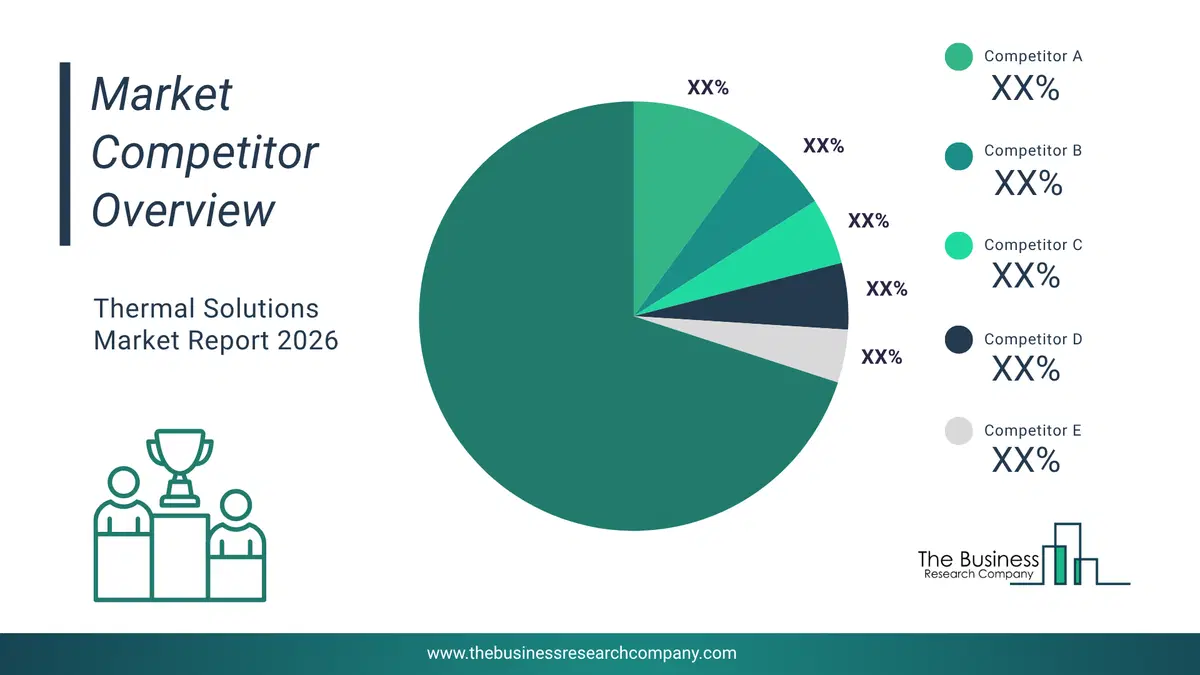
This chart is for illustrative purposes; the full report includes a detailed competitor analysis and comprehensive overview of the top 10 companies in the market.
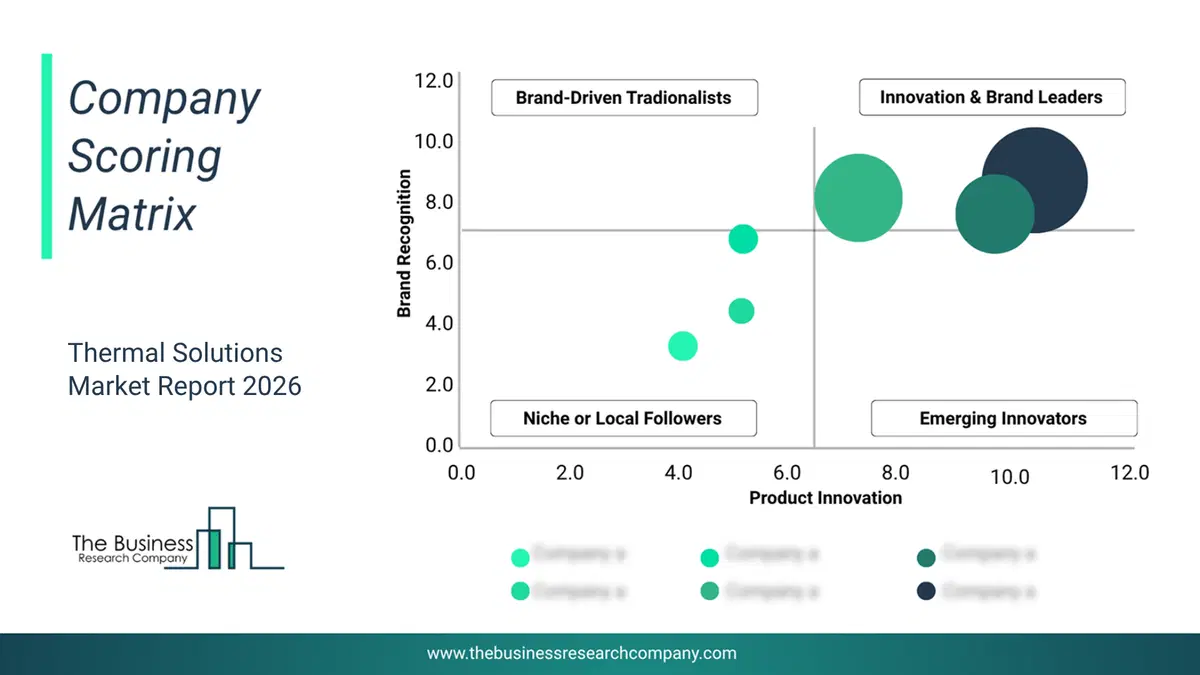
This chart maps companies by product innovation and brand strength, with bubble size indicating relative revenue, helping identify market leaders, challengers, and niche players. This is an illustrative chart; the full report provides a complete and accurate competitive analysis.
Global Thermal Solutions Market Trends and Insights
Major companies operating in the thermal solutions market are focusing on developing advanced technologies, such as direct-to-chip cooling systems, to improve heat dissipation, enhance energy efficiency, and support high-performance computing environments. Direct-to-chip cooling systems circulate liquid coolant directly over processors via cold plates to efficiently remove heat at the source and support high-performance computing with lower energy use. For instance, in February 2026, ASUS, a US-based technology company, introduced ASUS Optimized Liquid-Cooling Solutions and a strategic partner framework for enterprise AI liquid cooling solutions to support next-generation data centers. These solutions integrate advanced cooling architectures, including direct-to-chip and immersion cooling, to handle the increasing thermal demands of AI workloads, reduce power consumption, and improve overall system reliability and performance.What Are Latest Mergers And Acquisitions In The Thermal Solutions Market?
In February 2026, Paras Defence and Space Technologies Limited, an India-based defense engineering company, acquired a 49% stake in Himanshi Thermal Solutions Private Limited for an undisclosed strategic consideration. Through this acquisition, Paras Defence aims to enhance its thermal solutions capabilities by integrating Himanshi Thermal’s expertise in liquid cold plates and advanced thermal management systems, which are critical for aerospace and defense applications. Himanshi Thermal Solutions Private Limited is an India-based company specializing in precision-engineered thermal management solutions, including liquid cooling technologies and vacuum heat treatment services for high-performance aerospace and defense systems.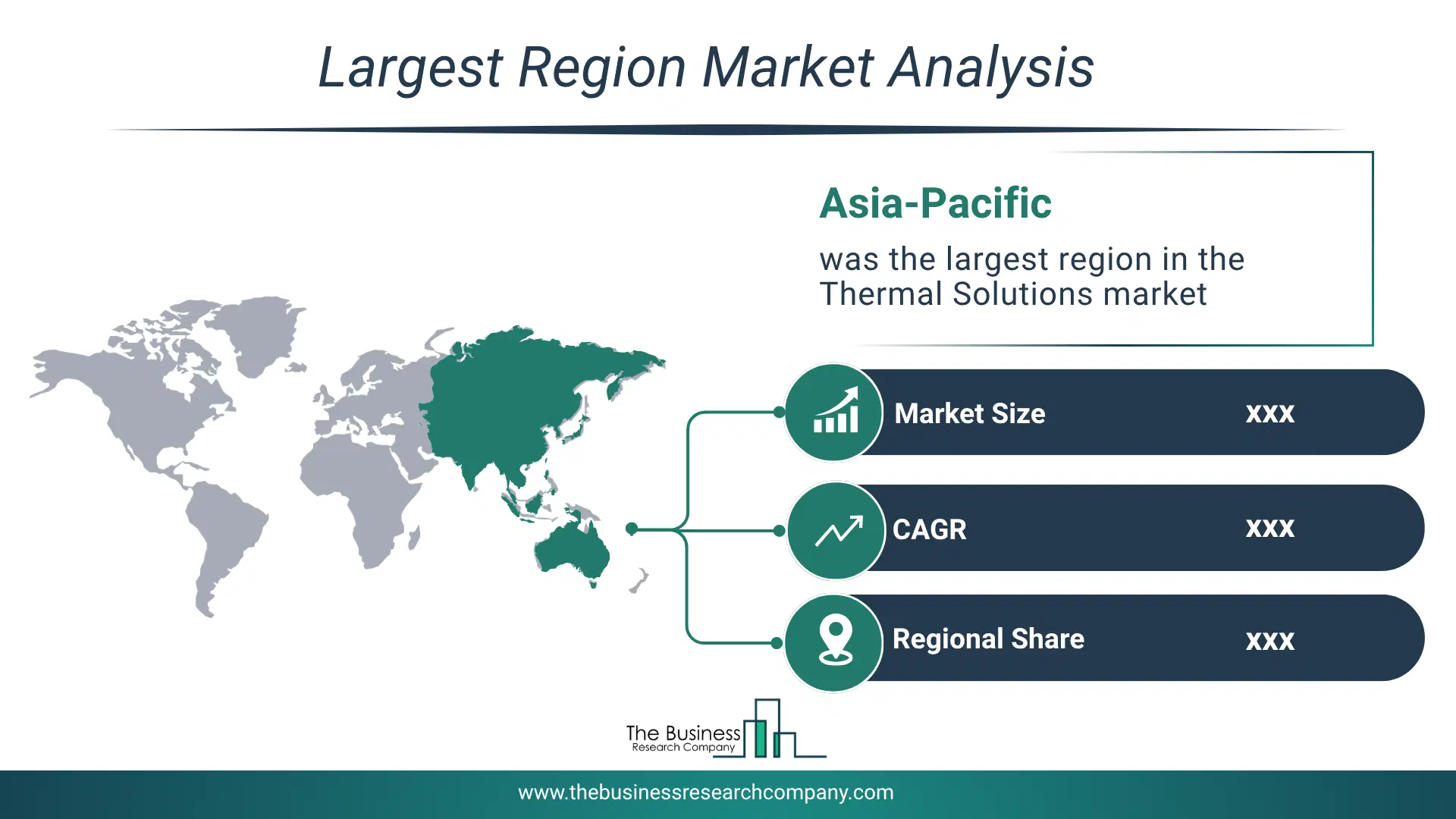
Regional Insights
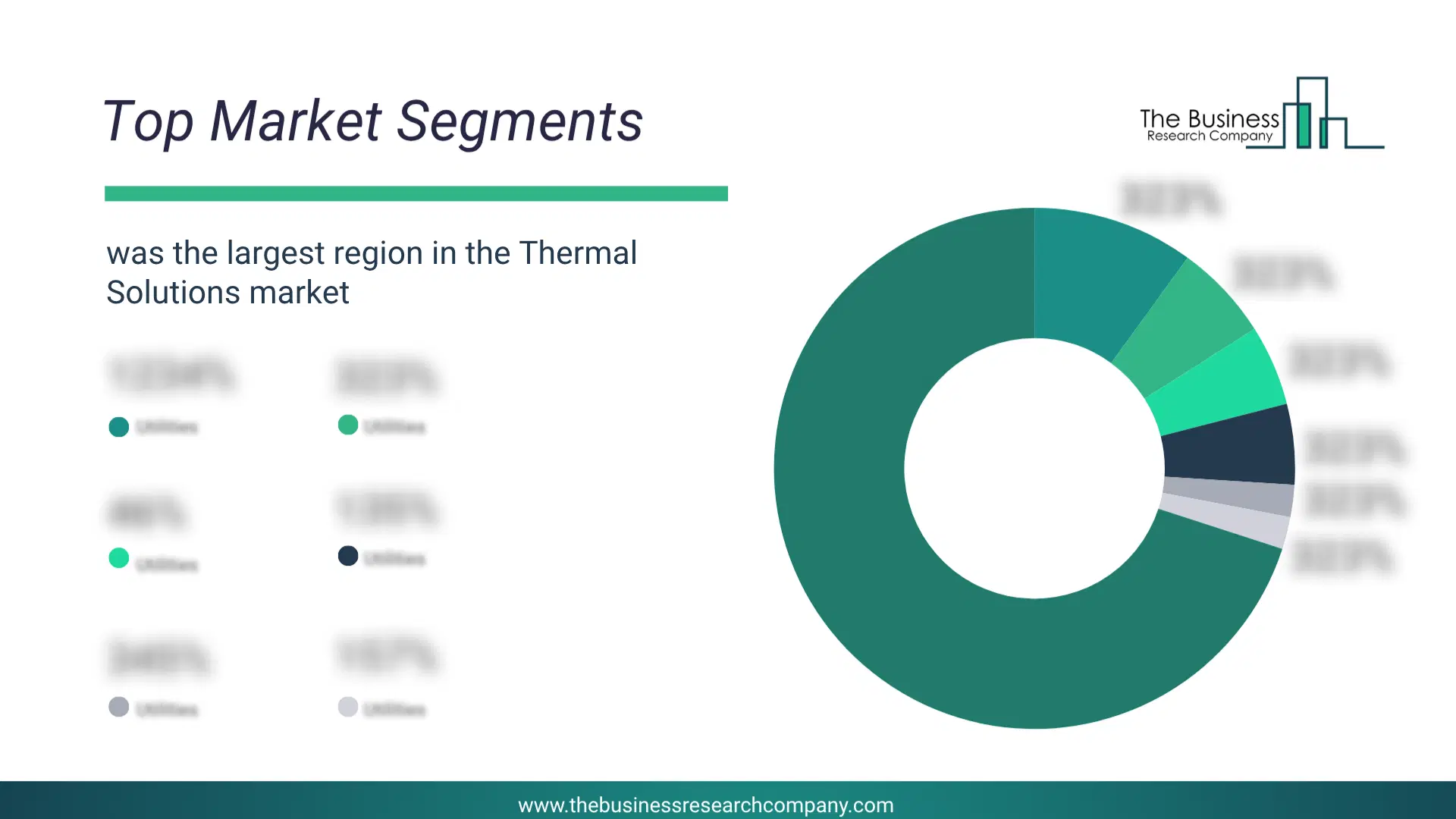
Asia-Pacific was the largest region in the thermal solutions market in 2025. North America is expected to be the fastest-growing region in the forecast period. The regions covered in this market report are Asia-Pacific, South East Asia, Western Europe, Eastern Europe, North America, South America, Middle East, Africa. The countries covered in this market report are Australia, Brazil, China, France, Germany, India, Indonesia, Japan, Taiwan, Russia, South Korea, UK, USA, Canada, Italy, Spain.What Defines the Thermal Solutions Market?
The thermal solutions market consists of revenues earned by entities by providing services such as thermal system design, heat load analysis, thermal simulation, and temperature monitoring and testing. The market value includes the value of related goods sold by the service provider or included within the service offering. The thermal solutions market also includes sales of thermal pads, phase change materials, cooling gels, and heat spreaders. Values in this market are ‘factory gate’ values, that is, the value of goods sold by the manufacturers or creators of the goods, whether to other entities (including downstream manufacturers, wholesalers, distributors, and retailers) or directly to end customers. The value of goods in this market includes related services sold by the creators of the goods.How is Market Value Defined and Measured?
The market value is defined as the revenues that enterprises gain from the sale of goods and/or services within the specified market and geography through sales, grants, or donations in terms of the currency (in USD unless otherwise specified). The revenues for a specified geography are consumption values that are revenues generated by organizations in the specified geography within the market, irrespective of where they are produced. It does not include revenues from resales along the supply chain, either further along the supply chain or as part of other products.
This chart presents market attractiveness based on a quantitative evaluation of growth, competition, strategic alignment, and risk, offering a clear view of opportunity areas for decision-making. This chart is for illustrative purposes; the full report contains the complete analysis.

This chart highlights the Total Addressable Market (TAM) by estimating the maximum revenue opportunity using an assumption-driven approach, supporting strategic planning and opportunity sizing across markets. The chart is illustrative; the full report provides a more comprehensive analysis.
What Key Data and Analysis Are Included in the Thermal Solutions Market Report 2026?
The thermal solutions market research report is one of a series of new reports from The Business Research Company that provides market statistics, including industry global market size, regional shares, competitors with the market share, detailed market segments, market trends and opportunities, and any further data you may need to thrive in the thermal solutions industry. The market research report delivers a complete perspective of everything you need, with an in-depth analysis of the current and future state of the industry.Thermal Solutions Market Report Forecast Analysis
| Report Attribute | Details |
|---|---|
| Market Size Value In 2026 | $17.06 billion |
| Revenue Forecast In 2030 | $23.6 billion |
| Growth Rate | CAGR of 8.50% from 2026 to 2030 |
| Base Year For Estimation | 2025 |
| Actual Estimates/Historical Data | 2020-2025 |
| Forecast Period | 2026 - 2030 |
| Market Representation | Revenue in USD Billion and CAGR from 2026 to 2030 |
| Segments Covered | Product Type, Electronic Component, Material Type, Cooling Method, End-Use Industry |
| Regional Scope | Asia-Pacific, Western Europe, Eastern Europe, North America, South America, Middle East, Africa |
| Country Scope | The countries covered in the report are Australia, Brazil, China, France, Germany, India, Indonesia, Japan, Taiwan, Russia, South Korea, UK, USA, Canada, Italy, Spain. |
| Key Companies Profiled | Schneider Electric SE; Danfoss A/S; Alfa Laval AB; Lennox International Inc.; NIBE Industrier AB; Modine Manufacturing Company; SPX Technologies Inc.; Voltas Limited; AAON Inc.; Munters Group AB; Systemair AB; Blue Star Limited; Güntner GmbH & Co. KG; Hisense HVAC Co. Ltd.; Zamil Air Conditioners Holding Co. Ltd.; Vertiv Holdings Co.; Delta Electronics, Inc.; Boyd Corporation; STULZ GmbH; Aavid Thermalloy |
| Customization Scope | Request for Customization |
| Pricing And Purchase Options | Explore Purchase Options |