
Liquid Cooling Systems Market Report 2026
Global Outlook – By Type ( Liquid Heat Exchanger Systems, Compressor-Based Systems), By Component ( Solution, Service), By End-Users ( BFSI (Banking, Financial Services, And Insurance), Manufacturing, IT And Telecom, Automotive, Retail, Government And Defense, Healthcare, Energy, Other End-Users) – Market Size, Trends, Strategies, and Forecast to 2030
Liquid Cooling Systems Market Overview
• Liquid Cooling Systems market size has reached to $7.04 billion in 2025 • Expected to grow to $17.73 billion in 2030 at a compound annual growth rate (CAGR) of 20.3% • Growth Driver: Impact Of Emerging Data Centers On Liquid Cooling Systems Market Growth • Market Trend: Impact Of Technological Advancements On The Liquid Cooling Systems Market • North America was the largest region in 2025.What Is Covered Under Liquid Cooling Systems Market?
Liquid cooling systems refer to a method used to lower the temperature of computer processor units (CPUs), and sometimes graphics processor units (GPUs). It is used to maintain the temperature of a computer system low by using water as a cooling medium. The main types of liquid cooling systems are liquid heat exchanger systems and compressor-based systems. A liquid heat exchanger is a device that transfers heat from one source to another through a working fluid. The main components are solutions and services, that are used by various industries such as BFSI, manufacturing, IT and telecom, automotive, retail, government and defense, healthcare, energy, and others.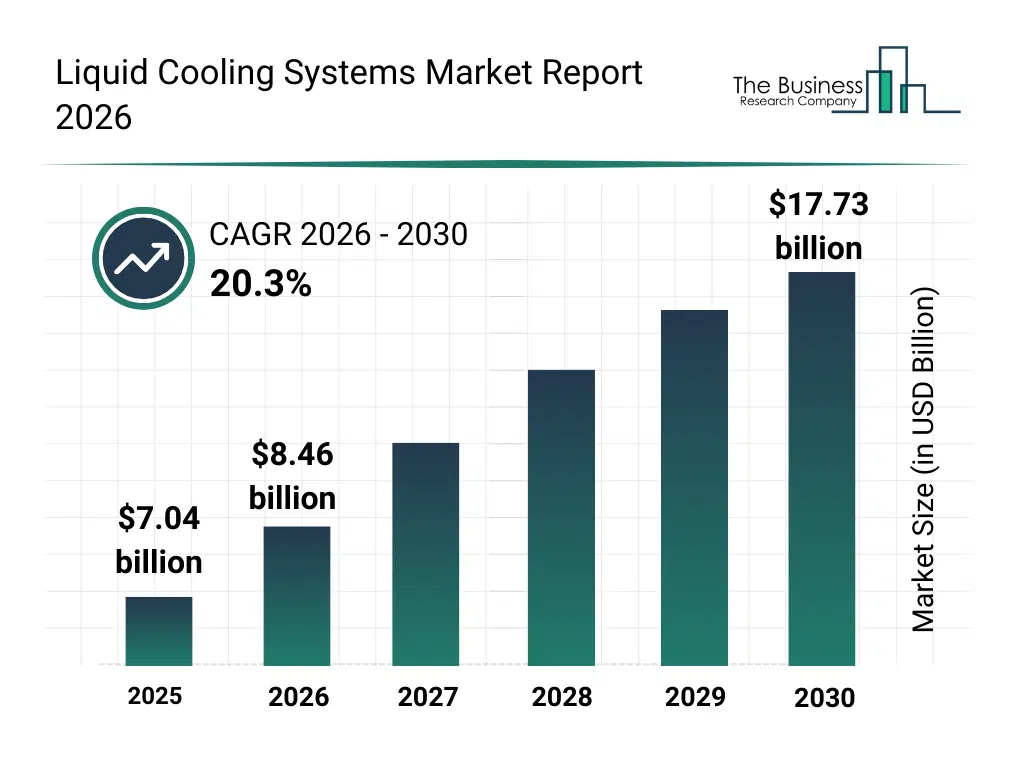
What Is The Liquid Cooling Systems Market Size 2026 And Growth Rate?
The liquid cooling systems market size has grown exponentially in recent years. It will grow from $7.04 billion in 2025 to $8.46 billion in 2026 at a compound annual growth rate (CAGR) of 20.2%. The growth in the historic period can be attributed to rise in cpu and gpu thermal loads, increasing adoption of data centers, growing need for high efficiency cooling systems, early use of liquid cooling in high performance computing, expansion of telecom and it infrastructure.What Is The Liquid Cooling Systems Market Growth Forecast?
The liquid cooling systems market size is expected to see exponential growth in the next few years. It will grow to $17.73 billion in 2030 at a compound annual growth rate (CAGR) of 20.3%. The growth in the forecast period can be attributed to rising demand for AI accelerated computing, increasing deployment of hyperscale data centers, growth in energy efficient cooling technologies, rising use of liquid cooling in industrial automation, increasing heat generation from compact electronic systems. Major trends in the forecast period include increasing adoption of high performance cooling for AI and data processing, growing integration of smart sensors and iot enabled monitoring in cooling systems, advancement in automated and intelligent thermal management solutions, rising demand for liquid cooling in high density industrial and cloud environments, shift toward sustainable and energy efficient cooling technologies.
Global Liquid Cooling Systems Market Segmentation
1) By Type: Liquid Heat Exchanger Systems, Compressor-Based Systems 2) By Component: Solution, Service 3) By End-Users: BFSI (Banking, Financial Services, And Insurance), Manufacturing, IT And Telecom, Automotive, Retail, Government And Defense, Healthcare, Energy, Other End-Users Subsegments: 1) By Liquid Heat Exchanger Systems: Plate Heat Exchangers, Shell and Tube Heat Exchangers, Fin Fan Coolers 2) By Compressor-Based Systems: Chiller Systems, Refrigerant-Based Liquid Cooling Systems, Heat Pump SystemsWhat Is The Driver Of The Liquid Cooling Systems Market?
The emergence of new data centers is a significant driver that will support the growth of the liquid cooling systems market in the forecast period. As the digital transformation and demand for cloud computing services continue to surge, data centers play a pivotal role in storing, managing, and processing vast amounts of data. However, data centers generate substantial heat from high-performance servers and networking equipment, necessitating efficient cooling solutions. Liquid cooling systems help data centers to handle high-power densities and provide superior heat dissipation. For instance, in September 2024, according to the National Telecommunications and Information Administration, a US-based government agency, the United States has around 5,000 data centers, and demand for these facilities is expected to increase by approximately 9% annually until 2030. Therefore, the emergence of new data centers is expected to drive the liquid cooling systems industry going forward.Key Players In The Global Liquid Cooling Systems Market
Major companies operating in the liquid cooling systems market are Schneider Electric SE, Vertiv Holdings Co, Rittal GmbH & Co KG, Emerson Electric Co., Boyd Corporation,Asetek Inc, CoolIT Systems, Green Revolution Cooling Inc., Iceotope Technologies Limited, LiquidCool Solutions, Inc., Fujitsu, Antec Inc., Prime ABGB, Vedant Computers, EK Water Blocks, Thermaltake Technology Co., Ltd., FormulaMod, Bykski, ID-Cooling, Barrowch, Stulz GmbH, XSPC, Phobya, Alphacool International GmbH, Laird Thermal Systems, DCX Liquid Cooling Systems, Kelvion, Baltimore Aircoil Company, RSC Group, Silent-Aire, AAON Inc, BasX, Corsair, NZXT, Swiftech, EVGA, Ascenty, ODATA, Terabyte, ChipArt, ACECO TI, UOL Diveo S.A., Daxtech IT Solutions, Emitac Data Systems, Prologix Distribution, Arabian Thermal Aire Industries Co. Ltd, Gulf Data Hub, Liquidstack
This chart is for illustrative purposes; the full report includes a detailed competitor analysis and comprehensive overview of the top 10 companies in the market.
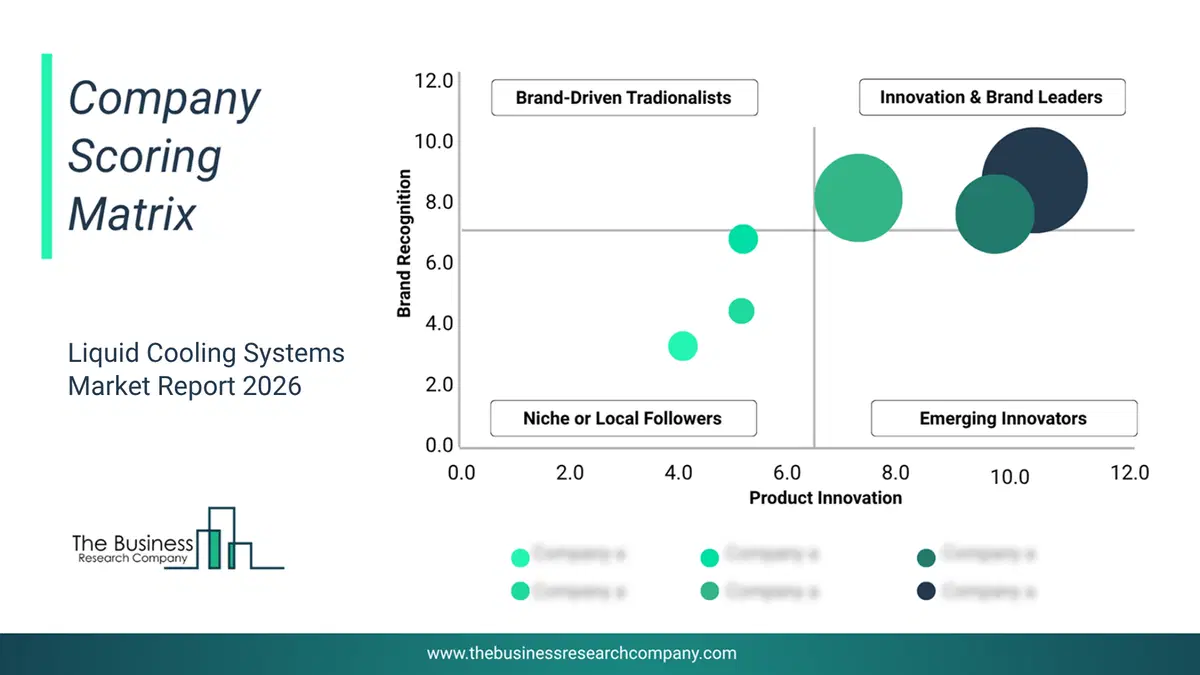
This chart maps companies by product innovation and brand strength, with bubble size indicating relative revenue, helping identify market leaders, challengers, and niche players. This is an illustrative chart; the full report provides a complete and accurate competitive analysis.
Global Liquid Cooling Systems Market Trends and Insights
Major companies operating in the liquid cooling system market are focusing on developing advanced technologies such as high-efficiency liquid cooling modules, compact microchannel cold plates, immersion cooling solutions, AI-integrated thermal management systems, and environmentally sustainable coolants to enhance heat dissipation performance, reduce energy consumption, to sustain their position in the liquid cooling system market. High-efficiency liquid cooling modules are advanced thermal management units designed to rapidly transfer and dissipate heat from high-performance electronic components using optimized fluid flow and heat exchange mechanisms. For instance, in February 2025, Vertiv, a United States-based provider of critical digital-infrastructure and continuity solutions, launched “Vertiv Liquid Cooling Services”, an innovative service portfolio for the liquid-cooling market that provides end-to-end support, covering design, installation, commissioning, fluid management, maintenance and digital services,for high-density, AI-driven compute environments; this offering integrates liquid-cooling systems with IT racks and adjacent infrastructure, ensures cleanliness and optimized fluid loops, and enables operators to deploy up to 30 kW+ racks (and beyond) with greater availability, efficiency and sustainability.What Are Latest Mergers And Acquisitions In The Liquid Cooling Systems Market?
In July 2023, Kohlberg Kravis Roberts & Co. L.P. (KKR), a US-based investment acquired CoolIT Systems for an undisclosed amount. This acquisition is in line with KKR's strategy to invest in innovative technology companies that develop advanced cooling solutions, especially in the realms of data centers and high-performance computing. CoolIT Systems is a Canada-based company that provides liquid cooling solutions designed for high-performance computing environments and data centers.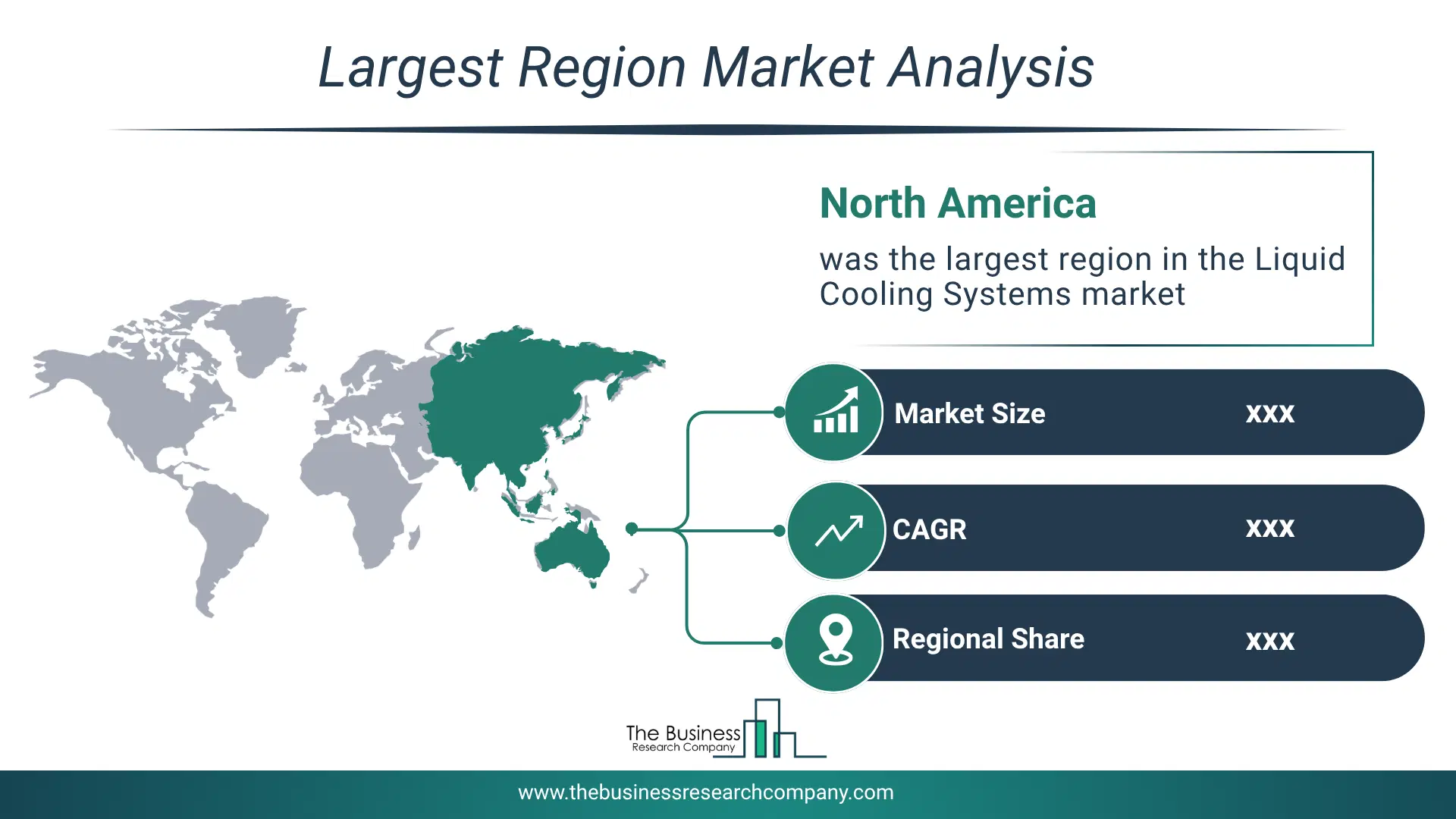
Regional Outlook
North America was the largest region in the liquid cooling systems market in 2025. The regions covered in this market report are Asia-Pacific, South East Asia, Western Europe, Eastern Europe, North America, South America, Middle East, Africa. The countries covered in this market report are Australia, Brazil, China, France, Germany, India, Indonesia, Japan, Taiwan, Russia, South Korea, UK, USA, Canada, Italy, Spain.What Defines the Liquid Cooling Systems Market?
The liquid cooling systems market consists of revenues earned by entities by providing services such as temperature control, variable flow control, bypass control. The market value includes the value of related goods sold by the service provider or included within the service offering. The liquid cooling system market also includes sales of Water, deionized water, glycol/water solutions, and dielectric fluids which are used in providing liquid cooling systems services. Values in this market are ‘factory gate’ values, that is the value of goods sold by the manufacturers or creators of the goods, whether to other entities (including downstream manufacturers, wholesalers, distributors and retailers) or directly to end customers. The value of goods in this market includes related services sold by the creators of the goods.How is Market Value Defined and Measured?
The market value is defined as the revenues that enterprises gain from the sale of goods and/or services within the specified market and geography through sales, grants, or donations in terms of the currency (in USD unless otherwise specified). The revenues for a specified geography are consumption values that are revenues generated by organizations in the specified geography within the market, irrespective of where they are produced. It does not include revenues from resales along the supply chain, either further along the supply chain or as part of other products.
This chart presents market attractiveness based on a quantitative evaluation of growth, competition, strategic alignment, and risk, offering a clear view of opportunity areas for decision-making. This chart is for illustrative purposes; the full report contains the complete analysis.

This chart highlights the Total Addressable Market (TAM) by estimating the maximum revenue opportunity using an assumption-driven approach, supporting strategic planning and opportunity sizing across markets. The chart is illustrative; the full report provides a more comprehensive analysis.
What Key Data and Analysis Are Included in the Liquid Cooling Systems Market Report 2026?
The liquid cooling systems market research report is one of a series of new reports from The Business Research Company that provides market statistics, including industry global market size, regional shares, competitors with the market share, detailed market segments, market trends and opportunities, and any further data you may need to thrive in the liquid cooling systems industry. The market research report delivers a complete perspective of everything you need, with an in-depth analysis of the current and future state of the industry.Liquid Cooling Systems Market Report Forecast Analysis
| Report Attribute | Details |
|---|---|
| Market Size Value In 2026 | $8.46 billion |
| Revenue Forecast In 2030 | $17.73 billion |
| Growth Rate | CAGR of 20.3% from 2026 to 2030 |
| Base Year For Estimation | 2025 |
| Actual Estimates/Historical Data | 2020-2025 |
| Forecast Period | 2026 - 2030 |
| Market Representation | Revenue in USD Billion and CAGR from 2026 to 2030 |
| Segments Covered | Type, Component, End-Users |
| Regional Scope | Asia-Pacific, Western Europe, Eastern Europe, North America, South America, Middle East, Africa |
| Country Scope | The countries covered in the report are Australia, Brazil, China, France, Germany, India, Indonesia, Japan, Taiwan, Russia, South Korea, UK, USA, Canada, Italy, Spain. |
| Key Companies Profiled | Schneider Electric SE, Vertiv Holdings Co, Rittal GmbH & Co KG, Emerson Electric Co., Boyd Corporation,Asetek Inc, CoolIT Systems, Green Revolution Cooling Inc., Iceotope Technologies Limited, LiquidCool Solutions, Inc., Fujitsu, Antec Inc., Prime ABGB, Vedant Computers, EK Water Blocks, Thermaltake Technology Co., Ltd., FormulaMod, Bykski, ID-Cooling, Barrowch, Stulz GmbH, XSPC, Phobya, Alphacool International GmbH, Laird Thermal Systems, DCX Liquid Cooling Systems, Kelvion, Baltimore Aircoil Company, RSC Group, Silent-Aire, AAON Inc, BasX, Corsair, NZXT, Swiftech, EVGA, Ascenty, ODATA, Terabyte, ChipArt, ACECO TI, UOL Diveo S.A., Daxtech IT Solutions, Emitac Data Systems, Prologix Distribution, Arabian Thermal Aire Industries Co. Ltd, Gulf Data Hub, Liquidstack |
| Customization Scope | Request for Customization |
| Pricing And Purchase Options | Explore Purchase Options |