

Thin Wafer Market Report 2026
Global Outlook – By Wafer Size ( 125 Mm, 200 Mm, 300 Mm), By Process ( Temporary Bonding And Debonding, Carrier-Less Or Taiko Process), By Technology ( Wafer Grinding, Wafer Polishing, Wafer Dicing), By Application ( MEMS, CIS, RF Devices, LED, Interposer, Logic, Other Applications) – Market Size, Trends, Strategies, and Forecast to 2030
Thin Wafer Market Overview
• Thin Wafer market size has reached to $12.57 billion in 2025 • Expected to grow to $19.45 billion in 2030 at a compound annual growth rate (CAGR) of 9.1% • Growth Driver: Internet Of Things (IOT) Adoption Fuels Thin Wafer Market Expansion • Market Trend: Adoption Of Ultra-Thin Silicon Power Wafers Drives High-Efficiency, High-Density Semiconductor Solutions • Asia-Pacific was the largest region and fastest growing region.Market Gains By 2030 – Top Opportunities By Segment
Market Gain identifies the most promising market opportunities by highlighting the segments or products expected to generate the highest incremental revenue growth over the next five years.
What Is Covered Under Thin Wafer Market?
Thin wafers are the building blocks used in producing semiconductor devices through mechanical grinding and stress reduction. The main sizes of thin wafers are 125 mm, 200 mm, and 300 mm. 125 mm-sized wafers are applied to durable, shatterproof semiconductor wafers as a base material. Major process types involved in thin wafer are temporary bonding and debonding, carrier-less or taiko process. Several technologies involved in thin wafers are wafer grinding, wafer polishing, and wafer dicing. A thin wafer is used by several applications, such as MEMS, CIS, RF devices, LED, interposers, logic, and other applications.
What Is The Thin Wafer Market Size 2026 And Growth Rate?
The thin wafer market size has grown strongly in recent years. It will grow from $12.57 billion in 2025 to $13.74 billion in 2026 at a compound annual growth rate (CAGR) of 9.3%. The growth in the historic period can be attributed to early semiconductor fabrication expansion, adoption of traditional wafer grinding techniques, growth in mems and led device production, reliance on manual wafer inspection, increased use of standard wafer thinning processes.What Is The Thin Wafer Market Growth Forecast?
The thin wafer market size is expected to see strong growth in the next few years. It will grow to $19.45 billion in 2030 at a compound annual growth rate (CAGR) of 9.1%. The growth in the forecast period can be attributed to rising demand for advanced semiconductor packaging, increasing adoption of thin wafers in 5g and AI chips, expansion of high-density device architectures, growth in logic and cmos image sensor production, development of wafer-level manufacturing innovations. Major trends in the forecast period include advancement of automated thin wafer processing, expansion of digital wafer manufacturing platforms, integration of IoT-enabled wafer monitoring systems, development of AI-based precision wafer grinding, growth of ev-focused semiconductor wafer production.
Global Thin Wafer Market Segmentation
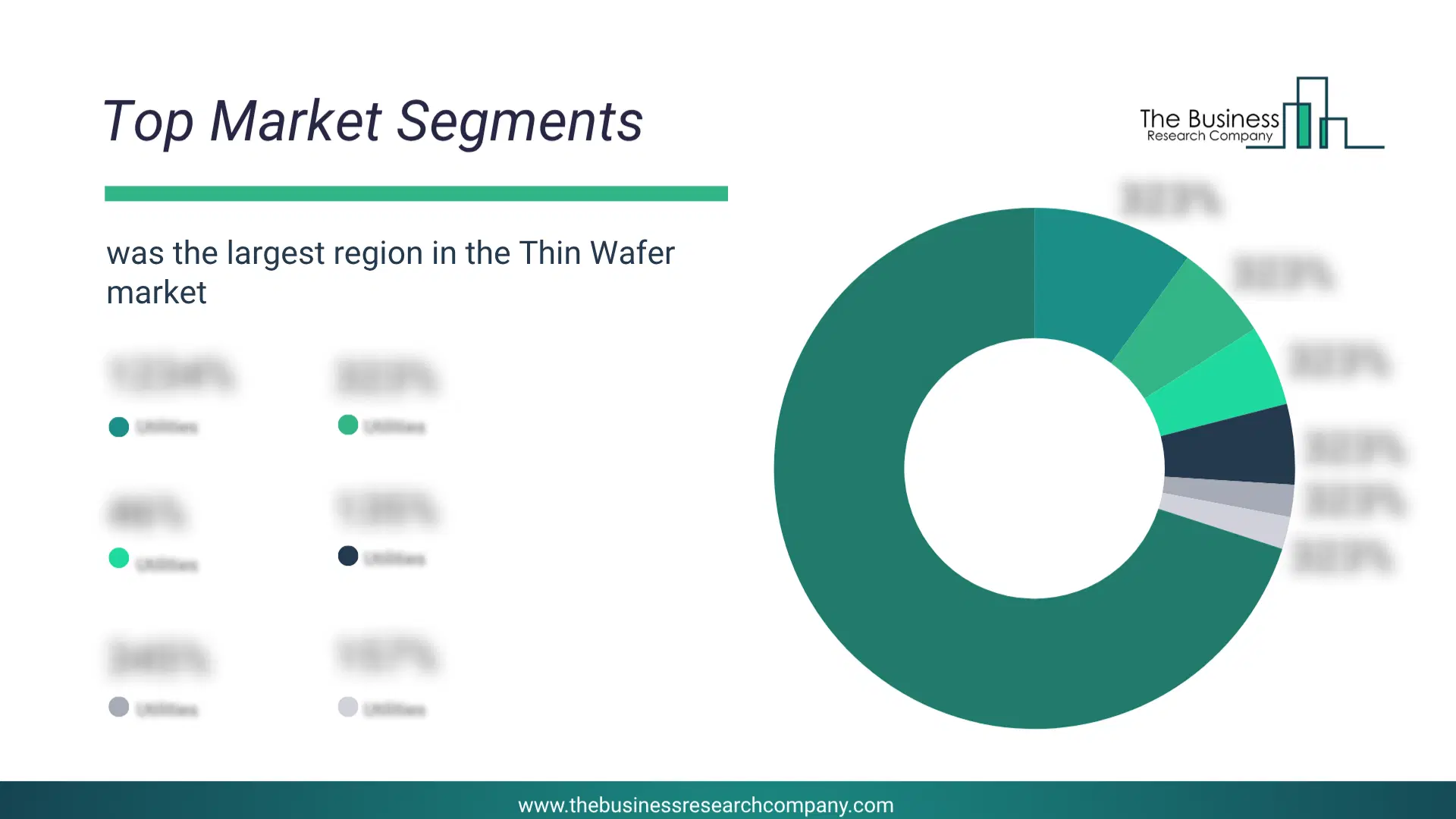
1) By Wafer Size: 125 Mm, 200 Mm, 300 Mm 2) By Process: Temporary Bonding And Debonding, Carrier-Less Or Taiko Process 3) By Technology: Wafer Grinding, Wafer Polishing, Wafer Dicing 4) By Application: MEMS, CIS, RF Devices, LED, Interposer, Logic, Other Applications Subsegments: 1) By 125 mm: Standard Thin Wafers, Specialty Thin Wafers 2) By 200 mm: Standard Thin Wafers, Specialty Thin Wafers 3) By 300 mm: Standard Thin Wafers, Specialty Thin Wafers The top segments in the thin wafer market will be: • 300 mm will reach $10 Billion by 2030. • 200 mm will reach $6 Billion by 2030. • 125 mm will reach $4 Billion by 2030.What Is The Driver Of The Thin Wafer Market?
The rising adoption of Internet of Things (IoT) devices is expected to propel the growth of the thin wafer market going forward. The Internet of Things (IoT) refers to the overall network of interconnected devices as well as the technology that enables communication between them and with the cloud. IoT devices play an important role in thin wafer manufacturing by enabling real-time monitoring and data collection, optimizing production processes, and enhancing quality control. For instance, in October 2025, according to IoT Analytics, a Germany-basedcompany that offers information on IoT, it was reported that in 2024, the number of connected IoT devices worldwide reached approximately 18.5 billion, reflecting a 12% growth compared to 2023. Additionally,the total number of connected devices is expected to increase by 14% year-over-year, reaching around 21.1 billion by the end of 2025. Therefore, the rising adoption of the Internet of Things (IoT) is driving the growth of the thin wafer industry.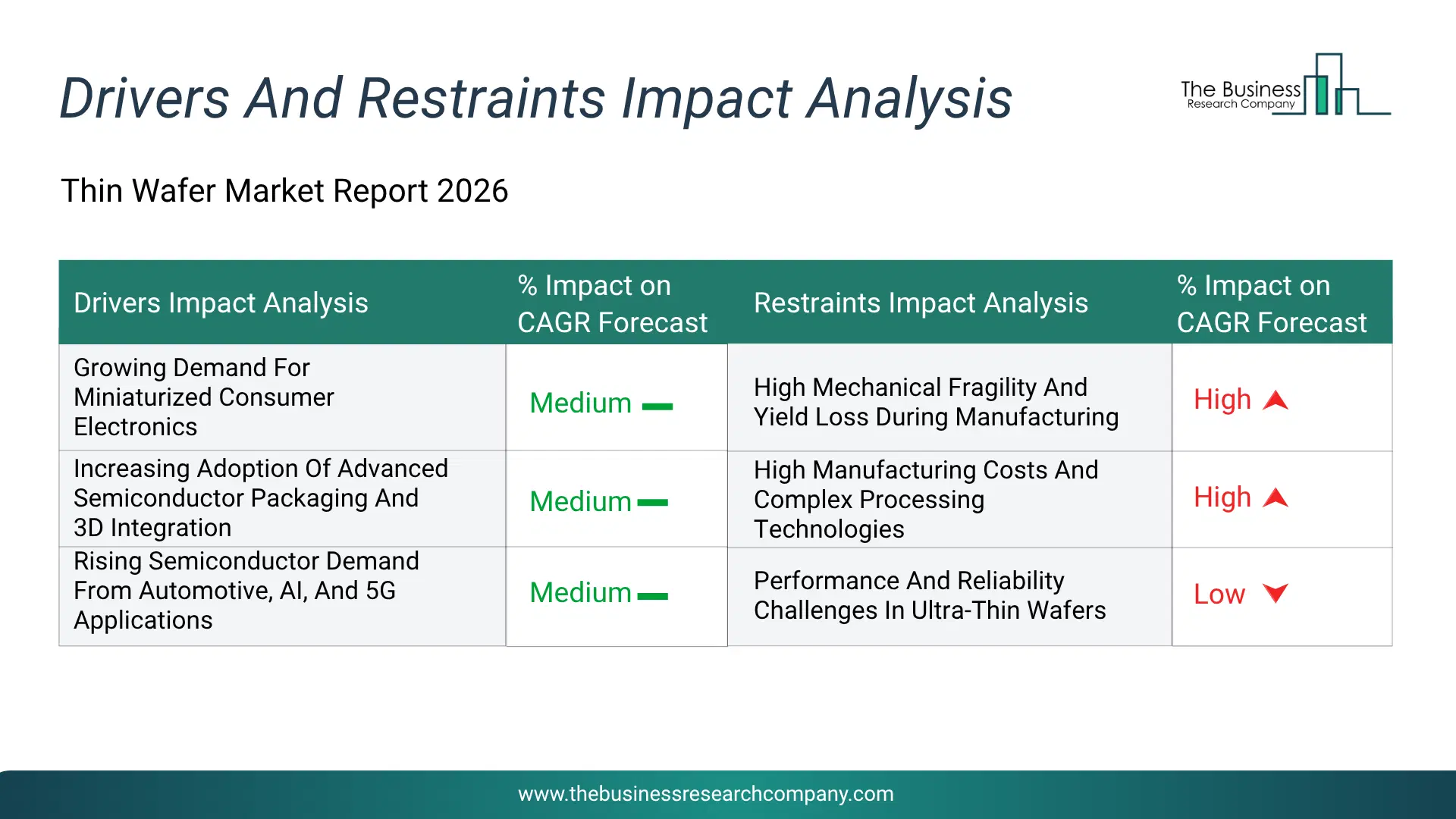
Infographic Chart Showing Key Market Drivers Analysis And Restraints For Thin Wafer Market
The chart presents an impact analysis of key drivers and restraints, quantifying their relative influence on the market's growth rate and helping assess the balance between growth enablers and limiting factors. This chart offers a high-level perspective; the full report contains more detailed insights.
How Will The Drivers Impact Growth In The Global Thin Wafer Market?
• Growing Demand For Miniaturized Consumer Electronics (Medium) – During the forecast period, the growing demand for miniaturized consumer electronics is expected to emerge as a major factor driving the expansion of the thin wafer market by 2030. the increasing popularity of smartphones, wearables, tablets, AR/VR devices, and other compact electronic products is creating strong demand for thinner semiconductor chips that deliver higher performance within smaller form factors. thin wafers enable lightweight device designs, improve thermal management, and support high-density semiconductor integration, making them essential for next-generation portable electronics. • Increasing Adoption Of Advanced Semiconductor Packaging And 3D Integration (Medium) – During the forecast period, the increasing adoption of advanced semiconductor packaging and 3D integration is expected to emerge as a major factor driving the expansion of the thin wafer market by 2030. this is because technologies such as 3D integrated circuits, wafer-level packaging, fan-out wafer-level packaging, and chiplet architectures require ultra-thin wafers to enable compact, high-performance semiconductor designs. these advanced packaging approaches improve signal transmission, reduce power consumption, and enhance thermal efficiency, supporting continued innovation across advanced computing and communication applications. • Rising Semiconductor Demand From Automotive, AI, And 5G Applications (Medium) – During the forecast period, the rising semiconductor demand from automotive, AI, and 5G applications is expected to act as a key growth catalyst for the thin wafer market by 2030. expanding deployment of electric vehicles, autonomous driving technologies, AI processors, industrial IoT devices, advanced sensors, and next-generation communication infrastructure is increasing the need for high-performance semiconductor components manufactured using thin wafer technologies. growing investments in global semiconductor fabrication capacity are further strengthening long-term market demand.How Will The Restraints Impact Growth In The Global Thin Wafer Market?
• High Mechanical Fragility And Yield Loss During Manufacturing (Medium) – During the forecast period, high Mechanical Fragility And Yield Loss During Manufacturing remains one of the most significant restraints affecting the thin wafer market. As semiconductor wafers are thinned to extremely small thicknesses, they become increasingly vulnerable to cracking, chipping, warping, edge damage, and breakage during grinding, polishing, cleaning, transportation, bonding, debonding, and packaging processes. Even minor mechanical defects can lead to substantial wafer losses, reduced production yields, increased material waste, and higher manufacturing costs. Manufacturers therefore need highly sophisticated handling systems, automated inspection equipment, and advanced process control technologies to minimize wafer damage. These additional investments increase production complexity and limit adoption among smaller fabrication facilities with limited capital resources. • High Manufacturing Costs And Complex Processing Technologies (Medium) – During the forecast period, high Manufacturing Costs And Complex Processing Technologies continue to restrict broader market expansion. Producing ultra-thin wafers involves multiple highly precise manufacturing steps, including mechanical grinding, chemical mechanical polishing (CMP), stress relief treatments, temporary wafer bonding, debonding, laser processing, and precision metrology. These sophisticated processes require expensive manufacturing equipment, cleanroom infrastructure, highly skilled technical personnel, and continuous quality assurance to maintain extremely tight dimensional tolerances. The substantial capital expenditure associated with establishing and operating these facilities increases the overall production cost of thin wafers and creates significant barriers for new entrants and smaller semiconductor manufacturers, slowing market penetration in cost-sensitive regions. • Performance And Reliability Challenges In Ultra-Thin Wafers (Medium) – During the forecast period, performance And Reliability Challenges In Ultra-Thin Wafers present another key challenge for market growth. Although wafer thinning improves device miniaturization and enables advanced semiconductor packaging, excessively thin wafers may experience reduced mechanical stability, increased stress accumulation, deformation during thermal processing, and greater susceptibility to defects during fabrication and assembly. These issues can negatively affect device reliability, production efficiency, and long-term operational performance, particularly in demanding applications such as automotive electronics, aerospace systems, industrial equipment, and high-performance computing. As manufacturers continue pursuing thinner semiconductor substrates, significant research and development investments are required to improve wafer strength, handling techniques, and process reliability, increasing both development timelines and manufacturing costs.Key Players In The Global Thin Wafer Market
Major companies operating in the thin wafer market are 3M Company, Applied Materials Inc., Brewer Science Inc., DISCO Corporation, EV Group, GlobalWafers Co. Ltd., Shin-Estu Chemical Co. Ltd., Sil'tronix Silicon Technologies, SK Siltron Co. Ltd., SUMCO Corporation, SUSS MicroTec, Synova S A, Virginia Semiconductor Inc., ULVAC GmbH, Wafer Works Corporation, Atecom Technology Co. Ltd., UniversityWafer Inc., Mechatronic Systemtechnik GmbH, Soitec, My-Chip Production GmbH, Polishing Corporation of America, Kulicke & Soffa Industries Inc., LG Siltronic, Han's Laser Technology Industry Group Co. Ltd., ASM Pacific Technology Ltd., Aixtron SE, SPTS Technologies Limited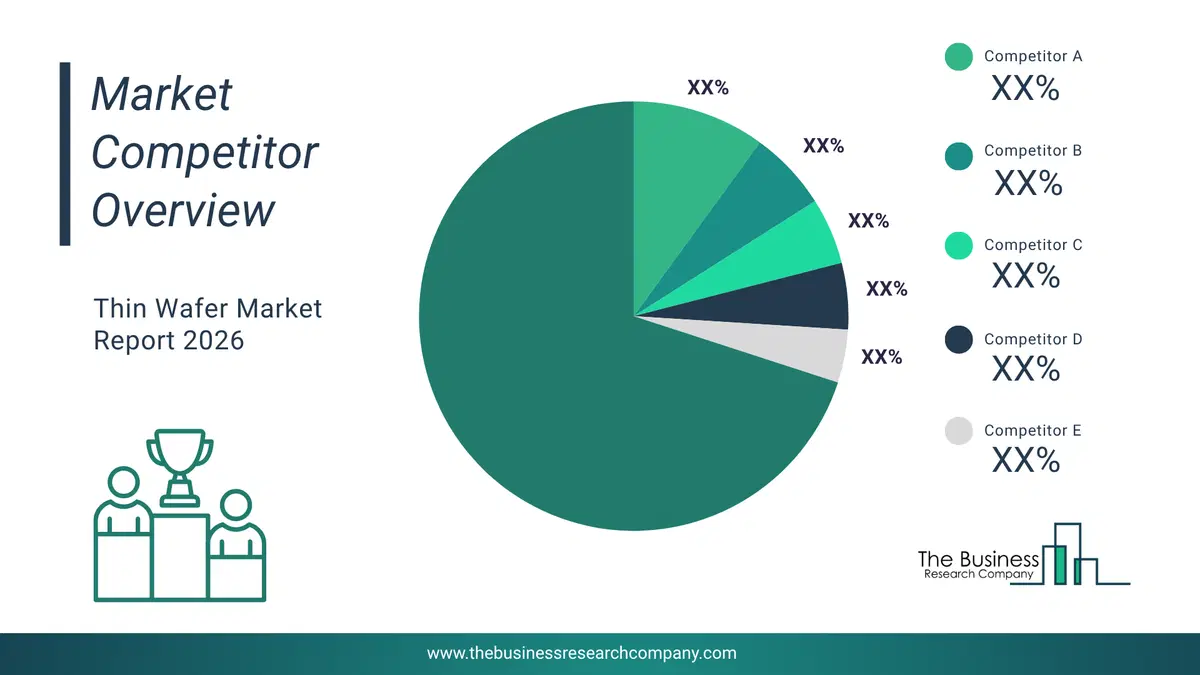
This chart is for illustrative purposes; the full report includes a detailed competitor analysis and comprehensive overview of the top 10 companies in the market.
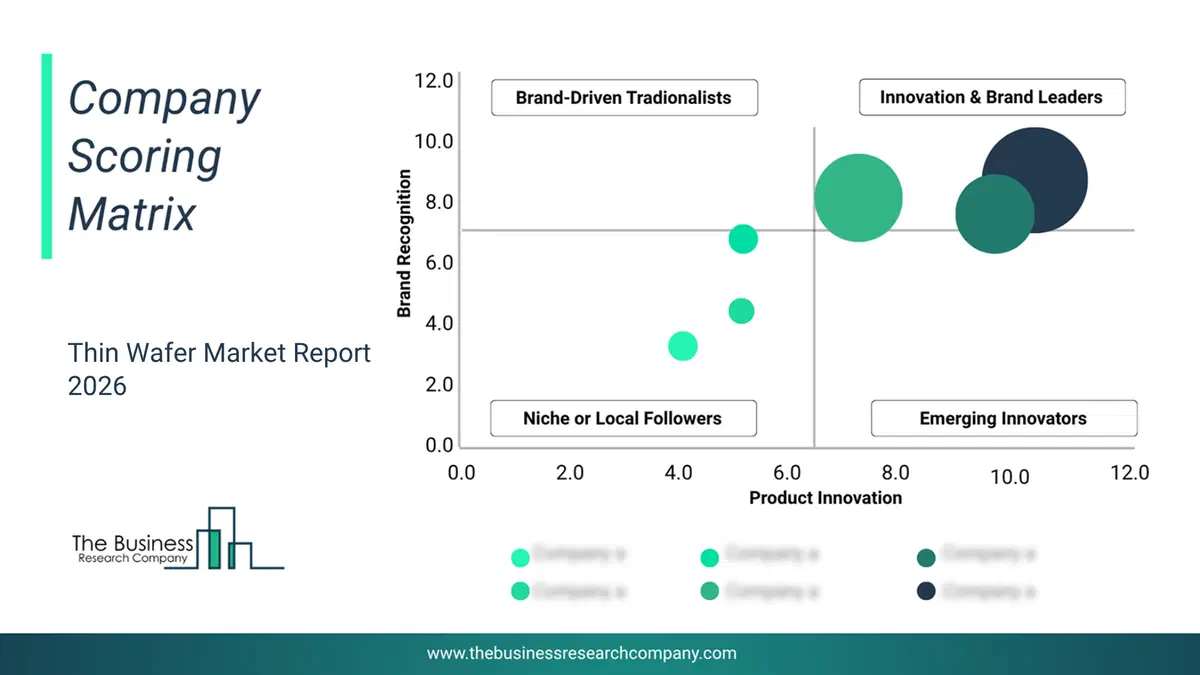
This chart maps companies by product innovation and brand strength, with bubble size indicating relative revenue, helping identify market leaders, challengers, and niche players. This is an illustrative chart; the full report provides a complete and accurate competitive analysis.
Global Thin Wafer Market Trends and Insights
Major companies operating in the thin wafer market are focusing on advanced innovations such as ultra-thin silicon power wafers to enhance energy efficiency, improve power density, reduce losses, and support high-performance applications in AI, consumer electronics, and industrial automation. Ultra-thin silicon power wafers, with thicknesses as low as 20 micrometers, allow for lower substrate resistance, reduced power loss, and more compact and reliable power conversion solutions. For instance, in October 2024, Infineon Technologies AG, a Germany-based semiconductor manufacturer, unveiled the world’s thinnest 20-micrometer silicon power wafer with a diameter of 300 millimeters. The technology improves efficiency in DC-DC converters, AI data centers, and motor control applications while leveraging existing high-volume manufacturing processes, positioning Infineon at the forefront of semiconductor innovation and enabling next-generation decarbonization and digitalization initiatives.What Are Latest Mergers And Acquisitions In The Thin Wafer Market?
In April 2025, Black Semiconductor, a US-based graphene technology company, acquired Applied Nanolayers (ANL), for an undisclosed amount. With this acquisition, Black Semiconductor aims to accelerate the development of energy-efficient, high-performance chip technology by combining its expertise in chip architectures and photonic processes with ANL’s specialized graphene production capabilities. Applied Nanolayers,is a US-basedcompany that offers thin wafer.
Regional Outlook
Asia-Pacific was the largest region in the thin wafer market analysis in 2025. Asia-Pacific is expected to be the fastest-growing region in the forecast period. The regions covered in this market report are Asia-Pacific, South East Asia, Western Europe, Eastern Europe, North America, South America, Middle East, Africa. The countries covered in this market report are Australia, Brazil, China, France, Germany, India, Indonesia, Japan, Taiwan, Russia, South Korea, UK, USA, Canada, Italy, Spain.What Defines the Thin Wafer Market?
The thin wafer market consists of sales of silicon wafers and sapphire wafers. Values in this market are ‘factory gate’ values, that is the value of goods sold by the manufacturers or creators of the goods, whether to other entities (including downstream manufacturers, wholesalers, distributors and retailers) or directly to end customers. The value of goods in this market includes related services sold by the creators of the goods. The thin wafer market is segmented into silicon wafers, sapphire wafers and other wafers.How is Market Value Defined and Measured?
The market value is defined as the revenues that enterprises gain from the sale of goods and/or services within the specified market and geography through sales, grants, or donations in terms of the currency (in USD unless otherwise specified). The revenues for a specified geography are consumption values that are revenues generated by organizations in the specified geography within the market, irrespective of where they are produced. It does not include revenues from resales along the supply chain, either further along the supply chain or as part of other products.
This chart presents market attractiveness based on a quantitative evaluation of growth, competition, strategic alignment, and risk, offering a clear view of opportunity areas for decision-making. This chart is for illustrative purposes; the full report contains the complete analysis.

This chart highlights the Total Addressable Market (TAM) by estimating the maximum revenue opportunity using an assumption-driven approach, supporting strategic planning and opportunity sizing across markets. The chart is illustrative; the full report provides a more comprehensive analysis.
What Key Data and Analysis Are Included in the Thin Wafer Market Report 2026?
The thin wafer market research report is one of a series of new reports from The Business Research Company that provides market statistics, including industry global market size, regional shares, competitors with the market share, detailed market segments, market trends and opportunities, and any further data you may need to thrive in the thin wafer industry. The market research report delivers a complete perspective of everything you need, with an in-depth analysis of the current and future state of the industry.Thin Wafer Market Report 2026 Market Report Forecast Analysis
| Report Attribute | Details |
|---|---|
| Market Size Value In 2026 | $13.74 billion |
| Revenue Forecast In 2030 | $19.45 billion |
| Growth Rate | CAGR of 9.1% from 2026 to 2030 |
| Base Year For Estimation | 2025 |
| Actual Estimates/Historical Data | 2020-2025 |
| Forecast Period | 2026 - 2030 |
| Market Representation | Revenue in USD Billion and CAGR from 2026 to 2030 |
| Segments Covered | Wafer Size, Process, Technology, Application |
| Regional Scope | Asia-Pacific, Western Europe, Eastern Europe, North America, South America, Middle East, Africa |
| Country Scope | The countries covered in the report are Australia, Brazil, China, France, Germany, India, Indonesia, Japan, Taiwan, Russia, South Korea, UK, USA, Canada, Italy, Spain. |
| Key Companies Profiled | 3M Company, Applied Materials Inc., Brewer Science Inc., DISCO Corporation, EV Group, GlobalWafers Co. Ltd., Shin-Estu Chemical Co. Ltd., Sil'tronix Silicon Technologies, SK Siltron Co. Ltd., SUMCO Corporation, SUSS MicroTec, Synova S A, Virginia Semiconductor Inc., ULVAC GmbH, Wafer Works Corporation, Atecom Technology Co. Ltd., UniversityWafer Inc., Mechatronic Systemtechnik GmbH, Soitec, My-Chip Production GmbH, Polishing Corporation of America, Kulicke & Soffa Industries Inc., LG Siltronic, Han's Laser Technology Industry Group Co. Ltd., ASM Pacific Technology Ltd., Aixtron SE, SPTS Technologies Limited |
| Customization Scope | Request for Customization |
| Pricing And Purchase Options | Explore Purchase Options |