

Tower Crane Market Report 2026
Global Outlook – By Type (Hammerhead Cranes, Flat Top Cranes, Luffing Jib Cranes, Self-Erecting Cranes), By Fuel Type (Electric, Diesel, Hybrid), By Capacity (Up To 5 Tons, 6–10 Tons, 11–20 Tons, 21–50 Tons, Above 50 Tons), By Sales Channel (Direct Sales, Distributors, Online Sales, Rental Services), By End-User (Infrastructure, Construction, Energy And Power, Other End-Users) – Market Size, Trends, Strategies, and Forecast to 2030
Tower Crane Market Overview
• Tower Crane market size has reached to $6.36 billion in 2025 • Expected to grow to $8.64 billion in 2030 at a compound annual growth rate (CAGR) of 6.2% • Growth Driver: Rise In Construction Projects Driving The Growth Of The Market Due To Increasing Urbanization And Infrastructure Development • Market Trend: High-Performance Luffing Jib Cranes For Dense Urban Construction • Asia-Pacific was the largest region and fastest growing region.What Is Covered Under Tower Crane Market?
A tower crane is a tall, fixed crane commonly used in the construction of high-rise buildings and large structures, capable of lifting heavy materials to significant heights. Its purpose is to provide efficient vertical and horizontal movement of construction materials, improving productivity and safety on construction sites. The main types of tower cranes are hammerhead cranes, flat-top cranes, luffing jib cranes, and self-erecting cranes. Hammerhead cranes are large, fixed-jib cranes with a horizontal, rotating boom mounted on a tall tower, commonly used in shipyards and heavy industrial construction for lifting and moving heavy loads. They are available in different power options, including electric, diesel, and hybrid, with various capacities ranging from up to 5 tons, 6–10 tons, 11–20 tons, 21–50 tons, and above 50 tons. These cranes are sold through various channels such as direct sales, distributors, online sales, and rental services, and their end-users include the infrastructure, construction, energy and power sectors, and others.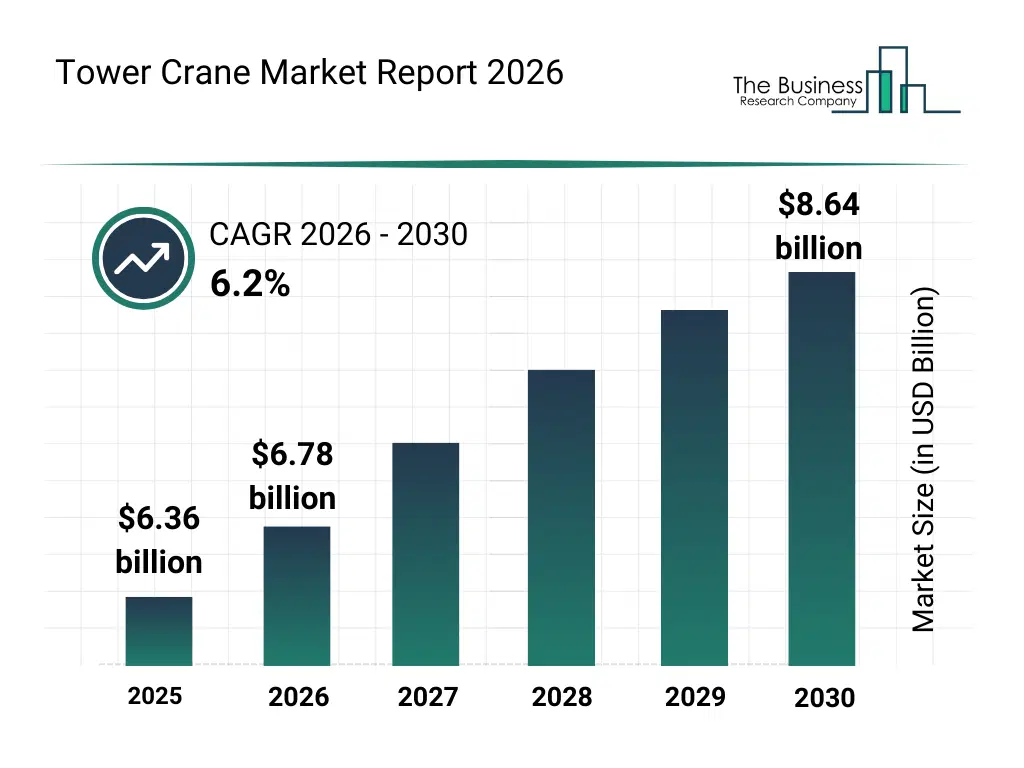
What Is The Tower Crane Market Size and Share 2026?
The tower crane market size has grown strongly in recent years. It will grow from $6.36 billion in 2025 to $6.78 billion in 2026 at a compound annual growth rate (CAGR) of 6.6%. The growth in the historic period can be attributed to urbanization trends, infrastructure development, commercial building projects, demand for vertical construction, availability of skilled operators.What Is The Tower Crane Market Growth Forecast?
The tower crane market size is expected to see strong growth in the next few years. It will grow to $8.64 billion in 2030 at a compound annual growth rate (CAGR) of 6.2%. The growth in the forecast period can be attributed to smart city projects, sustainable construction practices, investment in infrastructure, demand for automated cranes, growth of megacities. Major trends in the forecast period include growth in high rise construction, adoption of electric tower cranes, demand for high load capacity cranes, expansion of crane rental services, focus on site safety enhancements.Tariff Impact On Tower Crane Market
Tariffs have impacted the tower crane market by increasing costs of steel components, drive systems, and electronic controls. Asia Pacific and Europe are most affected. Equipment prices have risen. However, tariffs are supporting regional manufacturing and assembly capabilities.
Global Tower Crane Market Segmentation
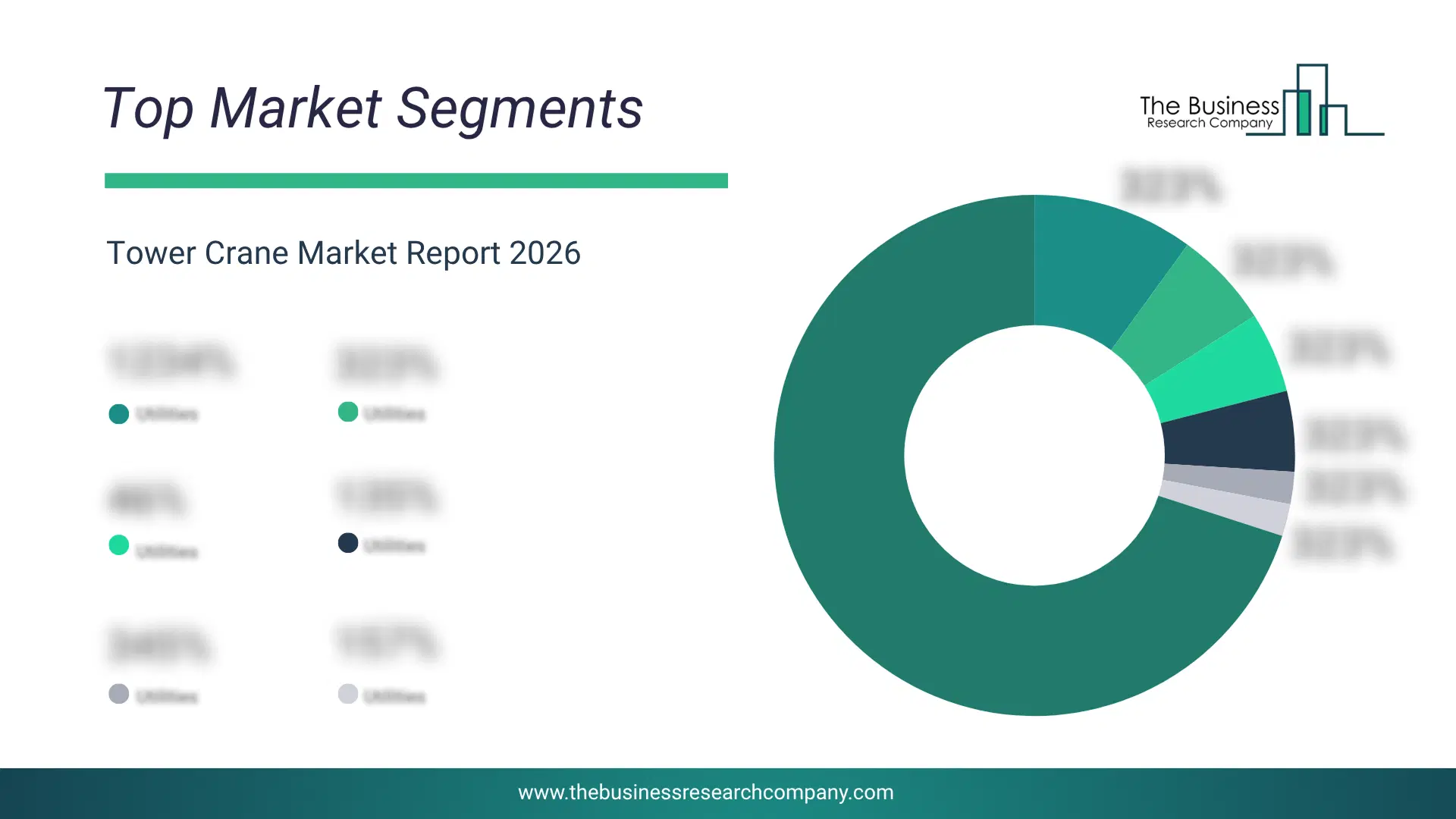
1) By Type: Hammerhead Cranes, Flat Top Cranes, Luffing Jib Cranes, Self-Erecting Cranes 2) By Fuel Type: Electric, Diesel, Hybrid 3) By Capacity: Up To 5 Tons, 6–10 Tons, 11–20 Tons, 21–50 Tons, Above 50 Tons 4) By Sales Channel: Direct Sales, Distributors, Online Sales, Rental Services 5) By End-User: Infrastructure, Construction, Energy And Power, Other End-Users Subsegments: 1) By Hammerhead Cranes: Fixed Hammerhead Cranes, Traveling Hammerhead Cranes 2) By Flat Top Cranes: Stationary Flat Top Cranes, Mobile Flat Top Cranes 3) By Luffing Jib Cranes: Fixed Luffing Jib Cranes, Mobile Luffing Jib Cranes 4) By Self-Erecting Cranes: Trailer Mounted Self-Erecting Cranes, Crawler Mounted Self-Erecting CranesWhat Is The Driver Of The Tower Crane Market?
The increasing volume of construction projects is expected to fuel the growth of the tower crane market going forward. Construction projects are planned activities focused on creating, modifying, or assembling buildings, infrastructure, or other physical structures. Construction projects are rising due to rapid urbanization, as increasing populations in cities drive the demand for residential, commercial, and infrastructural developments. Tower cranes benefit construction projects by allowing heavy materials to be lifted and moved to high elevations efficiently, which accelerates construction and enhances overall site productivity. For instance, in August 2025, according to the Census Bureau, a US-based government agency, the seasonally adjusted annual rate for public construction spending was approximately $514.3 billion in June, marking a 0.1% (±1.6%) rise compared to the revised May estimate of $513.7 billion. Therefore, the increasing volume of construction projects is driving the growth of the tower crane industry.Key Players In The Global Tower Crane Market
Major companies operating in the tower crane market are Xuzhou Construction Machinery Group Co. Ltd., Zoomlion Heavy Industry Science & Technology Co. Ltd., Liebherr‑International AG, The Manitowoc Company Inc., Sany Heavy Industry Co. Ltd., Terex Corporation, Action Construction Equipment Ltd., WOLFFKRAN International AG, Comansa S.A., Yongmao Holdings Limited, Favelle Favco Berhad, Jaso Tower Cranes, Raimondi Cranes S.p.A., FM Gru S.r.l., Saez Cranes, Wilbert Tower Cranes GmbH, Sichuan Construction Machinery Group Co. Ltd., HKTC, Kroll Cranes A/S, Vicario Srl, Mantis Cranes Ltd.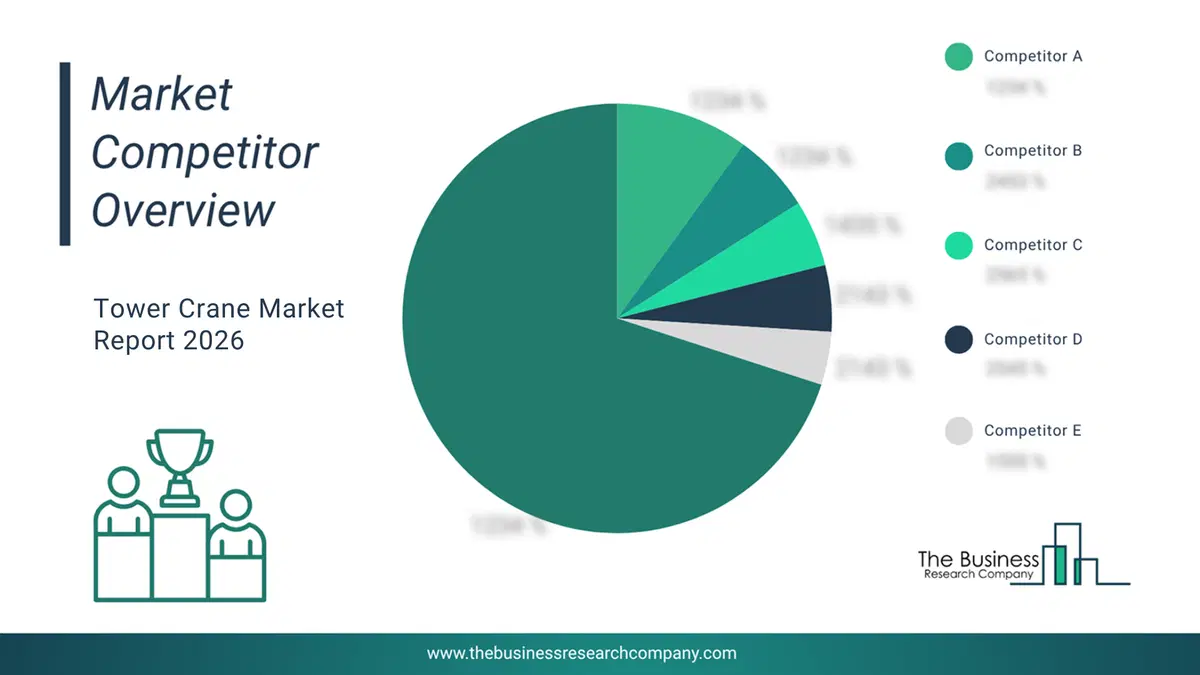
This chart is for illustrative purposes; the full report includes a detailed competitor analysis and comprehensive overview of the top 10 companies in the market.
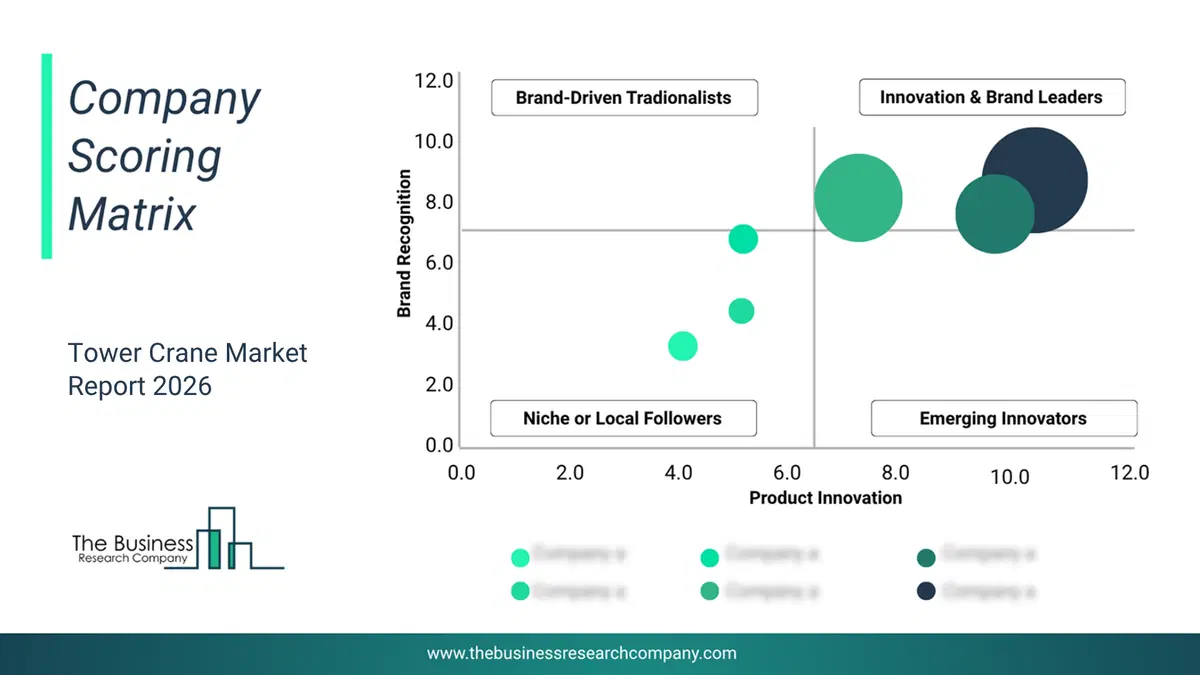
This chart maps companies by product innovation and brand strength, with bubble size indicating relative revenue, helping identify market leaders, challengers, and niche players. This is an illustrative chart; the full report provides a complete and accurate competitive analysis.
Global Tower Crane Market Trends and Insights
Major companies operating in the tower crane market are focusing on developing advanced technologies, such as T-Torque inverter technology, to enhance operator control, improve lifting efficiency, and ensure safer, more precise handling of heavy loads on construction sites. T-Torque inverter technology is a crane control system that allows operators to adjust torque precisely, improving lifting performance, energy efficiency, and safety during operations. For instance, in January 2025, Terex Corporation, a US-based technology company, launches CTL 702-32. The new CTL 702-32 is a high-performance luffing jib tower crane designed for heavy-duty lifting in dense urban and mega-infrastructure construction sites. It offers a maximum load capacity of 32 tons and a maximum jib length of 70 meters, delivering precision and strength in confined spaces. The crane features advanced load moment control, modular assembly, and digital interfaces for efficient operation and monitoring.What Are Latest Mergers And Acquisitions In The Tower Crane Market?
In April 2025, Maxim Crane Works L.P., a US-based provider of comprehensive lifting services, acquired tower crane assets from Sims Crane & Equipment Co. for an undisclosed amount. With this acquisition, Maxim Crane Works aims to expand its tower crane capabilities and enhance its ability to provide comprehensive, high-quality lifting solutions. Sims Crane & Equipment Co. Inc. is a US-based company that manufactures tower cranes.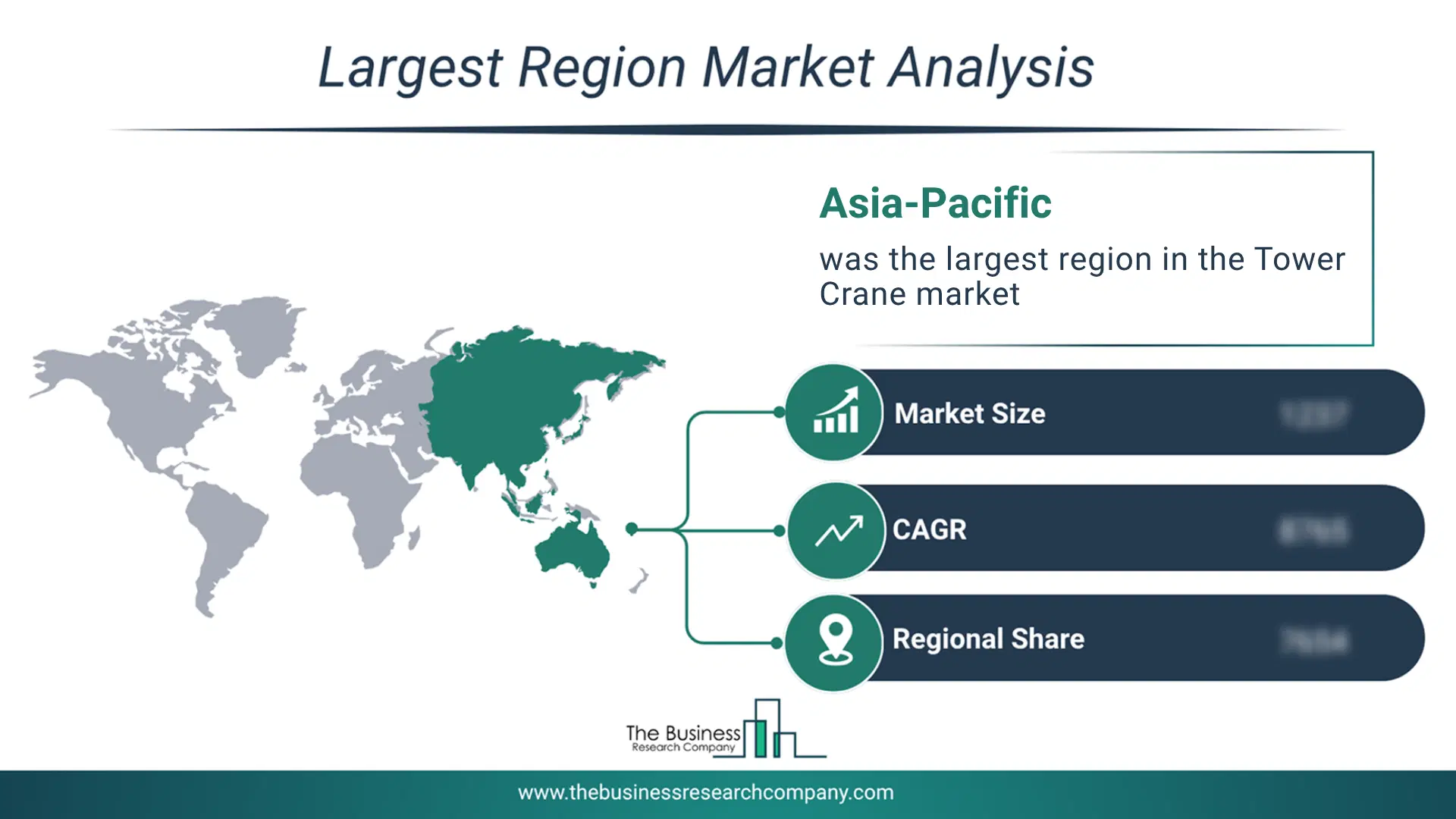
Regional Outlook
Asia-Pacific was the largest region in the tower crane market in 2025, and it is expected to be the fastest-growing region in the forecast period. The regions covered in this market report are Asia-Pacific, South East Asia, Western Europe, Eastern Europe, North America, South America, Middle East, Africa The countries covered in this market report are Australia, Brazil, China, France, Germany, India, Indonesia, Japan, Taiwan, Russia, South Korea, UK, USA, Canada, Italy, Spain.What Defines the Tower Crane Market?
The tower crane market consists of sales of jib arms, counterweights, hoist systems, and trolley mechanisms. Values in this market are ‘factory gate’ values, that is, the value of goods sold by the manufacturers or creators of the goods, whether to other entities (including downstream manufacturers, wholesalers, distributors, and retailers) or directly to end customers. The value of goods in this market includes related services sold by the creators of the goods.How is Market Value Defined and Measured?
The market value is defined as the revenues that enterprises gain from the sale of goods and/or services within the specified market and geography through sales, grants, or donations in terms of the currency (in USD unless otherwise specified). The revenues for a specified geography are consumption values that are revenues generated by organizations in the specified geography within the market, irrespective of where they are produced. It does not include revenues from resales along the supply chain, either further along the supply chain or as part of other products.
This chart presents market attractiveness based on a quantitative evaluation of growth, competition, strategic alignment, and risk, offering a clear view of opportunity areas for decision-making. This chart is for illustrative purposes; the full report contains the complete analysis.

This chart highlights the Total Addressable Market (TAM) by estimating the maximum revenue opportunity using an assumption-driven approach, supporting strategic planning and opportunity sizing across markets. The chart is illustrative; the full report provides a more comprehensive analysis.
What Key Data and Analysis Are Included in the Tower Crane Market Report 2026?
The tower crane market research report is one of a series of new reports from The Business Research Company that provides market statistics, including industry global market size, regional shares, competitors with the market share, detailed market segments, market trends and opportunities, and any further data you may need to thrive in the tower crane industry. The market research report delivers a complete perspective of everything you need, with an in-depth analysis of the current and future state of the industry.Tower Crane Market Report Forecast Analysis
| Report Attribute | Details |
|---|---|
| Market Size Value In 2026 | $6.78 billion |
| Revenue Forecast In 2030 | $8.64 billion |
| Growth Rate | CAGR of 6.2% from 2026 to 2030 |
| Base Year For Estimation | 2025 |
| Actual Estimates/Historical Data | 2020-2025 |
| Forecast Period | 2026 - 2030 |
| Market Representation | Revenue in USD Billion and CAGR from 2026 to 2030 |
| Segments Covered | Type, Fuel Type, Capacity, Sales Channel, End-User |
| Regional Scope | Asia-Pacific, Western Europe, Eastern Europe, North America, South America, Middle East, Africa |
| Key Companies Profiled | Xuzhou Construction Machinery Group Co. Ltd., Zoomlion Heavy Industry Science & Technology Co. Ltd., Liebherr‑International AG, The Manitowoc Company Inc., Sany Heavy Industry Co. Ltd., Terex Corporation, Action Construction Equipment Ltd., WOLFFKRAN International AG, Comansa S.A., Yongmao Holdings Limited, Favelle Favco Berhad, Jaso Tower Cranes, Raimondi Cranes S.p.A., FM Gru S.r.l., Saez Cranes, Wilbert Tower Cranes GmbH, Sichuan Construction Machinery Group Co. Ltd., HKTC, Kroll Cranes A/S, Vicario Srl, Mantis Cranes Ltd. |
| Customization Scope | Request for Customization |
| Pricing And Purchase Options | Explore Purchase Options |