
Transcranial Magnetic Stimulator Market Report 2026
Global Outlook – By Type (Deep Transcranial Magnetic Stimulation (dTMS) Systems, Repetitive Transcranial Magnetic Stimulation (rTMS) Systems, Theta Burst Stimulation (TBS) Systems), By Treatment Protocol (High-Frequency TMS, Low-Frequency TMS, Intermittent Theta Burst Stimulation (iTBS), Continuous Theta Burst Stimulation (cTBS)), By Application (Major Depressive Disorder (MDD), Treatment-Resistant Depression (TRD), Obsessive-Compulsive Disorder (OCD), Parkinson’s Disease, Alzheimer’s Disease and Other Dementias, Epilepsy, Other Applications) – Market Size, Trends, Strategies, and Forecast to 2030
Transcranial Magnetic Stimulator Market Overview
• Transcranial Magnetic Stimulator market size has reached to $1.39 billion in 2025 • Expected to grow to $2.21 billion in 2030 at a compound annual growth rate (CAGR) of 9.8% • Growth Driver: Rising Prevalence Of Neurological Diseases Drives Expansion Of Transcranial Magnetic Stimulator Market • Market Trend: Advanced Neuronavigation Systems Elevate Precision And Efficiency In TMS Therapy • North America was the largest region in 2025 and Asia-Pacific is the fastest growing region.What Is Covered Under Transcranial Magnetic Stimulator Market?
Transcranial magnetic stimulators (TMS) are non-invasive medical devices that employ magnetic waves to activate neurons in the nervous system in order to alleviate symptoms of depression. Transcranial magnetic stimulator (TMS) devices are used to activate neurons in the nervous system in order to alleviate symptoms of depression and other mental health and brain-related diseases. The main types of transcranial magnetic stimulators are deep transcranial magnetic stimulators (dTMS), repetitive TMS (rTMS), and others. Deep Transcranial Magnetic Stimulator (dTMS) refers to a type of transcranial magnetic stimulation (TMS) therapy that uses magnetic fields to stimulate nerve cells in the brain to improve symptoms of depression. It is available for children and adults and is used in various applications such as Parkinson's disease, depression, Alzheimer's disease, epilepsy, and others.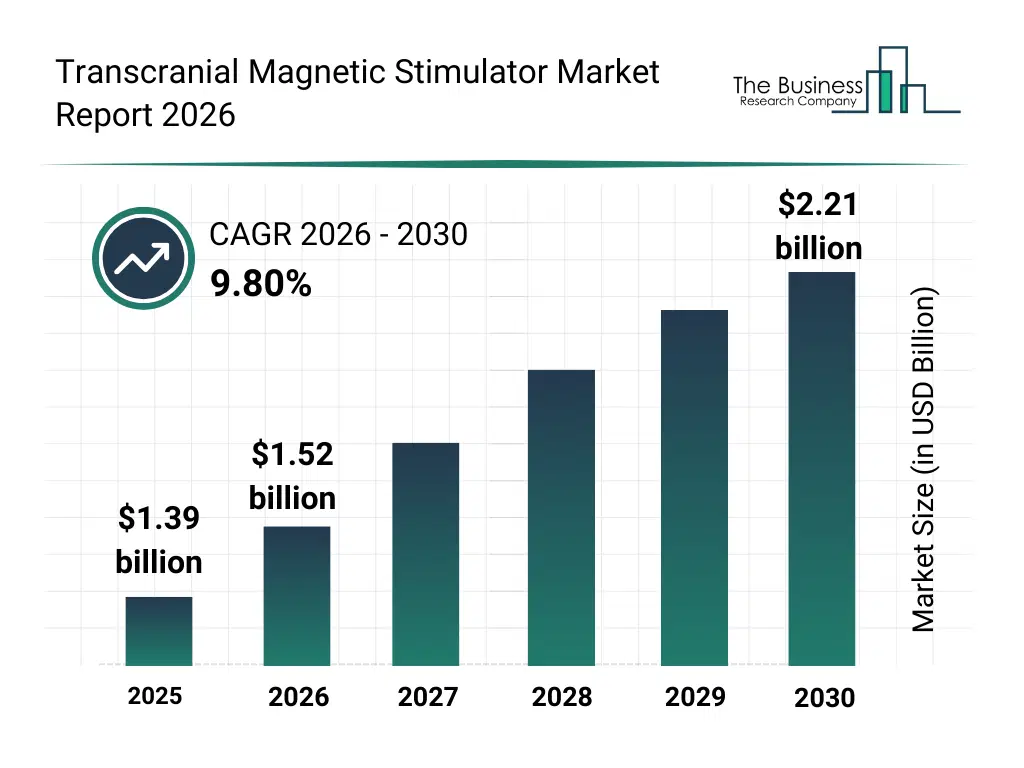
What Is The Transcranial Magnetic Stimulator Market Size and Share 2026?
The transcranial magnetic stimulator market size has grown strongly in recent years. It will grow from $1.39 billion in 2025 to $1.52 billion in 2026 at a compound annual growth rate (CAGR) of 9.5%. The growth in the historic period can be attributed to increasing prevalence of depression and neurological disorders, growing awareness of non-pharmacological therapies, availability of FDA-approved tms systems, expansion of mental health clinics, rising acceptance of neuromodulation therapies.What Is The Transcranial Magnetic Stimulator Market Growth Forecast?
The transcranial magnetic stimulator market size is expected to see strong growth in the next few years. It will grow to $2.21 billion in 2030 at a compound annual growth rate (CAGR) of 9.8%. The growth in the forecast period can be attributed to increasing adoption of tms for broader neurological indications, rising demand for personalized mental health treatments, expansion of outpatient psychiatric care, growing integration of digital treatment monitoring, increasing investments in neuromodulation research. Major trends in the forecast period include increasing adoption of non-invasive brain stimulation therapies, rising use of rtms in depression treatment, growing expansion of dtms clinical applications, enhanced focus on personalized neurostimulation protocols, expansion of outpatient mental health treatments.
Global Transcranial Magnetic Stimulator Market Segmentation
1) By Type: Deep Transcranial Magnetic Stimulation (dTMS) Systems, Repetitive Transcranial Magnetic Stimulation (rTMS) Systems, Theta Burst Stimulation (TBS) Systems 2) By Treatment Protocol: High-Frequency TMS, Low-Frequency TMS, Intermittent Theta Burst Stimulation (iTBS), Continuous Theta Burst Stimulation (cTBS) 3) By Application: Major Depressive Disorder (MDD), Treatment-Resistant Depression (TRD), Obsessive-Compulsive Disorder (OCD), Parkinson’s Disease, Alzheimer’s Disease and Other Dementias, Epilepsy, Other Applications Subsegments: 1) By Deep Transcranial Magnetic Stimulation (dTMS) Systems: FDA-Approved dTMS Systems, Coil-Based Deep Stimulation Systems 2) By Repetitive Transcranial Magnetic Stimulation (rTMS) Systems: Standard rTMS Systems, Navigated rTMS Systems 3) By Theta Burst Stimulation (TBS) Systems: Standalone TBS Systems, TBS-Enabled rTMS PlatformsWhat Is The Driver Of The Transcranial Magnetic Stimulator Market?
The increasing prevalence of neurological diseases is expected to drive the growth of the transcranial magnetic stimulator market. Transcranial magnetic stimulation (TMS) has shown promising results in treating various neurological and psychiatric illnesses. It is a new technique used to treat various neurological conditions such as stroke, spasticity, migraine, dementia, and movement disorders. For instance, in December 2022, a study by Parkinson's Foundation, a US-based non-profit organization, revealed that the number of people living with Parkinson's disease (PD) is estimated to increase to 1.2 million by 2030, up from 930,000 in 2020. Therefore, the increasing prevalence of neurological diseases is expected to propel the growth of the transcranial magnetic stimulator industry.Key Players In The Global Transcranial Magnetic Stimulator Market
Major companies operating in the transcranial magnetic stimulator market are BrainsWay Ltd., Nexstim Plc., The Magstim Company Limited, Neuronetics Inc., MagVenture Inc., MAG & More GmbH, neurocare group AG, Neurosoft, Neuroelectrics, NeuroConn GmbH, Neurofield Inc., Axilum Robotics, Yiruide Neurotech, Brainbox Ltd., Remed Inc., Soterix Medical Inc., Sinovation Medical Technology Co. Ltd., Shenzhen Yingchi Technology Co. Ltd., Wuhan Greentek Bioengineering Co. Ltd., Vishee Medical Technology Co. Ltd.
This chart is for illustrative purposes; the full report includes a detailed competitor analysis and comprehensive overview of the top 10 companies in the market.
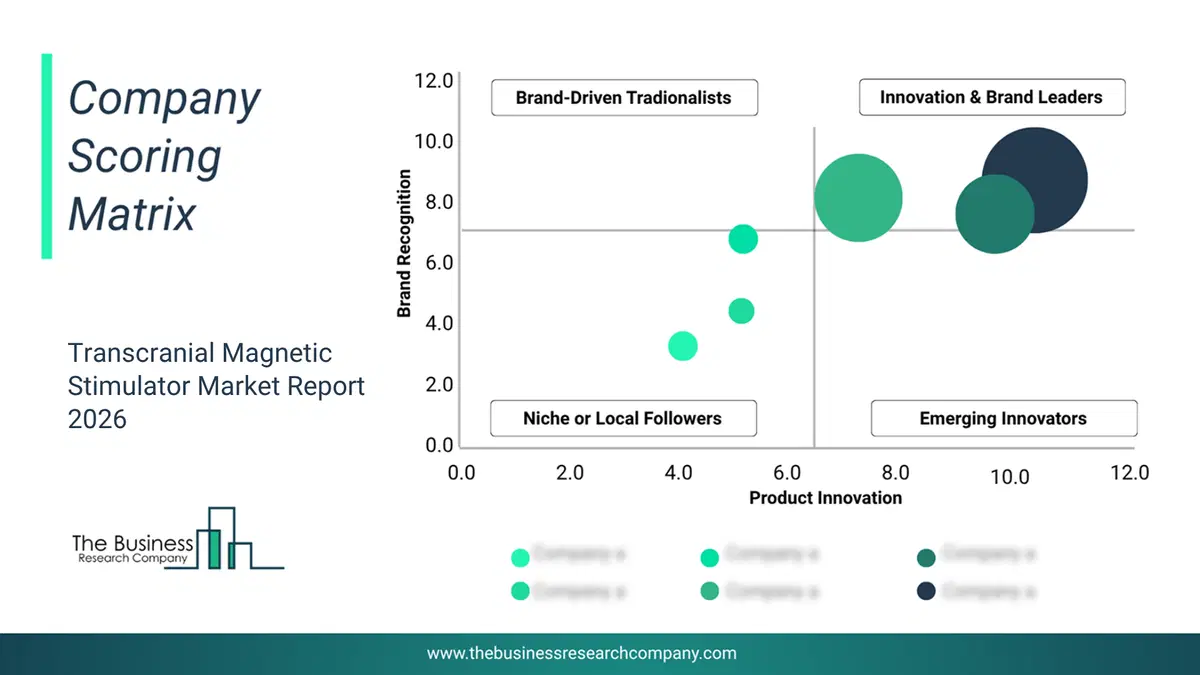
This chart maps companies by product innovation and brand strength, with bubble size indicating relative revenue, helping identify market leaders, challengers, and niche players. This is an illustrative chart; the full report provides a complete and accurate competitive analysis.
Global Transcranial Magnetic Stimulator Market Trends and Insights
Major companies operating in the transcranial magnetic stimulator market are focusing on developing innovative advancements such as neuronavigational-guided TMS systems to improve coil placement accuracy, enhance treatment consistency, and streamline clinical workflows. A neuronavigational-guided TMS system refers to an image-based guidance platform that integrates patient-specific neuroimaging with real-time coil tracking to ensure precise and reproducible stimulation targeting during transcranial magnetic stimulation procedures. For instance, in March 2023, MagVenture Inc., a US-based medical equipment manufacturer, introduced the MagVenture TMS Atlas Neuro Navigation System. This system optimizes transcranial magnetic stimulator coil positioning with a time-saving, high-precision workflow that is reliable and easy to use. It provides high precision and accuracy for clinical use. Atlas provides the operator with a greater range of movement during TMS treatments by eliminating line-of-sight concerns. It uses advanced technology to provide patients with a visual depiction of their MRI scan as well as real-time tracking of the treatment coil to their head position, allowing them to be more involved in the procedure.What Are Latest Mergers And Acquisitions In The Transcranial Magnetic Stimulator Market?
In December 2024, Neuronetics, Inc., a US-based provider of transcranial magnetic stimulation systems and neurotechnology solutions for mental health treatment, acquired Greenbrook TMS Inc. for an undisclosed amount. With this acquisition, Neuronetics aims to expand its treatment network, strengthen its commercial footprint, and accelerate access to transcranial magnetic stimulation therapies by integrating a large clinical service infrastructure with its technology platform. Greenbrook TMS Inc. is a Canada-based provider of outpatient transcranial magnetic stimulation services through a nationwide network of mental health treatment centers.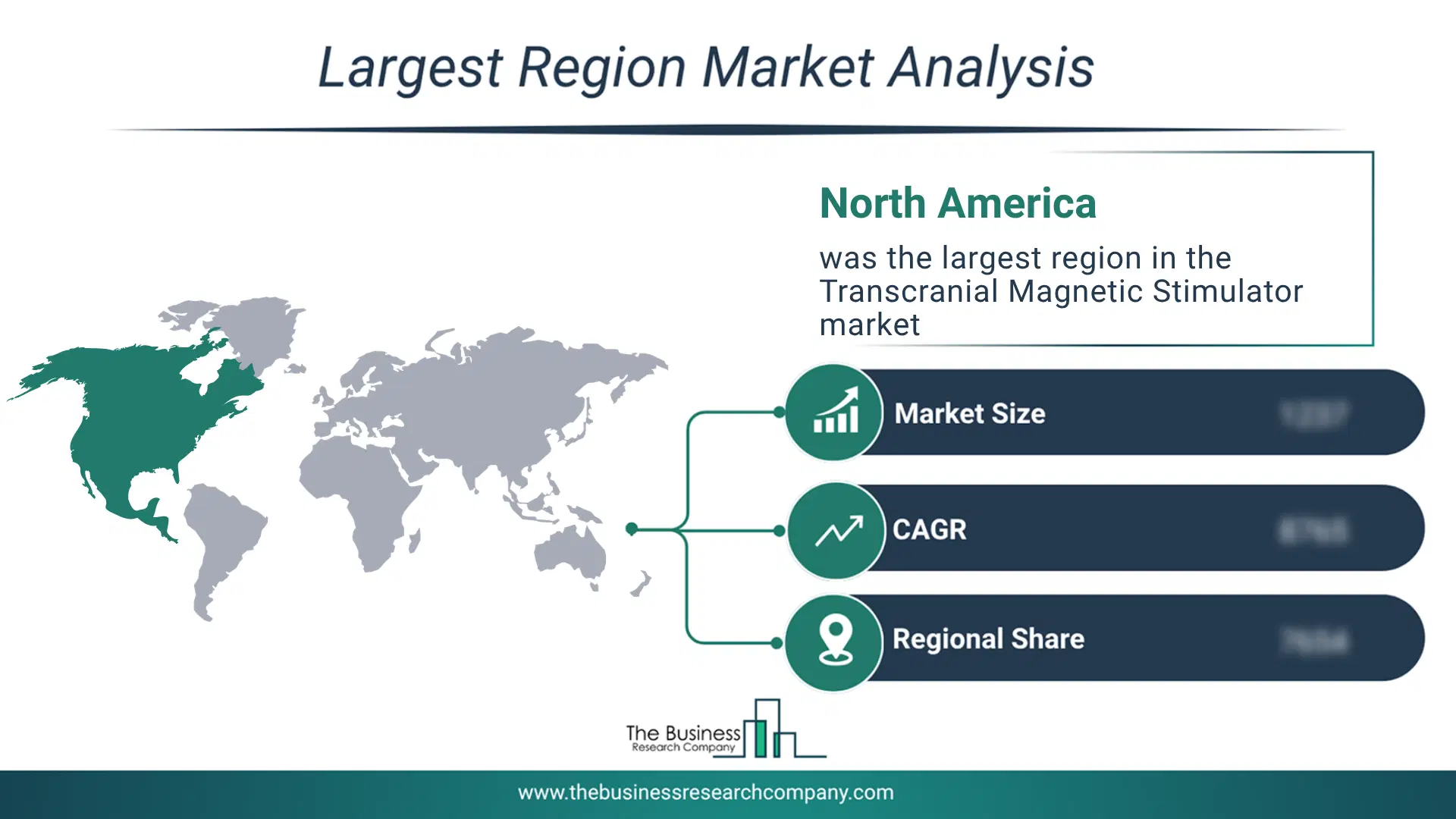
Regional Outlook
North America was the largest region in the transcranial magnetic stimulator market in 2025. Asia-Pacific is expected to be the fastest-growing region in the global transcranial magnetic stimulator market report during the forecast period. The regions covered in this market report are Asia-Pacific, South East Asia, Western Europe, Eastern Europe, North America, South America, Middle East, Africa. The countries covered in this market report are Australia, Brazil, China, France, Germany, India, Indonesia, Japan, Taiwan, Russia, South Korea, UK, USA, Canada, Italy, SpainWhat Defines the Transcranial Magnetic Stimulator Market?
The transcranial magnetic stimulator market consists of sales of single-pulse and paired-pulse transcranial magnetic stimulators. Values in this market are ‘factory gate’ values, that is the value of goods sold by the manufacturers or creators of the goods, whether to other entities (including downstream manufacturers, wholesalers, distributors, and retailers) or directly to end customers. The value of goods in this market includes related services sold by the creators of the goods.How is Market Value Defined and Measured?
The market value is defined as the revenues that enterprises gain from the sale of goods and/or services within the specified market and geography through sales, grants, or donations in terms of the currency (in USD unless otherwise specified). The revenues for a specified geography are consumption values that are revenues generated by organizations in the specified geography within the market, irrespective of where they are produced. It does not include revenues from resales along the supply chain, either further along the supply chain or as part of other products.
This chart presents market attractiveness based on a quantitative evaluation of growth, competition, strategic alignment, and risk, offering a clear view of opportunity areas for decision-making. This chart is for illustrative purposes; the full report contains the complete analysis.

This chart highlights the Total Addressable Market (TAM) by estimating the maximum revenue opportunity using an assumption-driven approach, supporting strategic planning and opportunity sizing across markets. The chart is illustrative; the full report provides a more comprehensive analysis.
What Key Data and Analysis Are Included in the Transcranial Magnetic Stimulator Market Report 2026?
The transcranial magnetic stimulator market research report is one of a series of new reports from The Business Research Company that provides market statistics, including industry global market size, regional shares, competitors with the market share, detailed market segments, market trends and opportunities, and any further data you may need to thrive in the transcranial magnetic stimulator industry. The market research report delivers a complete perspective of everything you need, with an in-depth analysis of the current and future state of the industry.Transcranial Magnetic Stimulator Market Report Forecast Analysis
| Report Attribute | Details |
|---|---|
| Market Size Value In 2026 | $1.52 billion |
| Revenue Forecast In 2030 | $2.21 billion |
| Growth Rate | CAGR of 9.8% from 2026 to 2030 |
| Base Year For Estimation | 2025 |
| Actual Estimates/Historical Data | 2020-2025 |
| Forecast Period | 2026 - 2030 |
| Market Representation | Revenue in USD Billion and CAGR from 2026 to 2030 |
| Segments Covered | Type, Treatment Protocol, Application |
| Regional Scope | Asia-Pacific, Western Europe, Eastern Europe, North America, South America, Middle East, Africa |
| Country Scope | The countries covered in the report are Australia, Brazil, China, France, Germany, India, Indonesia, Japan, Taiwan, Russia, South Korea, UK, USA, Canada, Italy, Spain. |
| Key Companies Profiled | BrainsWay Ltd., Nexstim Plc., The Magstim Company Limited, Neuronetics Inc., MagVenture Inc., MAG & More GmbH, neurocare group AG, Neurosoft, Neuroelectrics, NeuroConn GmbH, Neurofield Inc., Axilum Robotics, Yiruide Neurotech, Brainbox Ltd., Remed Inc., Soterix Medical Inc., Sinovation Medical Technology Co. Ltd., Shenzhen Yingchi Technology Co. Ltd., Wuhan Greentek Bioengineering Co. Ltd., Vishee Medical Technology Co. Ltd. |
| Customization Scope | Request for Customization |
| Pricing And Purchase Options | Explore Purchase Options |