

Urticaria Market Report 2026
Global Outlook – By Type (Acute Urticaria, Chronic Urticaria), By Drug Class (Antihistamines, Anti-inflammation Medications, Antidepressants, Monoclonal Antibodies, Other Drug Classes), By Route of Administration (Oral, Parenteral, Other Routes Of Administration), By Distribution Channel (Hospital Pharmacy, Online Pharmacy, Retail Pharmacy), By End-Users (Hospitals, Homecare, Specialty Clinics, Other End-Users) - Market Size, Trends, And Global Forecast 2026-2035
Urticaria Market Overview
• Urticaria market size has reached to $4.76 billion in 2025 • Expected to grow to $10.71 billion in 2030 at a compound annual growth rate (CAGR) of 17.5% • Growth Driver: Rising Skin Disease Awareness Fueling Growth Of The Market Due To Greater Focus On Early Detection And Treatment • Market Trend: Advancing Urticaria Treatment with Innovative Mast Cell Inhibitor Antibodies • North America was the largest region in 2025 and Asia-Pacific is the fastest growing region.What Is Covered Under Urticaria Market?
Urticaria, commonly known as hives, is a skin condition characterized by red, itchy, and raised welts. It occurs due to an allergic reaction, stress, or unknown triggers, leading to histamine release. The condition can be acute (lasting less than six weeks) or chronic (persisting longer). Treatment includes antihistamines, avoiding triggers, and, in severe cases, corticosteroids or immunotherapy. The main types of urticaria are acute urticaria and chronic urticaria. Acute urticaria is a sudden-onset skin condition lasting less than six weeks, characterized by red, itchy, and swollen welts, often triggered by allergic reactions, infections, medications, insect stings, or food allergens. This includes drug classes such as antihistamines, anti-inflammatory medications, antidepressants, monoclonal antibodies, and others, given by routes of administration such as oral, parenteral, and others. These are distributed by various channels, including hospital pharmacies, online pharmacies, and retail pharmacies, to the end users consisting of hospitals, homecare, specialty clinics, and others.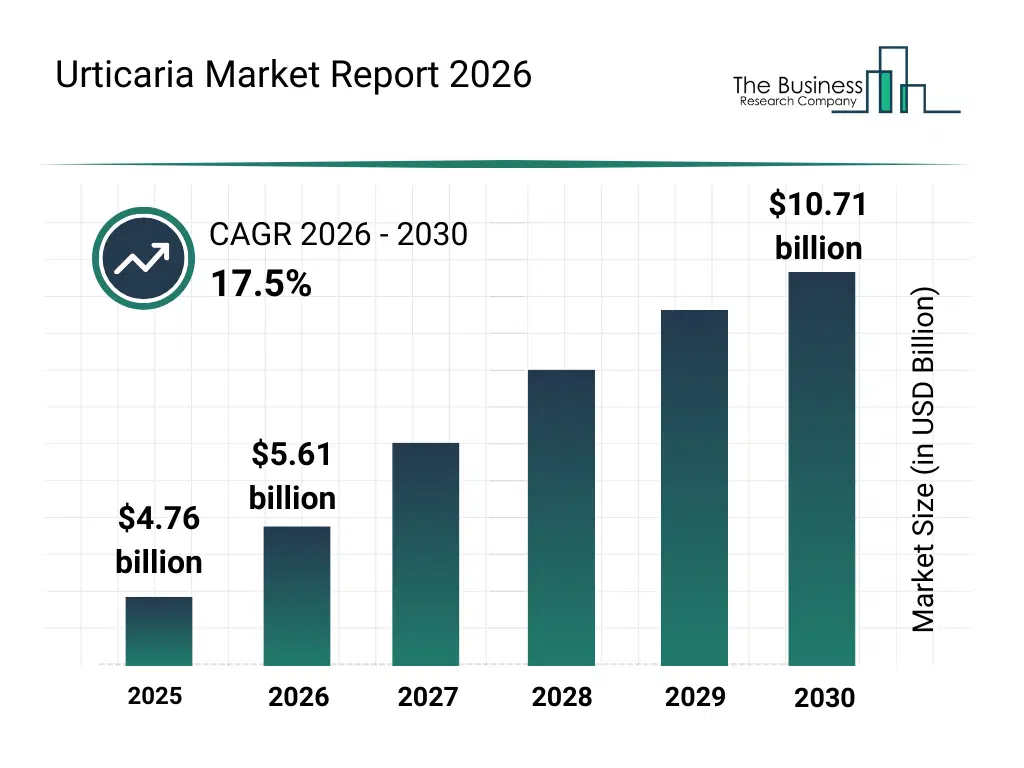
What Is The Urticaria Market Size and Share 2026?
The urticaria market size has grown rapidly in recent years. It will grow from $4.76 billion in 2025 to $5.61 billion in 2026 at a compound annual growth rate (CAGR) of 17.9%. The growth in the historic period can be attributed to increasing prevalence of allergic skin conditions, wider use of antihistamines, expansion of dermatology treatment services, rising awareness of chronic urticaria, availability of prescription therapies.What Is The Urticaria Market Growth Forecast?
The urticaria market size is expected to see rapid growth in the next few years. It will grow to $10.71 billion in 2030 at a compound annual growth rate (CAGR) of 17.5%. The growth in the forecast period can be attributed to increasing adoption of biologic treatments, rising demand for long-acting therapies, growing focus on immune-modulating drugs, expansion of specialty dermatology clinics, increasing investment in allergy and immunology research. Major trends in the forecast period include increasing development of biologic and monoclonal antibody therapies, growing use of personalized treatment approaches, rising focus on chronic urticaria management, expansion of advanced antihistamine formulations, enhanced emphasis on long-term disease control.
Global Urticaria Market Segmentation
1) By Type: Acute Urticaria, Chronic Urticaria 2) By Drug Class: Antihistamines, Anti-inflammation Medications, Antidepressants, Monoclonal Antibodies, Other Drug Classes 3) By Route of Administration: Oral, Parenteral, Other Routes Of Administration 4) By Distribution Channel: Hospital Pharmacy, Online Pharmacy, Retail Pharmacy 5) By End-Users: Hospitals, Homecare, Specialty Clinics, Other End-Users Subsegments: 1) By Acute Urticaria: Allergic Urticaria, Infectious Urticaria, Drug-Induced Urticaria, Contact Urticaria 2) By Chronic Urticaria: Chronic Spontaneous Urticaria (CSU), Chronic Inducible Urticaria (CIndU)What Is The Driver Of The Urticaria Market?
The increasing skin disease awareness and treatment is expected to boost the growth of the urticaria market going forward. Increasing pollution leads to more skin allergies and conditions, driving demand for awareness and advanced treatments. Urticaria contributes to skin disease awareness and treatment by showcasing immune system responses, driving research, enhancing diagnostics, and advancing targeted therapies. For instance, in February 2024, The Skin Cancer Foundation, a US-based nonprofit, reported that 1 in 5 Americans develop skin cancer by age 70, with over 2 deaths occurring every hour in the U.S. This highlights the urgent need for preventive measures, as having five or more sunburns doubles the risk of melanoma. Therefore, increasing skin disease awareness and treatment is driving the growth of the urticaria industry.Key Players In The Global Urticaria Market
Major companies operating in the urticaria market are Sanofi S.A., Novartis AG, GlaxoSmithKline PLC, Roche Holding AG, Teva Pharmaceutical Industries Ltd, Sun Pharmaceutical Industries Ltd, Incyte Corporation, Kyowa Kirin Co. Ltd, Argenx SE, Allakos Inc, AstraZeneca plc, Kiniksa Pharmaceuticals Ltd, United BioPharma Inc, Celldex Therapeutics Inc, Yuhan Corporation, Hangzhou Highlightll Pharmaceutical Co Ltd, Evommune Inc, Rapt Therapeutics Inc, Enanta Pharmaceuticals Inc, UCB PharmaGlobal Urticaria Market Trends and Insights
Major companies operating in the urticaria market are focusing on developing innovative solutions such as mast cell inhibitor antibodies to develop an advanced therapeutic solution for managing chronic spontaneous urticaria by targeting mast cell activation. A mast cell inhibitor antibody is a targeted monoclonal antibody that blocks the activation or degranulation of mast cells by inhibiting specific receptors or signaling pathways, thereby reducing allergic reactions, inflammation, and other mast cell-mediated disorders. For instance, in May 2024, Allakos Inc., a US-based biotechnology company, announced the initiation of a Phase 1 clinical trial for AK006, designed for the treatment of chronic spontaneous urticaria (CSU). This innovative therapy targets both IgE-dependent and IgE-independent mast cell activation pathways, offering the potential for broader efficacy in patients who are refractory to antihistamines or prior biologic treatments. By selectively inhibiting mast cell activity through the Siglec-6 receptor, AK006 aims to provide a more comprehensive and long-lasting solution for CSU management, marking a significant advancement in urticaria treatment and immunotherapy research.What Are Latest Mergers And Acquisitions In The Urticaria Market?
In April 2024, Incyte Corporation, a US-based biopharmaceutical company, acquired Escient Pharmaceuticals for $750 million. This deal aims to strengthen Incyte Corporation’s portfolio in inflammation and autoimmunity (IAI) by advancing first-in-class oral Mas-related G protein-coupled receptor X2 (MRGPRX2) and Mas-related G protein-coupled receptor X4 (MRGPRX4) antagonists, which have the potential to enhance treatments for chronic spontaneous urticaria (CSU), chronic inducible urticaria (CIndU), atopic dermatitis (AD), cholestatic pruritus, and other inflammatory disorders. Escient Pharmaceuticals is a US-based clinical-stage biotechnology company focused on developing small-molecule therapies for chronic urticaria and severe pruritus.Regional Outlook
North America was the largest region in the urticaria market in 2025. Asia-Pacific is expected to be the fastest-growing region in the forecast period. The regions covered in this market report are Asia-Pacific, South East Asia, Western Europe, Eastern Europe, North America, South America, Middle East, Africa. The countries covered in this market report are Australia, Brazil, China, France, Germany, India, Indonesia, Japan, Taiwan, Russia, South Korea, UK, USA, Canada, Italy, Spain.What Defines the Urticaria Market?
The urticaria market consists of sales of corticosteroids, biologics, immunosuppressants, leukotriene receptor antagonists, and topical anti-inflammatory creams or gels. Values in this market are ‘factory gate’ values, that is the value of goods sold by the manufacturers or creators of the goods, whether to other entities (including downstream manufacturers, wholesalers, distributors and retailers) or directly to end customers. The value of goods in this market includes related services sold by the creators of the goods.How is Market Value Defined and Measured?
The market value is defined as the revenues that enterprises gain from the sale of goods and/or services within the specified market and geography through sales, grants, or donations in terms of the currency (in USD unless otherwise specified). The revenues for a specified geography are consumption values that are revenues generated by organizations in the specified geography within the market, irrespective of where they are produced. It does not include revenues from resales along the supply chain, either further along the supply chain or as part of other products.What Key Data and Analysis Are Included in the Urticaria Market Report 2026?
The urticaria market research report is one of a series of new reports from The Business Research Company that provides market statistics, including industry global market size, regional shares, competitors with the market share, detailed market segments, market trends and opportunities, and any further data you may need to thrive in the urticaria industry. The market research report delivers a complete perspective of everything you need, with an in-depth analysis of the current and future state of the industry.Urticaria Market Report Forecast Analysis
| Report Attribute | Details |
|---|---|
| Market Size Value In 2026 | $5.61 billion |
| Revenue Forecast In 2035 | $10.71 billion |
| Growth Rate | CAGR of 17.9% from 2026 to 2035 |
| Base Year For Estimation | 2025 |
| Actual Estimates/Historical Data | 2020-2025 |
| Forecast Period | 2026 - 2030 - 2035 |
| Market Representation | Revenue in USD Billion and CAGR from 2026 to 2035 |
| Segments Covered | Type, Drug Class, Route of Administration, Distribution Channel, End-Users |
| Regional Scope | Asia-Pacific, Western Europe, Eastern Europe, North America, South America, Middle East, Africa |
| Country Scope | The countries covered in the report are Australia, Brazil, China, France, Germany, India, ... |
| Key Companies Profiled | Sanofi S.A., Novartis AG, GlaxoSmithKline PLC, Roche Holding AG, Teva Pharmaceutical Industries Ltd, Sun Pharmaceutical Industries Ltd, Incyte Corporation, Kyowa Kirin Co. Ltd, Argenx SE, Allakos Inc, AstraZeneca plc, Kiniksa Pharmaceuticals Ltd, United BioPharma Inc, Celldex Therapeutics Inc, Yuhan Corporation, Hangzhou Highlightll Pharmaceutical Co Ltd, Evommune Inc, Rapt Therapeutics Inc, Enanta Pharmaceuticals Inc, UCB Pharma |
| Customization Scope | Request for Customization |
| Pricing And Purchase Options | Explore Purchase Options |