
VAT Dyes Market Report 2026
Global Outlook – By Product Type (Carbazole Derivatives, Indigo Derivatives, Anthraquinone Derivatives, Thio-Indigo Dyes), By Methods (Dip Dyeing, Pad Dyeing), By Application (Cotton, Viscose Rayon, Leather, Others Applications) – Market Size, Trends, Strategies, and Forecast to 2030
VAT Dyes Market Overview
• VAT Dyes market size has reached to $1.87 billion in 2025 • Expected to grow to $2.71 billion in 2030 at a compound annual growth rate (CAGR) of 7.8% • Growth Driver: Online Retail Expansion Driving Growth In The VAT Dyes Market • Asia-Pacific was the largest region and fastest growing region.What Is Covered Under VAT Dyes Market?
Vat dyes usually referred to as Oil colors, are natural coloring substances that can be applied to cloth by immersion, spraying, or pad printing. They are primarily used for printing on leather, wood, and other materials. The main types of vat dyes are carbazole derivatives, indigo derivatives, anthraquinone derivatives, thio-indigo dyes, and others. Carbazole derivatives refer to an organic compound with an aromatic heterocyclic structure. The various methods include dip dyeing and pad dyeing. These are used in various applications such as wool, cotton, fiber, viscose rayon, leather, and others.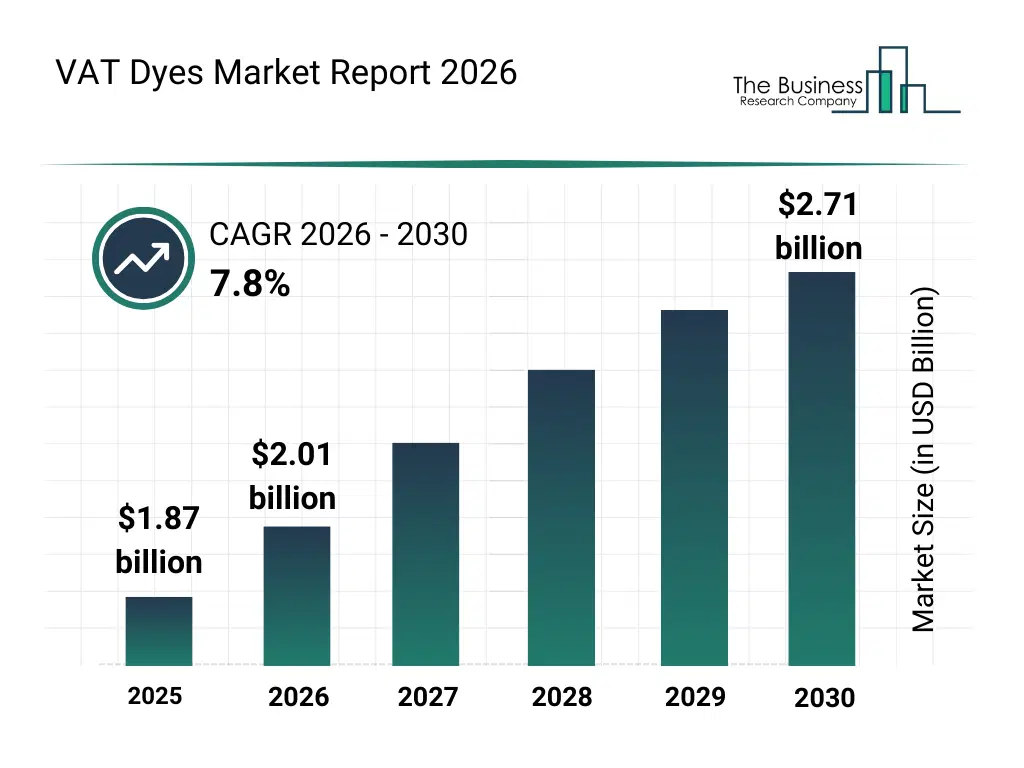
What Is The VAT Dyes Market Size and Share 2026?
The vat dyes market size has grown strongly in recent years. It will grow from $1.87 billion in 2025 to $2.01 billion in 2026 at a compound annual growth rate (CAGR) of 7.3%. The growth in the historic period can be attributed to expansion of textile manufacturing activities, rising use of vat dyes in cotton processing, growth of leather finishing industries, availability of synthetic indigo dyes, increasing demand for long-lasting color performance.What Is The VAT Dyes Market Growth Forecast?
The vat dyes market size is expected to see strong growth in the next few years. It will grow to $2.71 billion in 2030 at a compound annual growth rate (CAGR) of 7.8%. The growth in the forecast period can be attributed to growing focus on sustainable dyeing practices, rising adoption of eco-compliant vat dyes, expansion of textile production in emerging economies, increasing demand for high-purity dye intermediates, growing investment in advanced dyeing technologies. Major trends in the forecast period include rising demand for colorfast and durable textile dyes, growing adoption in leather and specialty printing applications, increased use of pad and dip dyeing techniques, expansion of high-performance indigo and anthraquinone dyes, enhanced focus on process efficiency and yield.
Global VAT Dyes Market Segmentation
1) By Product Type: Carbazole Derivatives, Indigo Derivatives, Anthraquinone Derivatives, Thio-Indigo Dyes 2) By Methods: Dip Dyeing, Pad Dyeing 3) By Application: Cotton, Viscose Rayon, Leather, Others Applications Subsegments: 1) By Carbazole Derivatives: Carbazole Blue Dyes, Carbazole Violet Dyes 2) By Indigo Derivatives: Natural Indigo, Synthetic Indigo 3) By Thio-Indigo Dyes: Thio-Indigo Blue, Thio-Indigo VioletWhat Are The Drivers Of The VAT Dyes Market?
The expansion of online retail is expected to propel the growth of the VAT dyes market going forward. Online retail popularity is rising due to its convenience, offering consumers easy access to a wide variety of products with seamless delivery options. The online retail platform for vat dyes enables manufacturers and suppliers to reach a broader customer base, facilitating easier ordering and distribution of specialty dyes. Additionally, it provides customers with access to detailed product information, customer reviews, and competitive pricing, enhancing their purchasing experience. For instance, in August 2024, according to the U.S. Census Bureau, a US-based government agency, in the US retail e-commerce sales reached $291.6 billion in quarter 2 2024, up 1.3% from quarter 1 and 6.7% year-over-year. Total retail sales were $1,826.9 billion, increasing 0.5% from quarter 1 and 2.1% from quarter 2 2023. Therefore, the expansion of online retail is expected to propel the growth of the VAT dyes industry. The rise in disposable income is expected to drive the vat dyes market. Disposable income is the total income available to an individual or household after deducting taxes and mandatory expenses, representing the funds available for discretionary spending and saving. VAT dyes, being versatile and widely used in the coloring of textiles, benefit from this increased consumer spending on clothing and fabric products. The expansion of the fashion and textile industries, coupled with higher consumer demand for vibrant and long-lasting colors in apparel, fuels the adoption of VAT dyes. For instance, in August 2024, according to the Bureau of Economic Analysis, a US-based government agency, personal disposable income rose by $75.1 billion (0.3% at a monthly rate) in July, compared to a 0.2% increase in June. Therefore, a rise in disposable income is expected to contribute to the growth of the vat dyes industry.Key Players In The Global VAT Dyes Market
Major companies operating in the vat dyes market are Archroma, DyStar Group, BASF SE, Huntsman Corporation, Atul Ltd., Kiri Industries Limited, Bodal Chemicals Ltd., Colourtex Industries Pvt. Ltd., Everlight Chemical Industrial Corp., Zhejiang Longsheng Group, Jay Chemical Industries, Oswal Udhyog, Setas Color, Nippon Kayaku Co. Ltd., Bhageria Industries, Chemie Colour, Vivek Dyechem, Trust Chem, Megachem Industries, York Chemicals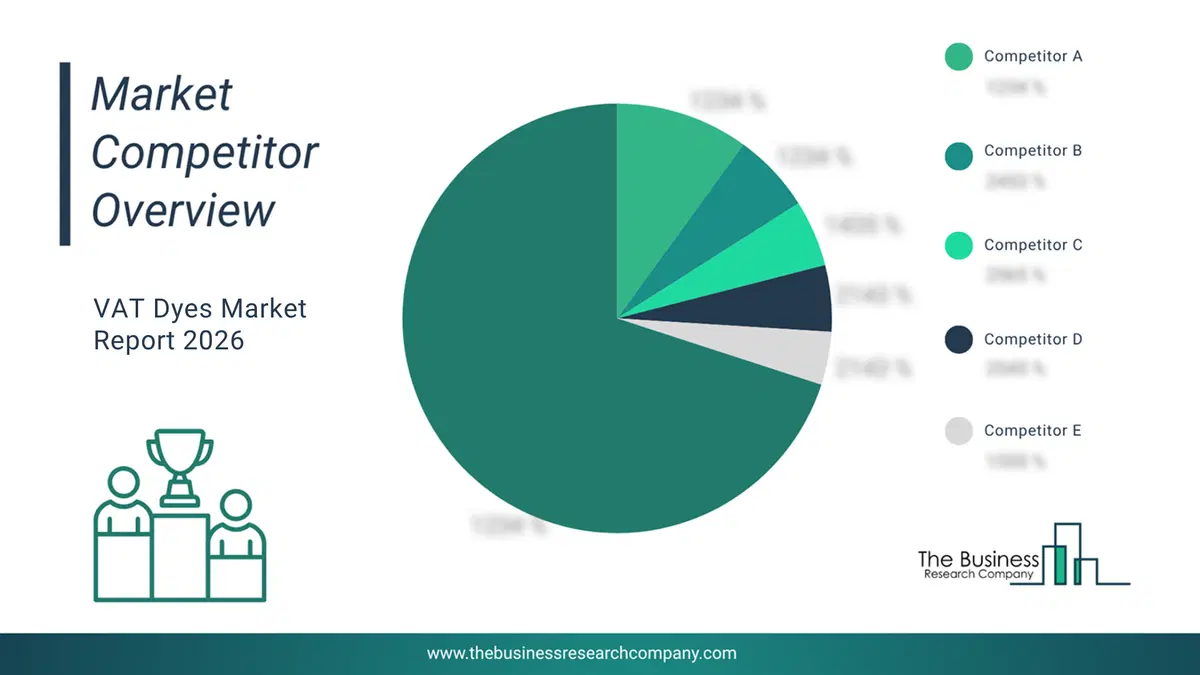
This chart is for illustrative purposes; the full report includes a detailed competitor analysis and comprehensive overview of the top 10 companies in the market.
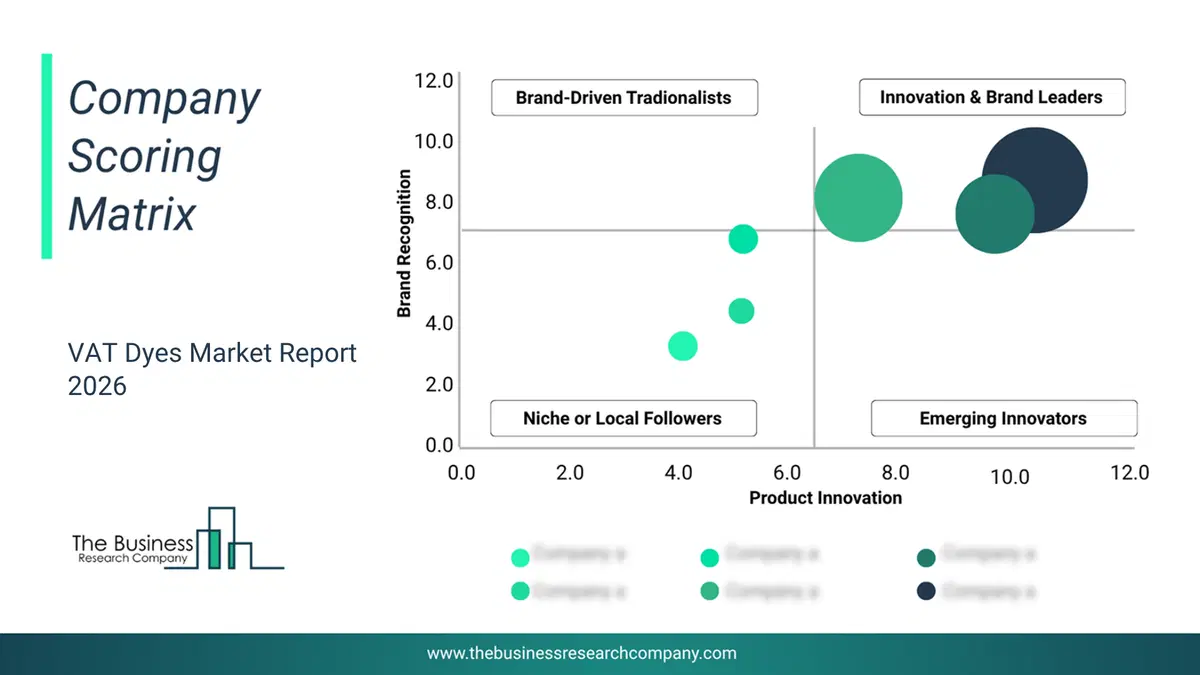
This chart maps companies by product innovation and brand strength, with bubble size indicating relative revenue, helping identify market leaders, challengers, and niche players. This is an illustrative chart; the full report provides a complete and accurate competitive analysis.
What Are Latest Mergers And Acquisitions In The VAT Dyes Market?
In August 2023, Madewell, a US-based clothing company, partnered with the Bluesign System, becoming a certified Bluesign System Partner committed to sustainable textile standards. Madewell aims to enhance sustainability in its production processes. This partnership involves adhering to strict environmental and safety standards, focusing on reducing resource consumption and minimizing environmental impact throughout the supply chain. Bluesign System is a US-based denim brand.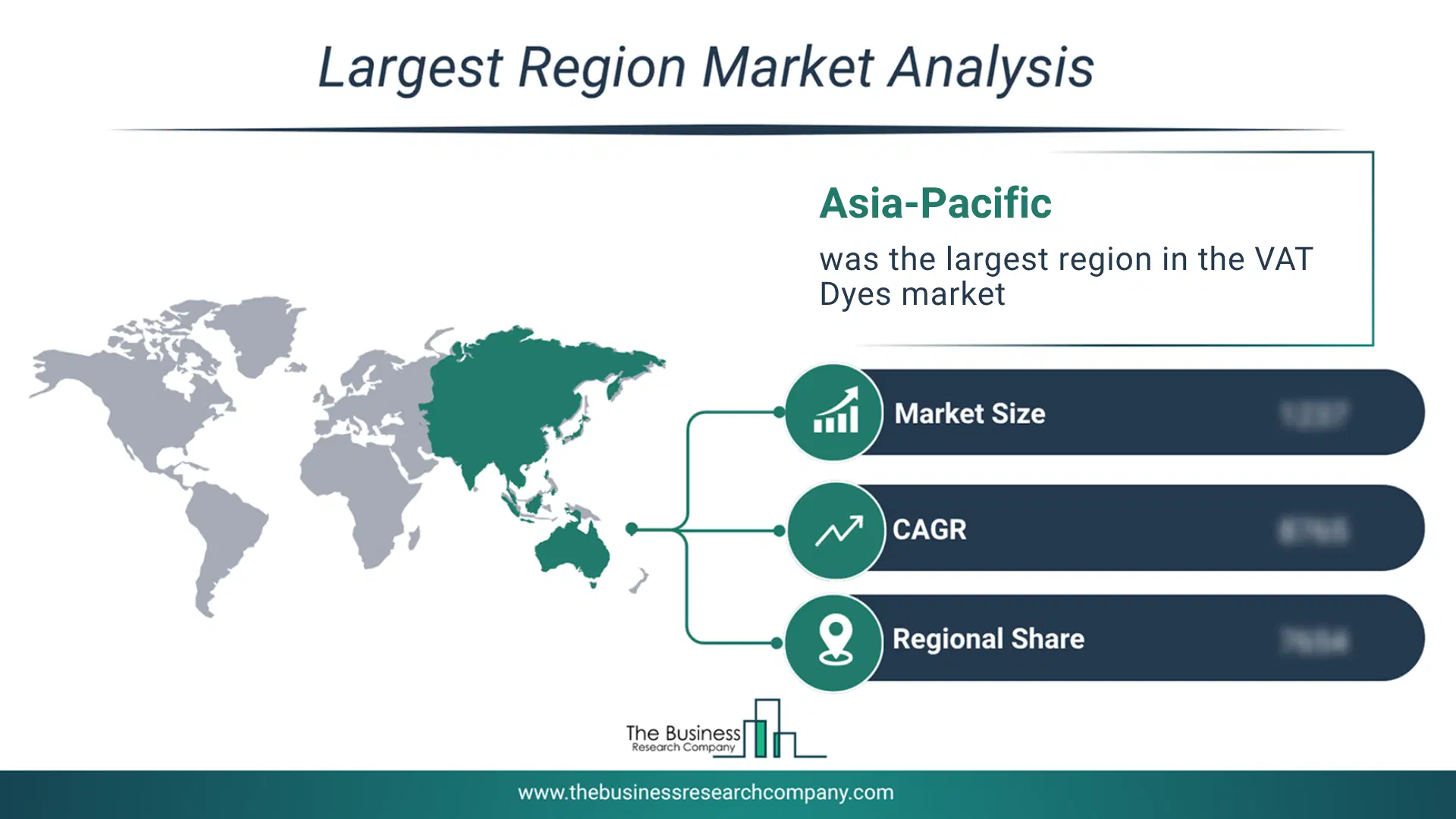
Regional Insights
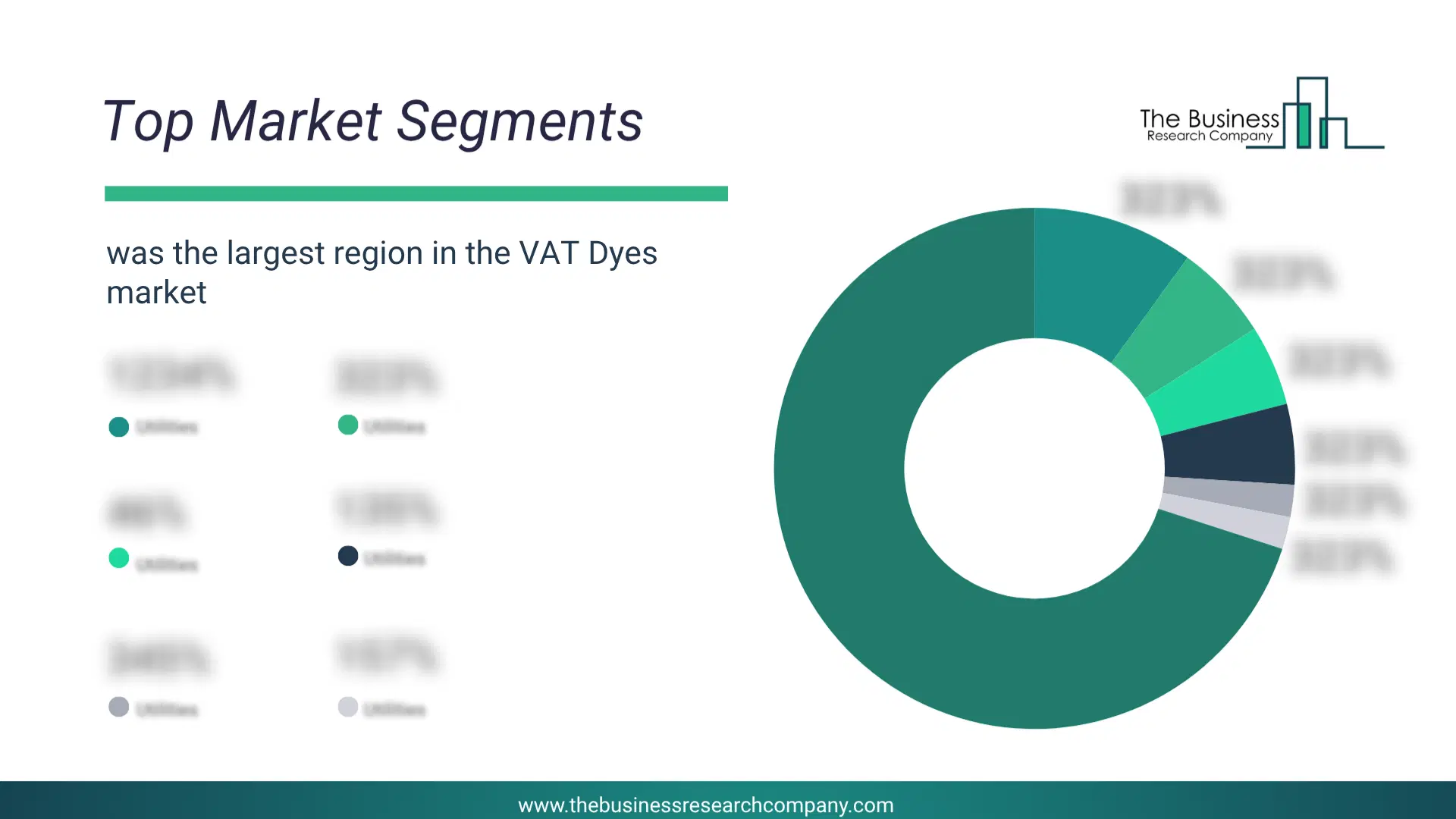
Asia-Pacific was the largest region in the VAT dyes market in 2025. The regions covered in this market report are Asia-Pacific, South East Asia, Western Europe, Eastern Europe, North America, South America, Middle East, Africa The countries covered in this market report are Australia, Brazil, China, France, Germany, India, Indonesia, Japan, Taiwan, Russia, South Korea, UK, USA, Canada, Italy, SpainWhat Defines the VAT Dyes Market?
The vat dyes market consists of sales of fiber-reactive dyes, direct dyes, and acid dyes. Values in this market are ‘factory gate’ values, that is, the value of goods sold by the manufacturers or creators of the goods, whether to other entities (including downstream manufacturers, wholesalers, distributors, and retailers) or directly to end customers. The value of goods in this market includes related services sold by the creators of the goods.How is Market Value Defined and Measured?
The market value is defined as the revenues that enterprises gain from the sale of goods and/or services within the specified market and geography through sales, grants, or donations in terms of the currency (in USD unless otherwise specified). The revenues for a specified geography are consumption values that are revenues generated by organizations in the specified geography within the market, irrespective of where they are produced. It does not include revenues from resales along the supply chain, either further along the supply chain or as part of other products.
This chart presents market attractiveness based on a quantitative evaluation of growth, competition, strategic alignment, and risk, offering a clear view of opportunity areas for decision-making. This chart is for illustrative purposes; the full report contains the complete analysis.

This chart highlights the Total Addressable Market (TAM) by estimating the maximum revenue opportunity using an assumption-driven approach, supporting strategic planning and opportunity sizing across markets. The chart is illustrative; the full report provides a more comprehensive analysis.
What Key Data and Analysis Are Included in the VAT Dyes Market Report 2026?
The vat dyes market research report is one of a series of new reports from The Business Research Company that provides market statistics, including industry global market size, regional shares, competitors with the market share, detailed market segments, market trends and opportunities, and any further data you may need to thrive in the vat dyes industry. The market research report delivers a complete perspective of everything you need, with an in-depth analysis of the current and future state of the industry.VAT Dyes Market Report Forecast Analysis
| Report Attribute | Details |
|---|---|
| Market Size Value In 2026 | $2.01 billion |
| Revenue Forecast In 2030 | $2.71 billion |
| Growth Rate | CAGR of 7.3% from 2026 to 2030 |
| Base Year For Estimation | 2025 |
| Actual Estimates/Historical Data | 2020-2025 |
| Forecast Period | 2026 - 2030 |
| Market Representation | Revenue in USD Billion and CAGR from 2026 to 2030 |
| Segments Covered | Product Type, Methods, Application |
| Regional Scope | Asia-Pacific, Western Europe, Eastern Europe, North America, South America, Middle East, Africa |
| Country Scope | The countries covered in this market report are Australia, Brazil, China, France, Germany, India, Indonesia, Japan, Taiwan, Russia, South Korea, UK, USA, Canada, Italy, Spain |
| Key Companies Profiled | Archroma, DyStar Group, BASF SE, Huntsman Corporation, Atul Ltd., Kiri Industries Limited, Bodal Chemicals Ltd., Colourtex Industries Pvt. Ltd., Everlight Chemical Industrial Corp., Zhejiang Longsheng Group, Jay Chemical Industries, Oswal Udhyog, Setas Color, Nippon Kayaku Co. Ltd., Bhageria Industries, Chemie Colour, Vivek Dyechem, Trust Chem, Megachem Industries, York Chemicals |
| Customization Scope | Request for Customization |
| Pricing And Purchase Options | Explore Purchase Options |