

Vehicle Access Control Market Report 2026
Global Outlook – By Type (Biometric System, Non-Biometric System), By Vehicle Type (PC, LCV, HCV), By Technology (Near Field Communication (NFC), Bluetooth, RFID, Wi-Fi), By Applications (Traffic Management, Sensitive Sites Or Facilities Or Zones, Toll Ways, Commercial Buildings, Residential Buildings) – Market Size, Trends, Strategies, and Forecast to 2030
Vehicle Access Control Market Overview
• Vehicle Access Control market size has reached to $13.01 billion in 2025 • Expected to grow to $21.39 billion in 2030 at a compound annual growth rate (CAGR) of 10.4% • Growth Driver: Surging Demand For Electric Vehicles Drives Growth In Vehicle Access Control Market • Market Trend: Technological Advancements Redefine Convenience And Security In The Market • North America was the largest region in 2025 and Asia-Pacific is the fastest growing region.What Is Covered Under Vehicle Access Control Market?
The vehicle access control refer to access control with simple systems that are tailored to the needs, ranging from simple vehicle entry and exit to advanced access control. Vehicle access control has a variety of approaches that can be used to control vehicles entering and exiting a region such as employment, time, and day. It is made up of both biometric and non-biometric components. This technology avoids human involvement to verify the vehicle by giving automatic access to the vehicles. The main types of vehicle access control in the market are biometric system and non-biometric system. The biometric system uses authentication and authorization to control access to a vehicle. A biometric system integrates security and convenience in a way that no other access control system can, due to its biometric codes. The biometric system is used for better security which is difficult to duplicate and is convenient, and inherent to the user. Vehicle access control is used in passenger cars (PC), light commercial vehicles (LCV) and heavy commercial vehicles (HCV) and uses technologies such as near field communication (NFC), Bluetooth, RFID and Wi-Fi. Vehicle access control have application in traffic management, sensitive sites/facilities/zones, toll ways, commercial buildings, residential buildings.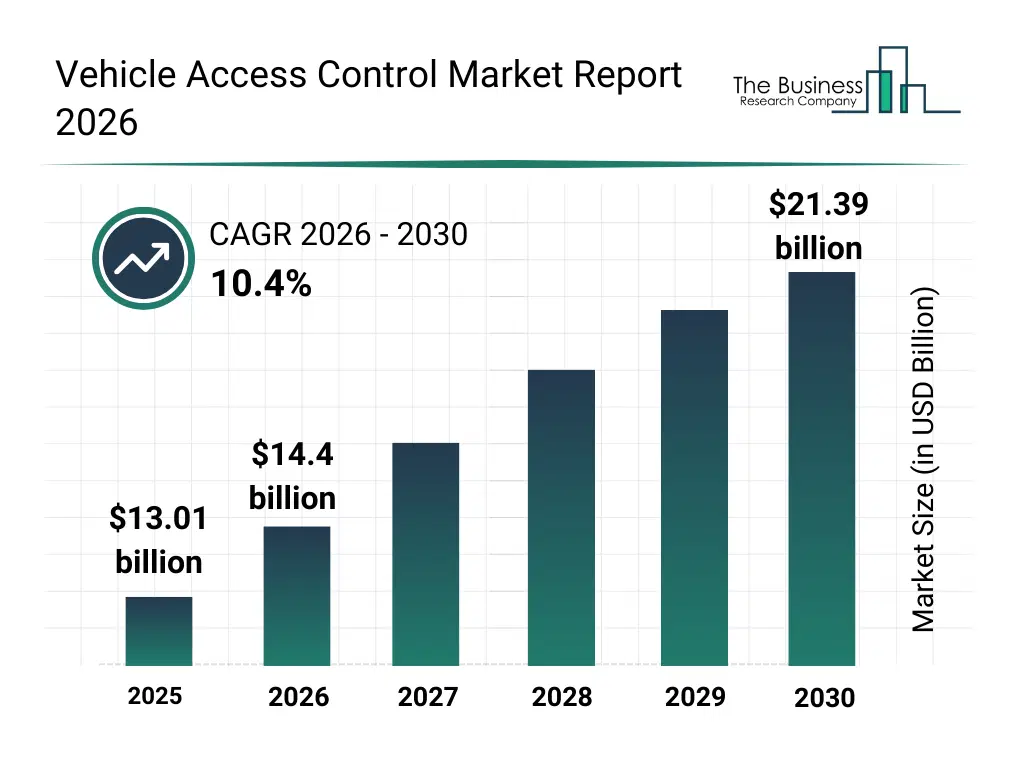
What Is The Vehicle Access Control Market Size and Share 2026?
The vehicle access control market size has grown rapidly in recent years. It will grow from $13.01 billion in 2025 to $14.4 billion in 2026 at a compound annual growth rate (CAGR) of 10.8%. The growth in the historic period can be attributed to expansion of urban infrastructure projects, increasing vehicle ownership rates, rising security concerns at facilities, adoption of electronic access control systems, growth of smart city initiatives.What Is The Vehicle Access Control Market Growth Forecast?
The vehicle access control market size is expected to see rapid growth in the next few years. It will grow to $21.39 billion in 2030 at a compound annual growth rate (CAGR) of 10.4%. The growth in the forecast period can be attributed to increasing deployment of ai-enabled access systems, rising demand for integrated traffic management solutions, expansion of contactless authentication adoption, growing investments in smart infrastructure, increasing focus on cybersecurity for access platforms. Major trends in the forecast period include increasing adoption of automated vehicle entry systems, rising integration of biometric authentication technologies, growing use of rfid and nfc-based access solutions, expansion of smart parking and tolling systems, enhanced focus on secure and contactless access.
Global Vehicle Access Control Market Segmentation
1) By Type: Biometric System, Non-Biometric System 2) By Vehicle Type: PC, LCV, HCV 3) By Technology: Near Field Communication (NFC), Bluetooth, RFID, Wi-Fi 4) By Applications: Traffic Management, Sensitive Sites Or Facilities Or Zones, Toll Ways, Commercial Buildings, Residential Buildings Subsegments: 1) By Biometric System: Fingerprint Recognition Systems, Facial Recognition Systems, Iris Recognition Systems, Voice Recognition Systems 2) By Non-Biometric System: Key Fob Systems, RFID Systems, Keypad Entry Systems, Mobile App-Based Access ControlWhat Is The Driver Of The Vehicle Access Control Market?
The increasing demand for electric vehicles will propel the growth of the vehicle access control market. A vehicle propelled by one or more electric motors is known as an electric vehicle (EV). It can be powered by a collector system that draws electricity from the outside of the car or by a battery. Road and rail vehicles, surface and underwater watercraft, electric airplanes, and electric spaceships are all examples of electric vehicles. As the demand increases for electric vehicles, it will create a significant need to employ vehicle access control systems. For instance, in May 2025, the International Energy Agency (IEA), a France-based intergovernmental organization in?2024, global electric?car sales hit about 17?million units, representing an increase of over 25% compared with 2023. Therefore, the growing demand for electric vehicles is driving the growth of the vehicle access control industry going forward.Key Players In The Global Vehicle Access Control Market
Major companies operating in the vehicle access control market are Denso Corporation; Valeo SA; Continental AG; Robert Bosch GmbH; Lear Corporation; HELLA GmbH & Co.; ZF Friedrichshafen AG; Mitsubishi Electric Corporation; Panasonic Corporation; Omron Corporation;NXP Semiconductors N. V.; Texas Instruments Incorporated;STMicroelectronics N. V.; Infineon Technologies AG; Alps Alpine Co Ltd.; Aptiv PLC.; Autoliv Inc.; Gentex Corporation; Harman International Industries Inc.; Hitachi Ltd.; HyundAI Mobis Co Ltd.; Johnson Electric Holdings Limited; Magna International Inc.; Murata Manufacturing Co Ltd.; NEC Corporation; Nidec Corporation; Osram Licht AG; Samsung Electronics Co Ltd.; Sony Corporation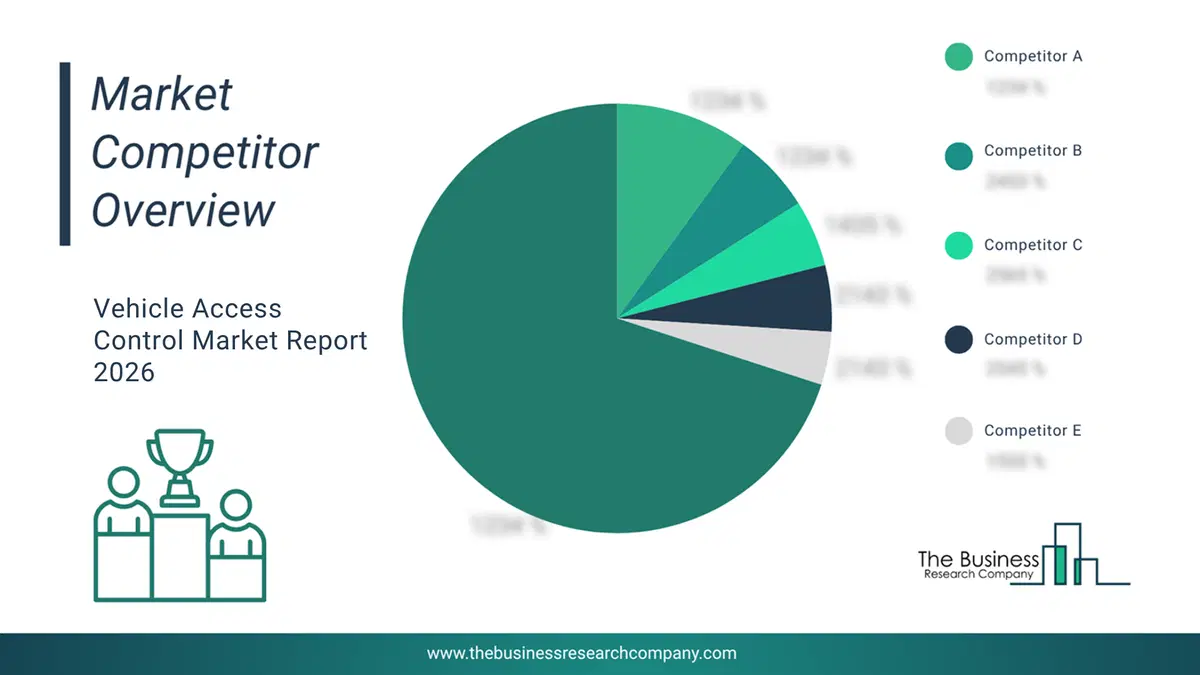
This chart is for illustrative purposes; the full report includes a detailed competitor analysis and comprehensive overview of the top 10 companies in the market.
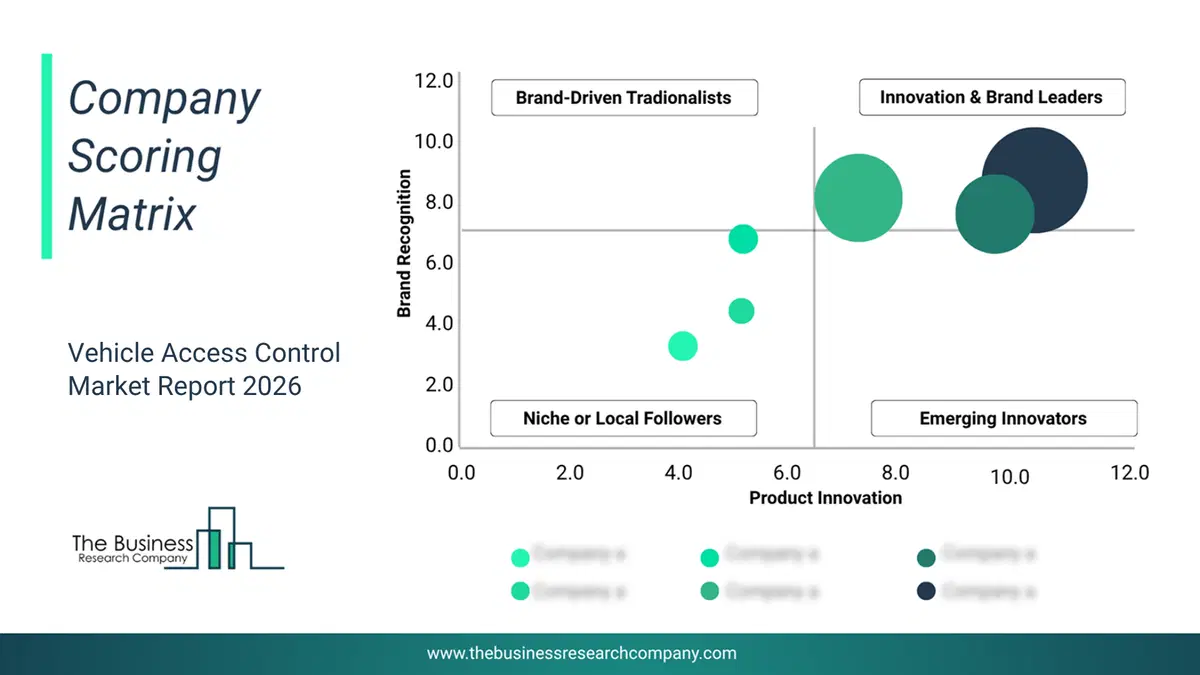
This chart maps companies by product innovation and brand strength, with bubble size indicating relative revenue, helping identify market leaders, challengers, and niche players. This is an illustrative chart; the full report provides a complete and accurate competitive analysis.
Global Vehicle Access Control Market Trends and Insights
Major companies operating in the vehicle access control market are focusing on developing innovative solutions such as long-range RFID readers to enable seamless and automated vehicle access. A long-range RFID reader is a device that can automatically identify and track RFID-tagged vehicles from several meters away, enabling fast, contactless, and secure access control. For instance, in June 2024, Nedap N.V., a Netherlands-based technology company, launched uPASS Go, a long-range vehicle access reader utilizing UHF RFID technology for secure identification of vehicles up to 10 meters (33 feet) away. The device enables automatic vehicle recognition and fast, secure access control, operating with passive UHF RFID tags that comply with EPC Gen 2 standards. It supports multiple communication protocols, including RS485, Ethernet, Wiegand, and secure OSDP v2. Built for easy installation and durable outdoor performance, uPASS Go integrates smoothly with existing access control systems, offering a cost-effective and user-friendly solution for vehicle access management.What Are Latest Mergers And Acquisitions In The Vehicle Access Control Market?
In January 2025, STAR Systems International Pte Ltd., a Singapore-based technology company, acquired V Track ID for an undisclosed amount. Through this acquisition, STAR Systems International aims to enhance its tolling and vehicle identification portfolio, accelerate innovation in vehicle connectivity, and strengthen its capabilities in V2X (Vehicle-to-Everything) communication and data-driven smart infrastructure solutions. V Track ID Inc. is a US-based company that provides vehicle access control capabilities.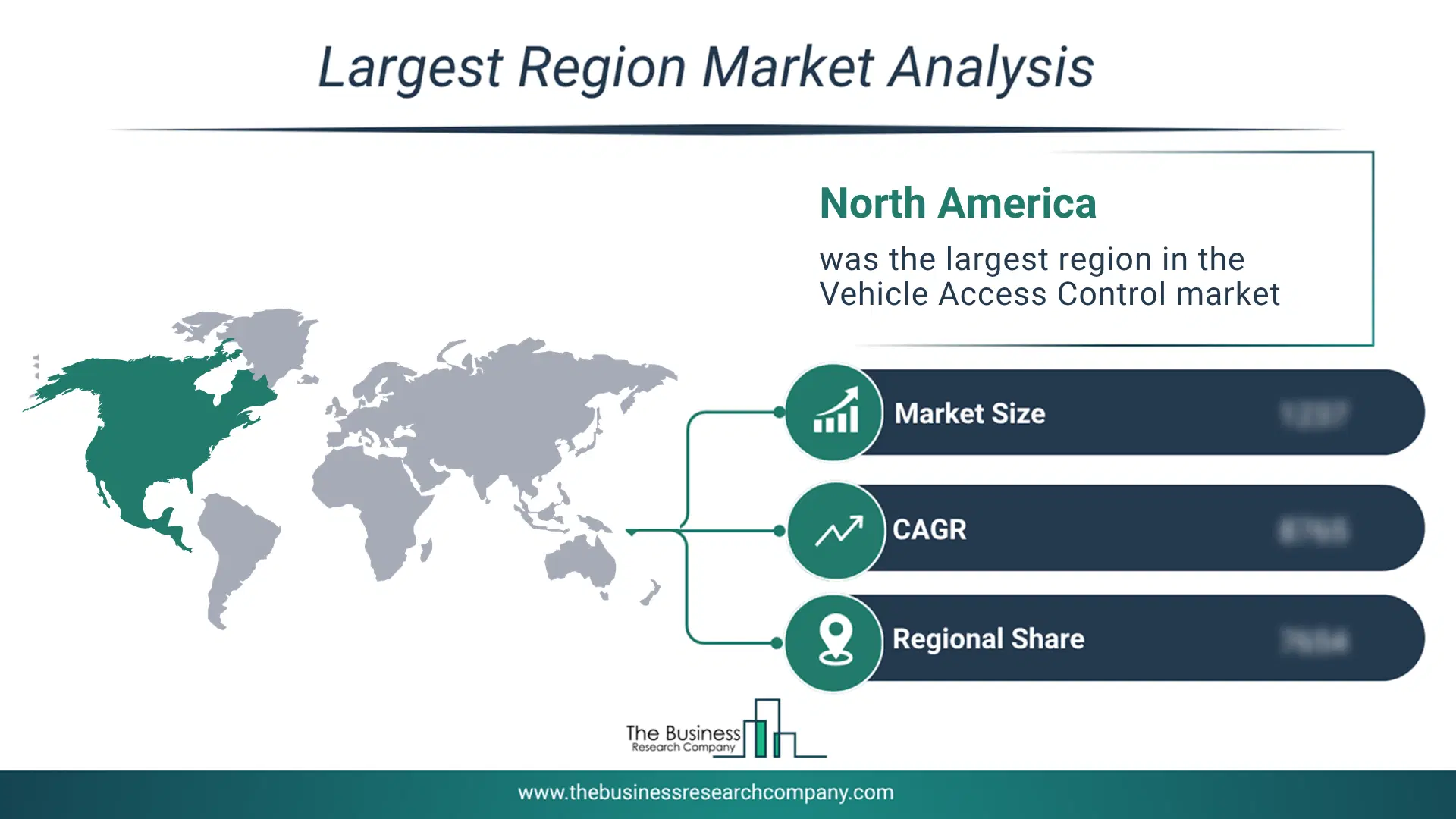
Regional Insights
North America was the largest region in the vehicle access control market in 2025. Asia-Pacific is expected to be the fastest-growing region in the forecast period. The regions covered in this market report are Asia-Pacific, South East Asia, Western Europe, Eastern Europe, North America, South America, Middle East, Africa. The countries covered in this market report are Australia, Brazil, China, France, Germany, India, Indonesia, Japan, Taiwan, Russia, South Korea, UK, USA, Canada, Italy, SpainWhat Defines the Vehicle Access Control Market?
The vehicle access control market includes revenues earned by entities by providing dynamic parking areas management, boarding area entrances management, multimedia kiosks management, accesses control management, remote configuration of entrance gates, user permission management. The market value includes the value of related goods sold by the service provider or included within the service offering. Only goods and services traded between entities or sold to end consumers are included.How is Market Value Defined and Measured?
The market value is defined as the revenues that enterprises gain from the sale of goods and/or services within the specified market and geography through sales, grants, or donations in terms of the currency (in USD unless otherwise specified). The revenues for a specified geography are consumption values that are revenues generated by organizations in the specified geography within the market, irrespective of where they are produced. It does not include revenues from resales along the supply chain, either further along the supply chain or as part of other products.
This chart presents market attractiveness based on a quantitative evaluation of growth, competition, strategic alignment, and risk, offering a clear view of opportunity areas for decision-making. This chart is for illustrative purposes; the full report contains the complete analysis.

This chart highlights the Total Addressable Market (TAM) by estimating the maximum revenue opportunity using an assumption-driven approach, supporting strategic planning and opportunity sizing across markets. The chart is illustrative; the full report provides a more comprehensive analysis.
What Key Data and Analysis Are Included in the Vehicle Access Control Market Report 2026?
The vehicle access control market research report is one of a series of new reports from The Business Research Company that provides market statistics, including industry global market size, regional shares, competitors with the market share, detailed market segments, market trends and opportunities, and any further data you may need to thrive in the vehicle access control industry. The market research report delivers a complete perspective of everything you need, with an in-depth analysis of the current and future state of the industry.Vehicle Access Control Market Report Forecast Analysis
| Report Attribute | Details |
|---|---|
| Market Size Value In 2026 | $14.4 billion |
| Revenue Forecast In 2030 | $21.39 billion |
| Growth Rate | CAGR of 10.4% from 2026 to 2030 |
| Base Year For Estimation | 2025 |
| Actual Estimates/Historical Data | 2020-2025 |
| Forecast Period | 2026 - 2030 |
| Market Representation | Revenue in USD Billion and CAGR from 2026 to 2030 |
| Segments Covered | Type, Vehicle Type, Technology, Applications |
| Regional Scope | Asia-Pacific, Western Europe, Eastern Europe, North America, South America, Middle East, Africa |
| Country Scope | The Countries Covered In This Market Report Are Australia, Brazil, China, France, Germany, India, Indonesia, Japan, Taiwan, Russia, South Korea, Uk, Usa, Canada, Italy, Spain. |
| Key Companies Profiled | Denso Corporation, Valeo SA, Continental AG, Robert Bosch GmbH, Lear Corporation, HELLA GmbH & Co., ZF Friedrichshafen AG, Mitsubishi Electric Corporation, Panasonic Corporation, Omron Corporation,NXP Semiconductors N. V., Texas Instruments Incorporated,STMicroelectronics N. V., Infineon Technologies AG, Alps Alpine Co Ltd., Aptiv PLC., Autoliv Inc., Gentex Corporation, Harman International Industries Inc., Hitachi Ltd., HyundAI Mobis Co Ltd., Johnson Electric Holdings Limited, Magna International Inc., Murata Manufacturing Co Ltd., NEC Corporation, Nidec Corporation, Osram Licht AG, Samsung Electronics Co Ltd., Sony Corporation |
| Customization Scope | Request for Customization |
| Pricing And Purchase Options | Explore Purchase Options |