

Vertical Market Software Market Report 2026
Global Outlook – By Software Type (Banking Software, Education Software, Legal Software, Agriculture Software, Alumni Management Software, Amusement Park Software, Apparel Software, Architecture Software, Other Software Types), By Deployment (Cloud-Based, On-Premise), By Enterprise Size (Small And Medium Enterprises, Large Enterprises), By Industry Vertical (Banking, Financial Services And Insurance (BFSI), Manufacturing, Retail, Healthcare, Information Technology (IT) And Telecommunication, Other Industry Verticals) – Market Size, Trends, Strategies, and Forecast to 2030
Vertical Market Software Market Overview
• Vertical Market Software market size has reached to $172.51 billion in 2025 • Expected to grow to $315.57 billion in 2030 at a compound annual growth rate (CAGR) of 12.8% • Growth Driver: Increasing Digitalization Fueling Growth In The Vertical Market Software Market • Market Trend: Accelerating Contract Review And Compliance With AI-Powered Insights • North America was the largest region in 2025 and Asia-Pacific is the fastest growing region.Market Gains By 2030 – Top Opportunities By Segment
Market Gain identifies the most promising market opportunities by highlighting the segments or products expected to generate the highest incremental revenue growth over the next five years.
What Is Covered Under Vertical Market Software Market?
Vertical market software refers to specialized software applications designed to meet the specific needs of a particular industry or niche market segment, such as healthcare, real estate, or manufacturing. These solutions aim to streamline processes, enhance productivity, improve compliance, and address the unique challenges faced by organizations operating within a particular sector. The software types of vertical market software are banking software, education software, legal software, agriculture software, alumni management software, amusement park software, apparel software, architecture software, and others. Banking software refers to specialized software solutions designed to facilitate various banking and financial activities for consumers and institutions. This can be deployed in the cloud as well as on-premise. This software is used by small and medium enterprises and large enterprises of various industry verticals, including banking, financial services and insurance (BFSI), manufacturing, retail, healthcare, information technology (IT), telecommunication, and others.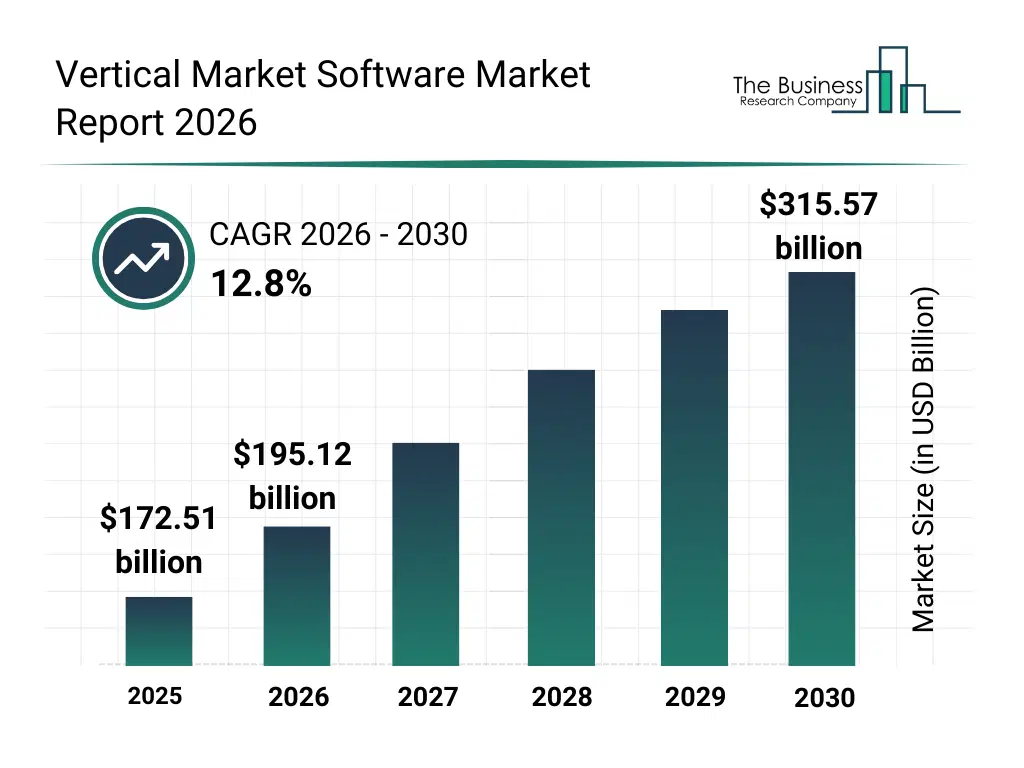
What Is The Vertical Market Software Market Size and Share 2026?
The vertical market software market size has grown rapidly in recent years. It will grow from $172.51 billion in 2025 to $195.12 billion in 2026 at a compound annual growth rate (CAGR) of 13.1%. The growth in the historic period can be attributed to growth of sector-specific regulatory requirements, increasing digital transformation across industries, demand for customized enterprise solutions, expansion of cloud computing adoption, rising investments in enterprise software.What Is The Vertical Market Software Market Growth Forecast?
The vertical market software market size is expected to see rapid growth in the next few years. It will grow to $315.57 billion in 2030 at a compound annual growth rate (CAGR) of 12.8%. The growth in the forecast period can be attributed to increasing demand for scalable vertical software platforms, rising adoption of data-driven decision tools, expansion of AI-powered industry applications, growing focus on interoperability with legacy systems, increasing investments in industry-specific digital ecosystems. Major trends in the forecast period include increasing demand for industry-specific saas solutions, rising adoption of cloud-based vertical platforms, growing integration of AI-driven industry workflows, expansion of compliance-focused software solutions, enhanced focus on process automation for niche industries.
Global Vertical Market Software Market Segmentation
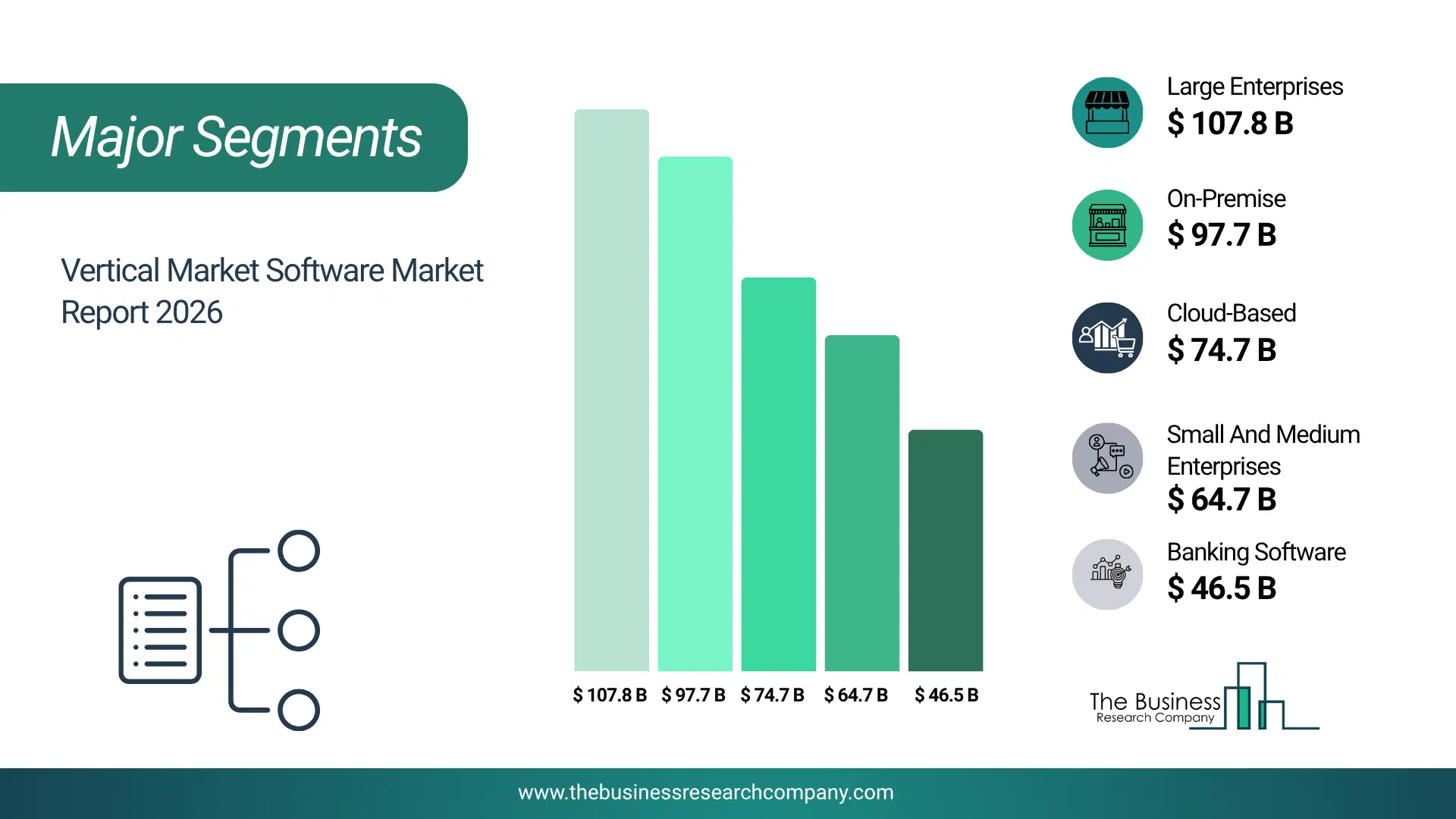
1) By Software Type: Banking Software, Education Software, Legal Software, Agriculture Software, Alumni Management Software, Amusement Park Software, Apparel Software, Architecture Software, Other Software Types 2) By Deployment: Cloud-Based, On-Premise 3) By Enterprise Size: Small And Medium Enterprises, Large Enterprises 4) By Industry Vertical: Banking, Financial Services And Insurance (BFSI), Manufacturing, Retail, Healthcare, Information Technology (IT) And Telecommunication, Other Industry Verticals Subsegments: 1) By Banking Software: Core Banking Software, Mobile Banking Software, Loan Management Software, Payment Processing Software, Risk Management Software, Fraud Detection Software, Trading And Investment Software 2) By Education Software: Learning Management Systems (LMS), Student Information Systems (SIS), Virtual Classroom Software, Exam Management Software, E-Learning Content Software, School Administration Software 3) By Legal Software: Case Management Software, Document Management Software, Legal Research Software, Billing And Invoicing Software, Time Tracking Software, Contract Management Software 4) By Agriculture Software: Farm Management Software, Crop Management Software, Livestock Management Software, Agricultural Supply Chain Management Software, Precision Farming Software, Irrigation Management Software 5) By Alumni Management Software: Alumni Database Management Software, Event Management Software, Fundraising And Donation Software, Alumni Engagement Platforms, Networking Software 6) By Amusement Park Software: Ticketing And Reservation Software, Visitor Management Software, Ride Management Software, Queue Management Software, Park Operations Software 7) By Apparel Software: Fashion Design Software, Apparel Manufacturing Software, Inventory Management Software, Supply Chain Management Software, Retail POS Software 8) By Architecture Software: Computer-Aided Design (CAD) Software, Building Information Modeling (BIM) Software, 3D Modeling Software, Project Management Software, Structural Analysis Software 9) By Other Software Types: Healthcare Software, Real Estate Software, Automotive Software, Energy And Utilities Software, Hospitality Management Software, Retail Management Software, Hr Management Software The top segments in the vertical market software market will be: • Large Enterprises will reach $107800.58 Million by 2025. • On-Premise will reach $97735.49 Million by 2025. • Cloud-Based will reach $74777.44 Million by 2025. • Small And Medium Enterprises will reach $64712.35 Million by 2025. • Banking Software will reach $46546.9 Million by 2025.What Is The Driver Of The Vertical Market?
The increasing digitization is expected to propel the vertical software market growth going forward. Digitalization is the utilization of digital technologies to convert various processes, activities, or assets into a digital form. Digitalization increases due to its ability to streamline processes, enhance efficiency, improve accessibility, and create new opportunities for innovation and growth in various sectors. Digitalization empowers vertical market software by enabling streamlined processes, enhanced data analytics, and improved customer engagement to meet industry-specific needs effectively. For instance, in September 2024, according to the United Nations Department of Economic and Social Affairs (UN DESA), a US-based international organization responsible for monitoring global digital government development, the proportion of the global population lagging in digital government development declined from 45.0% in 2022 to 22.4% in 2024. Therefore, increasing digitization is driving the vertical market software market growth.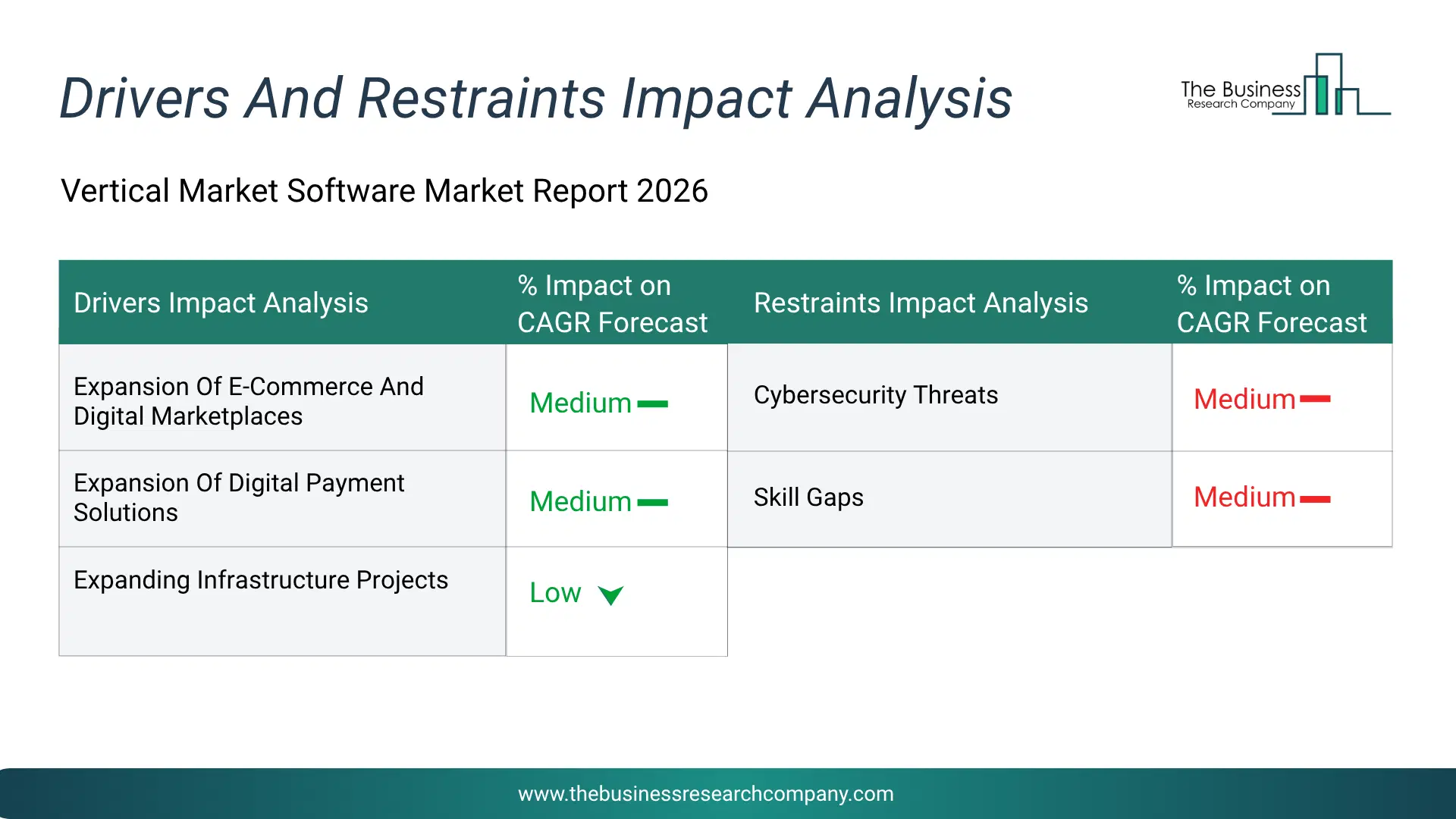
Infographic Chart Showing Key Market Drivers Analysis And Restraints For Vertical Market Software Market
The chart presents an impact analysis of key drivers and restraints, quantifying their relative influence on the market's growth rate and helping assess the balance between growth enablers and limiting factors. This chart offers a high-level perspective; the full report contains more detailed insights.
How Will The Drivers Impact Growth In The Global Vertical Market Software Market?
• Expansion Of E-Commerce And Digital Marketplaces (Medium) – The expansion of e-commerce and digital marketplaces will become a key driver of growth in the vertical market software market by 2030. Vertical market software plays a crucial role in these sectors by offering industry-specific features such as inventory management, payment processing, and compliance tools, all tailored to the unique requirements of each industry. This specialization not only boosts operational efficiency but also enhances customer experience and ensures smooth integration with existing business processes. • Expansion Of Digital Payment Solutions (Medium) – The expansion of digital payment solutions will emerge as a major factor driving the expansion of the vertical market software market by 2030. Vertical market software is vital for digital payment solutions, as it provides industry-specific features such as security, compliance, and transaction management, all tailored to meet the regulatory and operational needs of various sectors. This enables smooth integration with sector-specific financial workflows, strengthens fraud prevention, and enhances the overall user experience. • Expanding Infrastructure Projects (Low) – The expanding infrastructure projects within digital manufacturing processes will serve as a key growth catalyst for the vertical market software market by 2030. Vertical market software plays a crucial role in these projects by offering specialized tools for project management, regulatory compliance, and resource optimization, all tailored to the needs of the construction and engineering sectors. This enables efficient coordination of workflows, better cost control, and real-time monitoring, ultimately leading to enhanced project execution and scalability. • Expansion Of 5G Networks (Low) – The expansion of 5G networks will become a significant driver contributing to the growth of the vertical market software market by 2030. The rollout of 5G networks enhances vertical market software by enabling faster data processing, real-time analytics, and improved connectivity for cloud-based applications, resulting in greater efficiency and responsiveness. This advancement benefits industries such as healthcare, manufacturing, and fintech by supporting seamless IoT integration, remote operations, and high-speed transactions.How Will The Restraints Impact Growth In The Global Vertical Market Software Market?
• Cybersecurity Threats (Medium) – Cybersecurity Threats will restrict the growth of the Vertical Market Software market during the forecast period. Vertical market software platforms handle sensitive business data, making them targets for cyberattacks. Data breaches can result in financial losses, reputational damage, and regulatory penalties. The growing sophistication of cyber threats requires continuous security investments, increasing operational costs. Security concerns can also affect user trust and adoption, particularly in industries handling sensitive data such as healthcare and finance, limiting market growth. • Skill Gaps (Medium) – Skill Gaps will restrict the growth of the Vertical Market Software market during the forecast period. The implementation and customization of vertical market software require specialized technical skills that are in short supply. The talent shortage in software development, integration, and support limits the ability of vendors to meet growing demand. The skill gap can lead to project delays, suboptimal implementations, and reduced customer satisfaction, slowing market growth and limiting the adoption of vertical software solutions.Key Players In The Global Vertical Market
Major companies operating in the vertical market software market are McKesson Corporation, Siemens AG, IBM, Oracle Corporation, SAP SE, Salesforce Inc., Intuit Inc., Constellation Software, Dassault Systèmes SE, Autodesk Inc., Paychex Inc., Epic Systems Corporation, Sage Group plc, Verisk Analytics Inc., Veeva Systems Inc., Tyler Technologies Inc., Infor, Aptean, Epicor Software, Wolters Kluwer, SYSPRO Corp, Granular Inc, ROLLER Software, Guidewire Software, Procore Technologies Inc.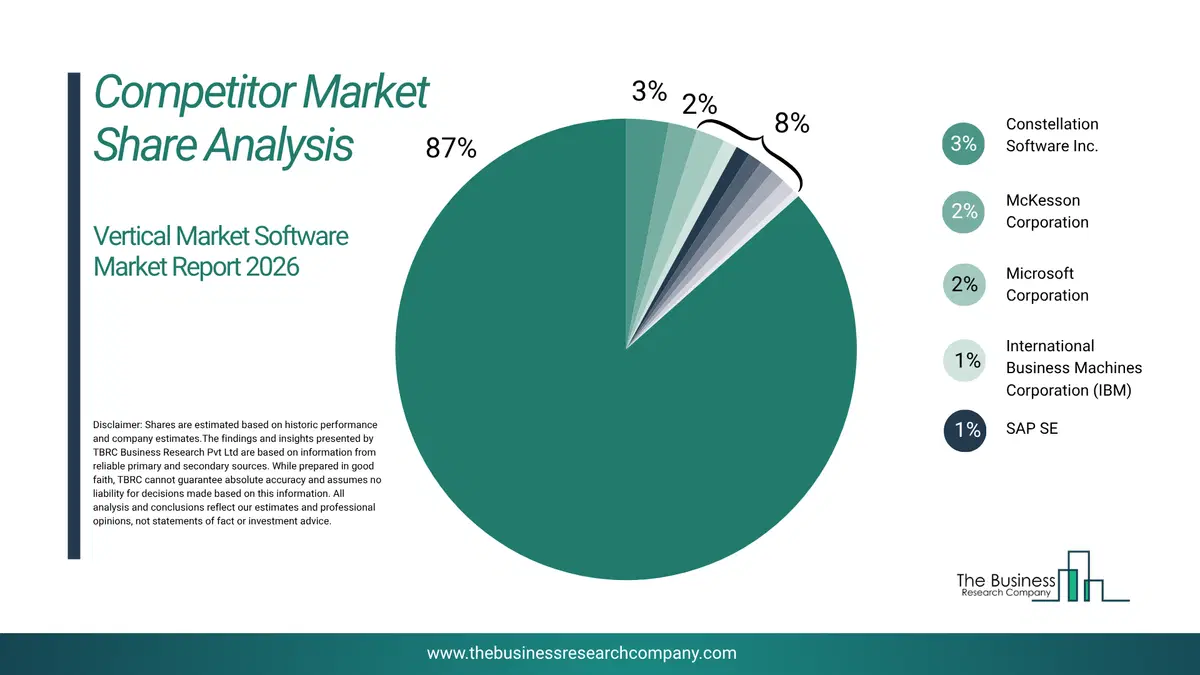
This chart is for illustrative purposes; the full report includes a detailed competitor analysis and comprehensive overview of the top 10 companies in the market.
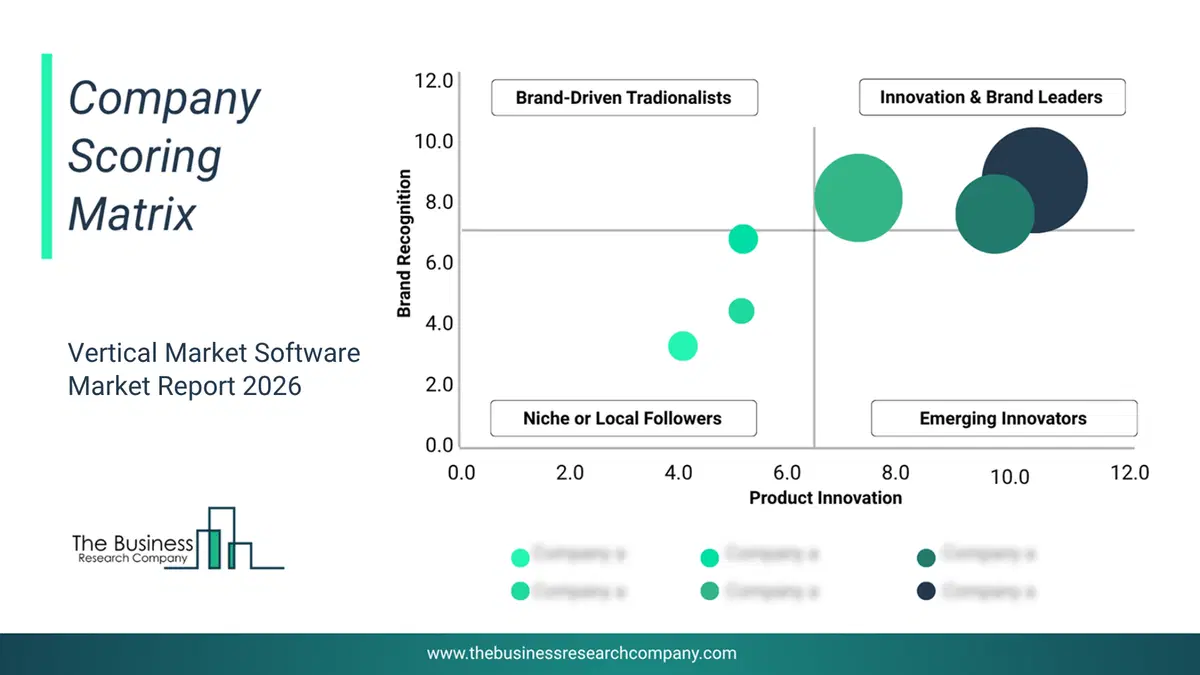
This chart maps companies by product innovation and brand strength, with bubble size indicating relative revenue, helping identify market leaders, challengers, and niche players. This is an illustrative chart; the full report provides a complete and accurate competitive analysis.
Global Vertical Market Trends and Insights
Major companies operating in the vertical software market are focusing on leveraging innovative technologies such as artificial intelligence-based automation and analytics to enhance industry-specific workflows and decision-making. Artificial intelligence-based automation and analytics is the use of AI to automatically perform routine tasks and analyze data, helping businesses save time, reduce errors, and make smarter, faster decisions. For instance, in March 2024, Wolters Kluwer N.V., a Netherlands-based professional software provider, launched new AI-enhanced contract-management functionality for Legisway, an advanced capability that automates contract review, supports natural-language querying, flags risks, and integrates audit workflows and collaboration features to help legal teams manage contract portfolios more efficiently.What Are Latest Mergers And Acquisitions In The Vertical Market?
In July 2023, Valsoft Corporation Inc., a Canada-based technology company, acquired Thatcher Technology Group for an undisclosed amount. Through this acquisition, Valsoft aims to strengthen its vertical-market software portfolio and accelerate growth in the direct-selling sector. Thatcher Technology Group is a US-based software company that provides solutions for managing direct-selling and party-plan business operations.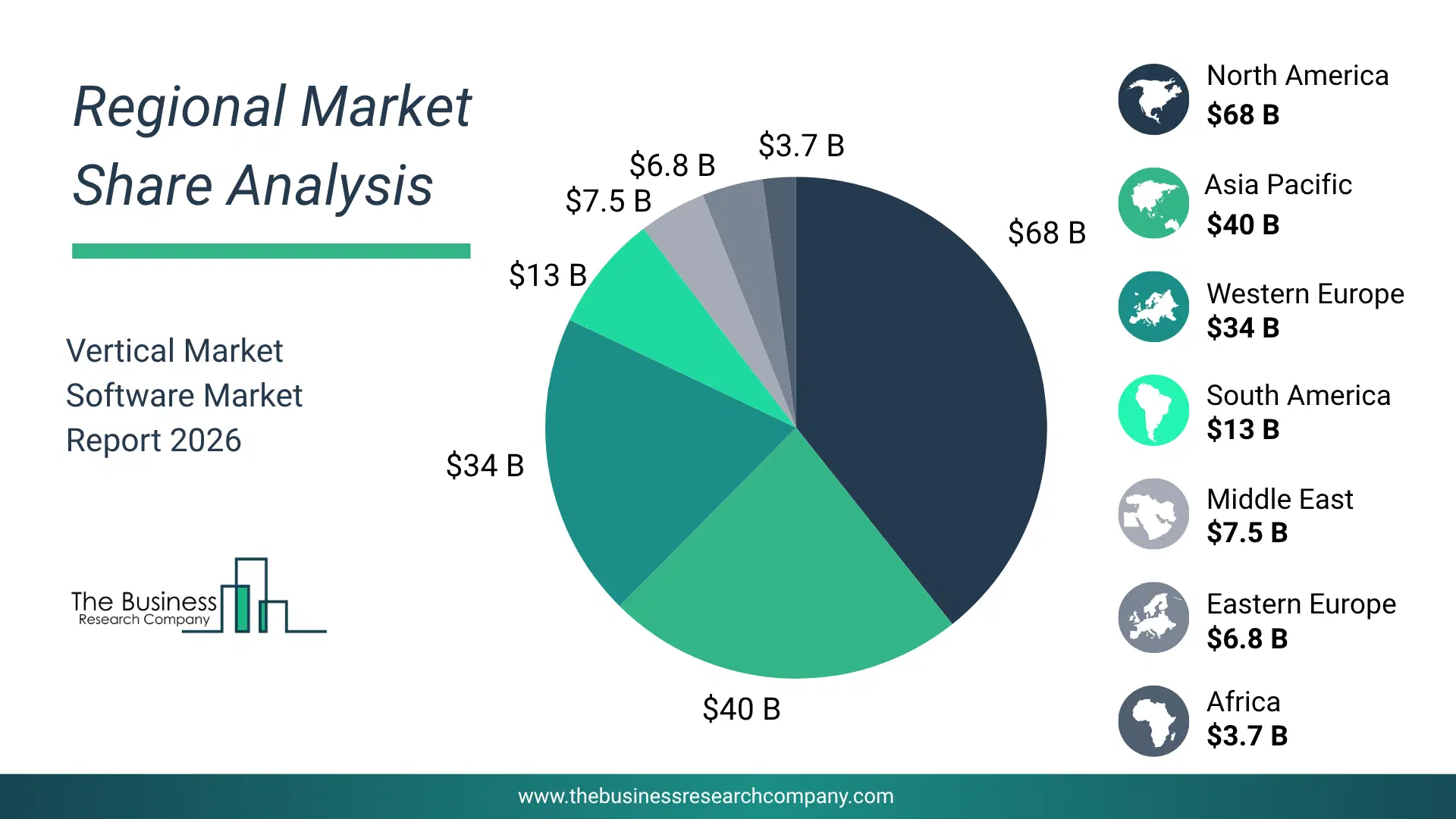
Regional Insights
North America was the largest region in the vertical market software market in 2025. Asia-Pacific is expected to be the fastest-growing region in the forecast period. The regions covered in this market report are Asia-Pacific, South East Asia, Western Europe, Eastern Europe, North America, South America, Middle East, Africa. The countries covered in this market report are Australia, Brazil, China, France, Germany, India, Indonesia, Japan, Taiwan, Russia, South Korea, UK, USA, Canada, Italy, Spain.What Defines the Vertical Market Software Market?
The vertical market software market includes revenues earned by entities by providing services such as implementation support, performance monitoring, customization, and training and education. The market value includes the value of related goods sold by the service provider or included within the service offering. Only goods and services traded between entities or sold to end consumers are included.How is Market Value Defined and Measured?
The market value is defined as the revenues that enterprises gain from the sale of goods and/or services within the specified market and geography through sales, grants, or donations in terms of the currency (in USD unless otherwise specified). The revenues for a specified geography are consumption values that are revenues generated by organizations in the specified geography within the market, irrespective of where they are produced. It does not include revenues from resales along the supply chain, either further along the supply chain or as part of other products.
This chart presents market attractiveness based on a quantitative evaluation of growth, competition, strategic alignment, and risk, offering a clear view of opportunity areas for decision-making. This chart is for illustrative purposes; the full report contains the complete analysis.

This chart highlights the Total Addressable Market (TAM) by estimating the maximum revenue opportunity using an assumption-driven approach, supporting strategic planning and opportunity sizing across markets. The chart is illustrative; the full report provides a more comprehensive analysis.
What Key Data and Analysis Are Included in the Vertical Market Software Market Report 2026?
The vertical market software market research report is one of a series of new reports from The Business Research Company that provides market statistics, including industry global market size, regional shares, competitors with the market share, detailed market segments, market trends and opportunities, and any further data you may need to thrive in the vertical market software industry. The market research report delivers a complete perspective of everything you need, with an in-depth analysis of the current and future state of the industry.Vertical Market Software Market Report Forecast Analysis
| Report Attribute | Details |
|---|---|
| Market Size Value In 2026 | $195.12 billion |
| Revenue Forecast In 2030 | $315.57 billion |
| Growth Rate | CAGR of 13.1% from 2026 to 2030 |
| Base Year For Estimation | 2025 |
| Actual Estimates/Historical Data | 2020-2025 |
| Forecast Period | 2026 - 2030 |
| Market Representation | Revenue in USD Billion and CAGR from 2026 to 2030 |
| Segments Covered | Software Type, Deployment, Enterprise Size, Industry Vertical |
| Regional Scope | Asia-Pacific, Western Europe, Eastern Europe, North America, South America, Middle East, Africa |
| Country Scope | The countries covered in the report are Australia, Brazil, China, France, Germany, India, Indonesia, Japan, Taiwan, Russia, South Korea, UK, USA, Canada, Italy, Spain. |
| Key Companies Profiled | McKesson Corporation, Siemens AG, IBM, Oracle Corporation, SAP SE, Salesforce Inc., Intuit Inc., Constellation Software, Dassault Systèmes SE, Autodesk Inc., Paychex Inc., Epic Systems Corporation, Sage Group plc, Verisk Analytics Inc., Veeva Systems Inc., Tyler Technologies Inc., Infor, Aptean, Epicor Software, Wolters Kluwer, SYSPRO Corp, Granular Inc, ROLLER Software, Guidewire Software, Procore Technologies Inc. |
| Customization Scope | Request for Customization |
| Pricing And Purchase Options | Explore Purchase Options |