

Real Estate Software Market Report 2026
Global Outlook – By Product (Enterprise Resource Planning (ERP), Property Management System (PMS), Customer Relationship Management (CRM)), By Deployment Type (Cloud, On-Premise), By Application (Commercial, Residential) – Market Size, Trends, Strategies, and Forecast to 2030
Real Estate Software Market Overview
• Real Estate Software market size has reached to $12.7 billion in 2025 • Expected to grow to $21.62 billion in 2030 at a compound annual growth rate (CAGR) of 11.3% • Growth Driver: The Rise In Urbanization Driving The Growth Of The Market Due To Industrialization And Population Migration • Market Trend: AI-Powered Tools Revolutionize Property Management And Enhance Tenant Experience • North America was the largest region in 2025.Market Gains By 2030 – Top Opportunities By Segment
Market Gain identifies the most promising market opportunities by highlighting the segments or products expected to generate the highest incremental revenue growth over the next five years.
What Is Covered Under Real Estate Software Market?
Real estate software is a set of solutions and platforms that are used for automating administrative, marketing, and other business tasks in real estate companies. Real estate software helps companies manage various functions such as operations, planning, stakeholder management, financing, marketing, and many others. The main types of real estate software products are customer relationship management software, content management software, financial management software, real estate contract software, and others. Customer relationship management (CRM) real estate software manages the relationships between buyers, sellers, agents, brokers, developers, and financial institutions. The various components include solutions and services, as well as organizations of various sizes, such as large enterprises, small businesses, and medium-sized businesses. It is used in commercial and residential settings and is deployed both on-premise and in the cloud.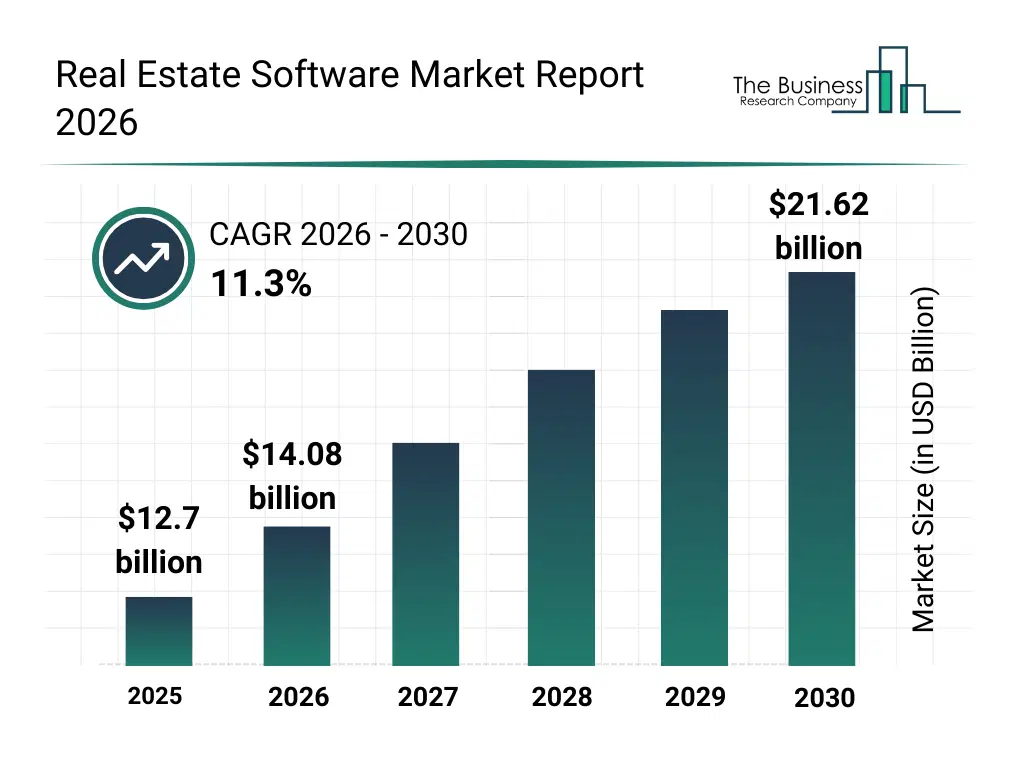
What Is The Real Estate Software Market Size and Share 2026?
The real estate software market size has grown rapidly in recent years. It will grow from $12.7 billion in 2025 to $14.08 billion in 2026 at a compound annual growth rate (CAGR) of 10.8%. The growth in the historic period can be attributed to manual process inefficiencies in real estate operations, growing real estate portfolio complexity, increasing demand for property management automation, expansion of commercial real estate projects, adoption of digital marketing tools.What Is The Real Estate Software Market Growth Forecast?
The real estate software market size is expected to see rapid growth in the next few years. It will grow to $21.62 billion in 2030 at a compound annual growth rate (CAGR) of 11.3%. The growth in the forecast period can be attributed to growth of smart buildings, rising demand for data-driven investment decisions, increased adoption of SaaS models, integration with financial services platforms, expanding residential housing developments. Major trends in the forecast period include growing adoption of cloud-based real estate platforms, integration of end-to-end property lifecycle management, rising demand for centralized data and analytics dashboards, expansion of mobile-first real estate applications, increasing focus on compliance and documentation automation.
Global Real Estate Software Market Segmentation
1) By Product: Enterprise Resource Planning (ERP), Property Management System (PMS), Customer Relationship Management (CRM) 2) By Deployment Type: Cloud, On-Premise 3) By Application: Commercial, Residential Subsegments: 1) By Enterprise Resource Planning (ERP): Financial Management, Project Management, Supply Chain Management 2) By Property Management System (PMS): Tenant Management, Lease Tracking, Maintenance Management 3) By Customer Relationship Management (CRM): Lead Management, Sales Tracking, Marketing Automation The top segments in the real estate software market will be: • Property Management System (PMS) will reach $10.26 Billion by 2030. • Customer Relationship Management (CRM) will reach $7.1 Billion by 2030. • Enterprise Resource Planning (ERP) will reach $4.15 Billion by 2030.What Is The Driver Of The Real Estate Software Market?
The increase in urbanization is expected to propel the growth of the real estate software market going forward. Urbanization refers to the process of the increasing growth and expansion of cities, often accompanied by population migration from rural to urban areas. The increase in urbanization is due to industrialization, as the growth of industries creates more job opportunities in cities, attracting people from rural areas in search of better employment, education, and living standards. Real estate software facilitates efficient management of urban development projects, optimizing property transactions and providing data-driven insights for sustainable and organized urban growth. For instance, in 2025, according to the World Population Review, a US-based independent organization, in 2023, the global urbanization rate reached 57.5%, reflecting the growing proportion of people living in cities worldwide. Therefore, increasing urbanization is driving the growth of the real estate software industry.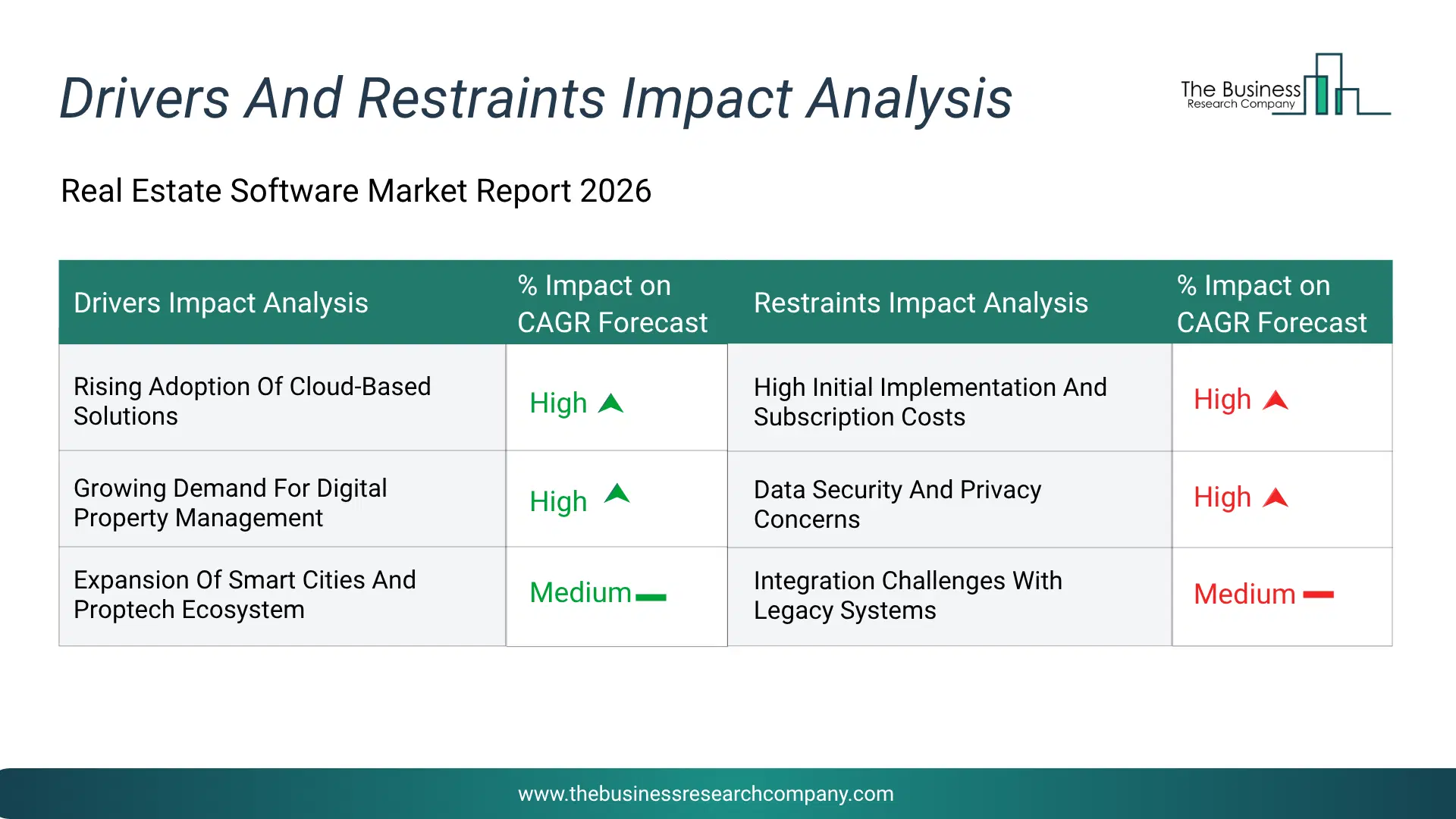
Infographic Chart Showing Key Market Drivers Analysis And Restraints For Real Estate Software Market
The chart presents an impact analysis of key drivers and restraints, quantifying their relative influence on the market's growth rate and helping assess the balance between growth enablers and limiting factors. This chart offers a high-level perspective; the full report contains more detailed insights.
How Will The Drivers Impact Growth In The Global Real Estate Software Market?
• Rising Adoption Of Cloud-Based Solutions (High) – During the forecast period, the rising adoption of cloud-based solutions is expected to become a key growth driver for the real estate software market by 2030. Real estate organizations are increasingly migrating from legacy systems to cloud platforms to improve scalability, accessibility, and operational flexibility. Cloud-based software enables seamless collaboration across multiple locations, supports remote property management activities, and reduces infrastructure maintenance costs. The ability to access real-time information and deploy software updates efficiently is further accelerating adoption among property owners and managers. • Growing Demand For Digital Property Management (High) – During the forecast period, the growing demand for digital property management is expected to emerge as a major factor driving the expansion of the real estate software market by 2030. Property owners and management companies are increasingly implementing digital platforms to streamline leasing, maintenance scheduling, rent collection, and tenant communications. These solutions improve operational transparency, enhance service quality, and reduce administrative workloads across residential and commercial portfolios. The need for centralized management of expanding property assets is further encouraging software deployment throughout the industry. • Expansion Of Smart Cities And Proptech Ecosystem (Medium) – During the forecast period, the expansion of smart cities and proptech ecosystem is expected to act as a key growth catalyst for the real estate software market by 2030. The increasing integration of connected infrastructure, intelligent buildings, and digital urban services is creating demand for advanced software platforms capable of managing complex real estate environments. Proptech innovations are enabling enhanced asset monitoring, predictive maintenance, and data-driven property optimization, supporting more efficient real estate operations. Additionally, collaboration between technology providers, developers, and municipal authorities is accelerating software adoption across modern urban developments.How Will The Restraints Impact Growth In The Global Real Estate Software Market?
• High Initial Implementation And Subscription Costs (High) – During the forecast period, the high upfront costs remain a significant restraint in the real estate software market, particularly for small and medium-sized real estate firms. Implementing such platforms often requires substantial capital investment in licensing, customization, cloud infrastructure, and employee training. In addition to initial setup costs, recurring subscription fees for SaaS-based solutions further increase the financial burden over time. Many real estate businesses, especially those operating in fragmented or price-sensitive markets, may hesitate to adopt these solutions due to uncertain short-term returns on investment. This cost sensitivity slows down the adoption rate, particularly among traditional firms that still rely on manual or semi-digital processes. Moreover, scaling the software to accommodate business growth can lead to additional expenses, creating further hesitation among potential users. As a result, cost-related barriers limit market penetration and delay digital transformation across the industry. • Data Security And Privacy Concerns (High) – During the forecast period, the data security and privacy concerns act as a critical restraint due to the sensitive nature of information handled by real estate software platforms. These systems store vast amounts of confidential data, including financial records, personal client details, property ownership documents, and transaction histories. Any breach or unauthorized access can result in severe financial and reputational damage for both service providers and users. Increasing incidents of cyberattacks and data leaks have made real estate firms more cautious about adopting cloud-based or integrated digital solutions. Additionally, varying data protection regulations across regions add complexity and compliance costs, making companies hesitant to fully transition to such platforms. Lack of trust in data handling practices and concerns over third-party access further restrict adoption. Consequently, these security challenges slow down market growth and create resistance among potential users. • Integration Challenges With Legacy Systems (Medium) – During the forecast period, the integration challenges with legacy systems present another major restraint, especially for established real estate firms with existing IT infrastructure. Many organizations continue to operate on outdated or fragmented systems that are not easily compatible with modern real estate software solutions. Integrating new platforms often requires significant technical effort, data migration, and process reconfiguration, which can disrupt ongoing operations. Compatibility issues may also lead to data inconsistencies or loss during transition, further discouraging adoption. Additionally, the need for skilled IT personnel or external consultants increases the overall implementation complexity and cost. Resistance to change within organizations also plays a role, as employees may be reluctant to shift from familiar legacy systems to new technologies. These integration barriers reduce the speed of digital adoption and limit the overall expansion of the real estate software market.Key Players In The Global Real Estate Software Market
Major companies operating in the real estate software market are Microsoft Corporation; International Business Machines Corporation; Oracle Corporation; SAP SE; Fiserv Inc; Constellation Software Inc; Trimble Inc; CoStar Group Inc; Zillow Group Inc; RealPage Inc; Yardi Systems Inc; Altus Group Ltd; AppFolio Inc; Entrata Inc; MRI Software LLC; Buildertrend Solutions Inc; Accruent LLC; Inside Real Estate LLC; Propertybase LLC; ServusConnect LLC; AMTdirect LLC; Procore Technologies Inc; CoreLogic Inc; Zoho Corporation Pvt Ltd; Newforma Inc
This chart is for illustrative purposes; the full report includes a detailed competitor analysis and comprehensive overview of the top 10 companies in the market.
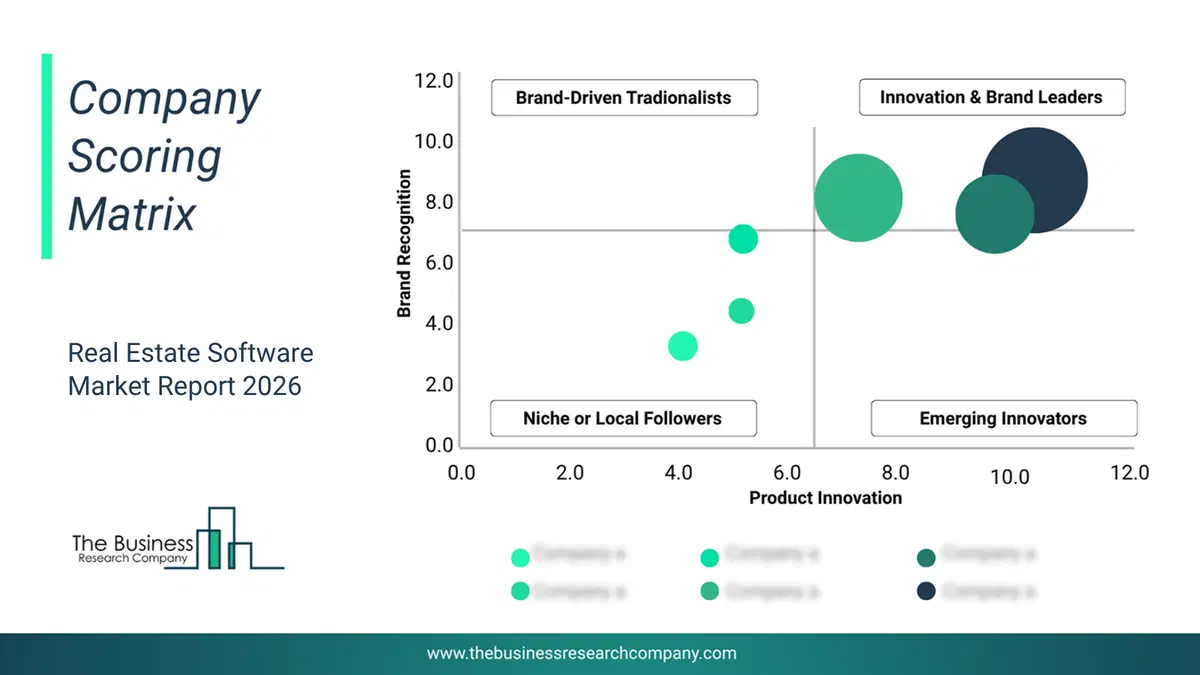
This chart maps companies by product innovation and brand strength, with bubble size indicating relative revenue, helping identify market leaders, challengers, and niche players. This is an illustrative chart; the full report provides a complete and accurate competitive analysis.
Global Real Estate Software Market Trends and Insights
Major companies in the real estate software market are focusing on developing technologically advanced solutions, such as AI-powered property management tools to optimize operations, enhance tenant experience, and streamline decision-making. AI-powered property management tools are software solutions that use artificial intelligence to automate tasks, analyze data, and optimize property operations for better efficiency and tenant satisfaction. For instance, In August 2024, reAlpha Tech Corp., a real estate technology firm focused on AI development and commercialization, launched reAlpha, a Super App for mobile devices. This Super App offers a comprehensive, commission-free real estate experience on mobile, complementing its online platform. It integrates Claire, reAlpha’s generative AI buyer’s agent, licensed human agent support, and a range of homebuying tools, including title and escrow agent services.What Are Latest Mergers And Acquisitions In The Real Estate Software Market?
In February 2023, MRI Software LLC a US-based real estate technology company, acquired PropTech Group for an undisclosed amount. With this acquisition, MRI Software aims to strengthen its residential sales and property management software suite, providing a comprehensive, end-to-end solution that supports real estate agencies in managing client relationships throughout the property lifecycle. PropTech Group is an Australia-based technology company that specializes in delivering integrated PropTech solutions, including software products like VaultRE and Eagle Software, for residential real estate agencies across marketing, sales, property management, and finance operations.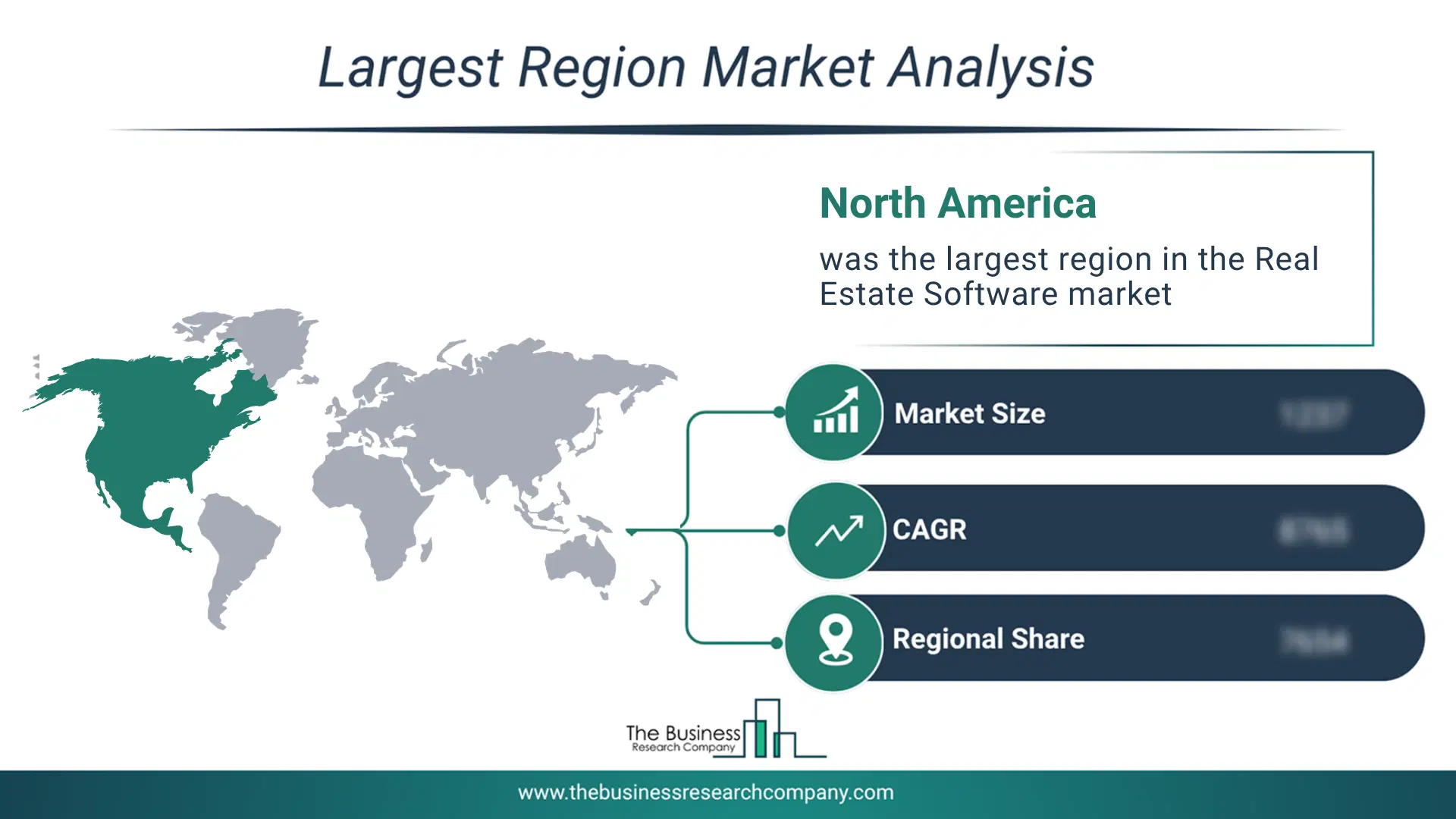
Regional Insights
North America was the largest region in the real estate software market in 2025. The regions covered in this market report are Asia-Pacific, South East Asia, Western Europe, Eastern Europe, North America, South America, Middle East, Africa. The countries covered in this market report are Australia, Brazil, China, France, Germany, India, Indonesia, Japan, Taiwan, Russia, South Korea, UK, USA, Canada, Italy, SpainWhat Defines the Real Estate Software Market?
The real estate software market includes revenues earned by entities by providing software tools designed to facilitate real estate property management, from the construction process to the marketing and sales processes and the solution provided by real estate software are management of property database, inbuilt messaging and calling feature, dashboard and analytics, property management, virtual property tour, and map integration. The market value includes the value of related goods sold by the service provider or included within the service offering. Only goods and services traded between entities or sold to end consumers are included.How is Market Value Defined and Measured?
The market value is defined as the revenues that enterprises gain from the sale of goods and/or services within the specified market and geography through sales, grants, or donations in terms of the currency (in USD unless otherwise specified). The revenues for a specified geography are consumption values that are revenues generated by organizations in the specified geography within the market, irrespective of where they are produced. It does not include revenues from resales along the supply chain, either further along the supply chain or as part of other products.
This chart presents market attractiveness based on a quantitative evaluation of growth, competition, strategic alignment, and risk, offering a clear view of opportunity areas for decision-making. This chart is for illustrative purposes; the full report contains the complete analysis.

This chart highlights the Total Addressable Market (TAM) by estimating the maximum revenue opportunity using an assumption-driven approach, supporting strategic planning and opportunity sizing across markets. The chart is illustrative; the full report provides a more comprehensive analysis.
What Key Data and Analysis Are Included in the Real Estate Software Market Report 2026?
The real estate software market research report is one of a series of new reports from The Business Research Company that provides market statistics, including industry global market size, regional shares, competitors with the market share, detailed market segments, market trends and opportunities, and any further data you may need to thrive in the real estate software industry. The market research report delivers a complete perspective of everything you need, with an in-depth analysis of the current and future state of the industry.Real Estate Software Market Report Forecast Analysis
| Report Attribute | Details |
|---|---|
| Market Size Value In 2026 | $14.08 billion |
| Revenue Forecast In 2030 | $21.62 billion |
| Growth Rate | CAGR of 10.8% from 2026 to 2030 |
| Base Year For Estimation | 2025 |
| Actual Estimates/Historical Data | 2020-2025 |
| Forecast Period | 2026 - 2030 |
| Market Representation | Revenue in USD Billion and CAGR from 2026 to 2030 |
| Segments Covered | Product, Deployment Type, Application |
| Regional Scope | Asia-Pacific, Western Europe, Eastern Europe, North America, South America, Middle East, Africa |
| Country Scope | The countries covered in the report are Australia, Brazil, China, France, Germany, India, Indonesia, Japan, Taiwan, Russia, South Korea, UK, USA, Canada, Italy, Spain. |
| Key Companies Profiled | Microsoft Corporation; International Business Machines Corporation; Oracle Corporation; SAP SE; Fiserv Inc; Constellation Software Inc; Trimble Inc; CoStar Group Inc; Zillow Group Inc; RealPage Inc; Yardi Systems Inc; Altus Group Ltd; AppFolio Inc; Entrata Inc; MRI Software LLC; Buildertrend Solutions Inc; Accruent LLC; Inside Real Estate LLC; Propertybase LLC; ServusConnect LLC; AMTdirect LLC; Procore Technologies Inc; CoreLogic Inc; Zoho Corporation Pvt Ltd; Newforma Inc |
| Customization Scope | Request for Customization |
| Pricing And Purchase Options | Explore Purchase Options |