
Integrated Facility Management Market Report 2026
Global Outlook – By Solution (Project Management And Real Estate Portfolio Management And Lease Administration, Asset And Space Management, Maintenance Management, Energy And Environment Sustainability Management, Other Solutions), By Deployment Type (On-Premise, Cloud), By End-User (Real Estate And Infrastructure, Healthcare, BFSI, Telecommunication, Manufacturing, Aerospace And Defense, Supply Chain And Logistics, Utilities, Retail, Energy And Resources, Other End Users) – Market Size, Trends, Strategies, and Forecast to 2030
Integrated Facility Management Market Overview
• Integrated Facility Management market size has reached to $98.91 billion in 2025 • Expected to grow to $136.59 billion in 2030 at a compound annual growth rate (CAGR) of 6.7% • Growth Driver: The Increasing Development Of Sustainable Infrastructure Driving The Integrated Facility Management Market • Market Trend: Strategic Partnerships Driving Development And Expansion In The Integrated Facility Management Market • North America was the largest region in 2025 and Asia-Pacific is the fastest growing region.Market Gains By 2030 – Top Opportunities By Segment
Market Gain identifies the most promising market opportunities by highlighting the segments or products expected to generate the highest incremental revenue growth over the next five years.
What Is Covered Under Integrated Facility Management Market?
The integrated facility management refer to the integration of all facility management activities under a single system and unified team. The facility management includes tools and services to support the functioning, security, and sustainability of buildings, landscapes, infrastructure, and real estate. Integrated facility management (IFM) improves operational efficiency, produces savings, and harnesses program data throughout a firm to better fulfil corporate goals. The contracts, vendor partnerships, space management, and real estate planning are part of integrated facility management. The main types of integrated facility management solutions include project management & real estate portfolio management & lease administration, asset & space management, maintenance management, energy & environment sustainability management, and others. They are deployed on-premise or cloud in industries ranging from real estate & infrastructure, healthcare, BFSI, telecommunication, manufacturing, aerospace & defense, supply chain & logistics, utilities, retail, energy & resources, and others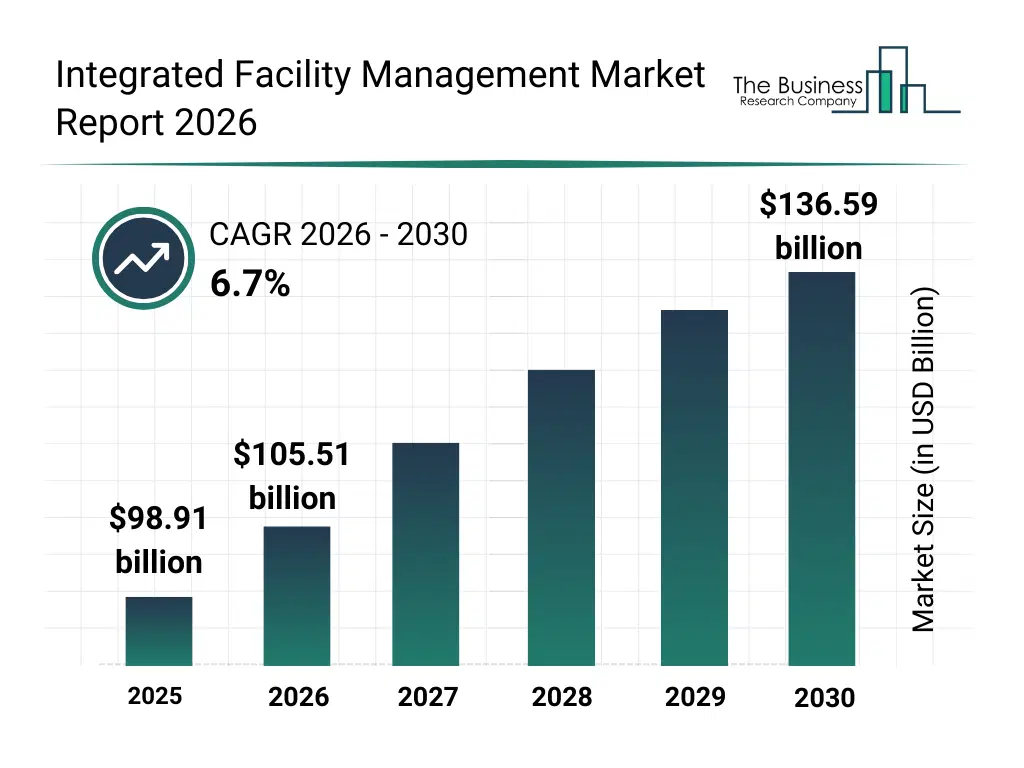
What Is The Integrated Facility Management Market Size and Share 2026?
The integrated facility management market size has grown strongly in recent years. It will grow from $98.91 billion in 2025 to $105.51 billion in 2026 at a compound annual growth rate (CAGR) of 6.7%. The growth in the historic period can be attributed to increasing complexity of large facility portfolios, growing outsourcing of facility management services, expansion of commercial real estate assets, rising operational cost pressures, adoption of integrated management frameworks.What Is The Integrated Facility Management Market Growth Forecast?
The integrated facility management market size is expected to see strong growth in the next few years. It will grow to $136.59 billion in 2030 at a compound annual growth rate (CAGR) of 6.7%. The growth in the forecast period can be attributed to increasing investments in smart infrastructure solutions, rising focus on sustainability-driven facility operations, expansion of cloud-based facility platforms, growing demand for data-driven asset management, increasing integration of ai-enabled facility analytics. Major trends in the forecast period include increasing adoption of centralized facility management platforms, rising use of predictive maintenance systems, growing integration of smart building technologies, expansion of energy and sustainability management solutions, enhanced focus on cost optimization.
Global Integrated Facility Management Market Segmentation
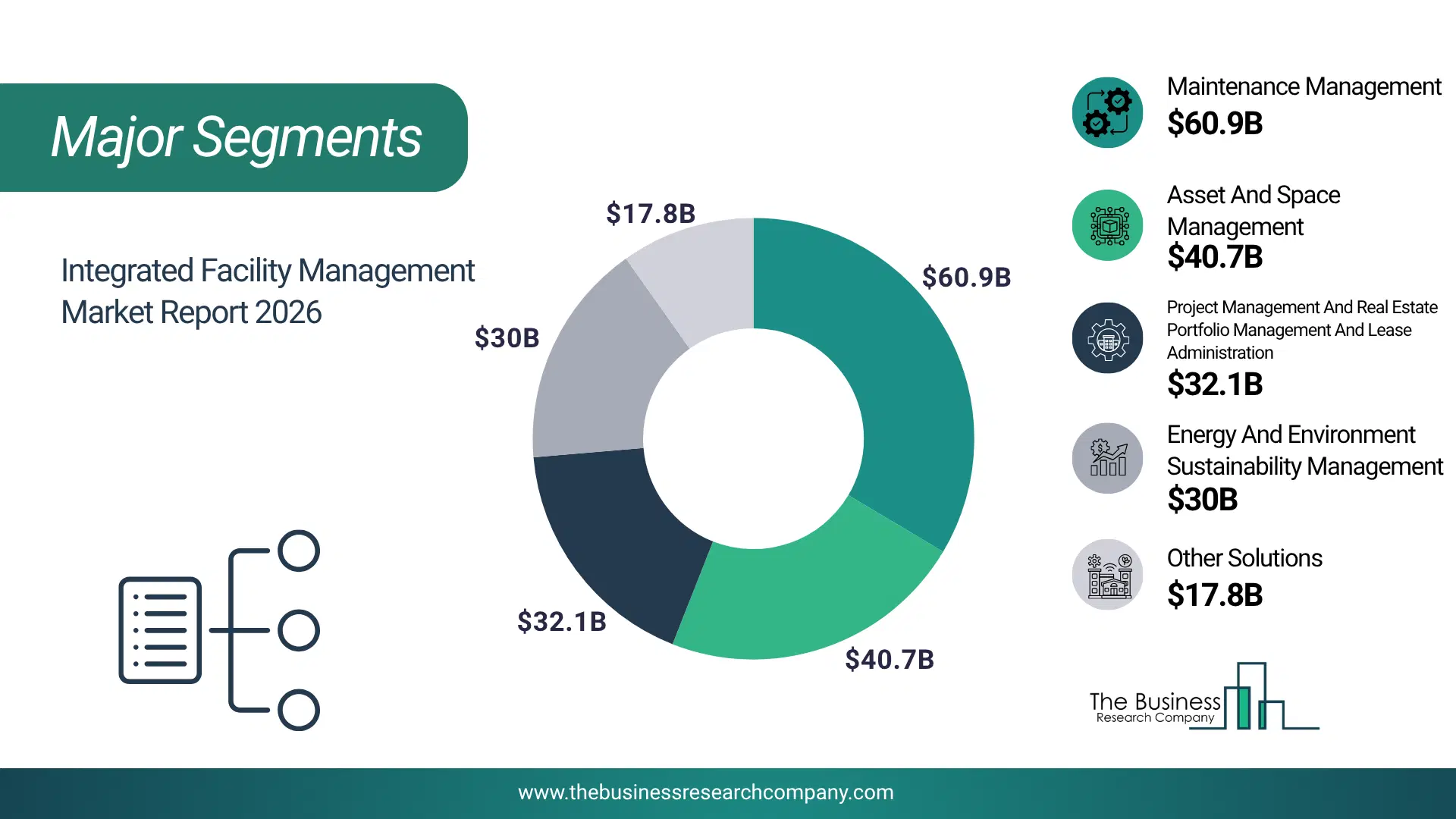
1) By Solution: Project Management And Real Estate Portfolio Management And Lease Administration, Asset And Space Management, Maintenance Management, Energy And Environment Sustainability Management, Other Solutions 2) By Deployment Type: On-Premise, Cloud 3) By End-User: Real Estate And Infrastructure, Healthcare, BFSI, Telecommunication, Manufacturing, Aerospace And Defense, Supply Chain And Logistics, Utilities, Retail, Energy And Resources, Other End Users Subsegments: 1) By Project Management And Real Estate Portfolio Management And Lease Administration: Project Planning And Execution, Lease Tracking And Administration 2) By Asset And Space Management: Asset Tracking And Management, Space Utilization Analysis 3) By Maintenance Management: Preventive Maintenance, Corrective Maintenance 4) By Energy And Environment Sustainability Management: Energy Monitoring And Reporting, Sustainability Initiatives 5) By Other Solutions: Security Management, Cleaning And Janitorial Services, Vendor Management, Workplace Management The top segments in the integrated facility management market will be: • Maintenance Management will reach $60.82 billion by 2030. • Asset And Space Management will reach $40.63 billion by 2030. • Project Management And Real Estate Portfolio Management And Lease Administration will reach $32.05 billion by 2030. • Energy And Environment Sustainability Management will reach $29.96 billion by 2030. • Other Solutions will reach $17.77 billion by 2030.What Is The Driver Of The Integrated Facility Management Market?
The increasing development of sustainable infrastructure is driving the growth of the integrated facility management (IFM) market. The development of sustainable infrastructure is increasing due to the need for enabling economic and social development, as well as environmental sustainability while preserving human fairness, variety, and natural system performance. The increasing development of sustainable infrastructure will drive the demand for integrated facility management as it provides solutions for responsible contact with the environment to minimize resource depletion or deterioration and ensure the long-term environmental quality of infrastructures. The integrated facility management follows a unique process to make structural, architectural, and operational changes in buildings to reduce the negative impact on their occupants and the environment. For instance, according to The New Climate Economy, a flagship project of the Global Commission on the Economy and Climate, the world is expected to invest $90 trillion in sustainable infrastructure by 2030. These investments are crucial to boosting the economic growth in emerging markets and developing countries in addition to fighting against climate change. Furthermore, the Organization for Economic Co-operation and Development (OCED) predicts that an annual average investment of $6.9 trillion in sustainable infrastructure is required until 2030 for global development. Both instances indicate the increased development of sustainable infrastructure globally. Hence, the increasing sustainable infrastructure development will propel the integrated facility management industry growth.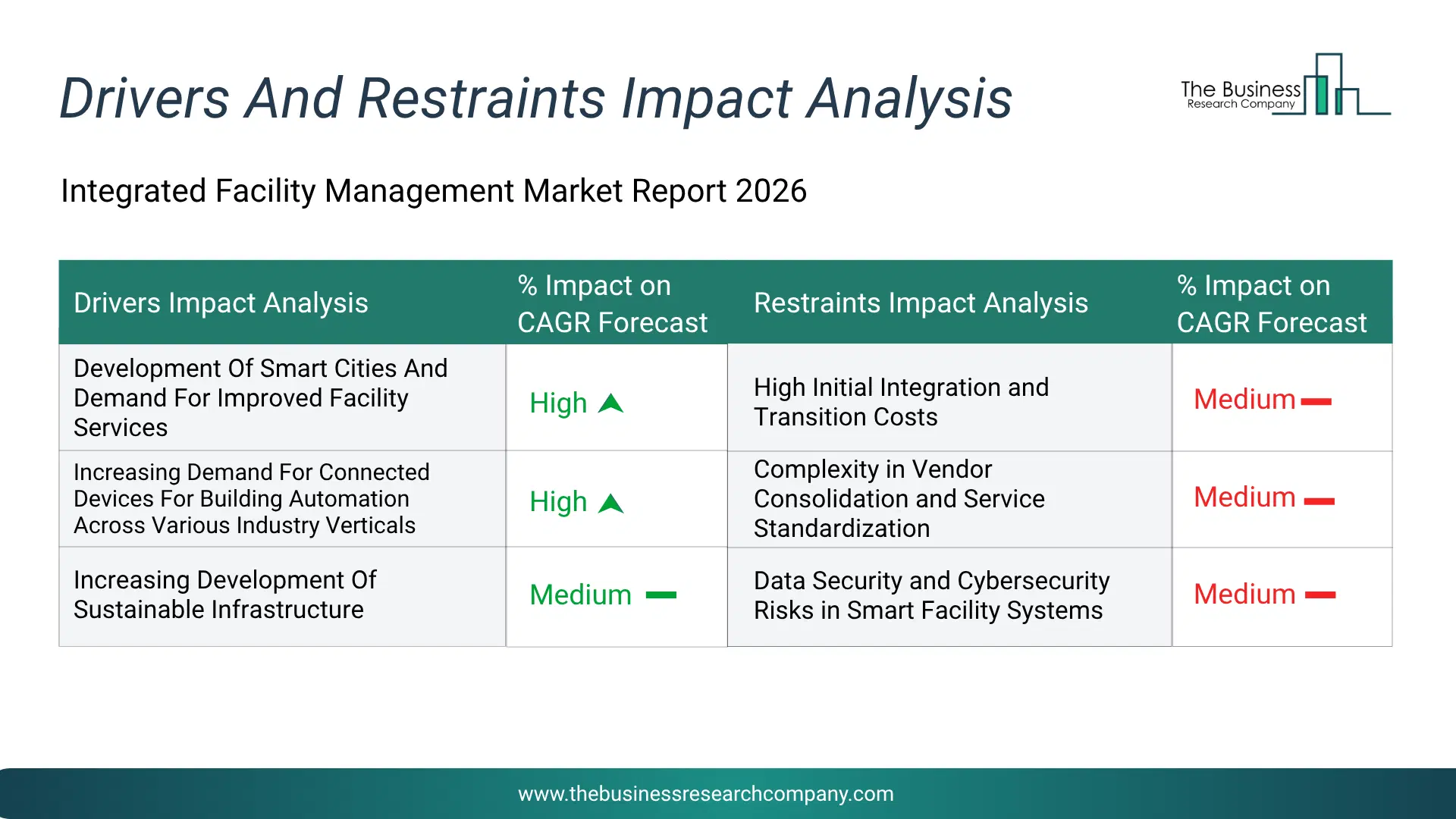
Infographic Chart Showing Key Market Drivers Analysis And Restraints For Integrated Facility Management Market
The chart presents an impact analysis of key drivers and restraints, quantifying their relative influence on the market's growth rate and helping assess the balance between growth enablers and limiting factors. This chart offers a high-level perspective; the full report contains more detailed insights.
How Will The Drivers Impact Growth In The Global Integrated Facility Management Market?
• Development Of Smart Cities And Demand For Improved Facility Services (High) – During the forecast period, the development of smart cities and the growing demand for improved facility services are expected to become a major growth driver for the integrated facility management market by 2030. Governments and urban planners across major economies are investing heavily in smart infrastructure projects that integrate digital technologies, intelligent transportation systems, energy -efficient buildings, and connected urban services. These large -scale developments require centralized and integrated facility management solutions to ensure smooth operations, asset monitoring, security management, and maintenance coordination across complex infrastructure networks. As smart city projects expand globally, the need for professional facility service providers capable of managing multi -site infrastructure and technology -enabled buildings is increasing significantly. • Increasing Demand For Connected Devices For Building Automation Across Various Industry Verticals (High) – During the forecast period, the increasing demand for connected devices for building automation across various industry verticals is expected to accelerate the growth of the integrated facility management market by 2030. Modern commercial buildings, hospitals, manufacturing plants, data centers, and corporate offices are rapidly adopting internet of things (iot) devices, smart sensors, and automated control systems to monitor building performance and improve operational efficiency. These connected systems enable real -time monitoring of hvac systems, lighting infrastructure, security systems, and occupancy management, creating a strong requirement for integrated platforms that can manage and maintain these technologies effectively. Facility management providers are therefore incorporating digital dashboards, predictive maintenance tools, and ai -driven analytics to support automated building operations. • Increasing Development Of Sustainable Infrastructure (Medium) – During the forecast period, the increasing development of sustainable infrastructure is expected to emerge as another key factor driving the expansion of the integrated facility management market by 2030. Organizations and governments worldwide are prioritizing environmentally sustainable building practices, including energy -efficient systems, green building materials, water conservation technologies, and waste management solutions. Sustainable infrastructure requires specialized facility management services to monitor energy consumption, manage renewable energy systems, optimize resource utilization, and ensure compliance with environmental regulations and green building certifications. Integrated facility management providers are therefore offering advanced energy management services, sustainability reporting tools, and environmental monitoring solutions to support these initiatives.How Will The Restraints Impact Growth In The Global Integrated Facility Management Market?
• High Initial Integration and Transition Costs (Medium) – During the forecast period, the shifting from multiple single-service vendors to a fully integrated facility management model requires significant upfront investment. Organizations must invest in digital platforms, iot systems, centralized command centers, and workforce restructuring during the transition phase. Contract consolidation, system integration, and technology deployment can temporarily disrupt operations and increase short-term expenses. Small and mid-sized enterprises often hesitate due to budget constraints and unclear short-term roi visibility. These high initial costs can slow adoption despite long-term efficiency benefits. • Complexity in Vendor Consolidation and Service Standardization (Medium) – During the forecast period, the integrated facility management combines soft services, hard engineering services, automation, and property management under one contract, which increases operational complexity. Managing diverse service lines across multiple locations requires standardized processes, skilled coordination, and strong governance frameworks. In large enterprises with geographically dispersed assets, aligning service levels and kpis can be challenging. Poor coordination during integration may lead to performance gaps or service disruptions. This operational complexity makes some organizations cautious about fully transitioning to ifm models. • Data Security and Cybersecurity Risks in Smart Facility Systems (Medium) – During the forecast period, the the increasing reliance on iot-enabled building automation systems exposes facilities to cybersecurity vulnerabilities. Integrated platforms connect hvac, access control, surveillance, and energy management systems, creating potential entry points for cyber threats. Any breach in smart infrastructure can disrupt operations and compromise sensitive enterprise data. Industries such as banking, healthcare, and government are particularly concerned about digital security risks. These cybersecurity concerns may restrain rapid adoption of highly digitized ifm solutions, especially in regulated sectors.Key Players In The Global Integrated Facility Management Market
Major companies operating in the integrated facility management market are JLL (Jones Lang LaSalle Incorporated); ISS A/S; CBRE Group Inc.; Cushman & Wakefield plc; Sodexo S. A.; CBM Qatar LLC; International Business Machines Corporation (IBM); ScienceSoft USA Corporation; MINES and Associates Inc.; Pegasystems Inc.; Atos SE; Happiest Minds Technologies Limited; Infostretch Corporation; Larsen & Toubro Infotech Limited (LTI); Nagarro Inc.; Tech Mahindra Limited; Compass Group PLC; AHI Facility Services Inc.; EMCOR Facility Services; Oracle Corporation; SAP SE; Trimble Inc.; Nemetschek SE; Archidata International Inc.; UpKeep Technologies Inc.; FacilityOne Technologies; OfficeSpace Software Inc.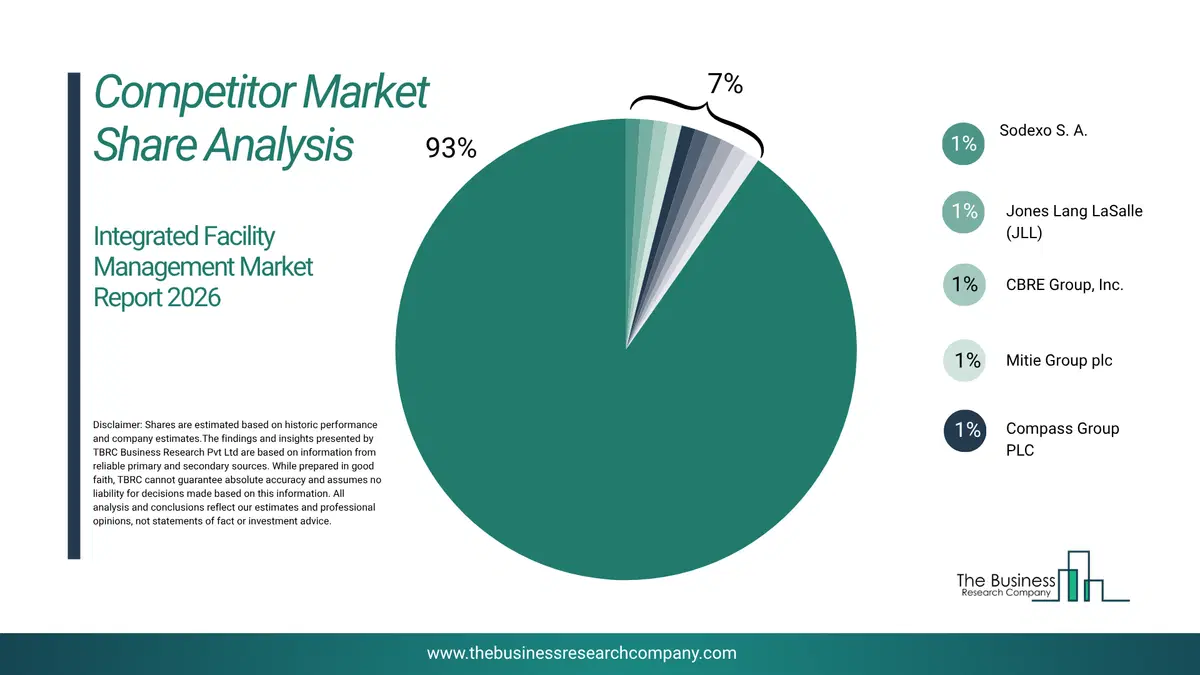
This chart is for illustrative purposes; the full report includes a detailed competitor analysis and comprehensive overview of the top 10 companies in the market.
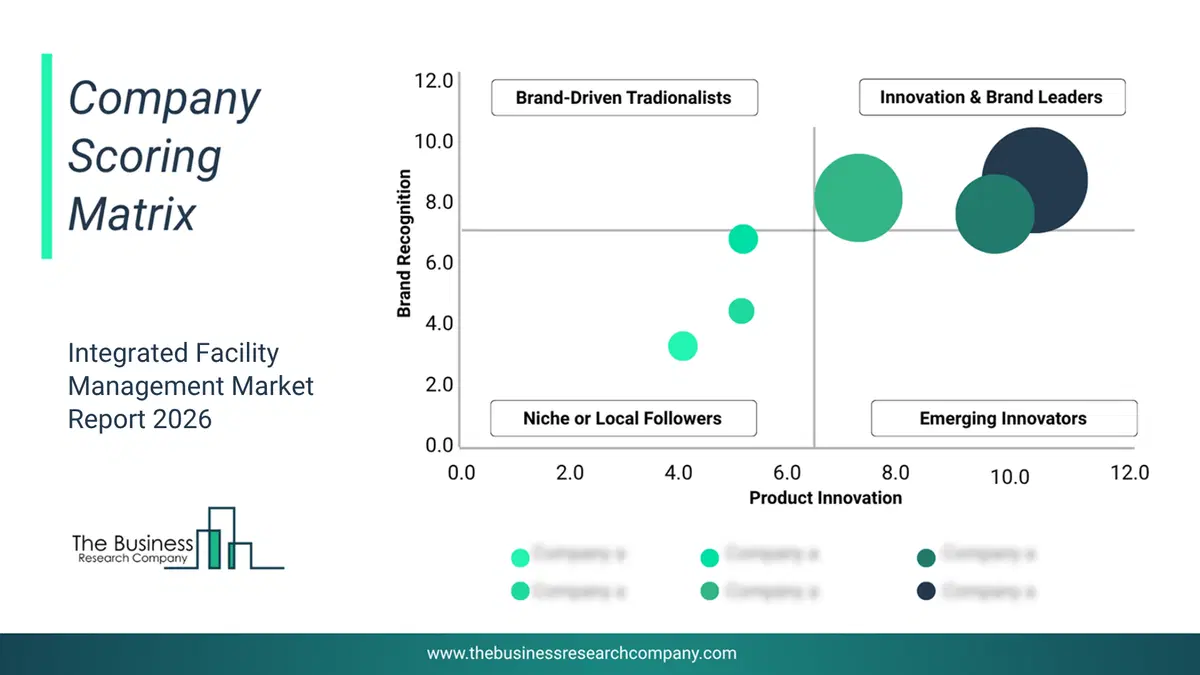
This chart maps companies by product innovation and brand strength, with bubble size indicating relative revenue, helping identify market leaders, challengers, and niche players. This is an illustrative chart; the full report provides a complete and accurate competitive analysis.
Global Integrated Facility Management Market Trends and Insights
Major companies operating in the integrated facility management market are developing and expanding their operations through strategic partnerships. Strategic partnerships refer to a process in which companies leverage each other's strengths and resources to achieve mutual benefits and success. For instance, in May 2023, Saned Facility Management LLC, a UAE-based facility management company, partnered with Greenhouse, Chalhoub Group's space for innovation and entrepreneurship. Chalhoub Group is a UAE-based luxury retail and distribution company. Through this partnership, Saned Facility Management LLC launched the Innovation in Integrated Facilities Management Center and Program. The center aims to make the industry more innovative and efficient by supporting and increasing the use of technology, artificial intelligence, software, and creative ideas in-house and across the facilities management sector in the UAE. The company aims to encourage the facilities management sector to upgrade innovative digital technologies to monitor remote work, improve the quality of services and operational efficiency, and reduce costs.What Are Latest Mergers And Acquisitions In The Integrated Facility Management Market?
In April 2023, Lessen, a US-based property technology company, acquired Blue Skyre IBE for an undisclosed amount. Through this acquisition, Lessen is expected to help Lessen expand its property services platform and strengthen its position in the real estate market. Skyre IBE is a US-based commercial real estate advisory and service company that provides integrated facility management (IFM) services.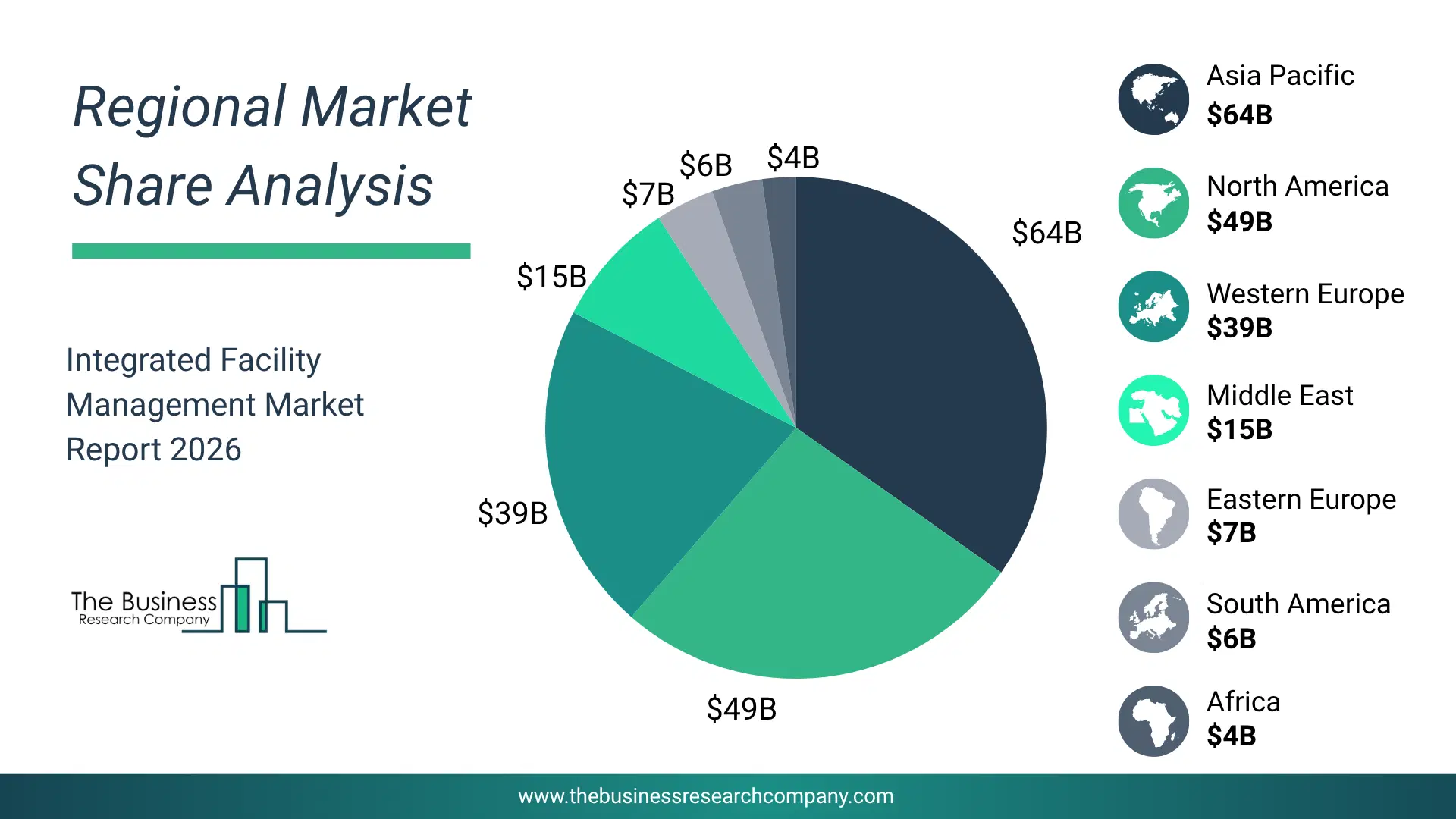
Regional Insights
North America was the largest region in the integrated facility management market in 2025. Asia-Pacific is expected to be the fastest-growing region in the forecast period. The regions covered in this market report are Asia-Pacific, South East Asia, Western Europe, Eastern Europe, North America, South America, Middle East, Africa. The countries covered in this market report are Australia, Brazil, China, France, Germany, India, Indonesia, Japan, Taiwan, Russia, South Korea, UK, USA, Canada, Italy, SpainWhat Defines the Integrated Facility Management Market?
The integrated facility management market includes revenues earned by entities by providing FM automation / IOT Services in FM (Smart FM) Soft, hard engineering services, property management services, guest house management services, warehouse management services. The market value includes the value of related goods sold by the service provider or included within the service offering. Only goods and services traded between entities or sold to end consumers are included.How is Market Value Defined and Measured?
The market value is defined as the revenues that enterprises gain from the sale of goods and/or services within the specified market and geography through sales, grants, or donations in terms of the currency (in USD unless otherwise specified). The revenues for a specified geography are consumption values that are revenues generated by organizations in the specified geography within the market, irrespective of where they are produced. It does not include revenues from resales along the supply chain, either further along the supply chain or as part of other products.
This chart presents market attractiveness based on a quantitative evaluation of growth, competition, strategic alignment, and risk, offering a clear view of opportunity areas for decision-making. This chart is for illustrative purposes; the full report contains the complete analysis.

This chart highlights the Total Addressable Market (TAM) by estimating the maximum revenue opportunity using an assumption-driven approach, supporting strategic planning and opportunity sizing across markets. The chart is illustrative; the full report provides a more comprehensive analysis.
What Key Data and Analysis Are Included in the Integrated Facility Management Market Report 2026?
The integrated facility management market research report is one of a series of new reports from The Business Research Company that provides market statistics, including industry global market size, regional shares, competitors with the market share, detailed market segments, market trends and opportunities, and any further data you may need to thrive in the integrated facility management industry. The market research report delivers a complete perspective of everything you need, with an in-depth analysis of the current and future state of the industry.Integrated Facility Management Market Report Forecast Analysis
| Report Attribute | Details |
|---|---|
| Market Size Value In 2026 | $105.51 billion |
| Revenue Forecast In 2030 | $136.59 billion |
| Growth Rate | CAGR of 6.7% from 2026 to 2030 |
| Base Year For Estimation | 2025 |
| Actual Estimates/Historical Data | 2020-2025 |
| Forecast Period | 2026 - 2030 |
| Market Representation | Revenue in USD Billion and CAGR from 2026 to 2030 |
| Segments Covered | Solution, Deployment Type, End-User |
| Regional Scope | Asia-Pacific, Western Europe, Eastern Europe, North America, South America, Middle East, Africa |
| Country Scope | The countries covered in the report are Australia, Brazil, China, France, Germany, India, ... |
| Key Companies Profiled | JLL (Jones Lang LaSalle Incorporated); ISS A/S; CBRE Group Inc.; Cushman & Wakefield plc; Sodexo S. A.; CBM Qatar LLC; International Business Machines Corporation (IBM); ScienceSoft USA Corporation; MINES and Associates Inc.; Pegasystems Inc.; Atos SE; Happiest Minds Technologies Limited; Infostretch Corporation; Larsen & Toubro Infotech Limited (LTI); Nagarro Inc.; Tech Mahindra Limited; Compass Group PLC; AHI Facility Services Inc.; EMCOR Facility Services; Oracle Corporation; SAP SE; Trimble Inc.; Nemetschek SE; Archidata International Inc.; UpKeep Technologies Inc.; FacilityOne Technologies; OfficeSpace Software Inc. |
| Customization Scope | Request for Customization |
| Pricing And Purchase Options | Explore Purchase Options |