
Veterinary Legionella Risk Management Market Report 2026
Global Outlook – By Solution Type (Water Testing, Disinfection Systems, Filtration Systems, Monitoring Services, Other Solution Types), By Distribution Channel (Direct Sales, Distributors, Online Platforms, Other Distribution Channels), By Application (Veterinary Hospitals, Veterinary Clinics, Animal Research Facilities, Other Applications), By End User (Small Animal Practices, Large Animal Practices, Mixed Animal Practices, Other End Users) – Market Size, Trends, Strategies, and Forecast to 2035
Veterinary Legionella Risk Management Market Overview
• Veterinary Legionella Risk Management market size has reached to $0.68 billion in 2025 • Expected to grow to $1.03 billion in 2030 at a compound annual growth rate (CAGR) of 8.7% • Growth Driver: Rising Livestock Farming Fueling The Growth Of The Market Due To Increasing Complexity Of Water Systems And Higher Risk Of Bacterial Contamination • North America was the largest region in 2025 and Asia-Pacific is the fastest growing region.What Is Covered Under Veterinary Legionella Risk Management Market?
Veterinary legionella risk management refers to the systematic oversight and control of factors that influence the presence and spread of Legionella bacteria within environments associated with animal care. It focuses on maintaining safe water systems and surrounding conditions in veterinary settings to reduce the likelihood of bacterial growth and transmission. This approach emphasizes awareness, regulatory alignment, and environmental responsibility to protect animal health, human handlers, and overall facility hygiene standards. The main solution types of veterinary Legionella risk management include water testing, disinfection systems, filtration systems, monitoring services, and other solution types. Water testing refers to analytical procedures used to detect and quantify Legionella bacteria in veterinary water systems to prevent infection risks and ensure biosecurity compliance. These solutions are distributed through direct sales, distributors, online platforms, and other distribution channels. The various applications involved are veterinary hospitals, veterinary clinics, animal research facilities, and other applications, and they are used by several end users such as small animal practices, large animal practices, mixed animal practices, and other end users.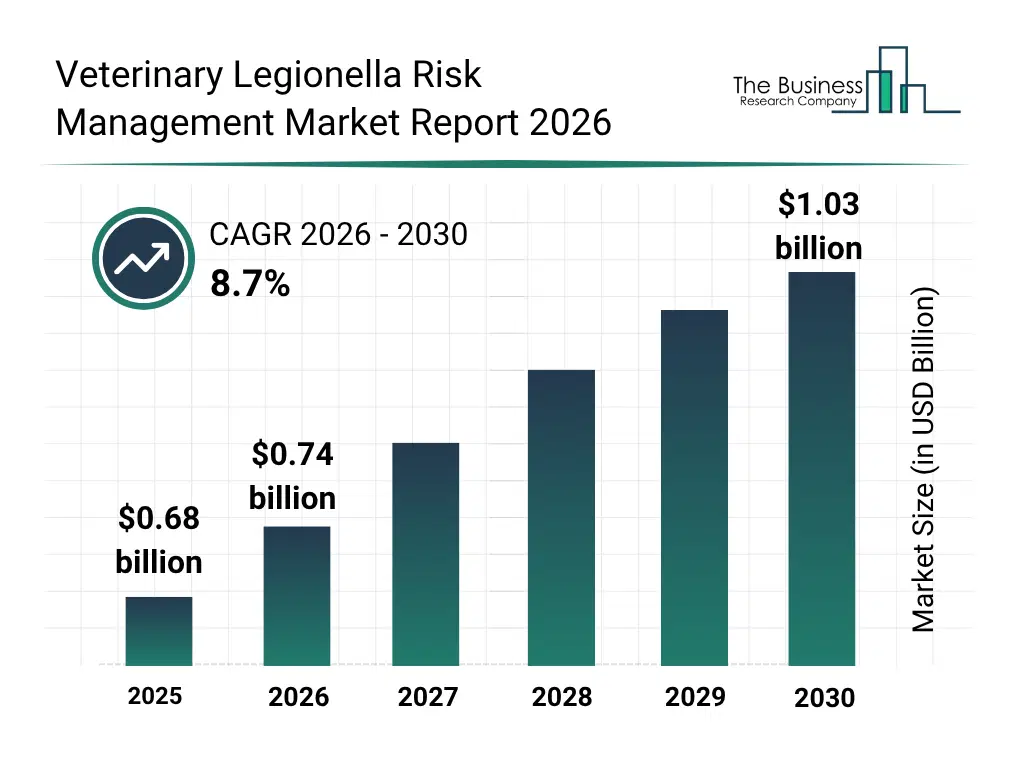
What Is The Veterinary Legionella Risk Management Market Size and Share 2026?
The veterinary legionella risk management market size has grown strongly in recent years.It will grow from $0.68 billion in 2025 to $0.74 billion in 2026 at a compound annual growth rate (CAGR) of 8.4%. The growth in the historic period can be attributed to increasing outbreak awareness in veterinary facilities, aging water infrastructure in animal care centers, rising zoonotic disease concerns, limited historical water quality monitoring adoption, reactive maintenance practices in clinics.What Is The Veterinary Legionella Risk Management Market Growth Forecast?
The veterinary legionella risk management market size is expected to see strong growth in the next few years.It will grow to $1.03 billion by 2030 at a compound annual growth rate (CAGR) of 8.7%. The growth in the forecast period can be attributed to predictive water safety governance expansion, stricter global veterinary hygiene regulations, increasing investment in preventive infrastructure upgrades, rising demand for continuous compliance certification, growth of standardized biosecurity protocols in veterinary ecosystems.Major trends in the forecast period include regulatory tightening of veterinary water safety and legionella compliance protocols, expansion of standardized water hygiene auditing frameworks in veterinary facilities, increasing adoption of chemical-free biofilm prevention practices in animal care water systems, growing emphasis on manual risk assessment and inspection-based legionella control programs in veterinary environments, rising implementation of centralized veterinary facility hygiene certification and accreditation systems.
Global Veterinary Legionella Risk Management Market Segmentation
1) By Solution Type: Water Testing, Disinfection Systems, Filtration Systems, Monitoring Services, Other Solution Types 2) By Distribution Channel: Direct Sales, Distributors, Online Platforms, Other Distribution Channels 3) By Application: Veterinary Hospitals, Veterinary Clinics, Animal Research Facilities, Other Applications 4) By End User: Small Animal Practices, Large Animal Practices, Mixed Animal Practices, Other End Users Subsegments: 1) By Water Testing: Microbiological Water Testing, Chemical Water Quality Testing, Temperature And pH Level Testing, Biofilm Detection Testing, Routine Compliance Sampling 2) By Disinfection Systems: Chemical Dosing Systems, Ultraviolet Disinfection Systems, Thermal Treatment Systems, Ozone Based Disinfection Systems, Advanced Oxidation Disinfection Systems 3) By Filtration Systems: Membrane Filtration Systems, Activated Carbon Filtration Systems, Multimedia Filtration Systems, Sediment Removal Filtration Systems, Reverse Osmosis Filtration Systems 4) By Monitoring Services: Remote Water Quality Monitoring Services, Routine Inspection And Audit Services, Laboratory Analysis Services, Predictive Risk Assessment Services, Compliance Documentation Services 5) By Other Solution Types: Legionella Risk Assessment Consulting, Automated Flushing Systems, Integrated Water Management Platforms, Preventive Maintenance Services, Water Safety Training ProgramsWhat Are The Drivers Of The Veterinary Legionella Risk Management Market?
The growing livestock farming is expected to propel the growth of the veterinary legionella risk management industry going forward.Livestock farming is the practice of raising domesticated animals for products such as food, fibre, and labour under managed agricultural conditions.Livestock farming is rising primarily due to increasing global demand for animal-based foods, as population growth and changing diets drive higher consumption of meat, milk, and other animal products.The expansion of livestock farming drives demand for veterinary Legionella risk management as larger and more complex water systems in intensive animal operations increase the likelihood of bacterial growth and contamination.For instance, in December 2025, according to the Department of Agriculture, a US-based government department, global chicken meat production is projected to increase by about 2% in 2026, reaching a record 109.6 million tons.Additionally, the US output is expected to grow by around 1% to 22.0 million tons.Therefore, the growing livestock farming is driving the growth of the veterinary legionella risk management industry. The growing pet ownership is expected to propel the growth of the veterinary legionella risk management industry going forward.A pet is an animal kept by humans primarily for companionship, emotional connection, or personal enjoyment rather than for economic or utilitarian purposes.Pet ownership is rising due to increasing social isolation and stress in modern lifestyles, prompting more individuals to adopt animals as companions to improve emotional well-being and reduce loneliness.Higher pet ownership increases the demand for veterinary legionella risk management as more pets lead to greater use of shared water systems (such as drinking stations and grooming facilities), raising the risk of Legionella contamination and thereby necessitating stricter monitoring and control measures.For instance, in March 2025, according to the American Pet Products Association, a US-based non-profit trade association, pet ownership has rebounded, with 94 million U.S.households owning at least one pet, up from 82 million in 2023, and overall ownership has increased for both dogs and cats, with dogs present in 51% of households (68 million) and cats in 37% (49 million).Therefore, the growing pet ownership is driving the growth of the veterinary legionella risk management industry. The rise in veterinary healthcare spending is expected to propel the growth of the veterinary legionella risk management industry going forward.Veterinary healthcare spending refers to the total financial resources allocated by governments, organizations, and individuals for the prevention, diagnosis, treatment, and management of animal health and welfare.Veterinary healthcare spending is rising due to the increasing prevalence of zoonotic diseases, which is driving higher government and institutional investment in disease surveillance, prevention programs, and veterinary infrastructure to safeguard both animal and public health.Expanding veterinary healthcare spending supports veterinary legionella risk management by allowing animal care facilities to invest in better water safety systems and regular monitoring, which helps prevent and control Legionella contamination more effectively.For instance, in April 2025, according to the American Animal Hospital Association, a US-based animal veterinary hospital, spending on veterinary care, including pharmaceuticals and related products dispensed through veterinary clinics in the United States, was projected to total approximately $41.4 billion in 2025.Therefore, rise in veterinary healthcare spending is driving the growth of the veterinary legionella risk management industry.Key Players In The Global Veterinary Legionella Risk Management Market
Major companies operating in the veterinary legionella risk management market are SGS SA, Eurofins Scientific Société Européenne, Bureau Veritas SA, Stantec Incorporated, Intertek Group Public Limited Company, TÜV Rheinland AG, NCH Corporation, ALS Limited, Rochester Midland Corporation, Ramboll Group A/S, Enwa Water Technology AS, Phigenics LLC, Water Treatment Products Limited, RHP Risk Management Incorporated, Legionella Control International Limited, H2O Control Products Limited, Envirosafe Services Limited, Water Hygiene Centre Limited, Swiftclean Building Services Limited, Envirocare Maintenance Solutions LimitedRegional Insights
North America was the largest region in the veterinary legionella risk management market in 2025. Asia-Pacific is expected to be the fastest-growing region in the forecast period. The regions covered in this market report are Asia-Pacific, South East Asia, Western Europe, Eastern Europe, North America, South America, Middle East and Africa. The countries covered in this market report are Australia, Brazil, China, France, Germany, India, Indonesia, Japan, Taiwan, Russia, South Korea, UK, USA, Canada, Italy, Spain.What Defines the Veterinary Legionella Risk Management Market?
The veterinary legionella risk management market includes revenues earned by entities by remedial action planning, incident management, laboratory analysis, and remote monitoring. The market value includes the value of related goods sold by the service provider or included within the service offering. Only goods and services traded between entities or sold to end consumers are included.What is the Market Assessment and Strategic Outlook for the Veterinary Legionella Risk Management Industry?
The veterinary legionella risk management market research report is one of a series of new reports from The Business Research Company that provides market statistics, including industry global market size, regional shares, competitors with the market share, detailed market segments, market trends and opportunities, and any further data you may need to thrive in the veterinary legionella risk management industry. The market research report delivers a complete perspective of everything you need, with an in-depth analysis of the current and future state of the industry.What is the Market Assessment and Strategic Outlook for the Veterinary Legionella Risk Management Market Report 2026?
The veterinary legionella risk management market research report is one of a series of new reports from The Business Research Company that provides veterinary legionella risk management market statistics, including veterinary legionella risk management industry global market size, regional shares, competitors with a veterinary legionella risk management market share, detailed veterinary legionella risk management market segments, market trends and opportunities, and any further data you may need to thrive in the veterinary legionella risk management industry. This veterinary legionella risk management market research report delivers a complete perspective of everything you need, with an in-depth analysis of the current and future scenario of the industry.Veterinary Legionella Risk Management Market Report Forecast Analysis
| Report Attribute | Details |
|---|---|
| Market Size Value In 2026 | $0.74 billion |
| Revenue Forecast In 2035 | $1.03 billion |
| Growth Rate | CAGR of 8.7% from 2026 to 2035 |
| Base Year For Estimation | 2025 |
| Actual Estimates/Historical Data | 2020-2025 |
| Forecast Period | 2026 - 2030 - 2035 |
| Market Representation | Revenue in USD Billion and CAGR from 2026 to 2035 |
| Segments Covered | Solution Type, Distribution Channel, Application, End User |
| Regional Scope | Asia-Pacific, Western Europe, Eastern Europe, North America, South America, Middle East, Africa |
| Country Scope | The countries covered in the report are Australia, Brazil, China, France, Germany, India, Indonesia, Japan, Taiwan, Russia, South Korea, UK, USA, Canada, Italy, Spain. |
| Key Companies Profiled | SGS SA, Eurofins Scientific Société Européenne, Bureau Veritas SA, Stantec Incorporated, Intertek Group Public Limited Company, TÜV Rheinland AG, NCH Corporation, ALS Limited, Rochester Midland Corporation, Ramboll Group A/S, Enwa Water Technology AS, Phigenics LLC, Water Treatment Products Limited, RHP Risk Management Incorporated, Legionella Control International Limited, H2O Control Products Limited, Envirosafe Services Limited, Water Hygiene Centre Limited, Swiftclean Building Services Limited, Envirocare Maintenance Solutions Limited |
| Customization Scope | Request for Customization |
| Pricing And Purchase Options | Explore Purchase Options |