
Vibration Sensor Market Report 2026
Global Outlook – By Product Type ( Velocity Transducers, Electrodynamics, Accelerometers, Non-Contact Displacement Transducer), By Material ( Doped Silicon, Quartz, Piezoelectric Ceramics), By Technology ( Piezoresistive, Strain Gauge, Variable Capacitance, Optical), By End User ( Aerospace, Coal And Quarry, Oil And Gas, Medical And Pharmaceuticals, Automobile, Consumer Electronics) – Market Size, Trends, Strategies, and Forecast to 2030
Vibration Sensor Market Overview
• Vibration Sensor market size has reached to $4.6 billion in 2025 • Expected to grow to $6.53 billion in 2030 at a compound annual growth rate (CAGR) of 7.2% • Growth Driver: Expanding Automotive Industry Fueling Vibration Sensor Market Growth • Market Trend: Introduction Of Wireless Vibration Sensor Drives Market Growth • North America was the largest region in 2025 and Asia-Pacific is the fastest growing region.What Is Covered Under Vibration Sensor Market?
A vibration sensor is a device used to measure vibrations in machines or structures. It converts mechanical motion (vibrations) into an electrical signal, allowing the detection and analysis of these vibrations. Vibration sensors are used in various applications such as condition monitoring, fault detection in machinery, and structural health monitoring. The main product types of vibration sensors are velocity transducers, electrodynamics, accelerometers, and non-contact displacement transducers. Velocity transducers are used to detect high-frequency vibration signals related to casing and foundation resonances, bearing supports, and others. The velocity transducers are used in gas turbines, axial compressors, and small and mid-size pumps. The different vibration sensor materials include doped silicon, quartz, and piezoelectric ceramics. The different vibration sensor technologies include piezoresistive, strain gauge, variable capacitance, and optical, which are used by end-users such as aerospace, coal and quarry, oil and gas, medical and pharmaceuticals, automobiles, and consumer electronics.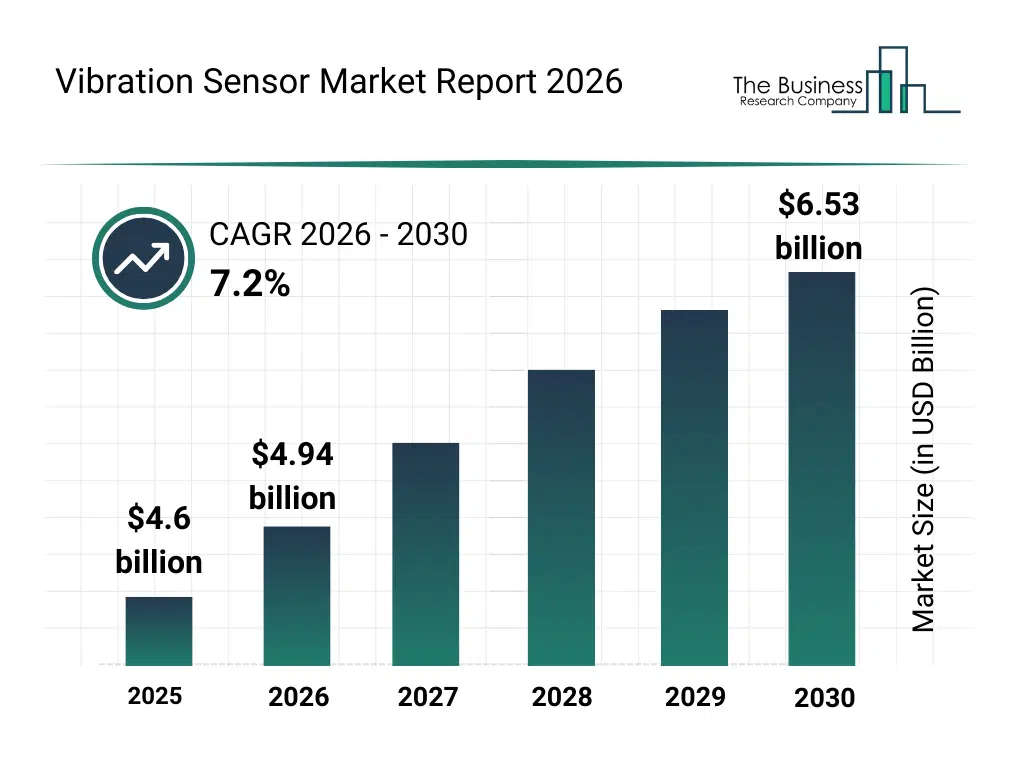
What Is The Vibration Sensor Market Size 2026 And Growth Rate?
The vibration sensor market size has grown strongly in recent years. It will grow from $4.6 billion in 2025 to $4.94 billion in 2026 at a compound annual growth rate (CAGR) of 7.4%. The growth in the historic period can be attributed to early adoption in industrial machinery monitoring, reliance on piezoelectric sensors, growth in automotive vibration testing, use in aerospace structural evaluations, expansion of manufacturing fault detection systems.What Is The Vibration Sensor Market Growth Forecast?
The vibration sensor market size is expected to see strong growth in the next few years. It will grow to $6.53 billion in 2030 at a compound annual growth rate (CAGR) of 7.2%. The growth in the forecast period can be attributed to rising demand for predictive maintenance, expansion of smart industrial automation, growing need for high-precision vibration measurement, development of advanced mems sensors, increasing deployment in energy and oil and gas sectors. Major trends in the forecast period include integration of smart predictive vibration monitoring, expansion of IoT-enabled condition monitoring platforms, development of AI-based fault detection systems, advancement of robotics-driven industrial diagnostics, growth of cloud-connected vibration analytics.
Global Vibration Sensor Market Segmentation
1) By Product Type: Velocity Transducers, Electrodynamics, Accelerometers, Non-Contact Displacement Transducer 2) By Material: Doped Silicon, Quartz, Piezoelectric Ceramics 3) By Technology: Piezoresistive, Strain Gauge, Variable Capacitance, Optical 4) By End User: Aerospace, Coal And Quarry, Oil And Gas, Medical And Pharmaceuticals, Automobile, Consumer Electronics Subsegments: 1) By Velocity Transducers: Dynamic Sensors, Magnetic Sensors 2) By Electrodynamics: Electrodynamic Accelerometers, Electrodynamic Vibration Sensors,3) By Accelerometers: MEMS (Micro-Electro-Mechanical Systems), Piezoelectric Accelerometers, Capacitive Accelerometers 3) By Non-Contact Displacement Transducers: Laser Displacement Sensors, Eddy Current SensorsWhat Is The Driver Of The Vibration Sensor Market?
The growing automotive industry is expected to propel the growth of the vibration sensor market going forward. The automotive sector refers to a group of businesses and institutions engaged in the creation, production, marketing, and sale of vehicles. Vibration sensors are used in automotive manufacturing to monitor the condition of various components in machines and equipment, and they play a critical role in preventing breakdowns and reducing maintenance costs.For instance, in August 2025, according to the Visualcapitalist, a Canada-based Media Publisher, in contrast, the U.S. produced 9.1 million commercial vehicles compared to just 1.4 million passenger cars in 2024. Therefore, the growing automotive industry is driving the growth of the vibration sensor industry.Key Players In The Global Vibration Sensor Market
Major companies operating in the vibration sensor market are TE Connectivity Ltd., Honeywell International Inc., Emerson Electric Co., Robert Bosch GmbH, Dytran Instruments Inc., Fluke Corporation, FUTEK Advanced Sensor Technology Inc., Hansford Sensors Ltd., Keyence Corporation, Colibrys Ltd., DIS Sensors, SKF GmbH, Omron Corp., PCB Piezotronics, Rockwell Automation Inc., Siemens AG, Endevco Corporation, PCB Piezotronics Inc., Sound and Vibration Measurement A/S, VTI Technologies Oy, MTS Systems Corporation, Hottinger Baldwin Messtechnik GmbH, Sensata Technologies Inc., LORD Corporation, GE Aviation Inc., United Technologies Corporation, Parker Hannifin Corporation, Meggitt plc, Rolls-Royce plc, Safran SA, Danaher Corporation, Teledyne Technologies Incorporated, Kistler Group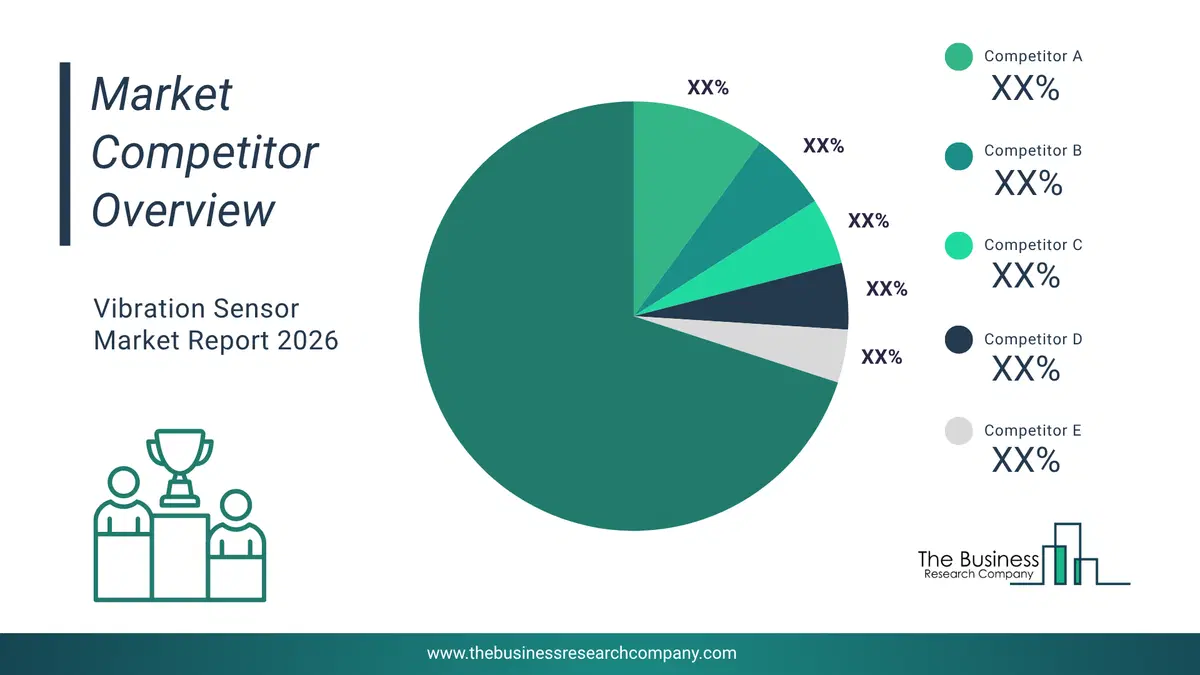
This chart is for illustrative purposes; the full report includes a detailed competitor analysis and comprehensive overview of the top 10 companies in the market.
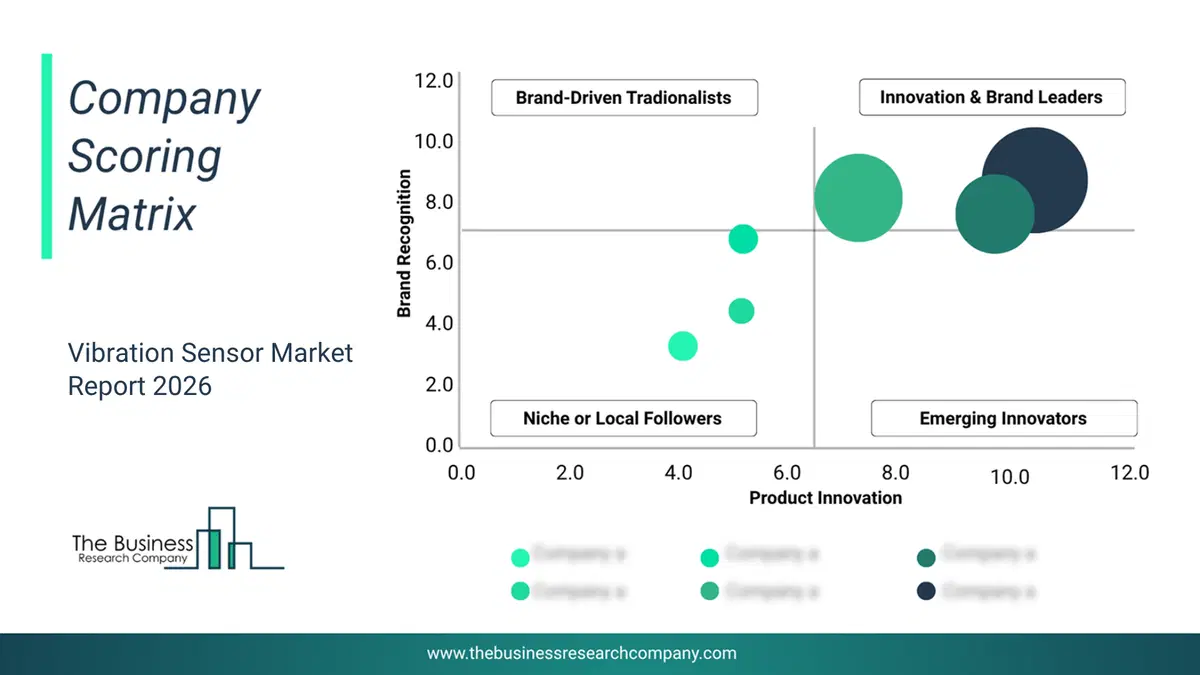
This chart maps companies by product innovation and brand strength, with bubble size indicating relative revenue, helping identify market leaders, challengers, and niche players. This is an illustrative chart; the full report provides a complete and accurate competitive analysis.
Global Vibration Sensor Market Trends and Insights
Major companies operating in the vibration sensor market are focused on introducing advanced wireless solutions, such as a wireless vibration sensor, to maximize their profits in the market. Advanced wireless vibration sensors are a type of sensor that is used to monitor vibrations in machinery and equipment. These sensors are designed to be wireless, which means they can be placed in hard-to-reach areas and can transmit data wirelessly to a central monitoring system. For instance In November 2023, Worldsensing, a Spain-based software company, unveiled its latest innovation, The Vibration Meter. This advanced device is specifically engineered to monitor vibrations resulting from long-term activities in mining and drilling operations, effectively addressing the environmental issues related to ground vibrations.What Are Latest Mergers And Acquisitions In The Vibration Sensor Market?
In September 2024, Spectris, a UK-based company specializing in industrial instrumentation acquired Piezocryst Advanced Sensorics GmbH. Valued at EUR 133.5 million (approximately USD 146.53 million), this acquisition is expected to enhance HBK's capabilities in the automotive, aerospace, defense, and industrial sectors by utilizing Piezocryst's expertise in piezoelectric sensing technologies. This move aligns with Spectris' strategy to bolster its product offerings and solidify its market leadership in the sensor industry, following several recent. Piezocryst Advanced Sensorics GmbH is an Austrian-based manufacturer known for its advanced pressure and vibration sensor technology.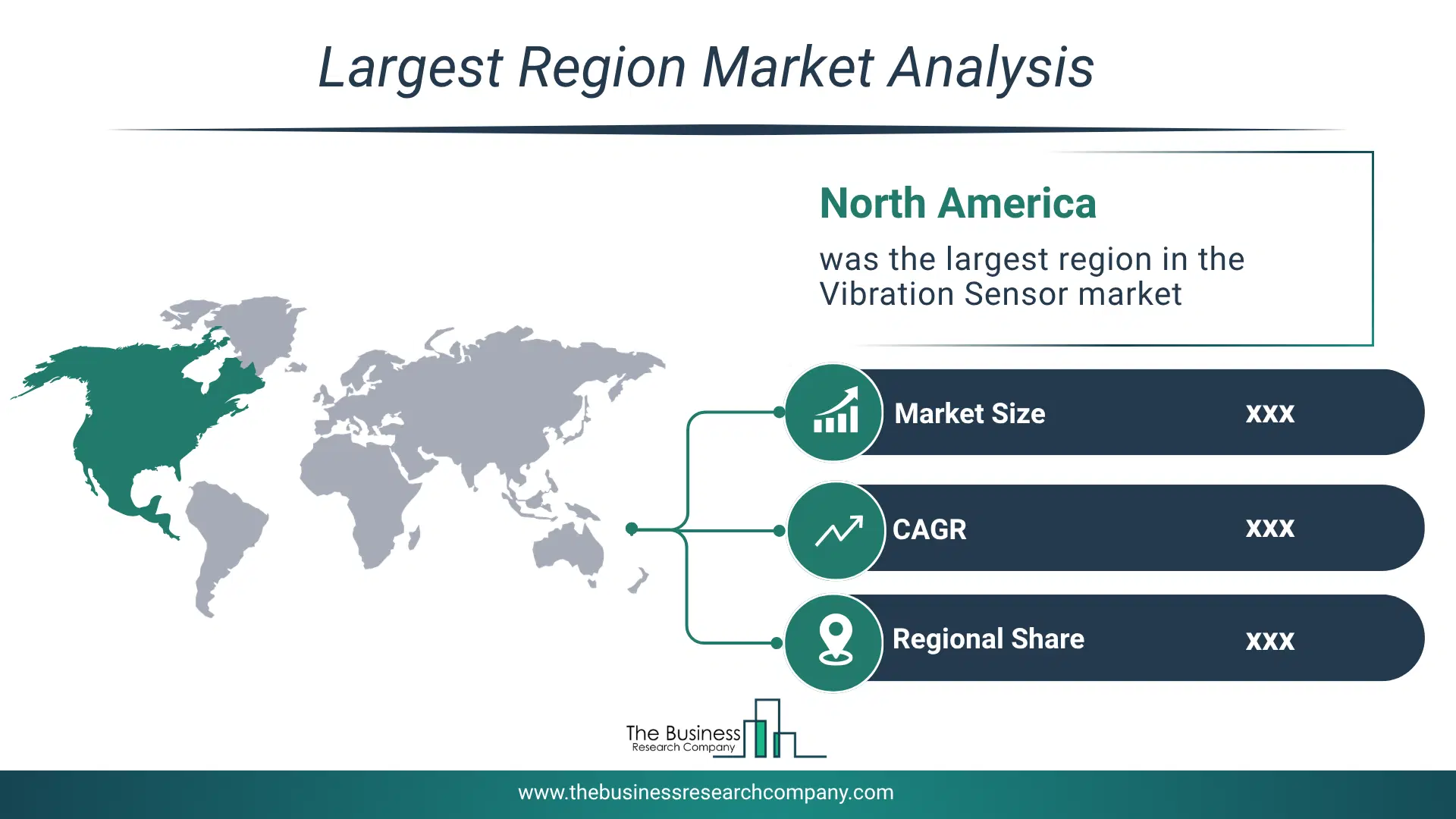
Regional Outlook
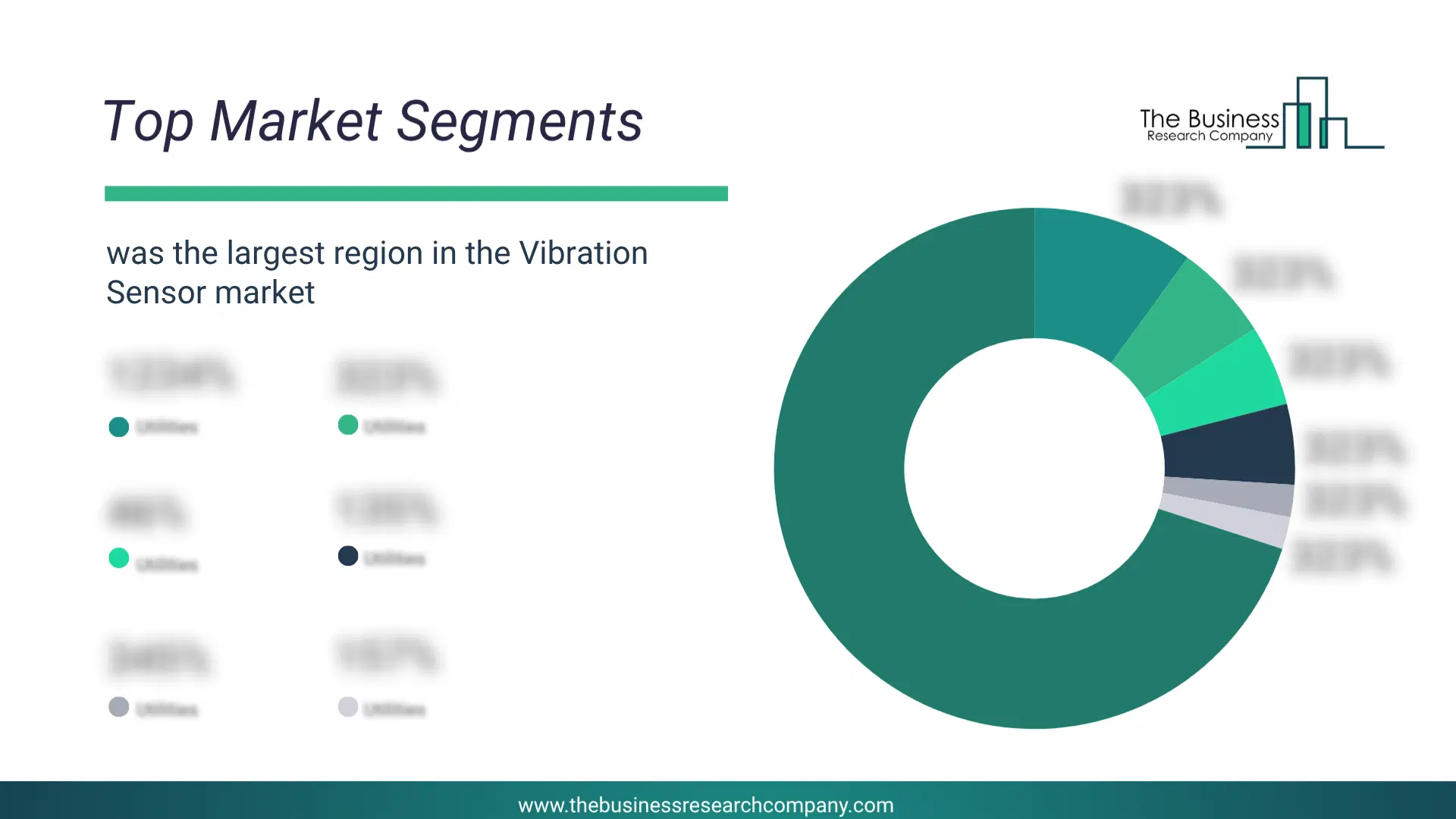
North America will be the largest region in the vibration sensor market share in 2025. Asia-Pacific is expected to be the fastest-growing region in the forecast period. The regions covered in this market report are Asia-Pacific, South East Asia, Western Europe, Eastern Europe, North America, South America, Middle East, Africa. The countries covered in this market report are Australia, Brazil, China, France, Germany, India, Indonesia, Japan, Taiwan, Russia, South Korea, UK, USA, Canada, Italy, Spain.What Defines the Vibration Sensor Market?
The vibration sensor market consists of sales of accelerometer, strain gauges, electromagnetic velocity sensor. Values in this market are ‘factory gate’ values, that is the value of goods sold by the manufacturers or creators of the goods, whether to other entities (including downstream manufacturers, wholesalers, distributors and retailers) or directly to end customers. The value of goods in this market includes related services sold by the creators of the goods.How is Market Value Defined and Measured?
The market value is defined as the revenues that enterprises gain from the sale of goods and/or services within the specified market and geography through sales, grants, or donations in terms of the currency (in USD unless otherwise specified). The revenues for a specified geography are consumption values that are revenues generated by organizations in the specified geography within the market, irrespective of where they are produced. It does not include revenues from resales along the supply chain, either further along the supply chain or as part of other products.
This chart presents market attractiveness based on a quantitative evaluation of growth, competition, strategic alignment, and risk, offering a clear view of opportunity areas for decision-making. This chart is for illustrative purposes; the full report contains the complete analysis.

This chart highlights the Total Addressable Market (TAM) by estimating the maximum revenue opportunity using an assumption-driven approach, supporting strategic planning and opportunity sizing across markets. The chart is illustrative; the full report provides a more comprehensive analysis.
What Key Data and Analysis Are Included in the Vibration Sensor Market Report 2026?
The vibration sensor market research report is one of a series of new reports from The Business Research Company that provides market statistics, including industry global market size, regional shares, competitors with the market share, detailed market segments, market trends and opportunities, and any further data you may need to thrive in the vibration sensor industry. The market research report delivers a complete perspective of everything you need, with an in-depth analysis of the current and future state of the industry.Vibration Sensor Market Report Forecast Analysis
| Report Attribute | Details |
|---|---|
| Market Size Value In 2026 | $4.94 billion |
| Revenue Forecast In 2030 | $6.53 billion |
| Growth Rate | CAGR of 7.2% from 2026 to 2030 |
| Base Year For Estimation | 2025 |
| Actual Estimates/Historical Data | 2020-2025 |
| Forecast Period | 2026 - 2030 |
| Market Representation | Revenue in USD Billion and CAGR from 2026 to 2030 |
| Segments Covered | Product Type, Material, Technology, End User |
| Regional Scope | Asia-Pacific, Western Europe, Eastern Europe, North America, South America, Middle East, Africa |
| Country Scope | The countries covered in the report are Australia, Brazil, China, France, Germany, India, Indonesia, Japan, Taiwan, Russia, South Korea, UK, USA, Canada, Italy, Spain. |
| Key Companies Profiled | TE Connectivity Ltd., Honeywell International Inc., Emerson Electric Co., Robert Bosch GmbH, Dytran Instruments Inc., Fluke Corporation, FUTEK Advanced Sensor Technology Inc., Hansford Sensors Ltd., Keyence Corporation, Colibrys Ltd., DIS Sensors, SKF GmbH, Omron Corp., PCB Piezotronics, Rockwell Automation Inc., Siemens AG, Endevco Corporation, PCB Piezotronics Inc., Sound and Vibration Measurement A/S, VTI Technologies Oy, MTS Systems Corporation, Hottinger Baldwin Messtechnik GmbH, Sensata Technologies Inc., LORD Corporation, GE Aviation Inc., United Technologies Corporation, Parker Hannifin Corporation, Meggitt plc, Rolls-Royce plc, Safran SA, Danaher Corporation, Teledyne Technologies Incorporated, Kistler Group |
| Customization Scope | Request for Customization |
| Pricing And Purchase Options | Explore Purchase Options |