
Waste Heat Recovery Market Report 2026
Global Outlook – By Technology (Heat Exchangers (Recuperators, Regenerators), Waste Heat Boilers, Organic Rankine Cycles (ORC), Turbocompounds), By Application (Pre-Heating, Electricity And Steam Generation, Steam Rankine Cycle), By End-Use Industry (Petroleum Refining, Chemical, Cement) – Market Size, Trends, Strategies, and Forecast to 2030
Waste Heat Recovery Market Overview
• Waste Heat Recovery market size has reached to $69.90 billion in 2025 • Expected to grow to $107.31 billion in 2030 at a compound annual growth rate (CAGR) of 8.9% • Growth Driver: Increasing Demand For Environmental Sustainability Fueling The Growth Of The Market Due To Reduction In Energy Waste And Emissions • Market Trend: ETI-W Heat Pump Introduced To Enhance Energy Efficiency And Sustainability • North America was the largest region in 2025 and Asia-Pacific is the fastest growing region.What Is Covered Under Waste Heat Recovery Market?
Waste heat recovery is the process of capturing and reusing heat generated by industrial processes, engines, or machines that would otherwise be lost to the environment. It helps to improve energy efficiency, reduce fuel consumption, and lower greenhouse gas emissions by converting wasted thermal energy into usable power or heat for other processes. This process also helps in lowering operational costs and enhancing the overall sustainability of industrial operations. The main technologies of the waste heat recovery market include heat exchangers (recuperators, regenerators), waste heat boilers, organic Rankine cycles (ORC), and turbocompounds. Heat exchangers (recuperators, regenerators) refer to systems designed to capture and reuse excess heat from industrial processes or exhaust gases by transferring thermal energy to incoming air, fluids, or process streams, thereby improving overall energy efficiency, reducing fuel consumption, and lowering operational emissions. The various applications are pre-heating, electricity and steam generation, and steam rankine cycle, and they are used by several end-uses such as petroleum refining, chemical, and cement.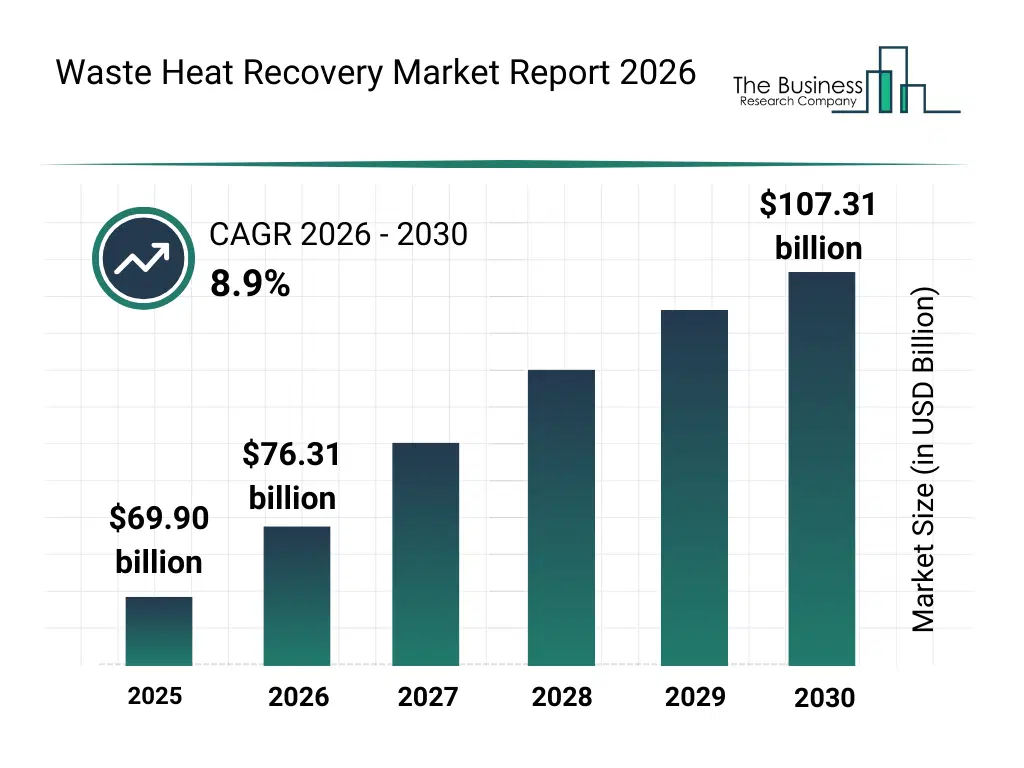
What Is The Waste Heat Recovery Market Size and Share 2026?
The waste heat recovery market size has grown strongly in recent years. It will grow from $69.90 billion in 2025 to $76.31 billion in 2026 at a compound annual growth rate (CAGR) of 9.2%. The growth in the historic period can be attributed to escalating Fuel & Electricity Prices, Initial Environmental Policies, Cost-Saving Potential & Financial Incentives, Expansion of Heavy Industry (APAC), Demonstration of ORC Viability.What Is The Waste Heat Recovery Market Growth Forecast?
The waste heat recovery market size is expected to see strong growth in the next few years. It will grow to $107.31 billion in 2030 at a compound annual growth rate (CAGR) of 8.9%. The growth in the forecast period can be attributed to global Decarbonization Mandates, Technological Breakthroughs in Low-Grade Heat, Shift to Decentralized Power & Microgrids, Emergence of Energy-as-a-Service (EaaS) Models, Targeted Government Incentives. Major trends in the forecast period include advanced ORC Dominance, Adoption of Modular, Compact Units, Integration with District Heating, Focus on Supercritical $\text{CO}_2$ Cycles, Cascade Heat Recovery Systems.
Global Waste Heat Recovery Market Segmentation
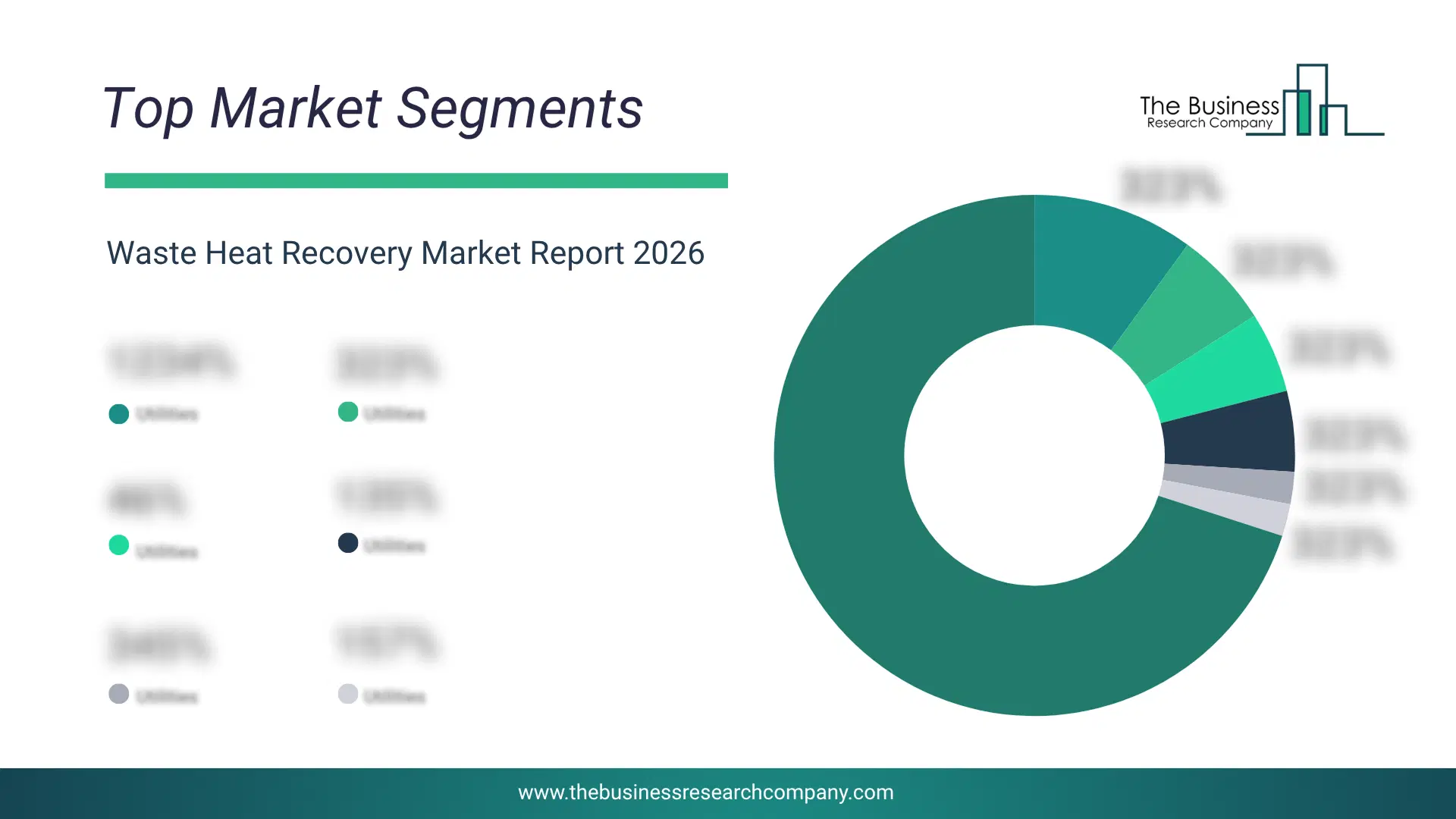
1) By Technology: Heat Exchangers (Recuperators, Regenerators), Waste Heat Boilers, Organic Rankine Cycles (ORC), Turbocompounds 2) By Application: Pre-Heating, Electricity And Steam Generation, Steam Rankine Cycle 3) By End-Use Industry: Petroleum Refining, Chemical, Cement Subsegments: 1) By Heat Exchangers: Shell & Tube, Plate Heat Exchangers, Plate-Fin Heat Exchangers, Air-Cooled Heat Exchangers, Heat Pipe Heat Exchangers 2) By Waste Heat Boilers: Fire-Tube, Water-Tube, Once-Through, Packaged Boilers 3) By Organic Rankine Cycle (ORC): Subcritical ORC, Supercritical ORC, Regenerative ORC, Two-Stage ORC 4) By Turbocompounds: Mechanical Turbocompound, Electrical Turbocompound, Hybrid TurbocompoundWhat Is The Driver Of The Waste Heat Recovery Market?
The increasing demand for environmental sustainability is expected to propel the growth of the waste heat recovery market going forward. Environmental sustainability refers to the responsible interaction with the environment to ensure that natural resources are preserved and maintained for current and future generations. The rise in awareness of environmental sustainability is due to stricter government regulations and policies as they enforce mandatory recycling standards and eco-friendly industrial practices. Waste heat recovery supports environmental sustainability by capturing and reusing excess heat from industrial processes and power generation. It reduces fuel consumption and greenhouse gas emissions, making operations more energy-efficient and eco-friendly. For instance, in October 2024, according to the United States Environmental Protection Agency, a US-based government agency, greenhouse gas emissions rose to 322 million metric tons in 2023, a 1.4% increase compared to 2022. Therefore, the increasing demand for environmental sustainability is driving the growth of the waste heat recovery industry.Key Players In The Global Waste Heat Recovery Market
Major companies operating in the waste heat recovery market are Siemens Energy AG, GE Vernova LLC, Mitsubishi Heavy Industries Ltd, Carrier Global Corporation, IHI Corporation, Spirax-Sarco Engineering plc, John Cockerill Group, Bitzer SE, Kelvion Holding GmbH, Thermax Limited, Forbes Marshall Pvt. Ltd., Ormat Technologies Inc., Nooter/Eriksen Inc., TICA Thermal Technology Co. Ltd., Exodraft A/S, Kawasaki Heavy Industries Ltd., Echogen Power Systems LLC, Climeon AB, Enertime SA, Exchanger Industries Limited, Heliex Power Ltd., Orcan Energy AG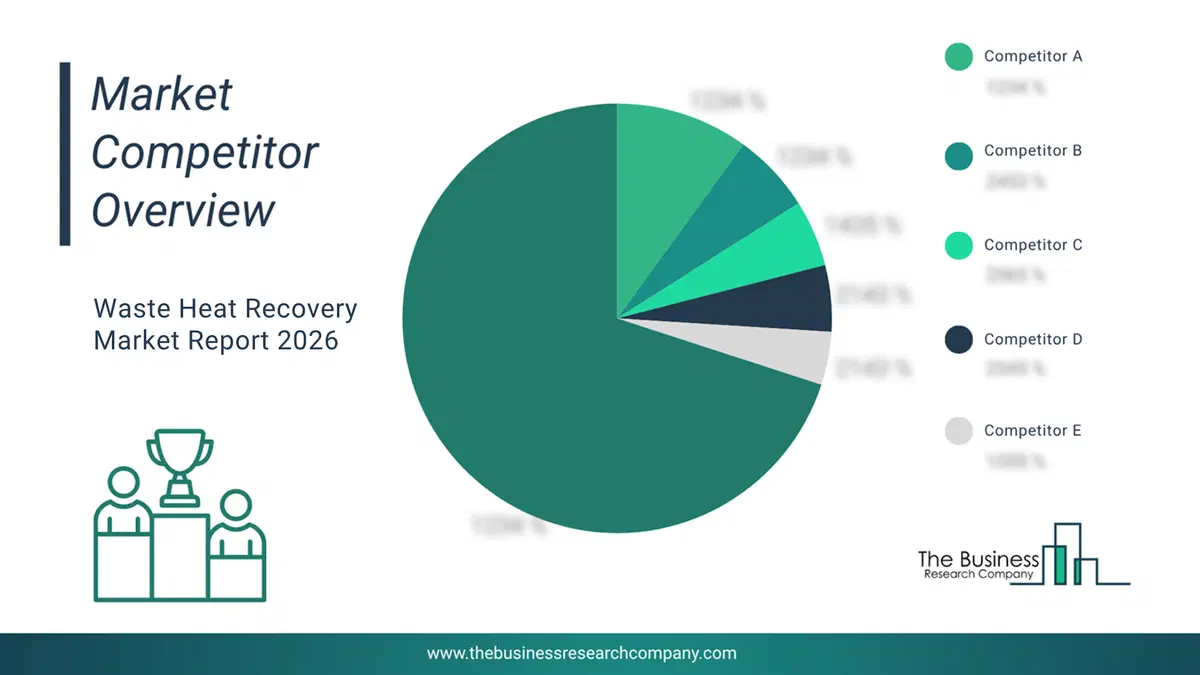
This chart is for illustrative purposes; the full report includes a detailed competitor analysis and comprehensive overview of the top 10 companies in the market.
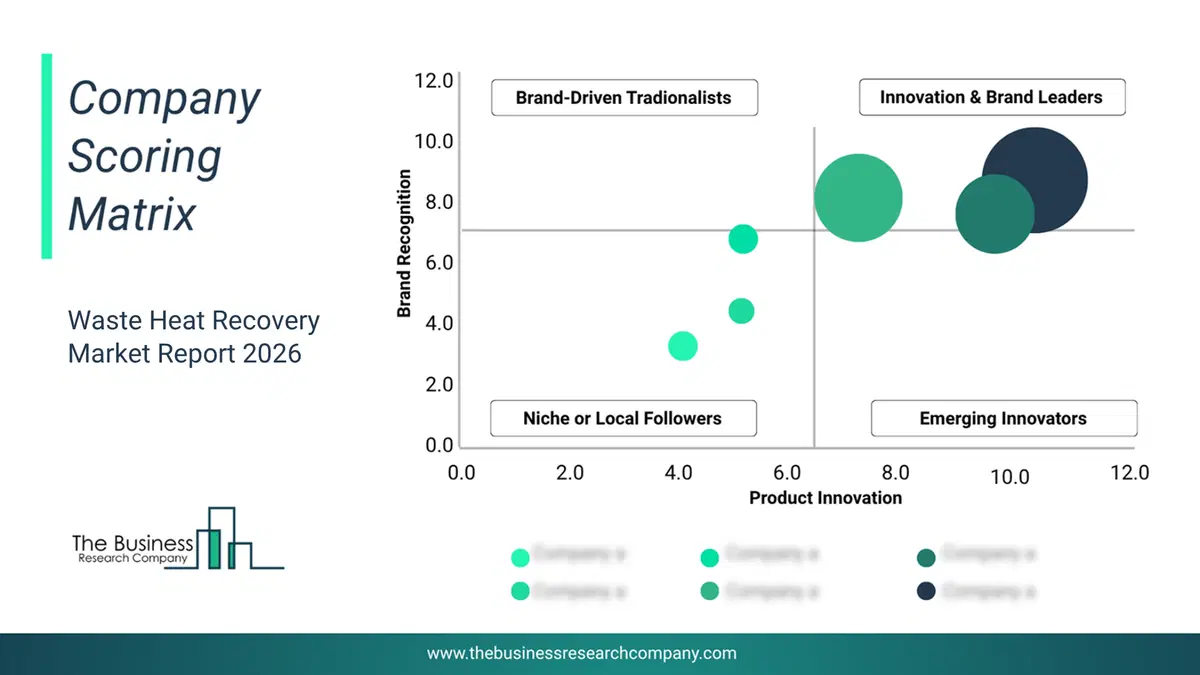
This chart maps companies by product innovation and brand strength, with bubble size indicating relative revenue, helping identify market leaders, challengers, and niche players. This is an illustrative chart; the full report provides a complete and accurate competitive analysis.
Global Waste Heat Recovery Market Trends and Insights
Major companies operating in the waste heat recovery market are focusing on developing advanced products, such as centrifugal heat pumps, to boost energy efficiency, enhance sustainability, and reduce operational costs and carbon emissions. Centrifugal heat pumps refer to advanced mechanisms that use a turbo-compressor to effectively upgrade and utilize low-temperature waste heat for high-temperature output. For instance, in October 2025, Mitsubishi Heavy Industries Thermal Systems Ltd., a Japan-based heating, ventilation, and air-conditioning (HVAC) systems company, launched the ETI-W, a centrifugal heat pump for the Japanese market. It is a high-capacity, high-efficiency heat pump featuring a turbo-compressor that can effectively utilize waste heat sources at approximately 65°C to produce hot water output at up to 95°C. It includes advanced operational functionality, enabling seamless integration into industrial processes without requiring major system changes. It also incorporates a single-stage compression cycle and a natural refrigerant (R-1233zd(E)), significantly reducing electricity consumption and greenhouse gas emissions for industrial users.What Are Latest Mergers And Acquisitions In The Waste Heat Recovery Market?
In November 2023, BITZER Group, a Germany-based refrigeration and HVAC solutions company, acquired BPOWER for an undisclosed amount. With this acquisition, BITZER expands into high-efficiency energy systems by integrating BPOWER’s modular power-generation expertise, enabling it to offer ORC waste-heat recovery solutions and strengthen its position in sustainable energy and industrial decarbonisation. BPOWER is a Czech Republic-based energy technology company specializing in ORC solutions that convert low-grade waste heat into usable electrical power.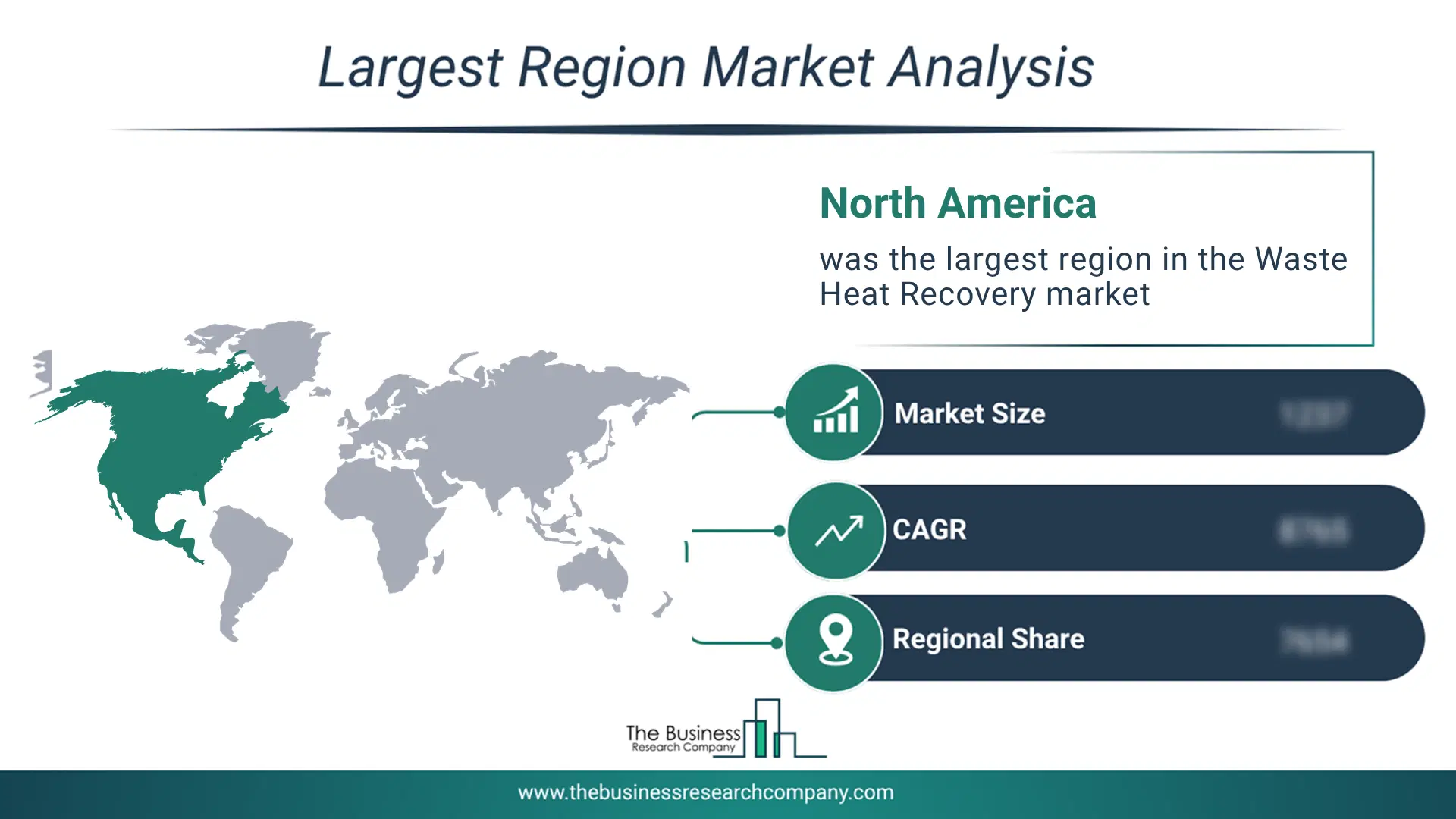
Regional Insights
North America was the largest region in the waste heat recovery market in 2025. Asia-Pacific is expected to be the fastest-growing region in the forecast period. The regions covered in this market report are Asia-Pacific, South East Asia, Western Europe, Eastern Europe, North America, South America, Middle East, Africa. The countries covered in this market report are Australia, Brazil, China, France, Germany, India, Indonesia, Japan, Taiwan, Russia, South Korea, UK, USA, Canada, Italy, Spain.What Defines the Waste Heat Recovery Market?
The waste heat recovery market consists of sales of waste heat recovery systems, heat exchangers, boilers, thermoelectric generators, boilers, economizers, and thermoelectric generators. Values in this market are ‘factory gate’ values, that is, the value of goods sold by the manufacturers or creators of the goods, whether to other entities (including downstream manufacturers, wholesalers, distributors, and retailers) or directly to end customers. The value of goods in this market includes related services sold by the creators of the goods.How is Market Value Defined and Measured?
The market value is defined as the revenues that enterprises gain from the sale of goods and/or services within the specified market and geography through sales, grants, or donations in terms of the currency (in USD unless otherwise specified). The revenues for a specified geography are consumption values that are revenues generated by organizations in the specified geography within the market, irrespective of where they are produced. It does not include revenues from resales along the supply chain, either further along the supply chain or as part of other products.
This chart presents market attractiveness based on a quantitative evaluation of growth, competition, strategic alignment, and risk, offering a clear view of opportunity areas for decision-making. This chart is for illustrative purposes; the full report contains the complete analysis.

This chart highlights the Total Addressable Market (TAM) by estimating the maximum revenue opportunity using an assumption-driven approach, supporting strategic planning and opportunity sizing across markets. The chart is illustrative; the full report provides a more comprehensive analysis.
What Key Data and Analysis Are Included in the Waste Heat Recovery Market Report 2026?
The waste heat recovery market research report is one of a series of new reports from The Business Research Company that provides market statistics, including industry global market size, regional shares, competitors with the market share, detailed market segments, market trends and opportunities, and any further data you may need to thrive in the waste heat recovery industry. The market research report delivers a complete perspective of everything you need, with an in-depth analysis of the current and future state of the industry.Waste Heat Recovery Market Report Forecast Analysis
| Report Attribute | Details |
|---|---|
| Market Size Value In 2026 | $76.31 billion |
| Revenue Forecast In 2030 | $107.31 billion |
| Growth Rate | CAGR of 9.2% from 2026 to 2030 |
| Base Year For Estimation | 2025 |
| Actual Estimates/Historical Data | 2020-2025 |
| Forecast Period | 2026 - 2030 - 2030 |
| Market Representation | Revenue in USD Billion and CAGR from 2026 to 2030 |
| Segments Covered | Technology, Application, End-Use Industry |
| Regional Scope | Asia-Pacific, Western Europe, Eastern Europe, North America, South America, Middle East, Africa |
| Country Scope | The countries covered in the report are Australia, Brazil, China, France, Germany, India, Indonesia, Japan, Taiwan, Russia, South Korea, UK, USA, Canada, Italy, Spain. |
| Key Companies Profiled | Siemens Energy AG, GE Vernova LLC, Mitsubishi Heavy Industries Ltd, Carrier Global Corporation, IHI Corporation, Spirax-Sarco Engineering plc, John Cockerill Group, Bitzer SE, Kelvion Holding GmbH, Thermax Limited, Forbes Marshall Pvt. Ltd., Ormat Technologies Inc., Nooter/Eriksen Inc., TICA Thermal Technology Co. Ltd., Exodraft A/S, Kawasaki Heavy Industries Ltd., Echogen Power Systems LLC, Climeon AB, Enertime SA, Exchanger Industries Limited, Heliex Power Ltd., Orcan Energy AG |
| Customization Scope | Request for Customization |
| Pricing And Purchase Options | Explore Purchase Options |