
Wearable Pregnancy Devices Market Report 2026
Global Outlook – By Device Type (Fetal Monitoring Wearables, Maternal Vital Sign Monitoring Wearables, Uterine Activity Monitoring Devices, Multi Parameter Pregnancy Monitoring Devices, Other Device Types), By Distribution Channel (E-Commerce, Retail Stores, Direct Sales), By Application (Fetal Health Monitoring, Maternal Health Monitoring, Remote Patient Monitoring, High Risk Pregnancy Management, Other Applications), By End User (Hospitals, Maternity Clinics, Home Care Settings, Diagnostic Centers, Other End Users) – Market Size, Trends, Strategies, and Forecast to 2030
Wearable Pregnancy Devices Market Overview
• Wearable Pregnancy Devices market size has reached to $11.38 billion in 2025 • Expected to grow to $24.57 billion in 2030 at a compound annual growth rate (CAGR) of 16.7% • Growth Driver: Rising Awareness Of Maternal Health Driving The Market Growth Due To Increasing Demand For Continuous Pregnancy Monitoring • Market Trend: Innovations In Wearable Monitoring Technology Enhance Continuous Maternal And Fetal Health Tracking • North America was the largest region in 2025 and Asia-Pacific is the fastest growing region.What Is Covered Under Wearable Pregnancy Devices Market?
Wearable pregnancy devices are smart, body-worn medical or wellness systems designed to monitor maternal and fetal health throughout pregnancy. These devices use advanced sensors, connectivity, and real-time data tracking to monitor fetal movement, heart rate, maternal vital signs, and other pregnancy-related indicators. Wearable pregnancy devices support continuous prenatal monitoring, enable early detection of complications, and improve maternal-fetal care through remote and preventive healthcare solutions. The main device types of wearable pregnancy devices include fetal monitoring wearables, maternal vital sign monitoring wearables, uterine activity monitoring devices, multi parameter pregnancy monitoring devices, and other device types. Fetal monitoring wearables refer to body-worn devices designed to continuously track fetal heart rate and movement for prenatal care. These products are distributed through e-commerce, retail stores, and direct sales. The various applications involved are fetal health monitoring, maternal health monitoring, remote patient monitoring, high risk pregnancy management, and others, and they are used by several end users such as hospitals, maternity clinics, home care settings, diagnostic centers, and others.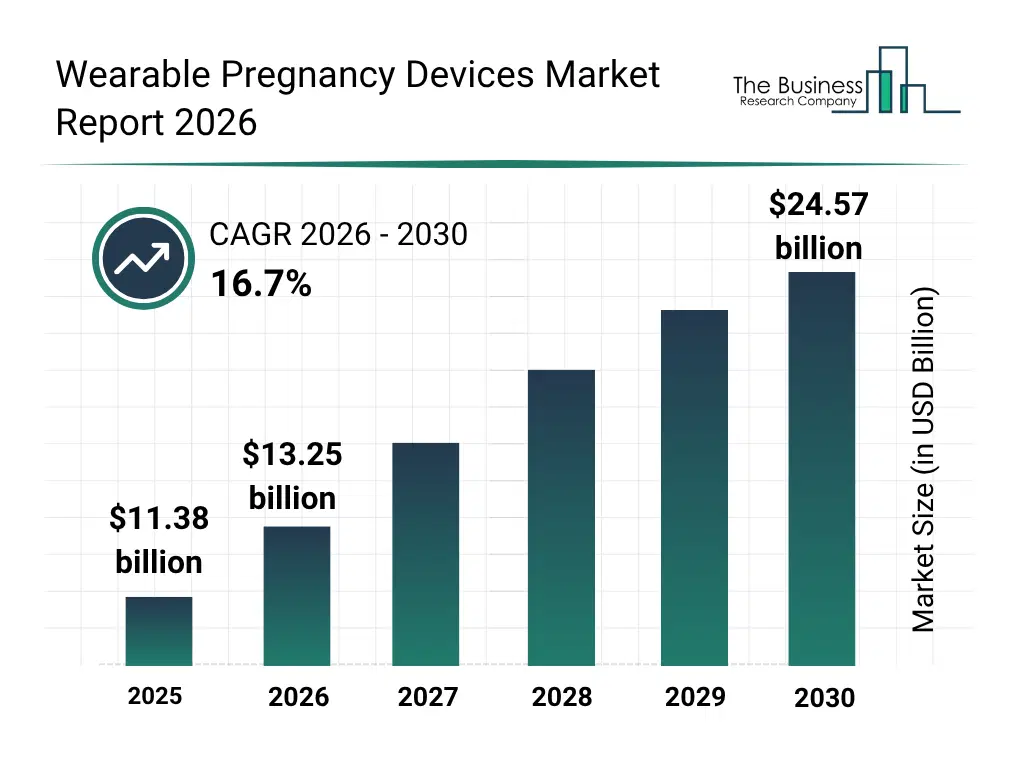
What Is The Wearable Pregnancy Devices Market Size and Share 2026?
The wearable pregnancy devices market size has grown rapidly in recent years. It will grow from $11.38 billion in 2025 to $13.25 billion in 2026 at a compound annual growth rate (CAGR) of 16.5%. The growth in the historic period can be attributed to rising maternal health awareness, increasing prevalence of high risk pregnancies, limited access to continuous prenatal monitoring, growth of basic fetal doppler usage, expansion of maternal healthcare infrastructure.What Is The Wearable Pregnancy Devices Market Growth Forecast?
The wearable pregnancy devices market size is expected to see rapid growth in the next few years. It will grow to $24.57 billion in 2030 at a compound annual growth rate (CAGR) of 16.7%. The growth in the forecast period can be attributed to increasing adoption of remote patient monitoring technologies, rising demand for personalized maternal healthcare solutions, growth of ai enabled predictive pregnancy analytics, expansion of home based healthcare models, increasing integration of wearable medical devices in prenatal care. Major trends in the forecast period include rising adoption of continuous remote maternal and fetal monitoring systems, increasing integration of ai-enabled predictive analytics for pregnancy risk detection, growing demand for multi-parameter wearable pregnancy monitoring devices, expansion of telehealth-based prenatal care and remote consultation services, rising use of non-invasive wearable sensors for early complication detection.
Global Wearable Pregnancy Devices Market Segmentation
1) By Device Type: Fetal Monitoring Wearables, Maternal Vital Sign Monitoring Wearables, Uterine Activity Monitoring Devices, Multi Parameter Pregnancy Monitoring Devices, Other Device Types 2) By Distribution Channel: E-Commerce, Retail Stores, Direct Sales 3) By Application: Fetal Health Monitoring, Maternal Health Monitoring, Remote Patient Monitoring, High Risk Pregnancy Management, Other Applications 4) By End User: Hospitals, Maternity Clinics, Home Care Settings, Diagnostic Centers, Other End Users Subsegments: 1) By Fetal Monitoring Wearables: Fetal Heart Rate Monitoring Wearables, Fetal Movement Tracking Wearables, Continuous Fetal Monitoring Patches, Wireless Fetal Monitoring Belts, Smart Fetal Monitoring Devices 2) By Maternal Vital Sign Monitoring Wearables: Maternal Heart Rate Monitoring Devices, Blood Pressure Monitoring Wearables, Oxygen Saturation Monitoring Devices, Respiratory Rate Monitoring Wearables, Temperature Monitoring Wearables 3) By Uterine Activity Monitoring Devices: Contraction Monitoring Devices, Uterine Pressure Monitoring Systems, Labor Progress Monitoring Devices, Wireless Uterine Activity Trackers, Home Based Contraction Monitoring Devices 4) By Multi Parameter Pregnancy Monitoring Devices: Combined Maternal And Fetal Monitoring Devices, Integrated Vital Sign Monitoring Systems, Remote Pregnancy Monitoring Platforms, Multi Sensor Pregnancy Monitoring Devices, Connected Pregnancy Monitoring Systems 5) By Other Device Types: Sleep Monitoring Devices For Pregnancy, Stress Monitoring Wearables, Activity Tracking Devices For Pregnancy, Hydration Monitoring Devices, Wellness Monitoring DevicesWhat Are The Drivers Of The Wearable Pregnancy Devices Market?
The rising awareness of maternal health is expected to propel the growth of the wearable pregnancy devices market going forward. Maternal health awareness refers to the growing recognition among expectant mothers, caregivers, and healthcare providers of the importance of monitoring and managing health outcomes during pregnancy and childbirth. Maternal health awareness is largely driven by the increasing prevalence of high-risk pregnancies in developed economies, as advanced maternal age and related complications have prompted greater focus on continuous prenatal monitoring and early intervention. The heightened focus on maternal health outcomes encourages expectant mothers to seek proactive, real-time monitoring solutions, directly increasing demand for wearable pregnancy devices that track vital parameters such as fetal heart rate, contractions, and maternal health indicators. For instance, in August 2024, according to the National Center for Health Statistics (NCHS), a U.S.-based federal agency, the percentage of mothers receiving no prenatal care increased from 2.2% in 2022 to 2.3% in 2023, highlighting critical gaps in timely maternal care access that underscore the urgent need for alternative monitoring solutions. Therefore, rising awareness of maternal health is driving the growth of the wearable pregnancy devices industry. The growing prevalence of high-risk pregnancies is expected to propel the growth of the wearable pregnancy devices market going forward. High-risk pregnancies are those involving medical conditions or maternal factors such as advanced maternal age, gestational diabetes, or hypertensive disorders that increase the likelihood of complications for the mother, fetus, or both during pregnancy and childbirth. This prevalence of high-risk pregnancies is rising primarily due to the growing trend of delayed childbearing, as more women are choosing to conceive later in life, which significantly increases the probability of pregnancy-related complications. The rising number of high-risk pregnancies drives demand for continuous and remote monitoring solutions that can track maternal and fetal health parameters in real time, enabling timely clinical intervention. For instance, in April 2026, according to the Centers for Disease Control and Prevention, a US-based national public health agency, the overall cesarean delivery rate in the U.S. increased to 32.5% in 2025 from 32.4% in 2024, reflecting a broader trend of intensified medical intervention and monitoring in obstetric care. Therefore, the growing prevalence of high-risk pregnancies is driving the growth of the wearable pregnancy devices industry.Key Players In The Global Wearable Pregnancy Devices Market
Major companies operating in the wearable pregnancy devices market are GE HealthCare Technologies Inc., Philips, Nuvo Group Ltd., Sibel Health Inc., Bloomlife Inc., CareNX Innovations Pvt. Ltd., Janitri Innovations Private Limited, HeraMED Limited, Kali Healthcare Pty Ltd, InnAccel Technologies Private Limited, JioVio Healthcare, Shenzhen Hwatime Biological Medical Electronics Co. Ltd.,Bellabeat Inc., Apple Inc., Fitbit LLCGlobal Wearable Pregnancy Devices Market Trends and Insights
Major companies operating in the wearable pregnancy devices market are focusing on developing advanced wireless maternal-fetal monitoring solutions to improve remote pregnancy care, enable continuous health tracking, and support early detection of pregnancy-related complications. Wireless maternal-fetal monitoring solutions are advanced connected systems that remotely track fetal and maternal health parameters in real time, improving prenatal care accessibility, mobility, and continuous monitoring efficiency. For instance, in February 2024, GE HealthCare, a US-based medical technology and digital solutions provider, launched Novii+, an advanced wireless maternal and fetal monitoring solution. It is designed to support continuous monitoring during labor and delivery. The system enhances maternal mobility and comfort through non-invasive wearable sensors while enabling clinicians to accurately monitor fetal heart rate, maternal heart rate, and uterine activity, thereby improving obstetric care efficiency and patient-centered monitoring.Regional Outlook
North America was the largest region in the wearable pregnancy devices market in 2025. Asia-Pacific is expected to be the fastest-growing region in the forecast period. The regions covered in this market report are Australia, Brazil, China, France, Germany, India, Indonesia, Japan, Taiwan, Russia, South Korea, UK, USA, Canada, Italy, Spain. The countries covered in this market report are Australia, Brazil, China, France, Germany, India, Indonesia, Japan, Taiwan, Russia, South Korea, UK, USA, Canada, Italy, Spain.What Defines the Wearable Pregnancy Devices Market?
The wearable pregnancy devices market consists of sales of smart pregnancy belts, fetal heartbeat tracking patches, connected maternity bands, and wireless prenatal biosensors. Values in this market are ‘factory gate’ values, that is, the value of goods sold by the manufacturers or creators of the goods, whether to other entities (including downstream manufacturers, wholesalers, distributors, and retailers) or directly to end customers. The value of goods in this market includes related services sold by the creators of the goods.How is Market Value Defined and Measured?
The market value is defined as the revenues that enterprises gain from the sale of goods and/or services within the specified market and geography through sales, grants, or donations in terms of the currency (in USD unless otherwise specified). The revenues for a specified geography are consumption values that are revenues generated by organizations in the specified geography within the market, irrespective of where they are produced. It does not include revenues from resales along the supply chain, either further along the supply chain or as part of other products.What Key Data and Analysis Are Included in the Wearable Pregnancy Devices Market Report 2026?
The wearable pregnancy devices market research report is one of a series of new reports from The Business Research Company that provides wearable pregnancy devices market statistics, including wearable pregnancy devices industry global market size, regional shares, competitors with a wearable pregnancy devices market share, detailed wearable pregnancy devices market segments, market trends and opportunities, and any further data you may need to thrive in the wearable pregnancy devices industry. This wearable pregnancy devices market research report delivers a complete perspective of everything you need, with an in-depth analysis of the current and future scenario of the industry.Wearable Pregnancy Devices Market Report Forecast Analysis
| Report Attribute | Details |
|---|---|
| Market Size Value In 2026 | $13.25 billion |
| Revenue Forecast In 2030 | $24.57 billion |
| Growth Rate | CAGR of 16.7% from 2026 to 2030 |
| Base Year For Estimation | 2025 |
| Actual Estimates/Historical Data | 2020-2025 |
| Forecast Period | 2026 - 2030 |
| Market Representation | Revenue in USD Billion and CAGR from 2026 to 2030 |
| Segments Covered | Device Type, Distribution Channel, Application, End User |
| Regional Scope | Asia-Pacific, Western Europe, Eastern Europe, North America, South America, Middle East, Africa |
| Country Scope | The countries covered in the wearable pregnancy devices market report are Australia, Brazil, China, France, Germany, India, Indonesia, Japan, Taiwan, Russia, South Korea, UK, USA, Canada, Italy, Spain. |
| Key Companies Profiled | GE HealthCare Technologies Inc., Philips, Nuvo Group Ltd., Sibel Health Inc., Bloomlife Inc., CareNX Innovations Pvt. Ltd., Janitri Innovations Private Limited, HeraMED Limited, Kali Healthcare Pty Ltd, InnAccel Technologies Private Limited, JioVio Healthcare, Shenzhen Hwatime Biological Medical Electronics Co. Ltd.,Bellabeat Inc., Apple Inc., Fitbit LLC |
| Customization Scope | Request for Customization |
| Pricing And Purchase Options | Explore Purchase Options |