
Wireless Maternal-Fetal Monitoring Systems Market Report 2026
Global Outlook – By Product Type (Wireless Cardiotocography Monitors, Remote Patient Monitoring Platforms, Wireless Fetal Heart Rate Only Devices, Wireless Intrauterine Pressure Monitoring Systems), By Modality (Internal Monitoring, External Monitoring), By Technology (Bluetooth Enabled Systems, Wi Fi Connected Systems, Cellular Enabled Systems, Artificial Intelligence Enhanced Analytics Platforms, Cloud-Based Or Edge Analytics Platforms), By Application (Antenatal Or Prenatal Monitoring, Labor And Delivery Monitoring, Postpartum Maternal Fetal Surveillance, High Risk Pregnancy Management, Routine Risk Or Low Risk Pregnancy Monitoring), By End User (Hospitals And Labor Wards, Ambulatory Birthing Centers, Obstetrics And Gynecology Clinics, Homecare Settings) – Market Size, Trends, Strategies, and Forecast to 2030
Wireless Maternal-Fetal Monitoring Systems Market Overview
• Wireless Maternal-Fetal Monitoring Systems market size has reached to $3.65 billion in 2025 • Expected to grow to $5.95 billion in 2030 at a compound annual growth rate (CAGR) of 10.3% • Growth Driver: The Increasing Prevalence Of High-Risk Pregnancies Driving The Growth Of The Market Due To Rising Maternal Age • Market Trend: Belt-Free Wireless Patch Technology Enables Continuous Real-Time Maternal And Fetal Monitoring With Enhanced Comfort And Mobility • North America was the largest region in 2025 and Asia-Pacific is the fastest growing region.What Is Covered Under Wireless Maternal-Fetal Monitoring Systems Market?
Wireless maternal-fetal monitoring systems are healthcare technologies that use wireless sensors to continuously track and transmit real-time data on the health of a pregnant woman and her fetus, such as fetal heart rate and maternal vital signs. These systems enable remote monitoring by clinicians, improving prenatal care, early risk detection, and patient mobility compared to traditional wired monitoring methods. The main product types of wireless maternal-fetal monitoring systems include wireless cardiotocography monitors, remote patient monitoring platforms, wireless fetal heart rate only devices, and wireless intrauterine pressure monitoring systems. Wireless cardiotocography monitors refer to monitoring devices that wirelessly track fetal heart rate and uterine contractions during pregnancy and labor. These systems are available in internal monitoring and external monitoring modalities and utilize technologies such as Bluetooth enabled systems, Wi Fi connected systems, cellular enabled systems, artificial intelligence enhanced analytics platforms, and Cloud-Based or edge analytics platforms. The key applications of antenatal or prenatal monitoring, labor and delivery monitoring, postpartum maternal fetal surveillance, high risk pregnancy management, and routine risk or low risk pregnancy monitoring, while the end-user includes hospitals and labor wards, ambulatory birthing centers, obstetrics and gynecology clinics, and homecare settings.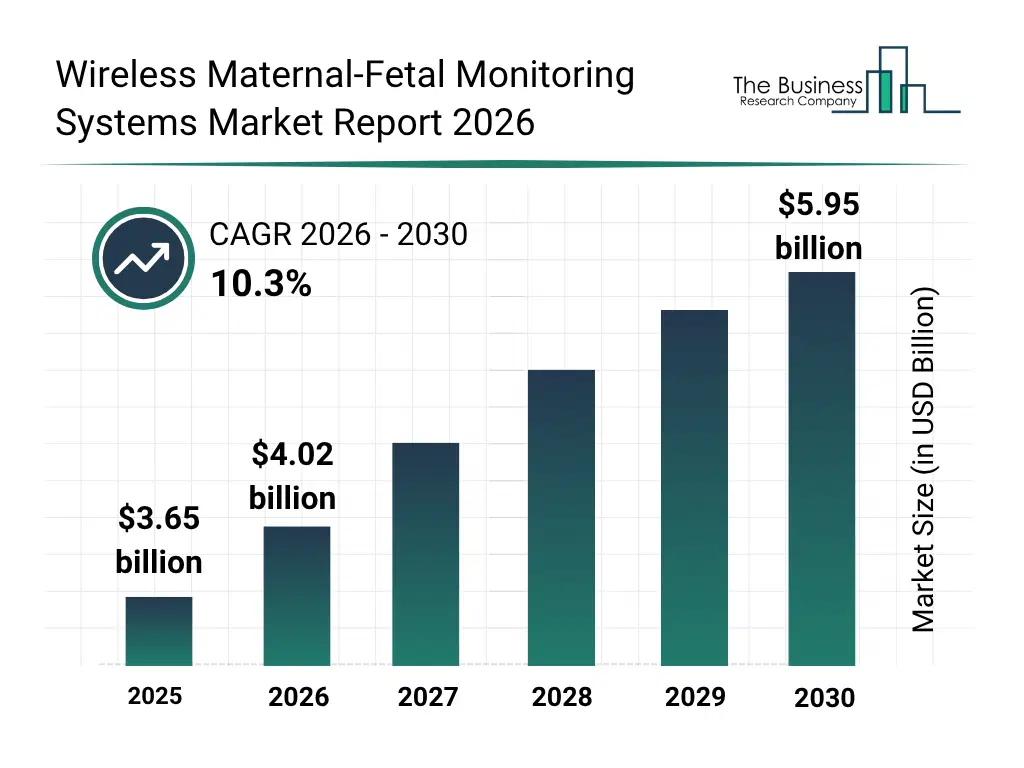
What Is The Wireless Maternal-Fetal Monitoring Systems Market Size and Share 2026?
The wireless maternal-fetal monitoring systems market size has grown rapidly in recent years. It will grow from $3.65 billion in 2025 to $4.02 billion in 2026 at a compound annual growth rate (CAGR) of 10.1%. The growth in the historic period can be attributed to limited accessibility of continuous fetal monitoring in rural regions, reliance on wired cardiotocography systems in hospitals, increasing maternal mortality awareness initiatives, growth of hospital-based obstetric care infrastructure, early adoption of basic fetal heart rate monitoring devices.What Is The Wireless Maternal-Fetal Monitoring Systems Market Growth Forecast?
The wireless maternal-fetal monitoring systems market size is expected to see rapid growth in the next few years. It will grow to $5.95 billion in 2030 at a compound annual growth rate (CAGR) of 10.3%. The growth in the forecast period can be attributed to rising demand for remote pregnancy monitoring and telehealth integration, increasing high-risk pregnancies requiring continuous surveillance, expansion of home healthcare and hospital-at-home models, growth of AI-based predictive maternal-fetal analytics, rising adoption of wireless and wearable medical sensor technologies. Major trends in the forecast period include AI-powered fetal risk prediction and anomaly detection systems, continuous remote maternal-fetal monitoring through connected wearable ecosystems, cloud-enabled real-time obstetric data integration platforms, home-based prenatal monitoring and tele-obstetrics adoption, advanced wireless cardiotocography and fetal telemetry system miniaturization.
Global Wireless Maternal-Fetal Monitoring Systems Market Segmentation
1) By Product Type: Wireless Cardiotocography Monitors, Remote Patient Monitoring Platforms, Wireless Fetal Heart Rate Only Devices, Wireless Intrauterine Pressure Monitoring Systems 2) By Modality: Internal Monitoring, External Monitoring 3) By Technology: Bluetooth Enabled Systems, Wi Fi Connected Systems, Cellular Enabled Systems, Artificial Intelligence Enhanced Analytics Platforms, Cloud-Based Or Edge Analytics Platforms 4) By Application: Antenatal Or Prenatal Monitoring, Labor And Delivery Monitoring, Postpartum Maternal Fetal Surveillance, High Risk Pregnancy Management, Routine Risk Or Low Risk Pregnancy Monitoring 5) By End User: Hospitals And Labor Wards, Ambulatory Birthing Centers, Obstetrics And Gynecology Clinics, Homecare Settings Subsegments: 1) By Wireless Cardiotocography Monitors: Portable Wireless Cardiotocography Monitors, Bedside Wireless Cardiotocography Monitors, Home Use Wireless Cardiotocography Monitors 2) By Remote Patient Monitoring Platforms: Cloud-Based Remote Monitoring Platforms, Hospital Integrated Remote Monitoring Platforms, Mobile Application Based Remote Monitoring Platforms 3) By Wireless Fetal Heart Rate Only Devices: Handheld Wireless Fetal Heart Rate Devices, Portable Wireless Fetal Heart Rate Devices, Home Use Wireless Fetal Heart Rate Devices 4) By Wireless Intrauterine Pressure Monitoring Systems: Catheter Based Wireless Intrauterine Pressure Monitoring Systems, Sensor Based Wireless Intrauterine Pressure Monitoring Systems, Hospital Use Wireless Intrauterine Pressure Monitoring SystemsWhat Is The Driver Of The Wireless Maternal-Fetal Monitoring Systems Market?
The increasing prevalence of high-risk pregnancies is expected to propel the growth of the wireless maternal-fetal monitoring systems market going forward. The prevalence of high-risk pregnancies refers to the proportion of pregnancies in a population that are classified as having an increased risk of complications for the mother, fetus, or both, such as abortion. The increasing prevalence of high-risk pregnancies is primarily due to rising maternal age, as women are increasingly conceiving later in life when the risk of complications such as gestational diabetes, hypertension, and chromosomal abnormalities is higher. Wireless maternal-fetal monitoring systems enhance the management of high-risk pregnancies by enabling continuous, real-time tracking of maternal and fetal vital signs, allowing early detection of complications and timely clinical intervention. For instance, in March 2026, according to Guttmacher Institute, a US-based research and policy organization, the abortion rate in 2025 stood at 16.7 abortions per 1,000 women aged 15–44, unchanged from 2024 and reflecting a 5% increase compared with 2023. Therefore, the increasing prevalence of high-risk pregnancies worldwide is driving the growth of the wireless maternal-fetal monitoring systems industry.Key Players In The Global Wireless Maternal-Fetal Monitoring Systems Market
Major companies operating in the wireless maternal-fetal monitoring systems market are Koninklijke Philips N.V., GE HealthCare Technologies Inc., Mindray Medical International Limited, Nihon Kohden Corporation, OSI Systems Inc., Contec Medical Systems Co Ltd., Edan Instruments Inc., Huntleigh Healthcare Ltd., Arjo, PeriGen, Life Plus Healthcare Pvt. Ltd., Shenzhen Comen Medical Instruments Co Ltd., Trivitron Healthcare, Nemo Healthcare B.V., Mediana Co. Ltd., MedGyn Products Inc., Dixion Vertrieb der Medizingeräte GmbH, Bionet Co. Ltd., GPC Medical Ltd., Bloomlife Inc., Janitri Innovations Pvt. Ltd., Neoventa Medical ABGlobal Wireless Maternal-Fetal Monitoring Systems Market Trends and Insights
Major companies in the wireless maternal-fetal monitoring systems market are focusing on developing innovative solutions, such as belt-free, wireless patch-based monitoring systems to improve maternal mobility, enhance patient comfort, and enable continuous, high-quality fetal and maternal monitoring during labor and pregnancy. Belt-free wireless patch-based monitoring systems are wearable devices placed on the mother’s abdomen that continuously track fetal heart rate, maternal heart rate, and uterine activity without using traditional wired belts, allowing greater mobility and comfort during pregnancy and labor. For instance, in February 2024, GE HealthCare Technologies Inc., a US-based medical technology company, received approval from the U.S. Food and Drug Administration (FDA) for its Novii+ Wireless Patch Solution, an advanced maternal and fetal monitoring system designed for pregnant patients from 34 weeks' gestation onward. The system non-invasively measures fetal heart rate, maternal heart rate, and uterine activity in real time using a patch-based sensor platform that eliminates the need for belts and wires. It also integrates an improved cross-check artifact reduction algorithm to enhance signal reliability and accuracy while enabling seamless data transmission to hospital monitoring systems for continuous clinical oversight.What Are Latest Mergers And Acquisitions In The Wireless Maternal-Fetal Monitoring Systems Market?
In February 2026, Sibel Health Inc., a US-based medical technology company that provides a wireless maternal-fetal monitoring system, partnered with LookDeep Health to integrate continuous vital sign monitoring with real-time bedside artificial intelligence (AI) analytics. This collaboration aims to enhance patient monitoring and clinical decision-making by combining Sibel Health’s wireless wearable monitoring systems with LookDeep Health’s AI-powered computer vision platform for hospital environments. The partnership focuses on improving early detection of patient deterioration, reducing alarm fatigue, and enabling more connected and continuous care without vendor lock-in across hospital systems. LookDeep Inc. is a US-based healthcare company providing AIME, a multimodal agentic AI platform.Regional Outlook
North America was the largest region in the wireless maternal-fetal monitoring systems market in 2025. Asia-Pacific is expected to be the fastest-growing region in the forecast period. The regions covered in this market report are Australia, Brazil, China, France, Germany, India, Indonesia, Japan, Taiwan, Russia, South Korea, UK, USA, Canada, Italy, Spain. The countries covered in this market report are Australia, Brazil, China, France, Germany, India, Indonesia, Japan, Taiwan, Russia, South Korea, UK, USA, Canada, Italy, Spain.What Defines the Wireless Maternal-Fetal Monitoring Systems Market?
The wireless maternal-fetal monitoring systems market consists of revenues earned by entities by providing services such as fetal heart rate monitoring, maternal vital sign tracking, uterine contraction monitoring, and real-time clinical alerts. The market value includes the value of related goods sold by the service provider or included within the service offering. The wireless maternal-fetal monitoring systems market also includes sales of wireless obstetric telemetry patches, maternal vital sign wearable monitors, wireless external tocodynamometer, central fetal monitoring workstation systems, and hub devices. Values in this market are ‘factory gate’ values, that is the value of goods sold by the manufacturers or creators of the goods, whether to other entities (including downstream manufacturers, wholesalers, distributors and retailers) or directly to end customers. The value of goods in this market includes related services sold by the creators of the goods.How is Market Value Defined and Measured?
The market value is defined as the revenues that enterprises gain from the sale of goods and/or services within the specified market and geography through sales, grants, or donations in terms of the currency (in USD unless otherwise specified). The revenues for a specified geography are consumption values that are revenues generated by organizations in the specified geography within the market, irrespective of where they are produced. It does not include revenues from resales along the supply chain, either further along the supply chain or as part of other products.What Key Data and Analysis Are Included in the Wireless Maternal-Fetal Monitoring Systems Market Report 2026?
The wireless maternal-fetal monitoring systems market research report is one of a series of new reports from The Business Research Company that provides wireless maternal-fetal monitoring systems market statistics, including wireless maternal-fetal monitoring systems industry global market size, regional shares, competitors with a wireless maternal-fetal monitoring systems market share, detailed wireless maternal-fetal monitoring systems market segments, market trends and opportunities, and any further data you may need to thrive in the wireless maternal-fetal monitoring systems industry. This wireless maternal-fetal monitoring systems market research report delivers a complete perspective of everything you need, with an in-depth analysis of the current and future scenario of the industry.Wireless Maternal-Fetal Monitoring Systems Market Report Forecast Analysis
| Report Attribute | Details |
|---|---|
| Market Size Value In 2026 | $4.02 billion |
| Revenue Forecast In 2030 | $5.95 billion |
| Growth Rate | CAGR of 10.3% from 2026 to 2030 |
| Base Year For Estimation | 2025 |
| Actual Estimates/Historical Data | 2020-2025 |
| Forecast Period | 2026 - 2030 |
| Market Representation | Revenue in USD Billion and CAGR from 2026 to 2030 |
| Segments Covered | Product Type, Modality, Technology, Application, End User |
| Regional Scope | Asia-Pacific, Western Europe, Eastern Europe, North America, South America, Middle East, Africa |
| Country Scope | The countries covered in the wireless maternal-fetal monitoring systems market report are Australia, Brazil, China, France, Germany, India, Indonesia, Japan, Taiwan, Russia, South Korea, UK, USA, Canada, Italy, Spain. |
| Key Companies Profiled | Koninklijke Philips N.V., GE HealthCare Technologies Inc., Mindray Medical International Limited, Nihon Kohden Corporation, OSI Systems Inc., Contec Medical Systems Co Ltd., Edan Instruments Inc., Huntleigh Healthcare Ltd., Arjo, PeriGen, Life Plus Healthcare Pvt. Ltd., Shenzhen Comen Medical Instruments Co Ltd., Trivitron Healthcare, Nemo Healthcare B.V., Mediana Co. Ltd., MedGyn Products Inc., Dixion Vertrieb der Medizingeräte GmbH, Bionet Co. Ltd., GPC Medical Ltd., Bloomlife Inc., Janitri Innovations Pvt. Ltd., Neoventa Medical AB |
| Customization Scope | Request for Customization |
| Pricing And Purchase Options | Explore Purchase Options |