
Workflow Orchestration Market Report 2026
Global Outlook – By Component (Software, Services), By Deployment Model (Cloud-Based, On-Premises, Hybrid), By Organization Size (Small And Medium Enterprises (SME), Large Enterprises), By Application (Business Process Automation, Information Technology Operations And Development Operations (DevOps), Data And Analytics Workflows, Application Integration), By Industry Vertical (Information Technology And Telecommunications, Healthcare, Retail, Manufacturing, Other Industry Verticals) – Market Size, Trends, Strategies, and Forecast to 2030
Workflow Orchestration Market Overview
• Workflow Orchestration market size has reached to $19.36 billion in 2025 • Expected to grow to $36.45 billion in 2030 at a compound annual growth rate (CAGR) of 13.5% • Growth Driver: The Growing Adoption Of Digital Transformation Accelerating Market Expansion Due To Enhanced Process Automation • Market Trend: Innovations In Customer Experience Orchestration Enhance Personalized, Data-Driven Digital Interactions • North America was the largest region in 2025 and Asia-Pacific is the fastest growing region.What Is Covered Under Workflow Orchestration Market?
Workflow orchestration refers to the automated coordination and management of tasks, processes, and dependencies within a defined workflow. It ensures that activities are executed in the correct sequence across systems, applications, and teams while handling data flow and decision logic. It improves efficiency, consistency, and visibility by reducing manual intervention and errors and also supports scalability and adaptability by enabling workflows to adjust dynamically to changing operational conditions and requirements. The main components of workflow orchestration include software and services. Software refers to solutions that enable organizations to design, automate, coordinate, and manage workflows across systems and applications to improve efficiency and operational consistency. The systems are deployed through cloud-based, on-premises, and hybrid models and are adopted across organizations of different sizes, including small and medium enterprises and large enterprises. The various applications involved are business process automation, information technology operations and development operations, data and analytics workflows, and application integration and are used by industry verticals such as information technology and telecommunications, healthcare, retail, manufacturing, and other industry verticals.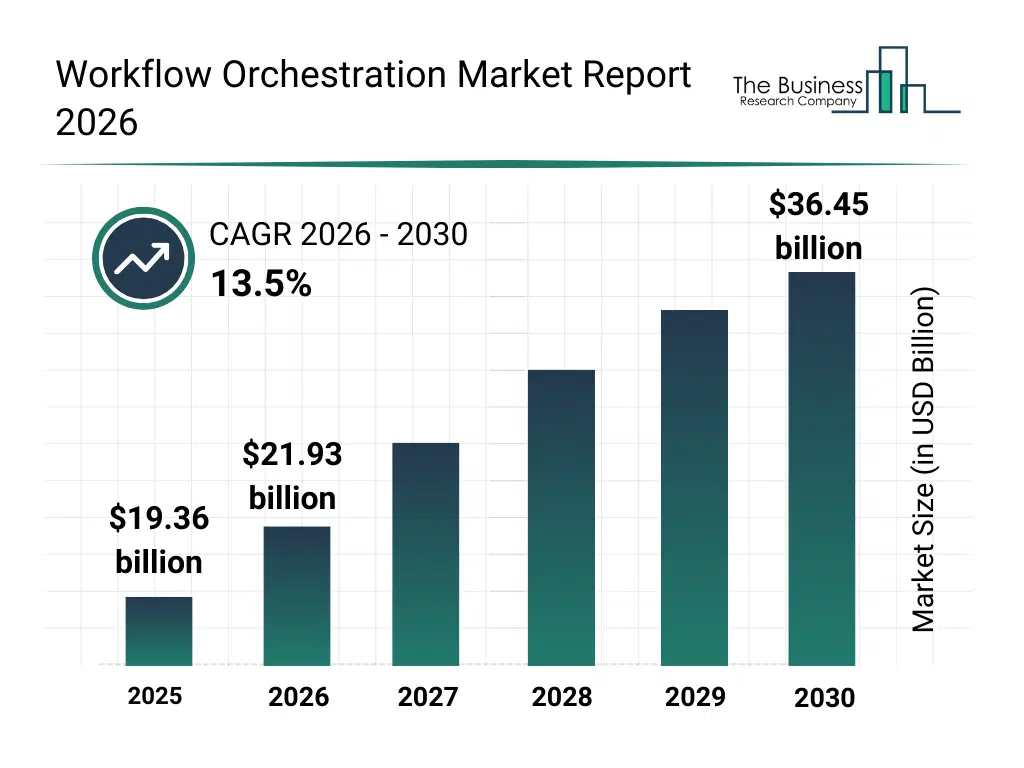
What Is The Workflow Orchestration Market Size and Share 2026?
The workflow orchestration market size has grown rapidly in recent years. It will grow from $19.36 billion in 2025 to $21.93 billion in 2026 at a compound annual growth rate (CAGR) of 13.3%. The growth in the historic period can be attributed to increase in enterprise digital transformation initiatives, rise in business process automation demand, growth of cloud computing adoption, expansion of enterprise resource planning systems, need for operational efficiency improvements.What Is The Workflow Orchestration Market Growth Forecast?
The workflow orchestration market size is expected to see rapid growth in the next few years. It will grow to $36.45 billion in 2030 at a compound annual growth rate (CAGR) of 13.5%. The growth in the forecast period can be attributed to integration of AI driven decision automation, expansion of hybrid cloud infrastructure, growing demand for real time data orchestration, rise in remote and distributed workforce management, increasing adoption of predictive workflow analytics. Major trends in the forecast period include growing adoption of low code and no code workflow platforms, expansion of cross platform system integrations, rising demand for real time workflow monitoring and analytics, increasing focus on error reduction and process visibility, shift toward modular and scalable workflow architectures.
Global Workflow Orchestration Market Segmentation
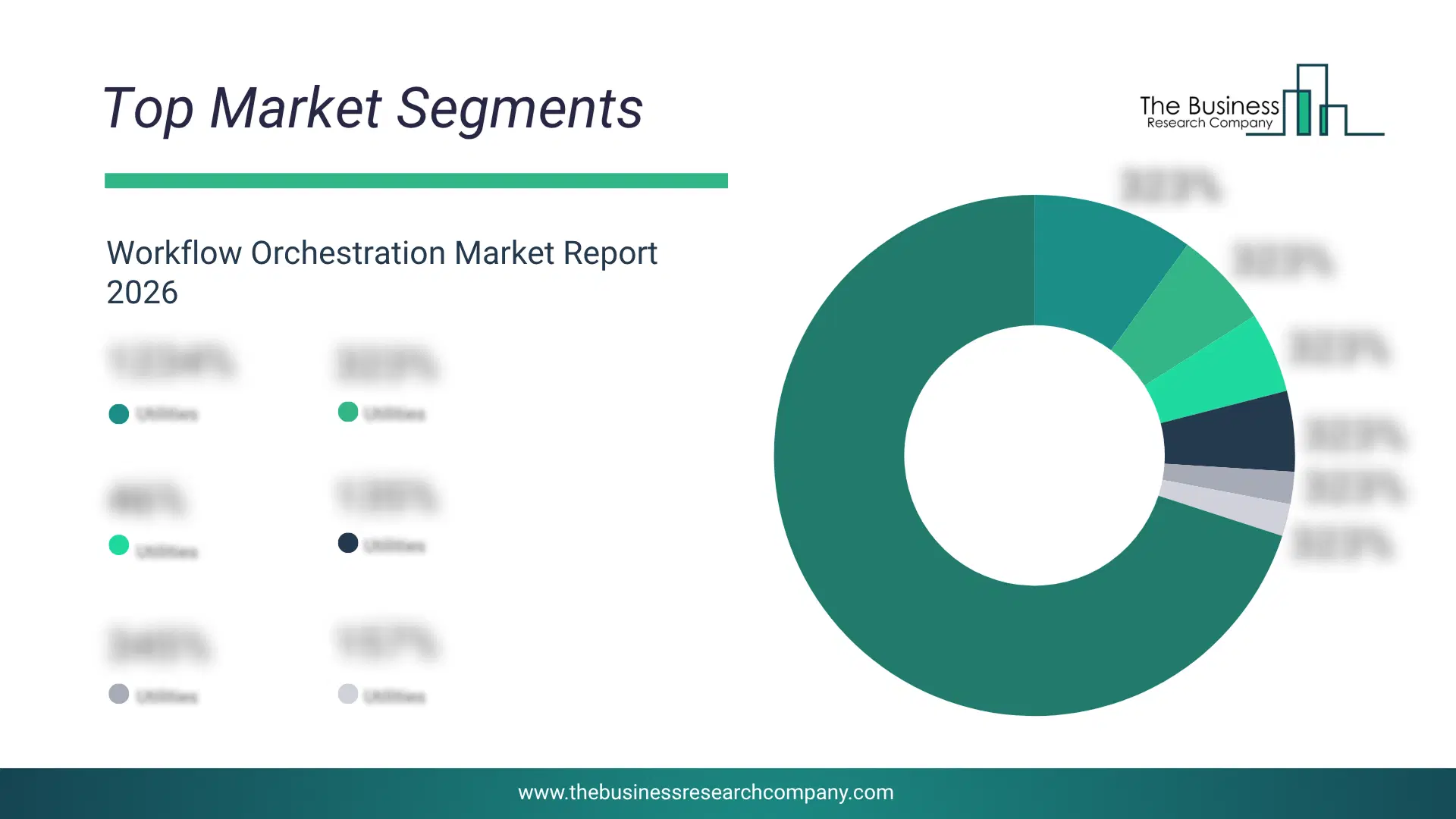
1) By Component: Software, Services 2) By Deployment Model: Cloud-Based, On-Premises, Hybrid 3) By Organization Size: Small And Medium Enterprises (SME), Large Enterprises 4) By Application: Business Process Automation, Information Technology Operations And Development Operations (DevOps), Data And Analytics Workflows, Application Integration 5) By Industry Vertical: Information Technology And Telecommunications, Healthcare, Retail, Manufacturing, Other Industry Verticals Subsegments: 1) By Software: Robot Operating Systems And Firmware, Simulation And Digital-Twin Software, Motion Planning And Path Optimization, Artificial Intelligence (AI) And Machine Learning Software, Vision And Perception Software, Cell And Fleet Management Software, Manufacturing Execution System (MES) Or Enterprise Resource Planning (ERP) Integration Software, Predictive Maintenance And Analytics, Cybersecurity Software, Low-Code Or No-Code Programming Tools 2) By Services: System Design And Engineering, Integration And Commissioning, Maintenance And Field Support, Training And Skill Development, Retrofit And Modernization Services, Custom Application Development, Robotics-As-A-Service (RaaS), Validation And Testing Services, Consulting And Return On Investment (ROI) Analysis, Research And Development (R&D) And Co-Innovation ServicesWhat Is The Driver Of The Workflow Orchestration Market?
The growing adoption of digital transformation initiatives is expected to propel the growth of the workflow orchestration market going forward. Digital transformation refers to the integration of advanced digital technologies such as cloud computing, artificial intelligence, automation, and data analytics to modernize organizational operations and improve efficiency. The adoption of digital transformation is increasing as enterprises seek to streamline complex workflows, minimize manual processes, and improve cross-functional agility. Workflow orchestration solutions enable organizations to coordinate automated tasks, applications, and data flows across distributed enterprise environments, supporting large-scale digital initiatives. For instance, in November 2023, according to a report published by the Central Digital and Data Office, a UK-based government entity, the government’s focus on digital transformation has resulted in a 9% growth in the Government Digital and Data profession over the past six months, bringing the total number of professionals in this field to 28,337. Therefore, the rising adoption of digital transformation initiatives is driving the growth of the workflow orchestration industry.Key Players In The Global Workflow Orchestration Market
Major companies operating in the workflow orchestration market are Google LLC, Microsoft Corporation, Amazon Web Services Inc., Dell Technologies Inc., International Business Machines Corporation, Cisco Systems Inc., Oracle Corporation, Broadcom Inc., SAP SE, Hewlett Packard Enterprise Development LP, ServiceNow Inc., OpenText Corporation, Zoho Corporation Pvt. Ltd., Hitachi Vantara LLC, BMC Software Inc., Salesforce Inc., Informatica Inc., UiPath Inc., Appian Corporation, TIBCO Software Inc., Workato Inc., and Camunda.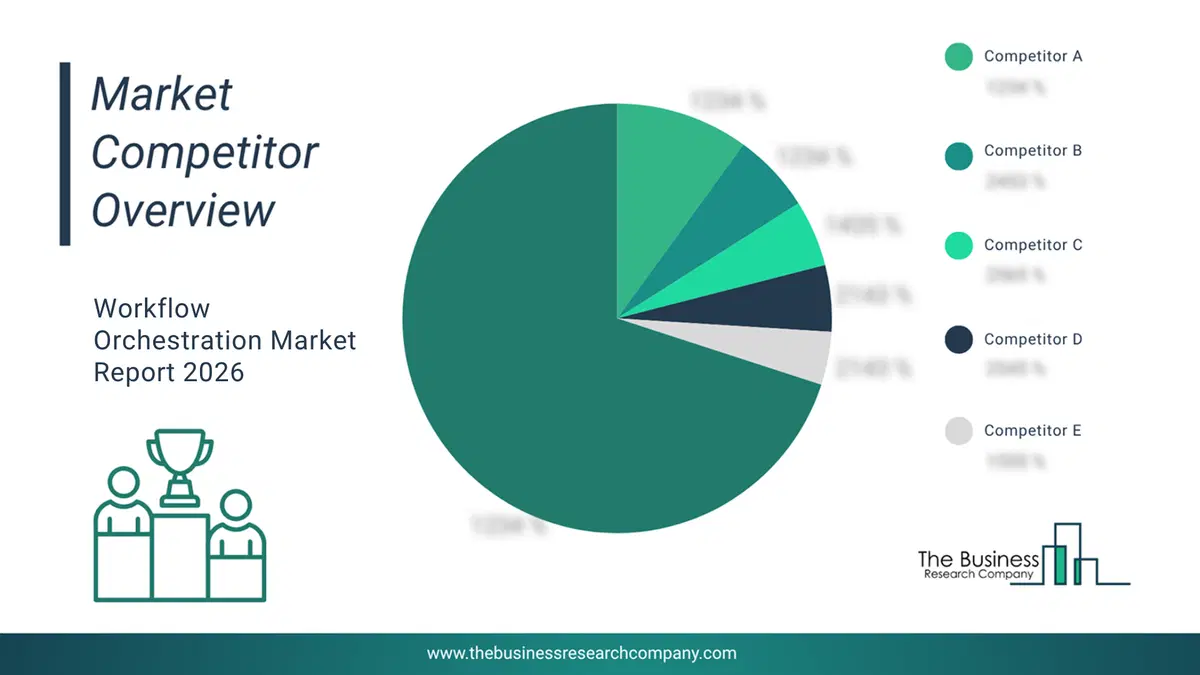
This chart is for illustrative purposes; the full report includes a detailed competitor analysis and comprehensive overview of the top 10 companies in the market.
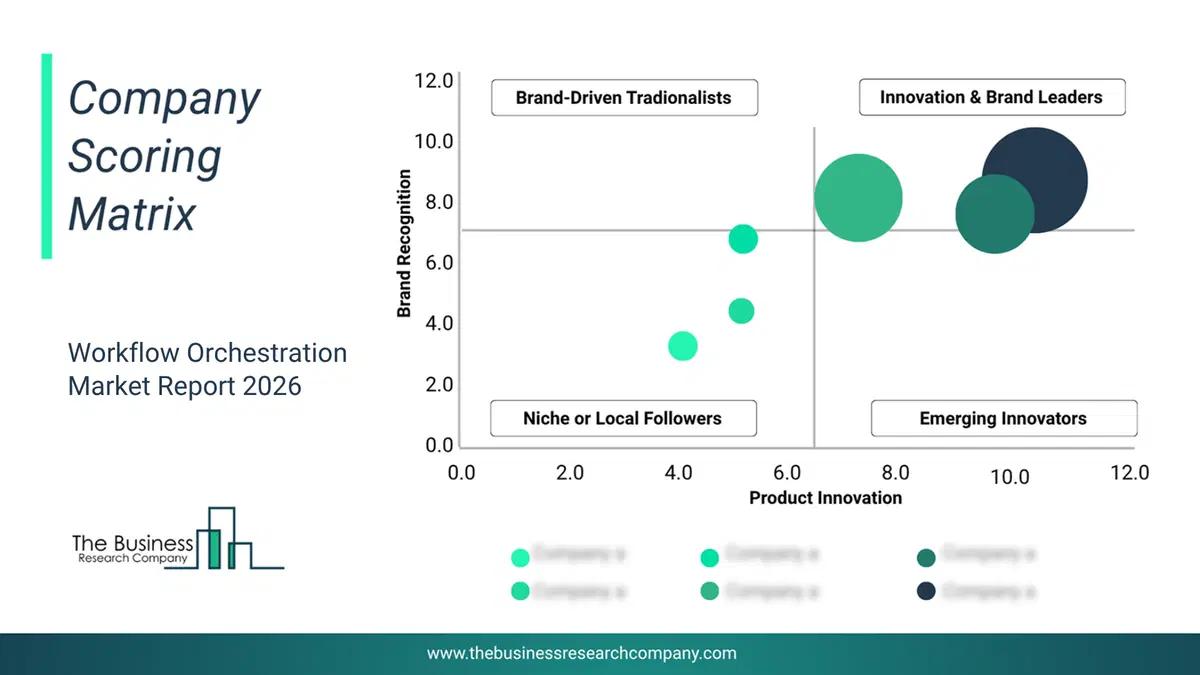
This chart maps companies by product innovation and brand strength, with bubble size indicating relative revenue, helping identify market leaders, challengers, and niche players. This is an illustrative chart; the full report provides a complete and accurate competitive analysis.
Global Workflow Orchestration Market Trends and Insights
Major companies operating in the workflow orchestration market are focusing on advanced innovations such as customer experience orchestration to improve personalization, operational efficiency, and real-time decision-making across digital channels. Customer experience orchestration refers to the coordinated management of data, analytics, automation, and artificial intelligence to design, execute, and optimize end-to-end customer workflows across multiple touchpoints. For instance, in September 2025, Adobe, a US-based provider of creative and digital experience solutions, introduced a new suite of AI-powered agents built on the Adobe Experience Platform Agent Orchestrator. The solution enables enterprises to orchestrate customer journeys through capabilities such as cross-channel audience personalization, journey design and optimization, experimentation analysis, predictive data insights, website performance optimization, and automated product support. These AI-driven agents support context-aware actions, multi-step automation, and personalized insights, strengthening workflow orchestration across customer experience, marketing, and support operations.What Are Latest Mergers And Acquisitions In The Workflow Orchestration Market?
In September 2025, SoundHound AI, Inc., a US-based voice and conversational artificial intelligence company, acquired Interactions LLC for an undisclosed amount. Through this acquisition, SoundHound AI aims to strengthen its leadership in agentic AI by integrating Interactions’ AI-powered customer service and workflow orchestration capabilities, expanding its enterprise market reach, and enhancing its suite of omnichannel AI solutions. Interactions LLC is a US-based company that develops AI for customer service and workflow orchestration.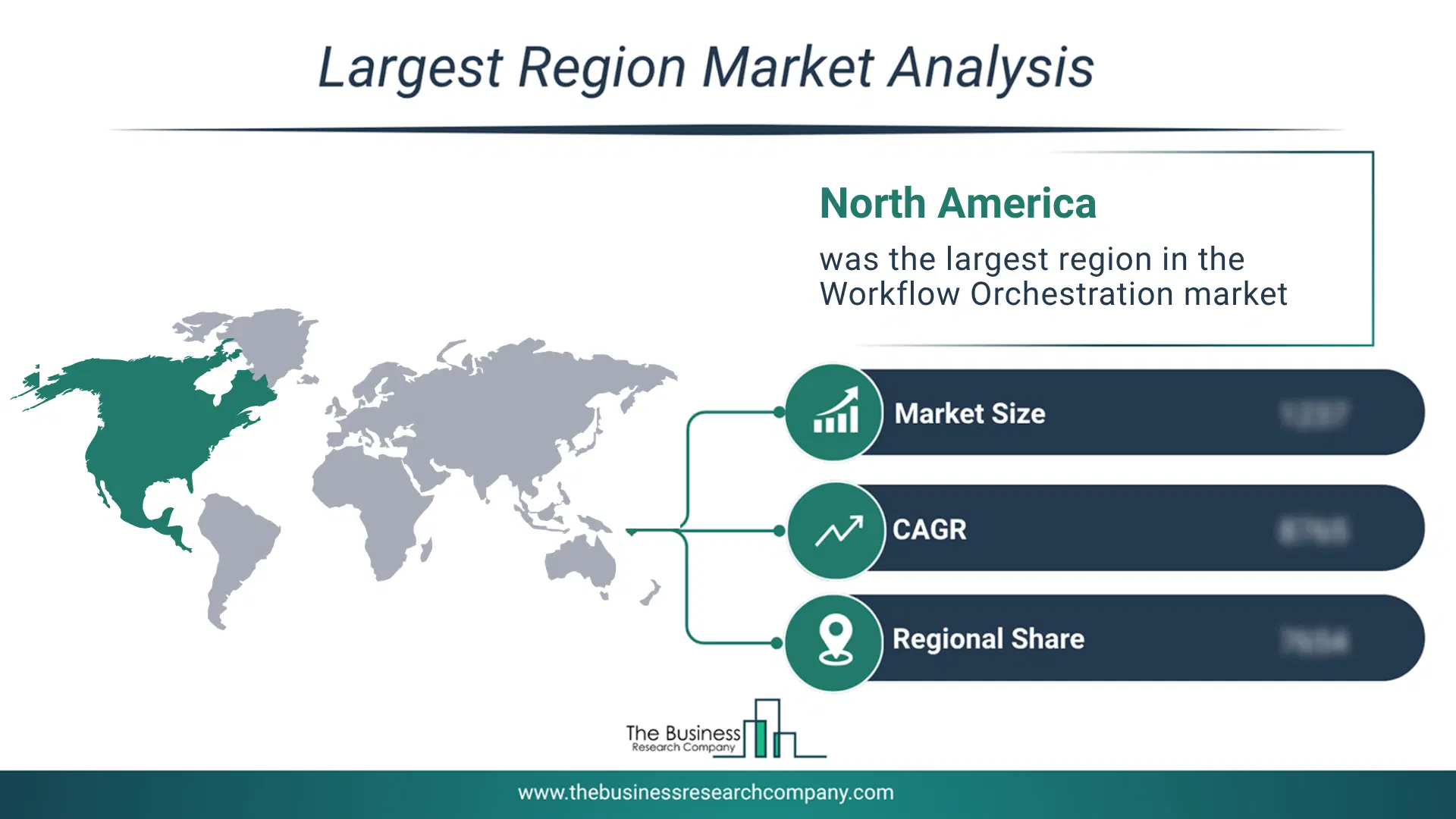
Regional Outlook
North America was the largest region in the workflow orchestration market in 2025. Asia-Pacific is expected to be the fastest-growing region in the forecast period. The regions covered in this market report are Asia-Pacific, South East Asia, Western Europe, Eastern Europe, North America, South America, Middle East, Africa. The countries covered in this market report are Australia, Brazil, China, France, Germany, India, Indonesia, Japan, Taiwan, Russia, South Korea, UK, USA, Canada, Italy, Spain.What Defines the Workflow Orchestration Market?
The workflow orchestration consists of revenues earned by entities by providing services such as designing and automating workflows, coordinating tasks across multiple systems, managing process execution, monitoring workflow performance, and ensuring reliable data and application integration. The market value includes the value of related goods sold by the service provider or included within the service offering. The workflow orchestration consists of sales of workflow orchestration software, automation platforms, process management tools, and workflow monitoring and integration solutions designed to coordinate and manage complex workflows. Values in this market are ‘factory gate’ values, that is, the value of goods sold by the manufacturers or creators of the goods, whether to other entities (including downstream manufacturers, wholesalers, distributors, and retailers) or directly to end customers. The value of goods in this market includes related services sold by the creators of the goods.How is Market Value Defined and Measured?
The market value is defined as the revenues that enterprises gain from the sale of goods and/or services within the specified market and geography through sales, grants, or donations in terms of the currency (in USD unless otherwise specified). The revenues for a specified geography are consumption values that are revenues generated by organizations in the specified geography within the market, irrespective of where they are produced. It does not include revenues from resales along the supply chain, either further along the supply chain or as part of other products.
This chart presents market attractiveness based on a quantitative evaluation of growth, competition, strategic alignment, and risk, offering a clear view of opportunity areas for decision-making. This chart is for illustrative purposes; the full report contains the complete analysis.

This chart highlights the Total Addressable Market (TAM) by estimating the maximum revenue opportunity using an assumption-driven approach, supporting strategic planning and opportunity sizing across markets. The chart is illustrative; the full report provides a more comprehensive analysis.
What Key Data and Analysis Are Included in the Workflow Orchestration Market Report 2026?
The workflow orchestration market research report is one of a series of new reports from The Business Research Company that provides market statistics, including industry global market size, regional shares, competitors with the market share, detailed market segments, market trends and opportunities, and any further data you may need to thrive in the workflow orchestration industry. The market research report delivers a complete perspective of everything you need, with an in-depth analysis of the current and future state of the industry.Workflow Orchestration Market Report Forecast Analysis
| Report Attribute | Details |
|---|---|
| Market Size Value In 2026 | $21.93 billion |
| Revenue Forecast In 2030 | $36.45 billion |
| Growth Rate | CAGR of 13.5% from 2026 to 2030 |
| Base Year For Estimation | 2025 |
| Actual Estimates/Historical Data | 2020-2025 |
| Forecast Period | 2026 - 2030 |
| Market Representation | Revenue in USD Billion and CAGR from 2026 to 2030 |
| Segments Covered | Component, Deployment Model, Organization Size, Application, Industry Vertical |
| Regional Scope | Asia-Pacific, Western Europe, Eastern Europe, North America, South America, Middle East, Africa |
| Country Scope | The Countries Covered In This Market Report Are Australia, Brazil, China, France, Germany, India, Indonesia, Japan, Taiwan, Russia, South Korea, Uk, Usa, Canada, Italy, Spain. |
| Key Companies Profiled | Google LLC, Microsoft Corporation, Amazon Web Services Inc., Dell Technologies Inc., International Business Machines Corporation, Cisco Systems Inc., Oracle Corporation, Broadcom Inc., SAP SE, Hewlett Packard Enterprise Development LP, ServiceNow Inc., OpenText Corporation, Zoho Corporation Pvt. Ltd., Hitachi Vantara LLC, BMC Software Inc., Salesforce Inc., Informatica Inc., UiPath Inc., Appian Corporation, TIBCO Software Inc., Workato Inc., and Camunda. |
| Customization Scope | Request for Customization |
| Pricing And Purchase Options | Explore Purchase Options |