
Yarn, Fiber And Thread Market Report 2026
Global Outlook – By Type (Regular Yarn, Fiber and Thread, and Special Yarn), By End User (Apparel, Footwear and Accessories, Home Interior, Other End Users), By Application (Quilting, Sew and Stitch, Embroidery) – Market Size, Trends, Strategies, and Forecast to 2030
Yarn, Fiber And Thread Market Overview
• Yarn, Fiber And Thread market size has reached to $102.57 billion in 2025 • Expected to grow to $138.81 billion in 2030 at a compound annual growth rate (CAGR) of 6.3% • Growth Driver: E-Commerce Accelerates Growth In Yarn, Fiber, And Thread Manufacturing Market • Market Trend: Innovations In Sustainable Fabric And Yarn Technology Transform The Textile Industry • Asia-Pacific was the largest region in 2025.Market Gains By 2030 – Top Opportunities By Segment
Market Gain identifies the most promising market opportunities by highlighting the segments or products expected to generate the highest incremental revenue growth over the next five years.
What Is Covered Under Yarn, Fiber And Thread Market?
Yarn, fiber, and thread refers to the process of manufacturing spinning yarn from fibers, and threads for sewing, crocheting, embroidery, and other applications. The main types of yarn, fiber, and thread are regular yarn, fiber and thread, and special yarn, fiber, and thread. The regular yarn thread is a thread that is mostly used for sewing. The various applications include quilting, sew and stitch, embroidery that are used by various end users such as apparel, footwear and accessories, home interior, and others.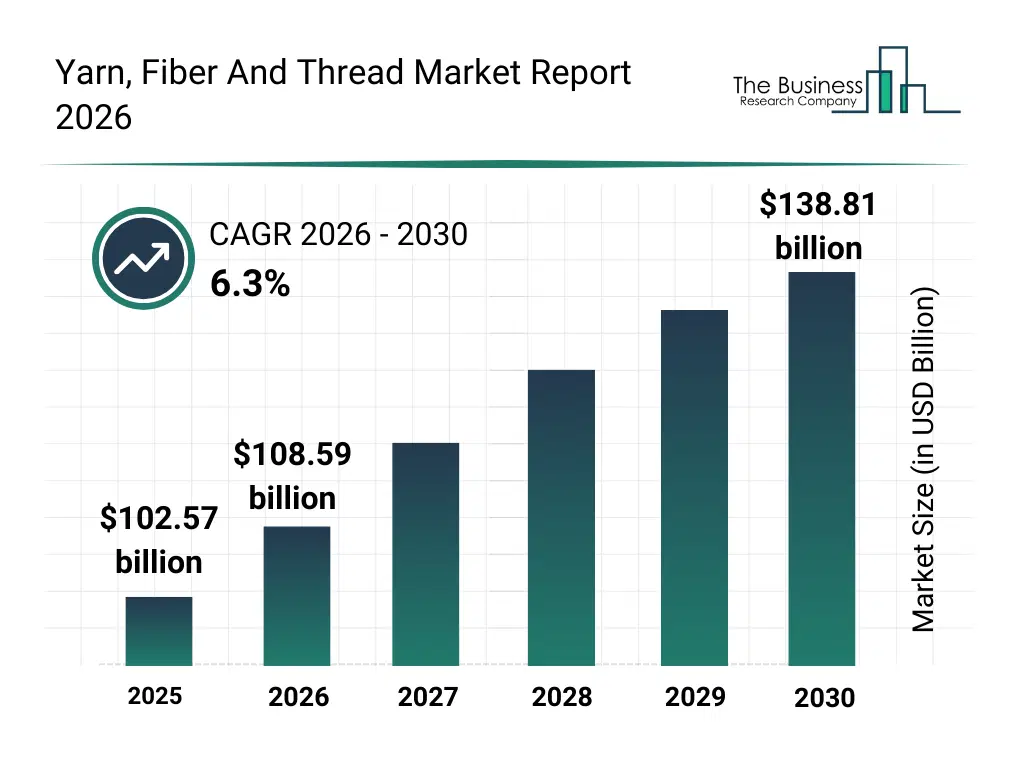
What Is The Yarn, Fiber And Thread Market Size and Share 2026?
The yarn, fiber and thread market size has grown strongly in recent years. It will grow from $102.57 billion in 2025 to $108.59 billion in 2026 at a compound annual growth rate (CAGR) of 5.9%. The growth in the historic period can be attributed to growth of textile and apparel manufacturing, long-standing use of natural fibers, expansion of sewing and embroidery applications, availability of mass-scale spinning infrastructure, rising demand from home textile segment.What Is The Yarn, Fiber And Thread Market Growth Forecast?
The yarn, fiber and thread market size is expected to see strong growth in the next few years. It will grow to $138.81 billion in 2030 at a compound annual growth rate (CAGR) of 6.3%. The growth in the forecast period can be attributed to increasing adoption of eco-friendly textile materials, rising demand for performance textiles, expansion of industrial textile usage, growing investments in advanced spinning technologies, increased focus on traceable and certified fibers. Major trends in the forecast period include increasing demand for sustainable and recycled fibers, growing adoption of functional and technical yarns, rising use of blended yarn solutions, expansion of industrial and technical textile applications, enhanced focus on quality and consistency.
Global Yarn, Fiber And Thread Market Segmentation
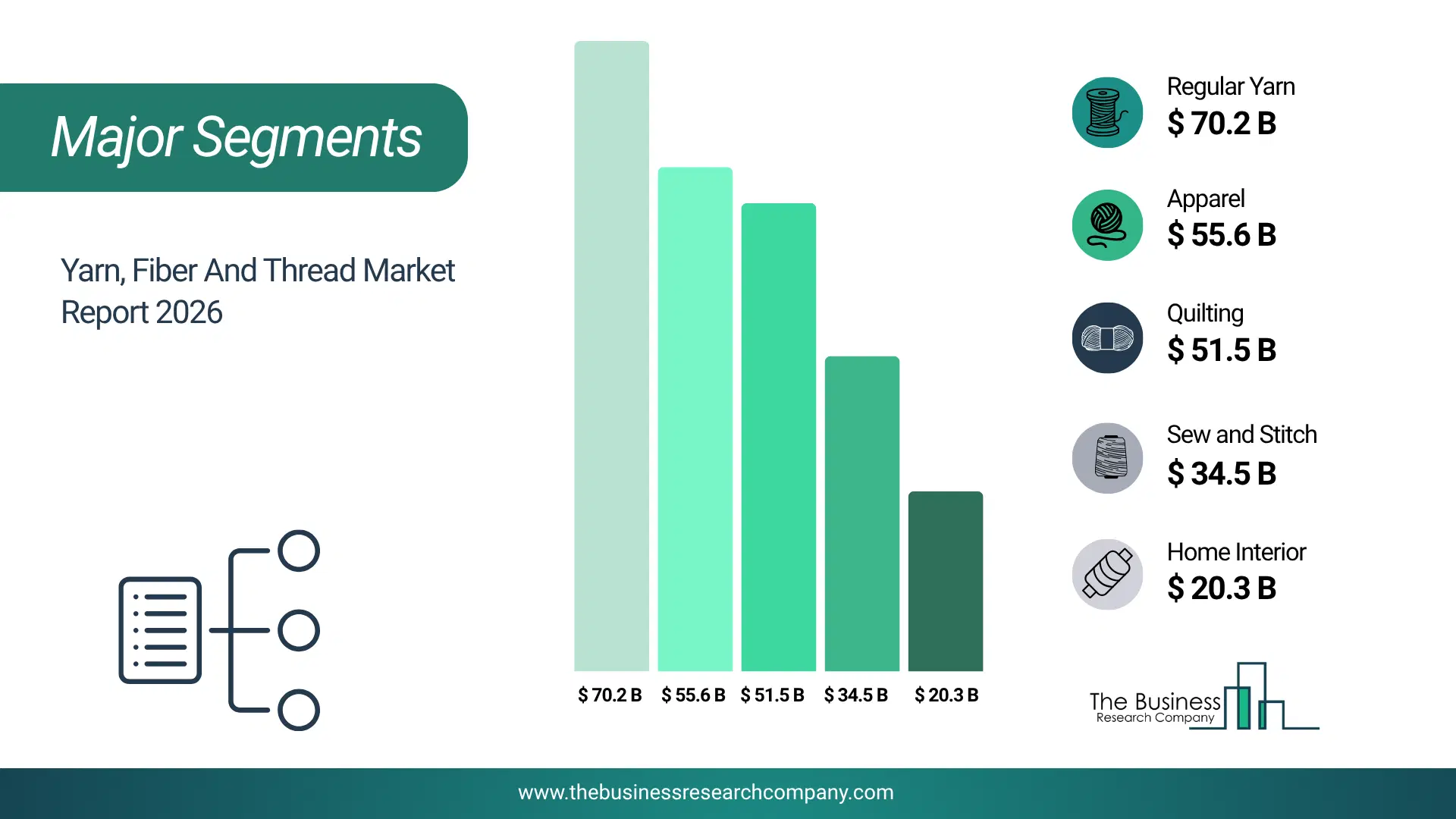
1) By Type: Regular Yarn, Fiber and Thread, and Special Yarn 2) By End User: Apparel, Footwear and Accessories, Home Interior, Other End Users 3) By Application: Quilting, Sew and Stitch, Embroidery Subsegments: 1) By Regular Yarn: Natural Yarn, Synthetic Yarn 2) By Fiber And Thread: Sewing Thread, Embroidery Thread, Industrial Thread 3) By Special Yarn: Specialty Yarn, Blended Yarn, Functional Yarn, Textured Yarn The top segments in the yarn, fiber and thread market will be: • Regular Yarn will reach $70246.24 Million by 2025. • Apparel will reach $55644.11 Million by 2025. • Quilting will reach $51539.06 Million by 2025. • Sew and Stitch will reach $34596.74 Million by 2025. • Home Interior will reach $20378.77 Million by 2025.What Is The Driver Of The Yarn, Fiber And Thread Market?
The rapid growth in e-commerce supports the growth of the yarn, fiber, and thread market. E-commerce is the process of exchange of money and data to transact business through the internet. The rapid growth in e-commerce is primarily driven by the widespread adoption of the internet and smartphones, which have made online shopping more accessible, convenient, and convenient for a larger number of consumers. E-commerce offers several benefits to the yarn, fiber, and thread manufacturing industry, transforming the way businesses operate and interact with customers. For instance, in February 2024, according to data by US Census Bureau, US-based government agency, total e-commerce sales for 2023 were estimated at $1, 118.7 billion, an increase of 7.6 percent (±1.2%) from 2022. Thus, the rapid growth in e-commerce supports the growth of the yarn, fiber, and thread manufacturing market.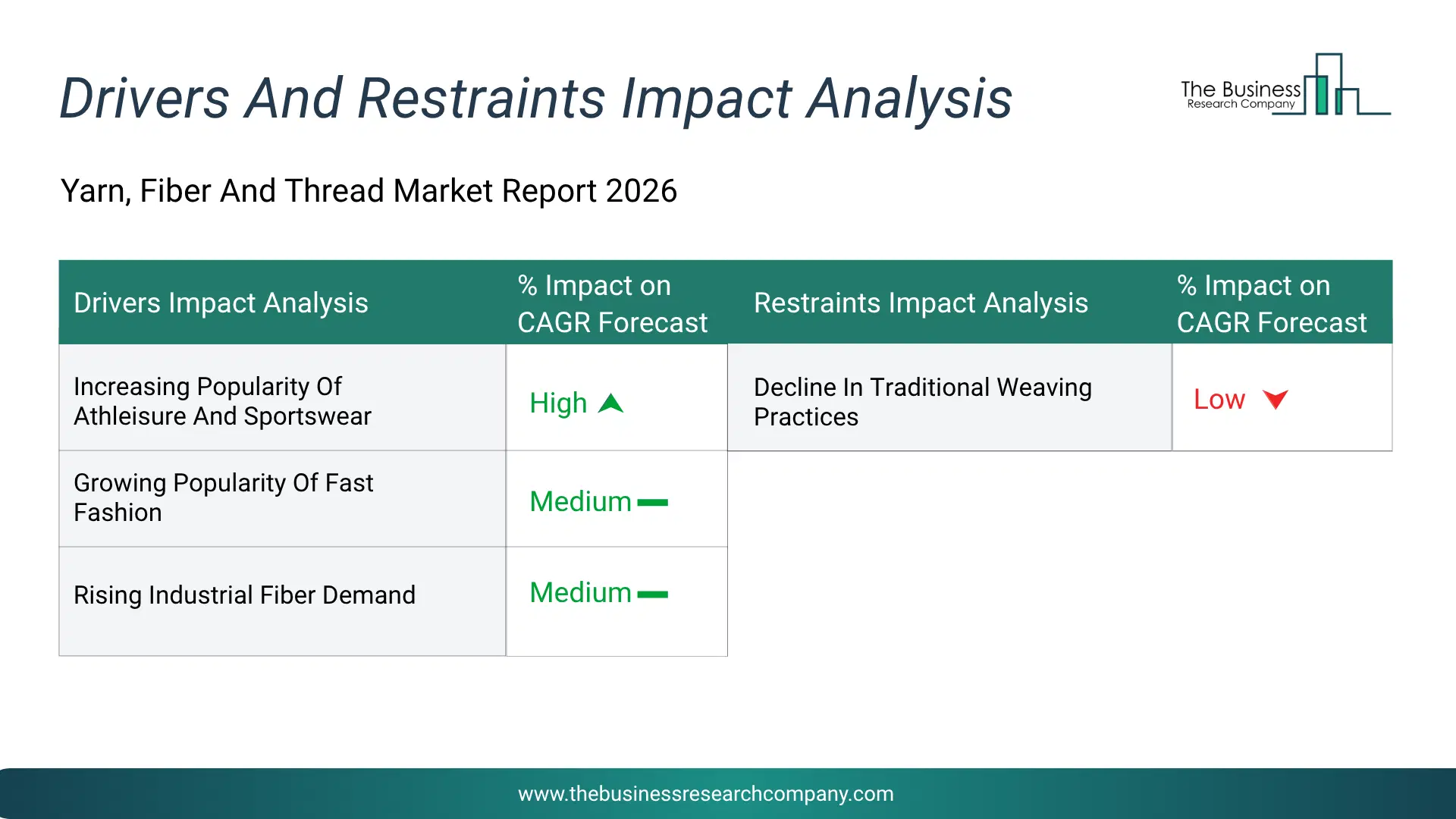
Infographic Chart Showing Key Market Drivers Analysis And Restraints For Yarn, Fiber And Thread Market
The chart presents an impact analysis of key drivers and restraints, quantifying their relative influence on the market's growth rate and helping assess the balance between growth enablers and limiting factors. This chart offers a high-level perspective; the full report contains more detailed insights.
How Will The Drivers Impact Growth In The Global Yarn, Fiber And Thread Market?
• Increasing Popularity Of Athleisure And Sportswear (High) – he increasing popularity of athleisure and sportswear will become a key driver of growth in the yarn, fiber and thread market by 2030. This trend is fueled by the growing emphasis on health and fitness, casual workwear, and lifestyle shifts toward active living. Manufacturers are investing in advanced textile technologies, including moisture-wicking, stretchable, and breathable fabrics, to meet consumer expectations for functionality and aesthetics. As a result, the increasing popularity of athleisure and sportswear is anticipated to contributing to a 2.2% annual growth in the market. • Growing Popularity Of Fast Fashion (Medium) – The growing popularity of fast fashion will emerge as a major factor driving the expansion of the yarn, fiber and thread market by 2030. Fast fashion’s emphasis on affordability, variety, and quick turnaround times is driving large-scale consumption of synthetic and blended fibers, such as polyester and elastane, which offer cost efficiency and versatility. The continuous need for new styles and mass-produced garments is pushing manufacturers to enhance textile production capacity and innovate with durable yet lightweight materials. Consequently, the growing popularity of fast fashion is projected to contributing to a 1.7% annual growth in the market. • Rising Industrial Fiber Demand (Medium) – The rising industrial fiber demand will serve as a key growth catalyst for the yarn, fiber and thread market by 2030. Sectors such as automotive, construction, aerospace, and filtration are driving demand for technical and industrial-grade fibers, including aramid, carbon, glass, and high-tenacity polyester. These fibers offer superior strength, heat resistance, and durability, making them essential for manufacturing products such as reinforced composites, conveyor belts, protective clothing, and industrial textiles. Therefore, this rising industrial fiber demand is projected to supporting to a 1.2% annual growth in the market. • Growing E-Commerce And Online Retail (Low) – The growing e-commerce and online retail will become a significant driver contributing to the growth of the yarn, fiber and thread market by 2030. The convenience of online shopping, coupled with rising internet penetration and smartphone usage, is driving higher sales of clothing, home textiles, and DIY craft supplies. Fast fashion brands, independent retailers, and direct-to-consumer labels are leveraging digital platforms to reach broader customer bases, accelerating the need for rapid and flexible textile production. Consequently, the growing e-commerce and online retail is projected to contributing to a 0.7% annual growth in the market.How Will The Restraints Impact Growth In The Global Yarn, Fiber And Thread Market?
• Labor Shortages (Medium) – Labor Shortages will restrict the growth of the Yarn, Fiber And Thread market during the forecast period. Yarn, fiber, and thread manufacturing require skilled workers with expertise in spinning, winding, and quality control. The shortage of qualified textile workers in many regions affects production capacity and efficiency. Labor shortages can lead to production delays and increased costs, limiting market growth. • Decline In Traditional Weaving Practices (Medium) – Decline In Traditional Weaving Practices will restrict the growth of the Yarn, Fiber And Thread market during the forecast period. The decline of traditional weaving and textile manufacturing in some regions reduces demand for certain yarn and thread products. Changing consumer preferences and the shift to synthetic fibers may affect traditional segment growth. Market contraction in traditional applications can limit overall market expansion.Key Players In The Global Yarn, Fiber And Thread Market
Major companies operating in the yarn, fiber and thread market are Toray Industries Inc., Reliance Industries Limited, Alpek S.A.B. de C.V., Far Eastern New Century Corporation, Lenzing AG, Indorama Corporation, Teijin Limited, DuPont de Nemours Inc., Weiqiao Textile Company Limited, Nisshinbo Textile Inc., Laxtons Limited, Amann & Söhne GmbH & Co. KG (AMANN Group), Silkoplus GmbH German Embroidery Threads, JSC STEKLONiT, Unifi Inc., Bally Ribbon Mills, Paramount Têxteis Indústria e Comércio S.A., Fiação São Bento S.A., Siltex Brasil Ltda, Saudi Spinning and Textile Mill Company, Elasticos Yarns S.A., Integrated Fibres Limited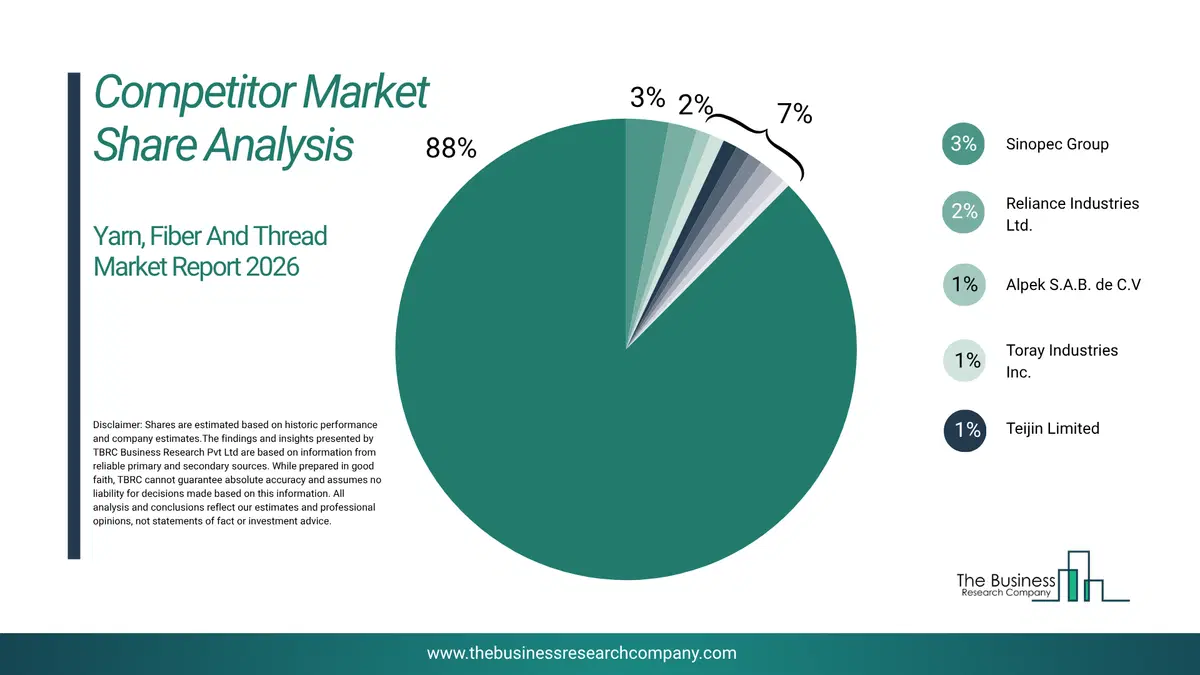
This chart is for illustrative purposes; the full report includes a detailed competitor analysis and comprehensive overview of the top 10 companies in the market.
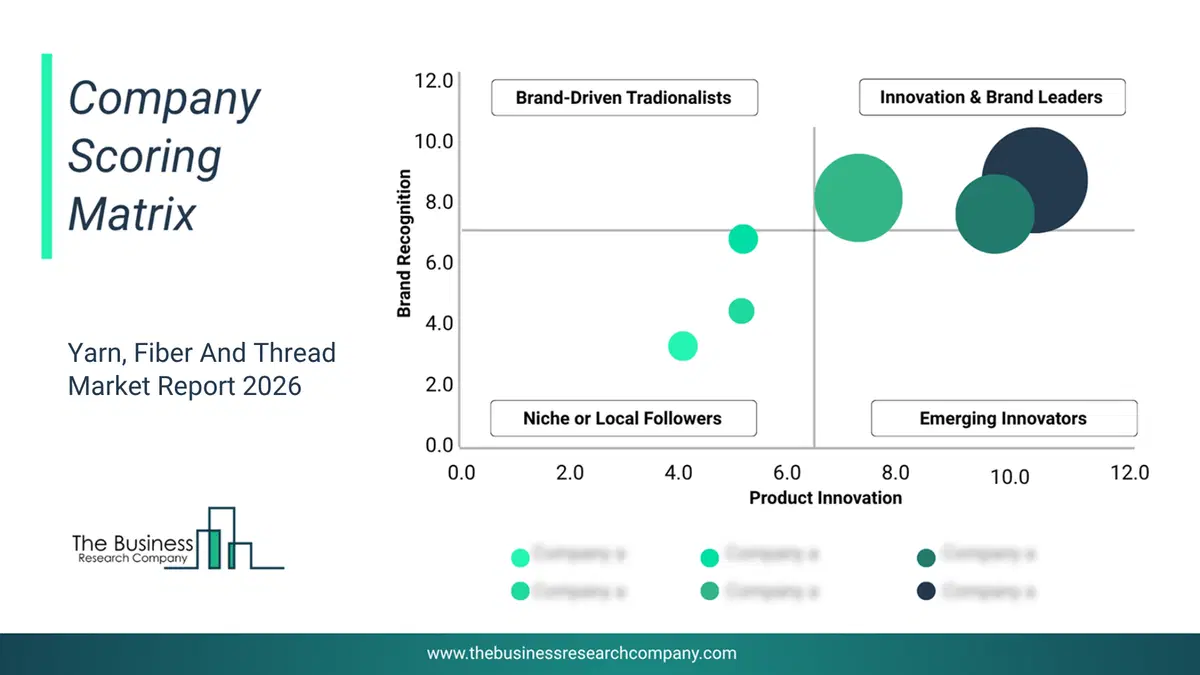
This chart maps companies by product innovation and brand strength, with bubble size indicating relative revenue, helping identify market leaders, challengers, and niche players. This is an illustrative chart; the full report provides a complete and accurate competitive analysis.
Global Yarn, Fiber And Thread Market Trends and Insights
Major companies operating in the yarn, fiber, and thread market are focusing on developing sustainable solutions, such as smart, sustainable fabric and yarn technology, to meet growing consumer demand and environmental regulations. Smart, sustainable fabric and yarn technology refers to advanced textile innovations designed to improve performance while minimizing environmental impact. For instance, in December 2023, Transforming Textiles AB, a Sweden-based trailblazing company, launched Sense-Tex, an innovative fabric and yarn technology that combines smart functionality with sustainability. This advanced textile features a unique 5-fiber yarn composition that includes two conductive fibers and three natural fibers, enabling health monitoring capabilities and antibacterial properties. Made from sustainable materials like soybean, Ramie, and seaweed-derived cellulose, Sense-Tex aims to democratize access to smart textiles, ensuring that health and safety are not limited by financial means.What Are Latest Mergers And Acquisitions In The Yarn, Fiber And Thread Market?
In March 2023, Reliance Industries Ltd (RIL) an India-based multinational conglomerate company acquired Sintex Industries for $42.8 million. The acquisition adds the textile and yarn portfolio of Sintex industries to RIL’s portfolio of offerings. Sintex Industries is an India-based yarn manufacturer.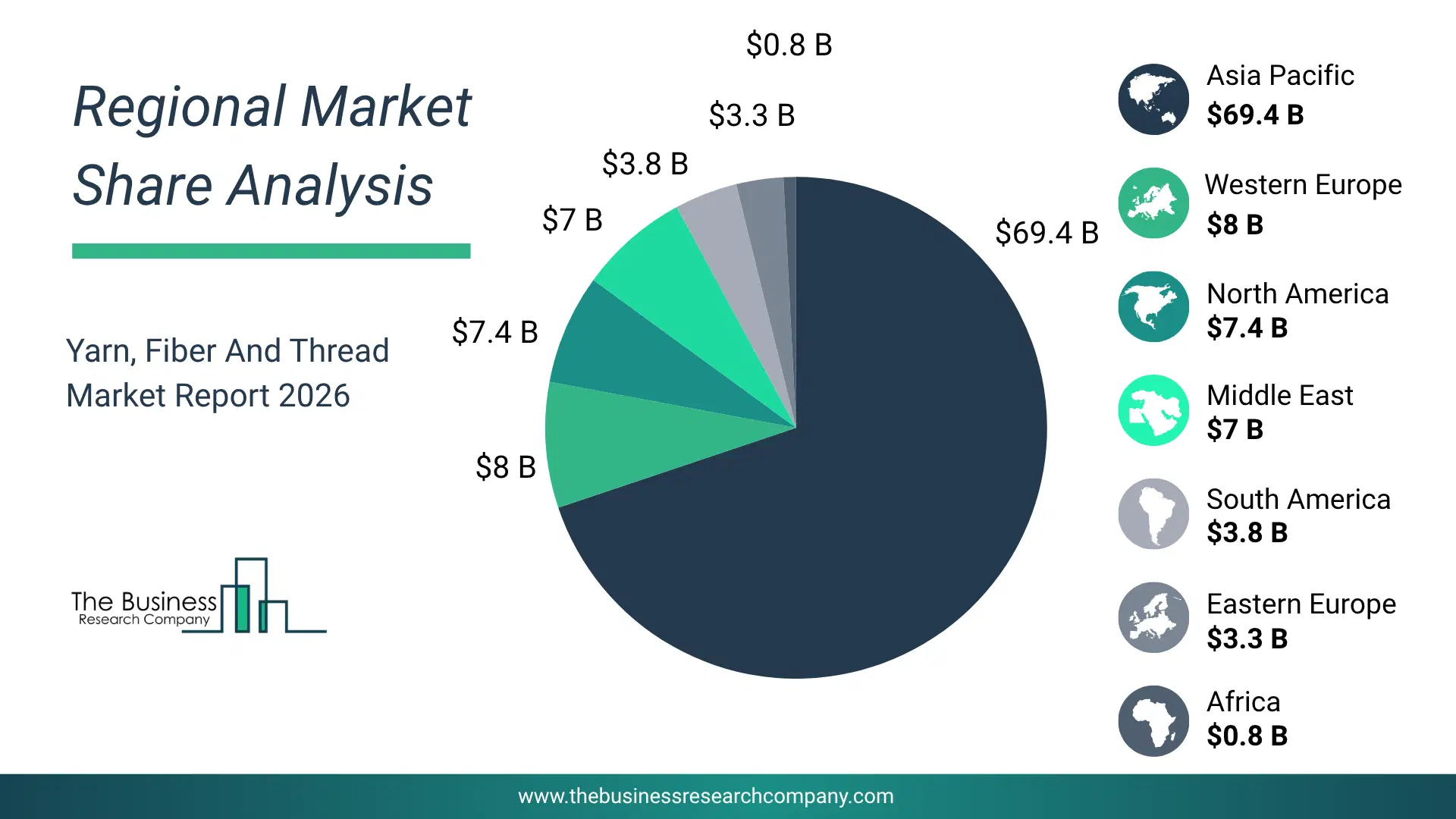
Regional Outlook
Asia-Pacific was the largest region in the yarn, fiber, and thread manufacturing market in 2025. The regions covered in this market report are Asia-Pacific, South East Asia, Western Europe, Eastern Europe, North America, South America, Middle East, Africa. The countries covered in this market report are Australia, Brazil, China, France, Germany, India, Indonesia, Japan, Taiwan, Russia, South Korea, UK, USA, Canada, Italy, Spain.What Defines the Yarn, Fiber And Thread Market?
The yarn, fiber, and thread market include revenues earned by entities by getting used in knitting, weaving, and the production of textiles. The market value includes the value of related goods sold by the service provider or included within the service offering. Only goods and services traded between entities or sold to end consumers are included.How is Market Value Defined and Measured?
The market value is defined as the revenues that enterprises gain from the sale of goods and/or services within the specified market and geography through sales, grants, or donations in terms of the currency (in USD unless otherwise specified). The revenues for a specified geography are consumption values that are revenues generated by organizations in the specified geography within the market, irrespective of where they are produced. It does not include revenues from resales along the supply chain, either further along the supply chain or as part of other products.
This chart presents market attractiveness based on a quantitative evaluation of growth, competition, strategic alignment, and risk, offering a clear view of opportunity areas for decision-making. This chart is for illustrative purposes; the full report contains the complete analysis.

This chart highlights the Total Addressable Market (TAM) by estimating the maximum revenue opportunity using an assumption-driven approach, supporting strategic planning and opportunity sizing across markets. The chart is illustrative; the full report provides a more comprehensive analysis.
What Key Data and Analysis Are Included in the Yarn, Fiber And Thread Market Report 2026?
The yarn, fiber and thread market research report is one of a series of new reports from The Business Research Company that provides market statistics, including Market Report 2026?global market size, regional shares, competitors with the market share, detailed market segments, market trends and opportunities, and any further data you may need to thrive in the yarn, fiber and thread Market Report 2026? The market research report delivers a complete perspective of everything you need, with an in-depth analysis of the current and future state of the Market Report 2026?Yarn, Fiber And Thread Market Report Forecast Analysis
| Report Attribute | Details |
|---|---|
| Market Size Value In 2026 | $108.59 billion |
| Revenue Forecast In 2030 | $138.81 billion |
| Growth Rate | CAGR of 5.9% from 2026 to 2030 |
| Base Year For Estimation | 2025 |
| Actual Estimates/Historical Data | 2020-2025 |
| Forecast Period | 2026 - 2030 |
| Market Representation | Revenue in USD Billion and CAGR from 2026 to 2030 |
| Segments Covered | Type, End User, Application |
| Regional Scope | Asia-Pacific, Western Europe, Eastern Europe, North America, South America, Middle East, Africa |
| Country Scope | The countries covered in the report are Australia, Brazil, China, France, Germany, India, Indonesia, Japan, Taiwan, Russia, South Korea, UK, USA, Canada, Italy, Spain. |
| Key Companies Profiled | Toray Industries Inc., Reliance Industries Limited, Alpek S.A.B. de C.V., Far Eastern New Century Corporation, Lenzing AG, Indorama Corporation, Teijin Limited, DuPont de Nemours Inc., Weiqiao Textile Company Limited, Nisshinbo Textile Inc., Laxtons Limited, Amann & Söhne GmbH & Co. KG (AMANN Group), Silkoplus GmbH German Embroidery Threads, JSC STEKLONiT, Unifi Inc., Bally Ribbon Mills, Paramount Têxteis Indústria e Comércio S.A., Fiação São Bento S.A., Siltex Brasil Ltda, Saudi Spinning and Textile Mill Company, Elasticos Yarns S.A., Integrated Fibres Limited |
| Customization Scope | Request for Customization |
| Pricing And Purchase Options | Explore Purchase Options |