
Yarn Market Report 2026
Global Outlook – By Type (Natural, Artificial), By Source (Chemical, Plant, Animal, Other Sources), By Distribution Channel (Business-To-Business (B2B), Business-To-Consumer (B2C)), By Application (Apparel, Home Textile, Industrial, Other Applications) – Market Size, Trends, Strategies, and Forecast to 2030
Yarn Market Overview
• Yarn market size has reached to $67.75 billion in 2025 • Expected to grow to $70.65 billion in 2030 at a compound annual growth rate (CAGR) of 4.5% • Growth Driver: Growing Demand From Textiles And Apparel Industry Fueling The Growth Of The Market Due To Rising Demand For High-Quality, Durable, And Sustainable Fabrics • Market Trend: Advancing Transparency And Sustainability Through Next-Generation Yarn Innovations • Asia-Pacific was the largest region in 2025 and Middle East is the fastest growing region.What Is Covered Under Yarn Market?
Yarn is a continuous strand of natural or synthetic fibers twisted or bonded together to provide strength, cohesion, and flexibility for textile processing. It serves as an intermediate material used to convert raw fibers into fabrics through weaving, knitting, or other methods. It also enables control over texture, durability, and appearance in end-use textiles by allowing fibers to be engineered into specific performance characteristics. The main types of yarn include natural yarn and artificial yarn. Natural yarn is derived from plant and animal-based fibers, while artificial yarn is produced through chemical processes to achieve enhanced durability, consistency, and performance characteristics. The various sources of yarn include chemical, plant, animal, and others. It is distributed through business-to-business (B2B) and business-to-consumer (B2C) and finds applications in apparel, home textile, industrial, and others.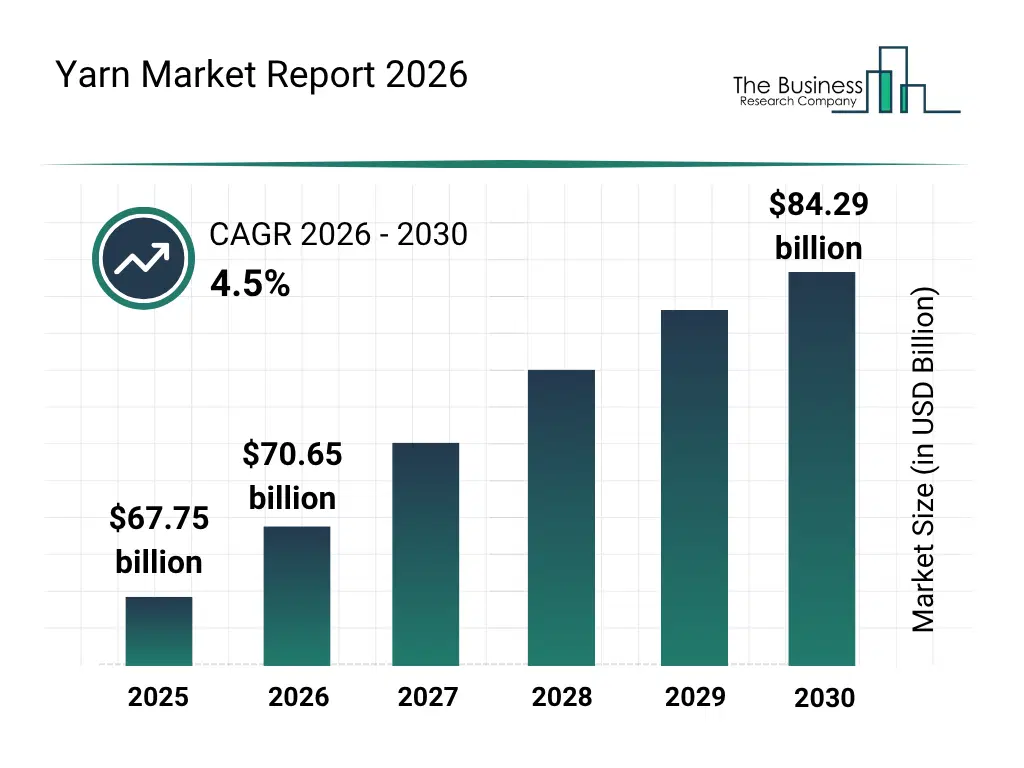
What Is The Yarn Market Size and Share 2026?
The yarn market size has grown steadily in recent years. It will grow from $67.75 billion in 2025 to $70.65 billion in 2026 at a compound annual growth rate (CAGR) of 4.3%. The growth in the historic period can be attributed to labor intensive textile manufacturing reliance, dominance of cotton and conventional fibers, limited synthetic yarn adoption in early stages, manual spinning and weaving processes, regional textile manufacturing clusters concentration.What Is The Yarn Market Growth Forecast?
The yarn market size is expected to see steady growth in the next few years. It will grow to $84.29 billion by 2030 at a compound annual growth rate (CAGR) of 4.5%. The growth in the forecast period can be attributed to increasing demand for technical textiles and performance yarns, shift toward blended and specialty yarn innovation, expansion of global apparel and fast fashion consumption, rising industrial automation in textile production, growth of export oriented textile supply chains. Major trends in the forecast period include rising demand for high-performance technical and functional yarns in industrial applications, increasing adoption of blended yarns for improved durability and comfort in textiles, growth in synthetic fiber-based yarn production driven by scalability and cost efficiency, expansion of specialty yarns for home furnishing applications, rising demand for engineered yarns with customized texture and performance characteristics.
Global Yarn Market Segmentation
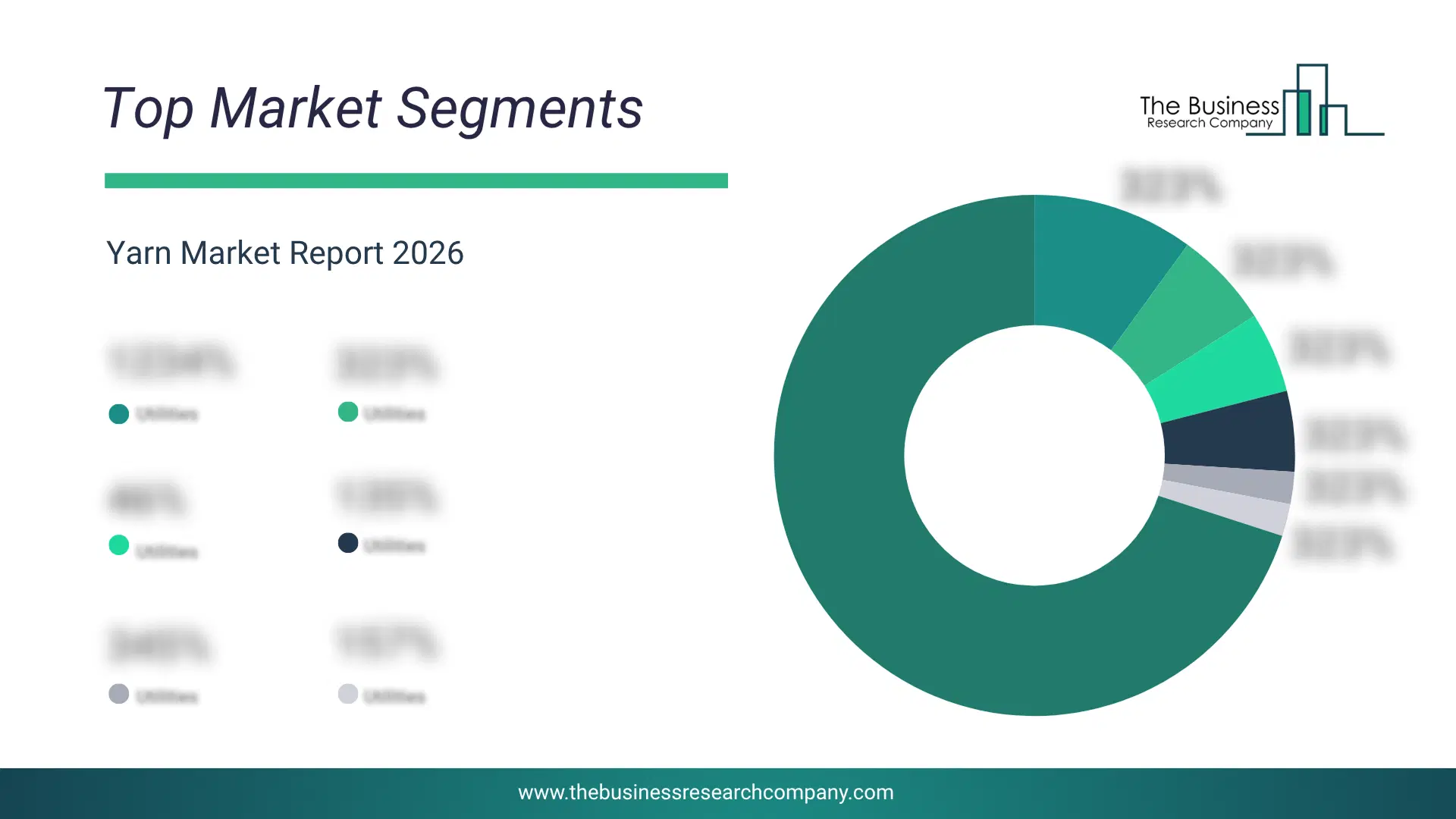
1) By Type: Natural, Artificial 2) By Source: Chemical, Plant, Animal, Other Sources 3) By Distribution Channel: Business-To-Business (B2B), Business-To-Consumer (B2C) 4) By Application: Apparel, Home Textile, Industrial, Other Applications Subsegments: 1) By Natural: Cotton Yarn, Wool Yarn, Silk Yarn, Linen Yarn, Bamboo Yarn, Hemp Yarn, Jute Yarn 2) By Artificial: Polyester Yarn, Nylon Yarn, Acrylic Yarn, Rayon Yarn, Viscose Yarn, Polypropylene Yarn, Spandex YarnWhat Is The Driver Of The Yarn Market?
The growing demand from textiles and apparel industry is expected to propel the growth of the yarn market going forward. Textiles and apparel refer to the broad industry encompassing the production, design, and distribution of fabrics, clothing, and accessories used for personal, commercial, or industrial purposes. The growing demand from textiles and apparel industry is driven by the increasing consumer preference for high-quality, durable, and innovative fabric materials, as consumers seek long-lasting, comfortable, and stylish clothing that offers improved performance and sustainability. Yarn strengthens the textiles and apparel industry by acting as a key raw material for fabric production, enabling diverse textile structures and finishes. It improves manufacturing efficiency and supports consistent, high-quality garment production. For instance, in June 2024, according to the International Trade Administration, a US-based government agency, the imports of textiles and apparel for the year-to-date period ending in April 2024 reached 30,095.1 million square meter equivalents (MSME), marking a 9.5% increase compared to the same period in 2023. Therefore, the growing demand from textiles and apparel industry is driving the growth of the yarn industry.Key Players In The Global Yarn Market
Major companies operating in the yarn market are Reliance Industries Limited, Toray Industries Inc., Indorama Ventures Public Company Limited, Grasim Industries Limited, Hengli Group Co. Ltd., Hyosung TNC Corporation, Texhong International Group Ltd., Lenzing AG, Vardhman Textiles Ltd., Trident Group, Huvis Corporation, KPR Mill Ltd., Adriafil S.p.A., RSWM Limited, Sutlej Textiles and Industries Ltd., Nahar Spinning Mills, Chainlon, Parkdale Mills Incorporated, Nishat Chunian Limited, Loyal Textile Mills Ltd., Lion Brand Yarn Company, Arvind Group, Brown Sheep Company Inc., Cascade Yarns Inc., Fazal Group, Huntingdon Yarn Mill Inc., Sanathan Textiles Limited.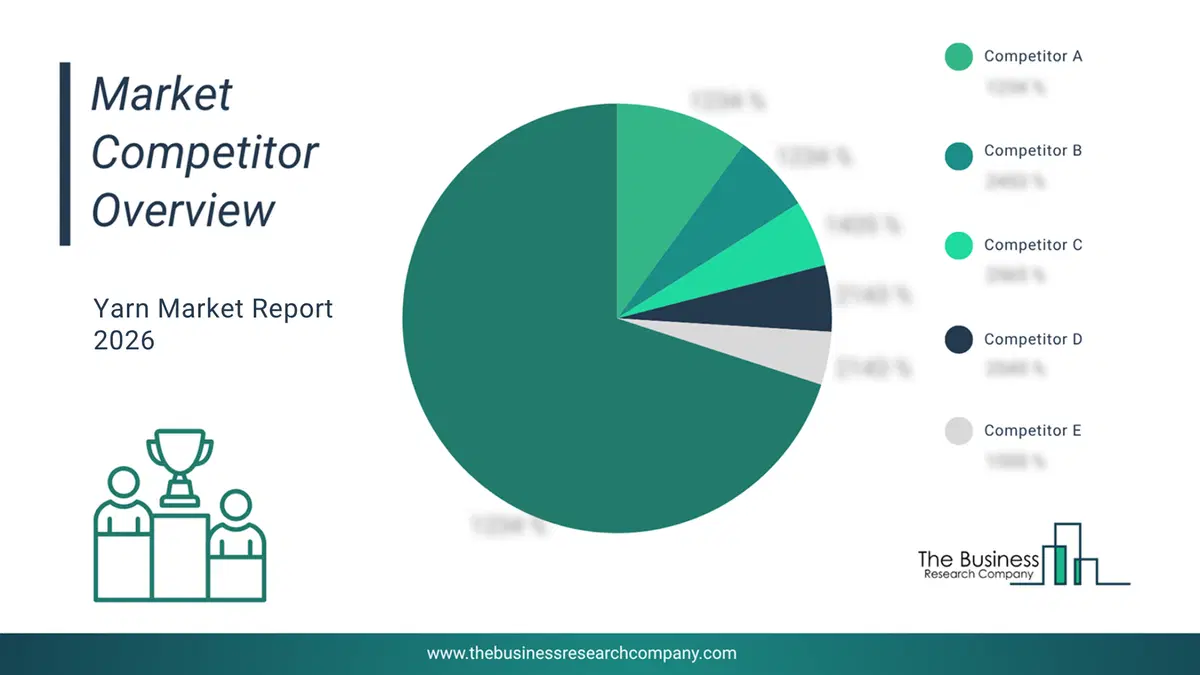
This chart is for illustrative purposes; the full report includes a detailed competitor analysis and comprehensive overview of the top 10 companies in the market.
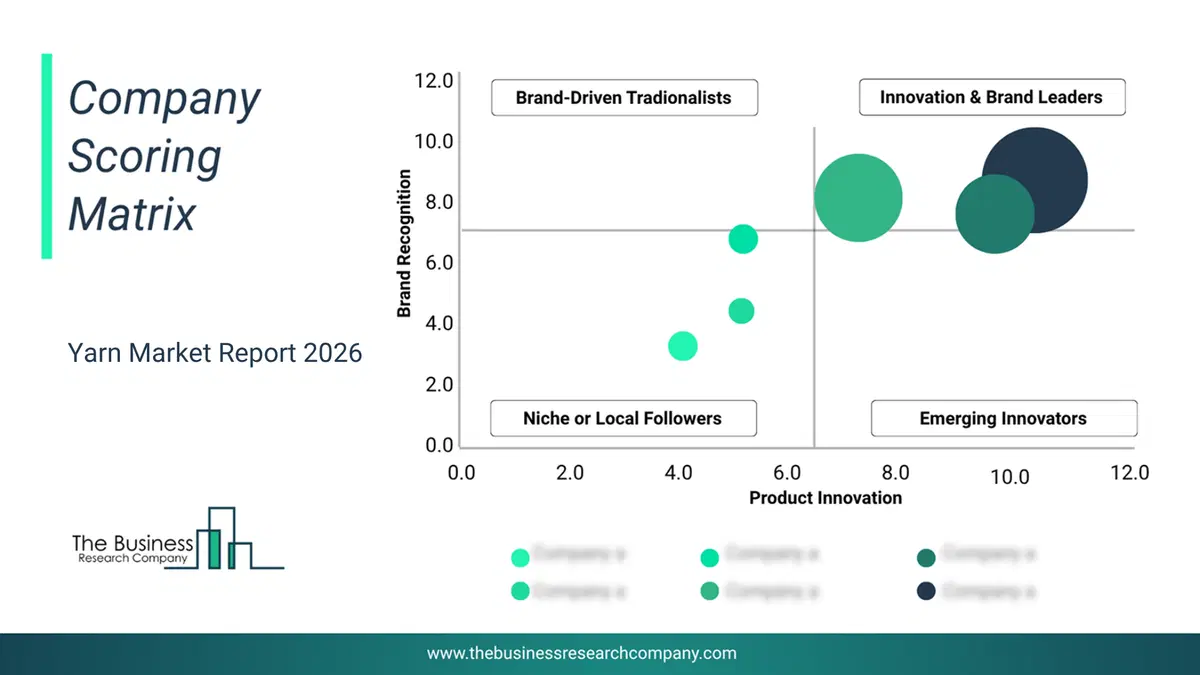
This chart maps companies by product innovation and brand strength, with bubble size indicating relative revenue, helping identify market leaders, challengers, and niche players. This is an illustrative chart; the full report provides a complete and accurate competitive analysis.
Global Yarn Market Trends and Insights
Major companies operating in the yarn market are focusing on developing advanced products, such as sustainable, traceable yarn, to improve supply chain transparency and meet evolving sustainability requirements. A sustainable, traceable yarn is a yarn produced from environmentally responsible materials with embedded technologies enabling full supply chain traceability. For instance, in August 2025, Grasim Industries, an India-based materials manufacturing company, launched Raysileco, a sustainable filament yarn. It is a sustainable Viscose Filament Yarn (VFY) produced from wood pulp sourced from certified, sustainably managed forests. Raysileco features end-to-end traceability by embedding both molecular-level physical markers and blockchain-based digital technology. It uses unique digital tokens called Fibercoins to track the yarn’s journey from source to store, creating a tamper-proof, real-time digital record for brands to monitor. This innovation enables value chain partners to authenticate products and verify responsible sourcing without manual intervention.What Are Latest Mergers And Acquisitions In The Yarn Market?
In February 2026, Rieter Holding Ltd., a Switzerland-based textile machinery and spinning systems manufacturing company, acquired Barmag for an undisclosed amount. With this acquisition, Rieter aims to expand its technological capabilities and product portfolio by integrating advanced filament yarn manufacturing expertise, thereby strengthening its position as a comprehensive system provider across both natural and synthetic fiber segments while accelerating automation and digitalization initiatives. Barmag is a Germany-based provider of machinery and engineering solutions for producing man-made fiber yarns such as polyester and nylon.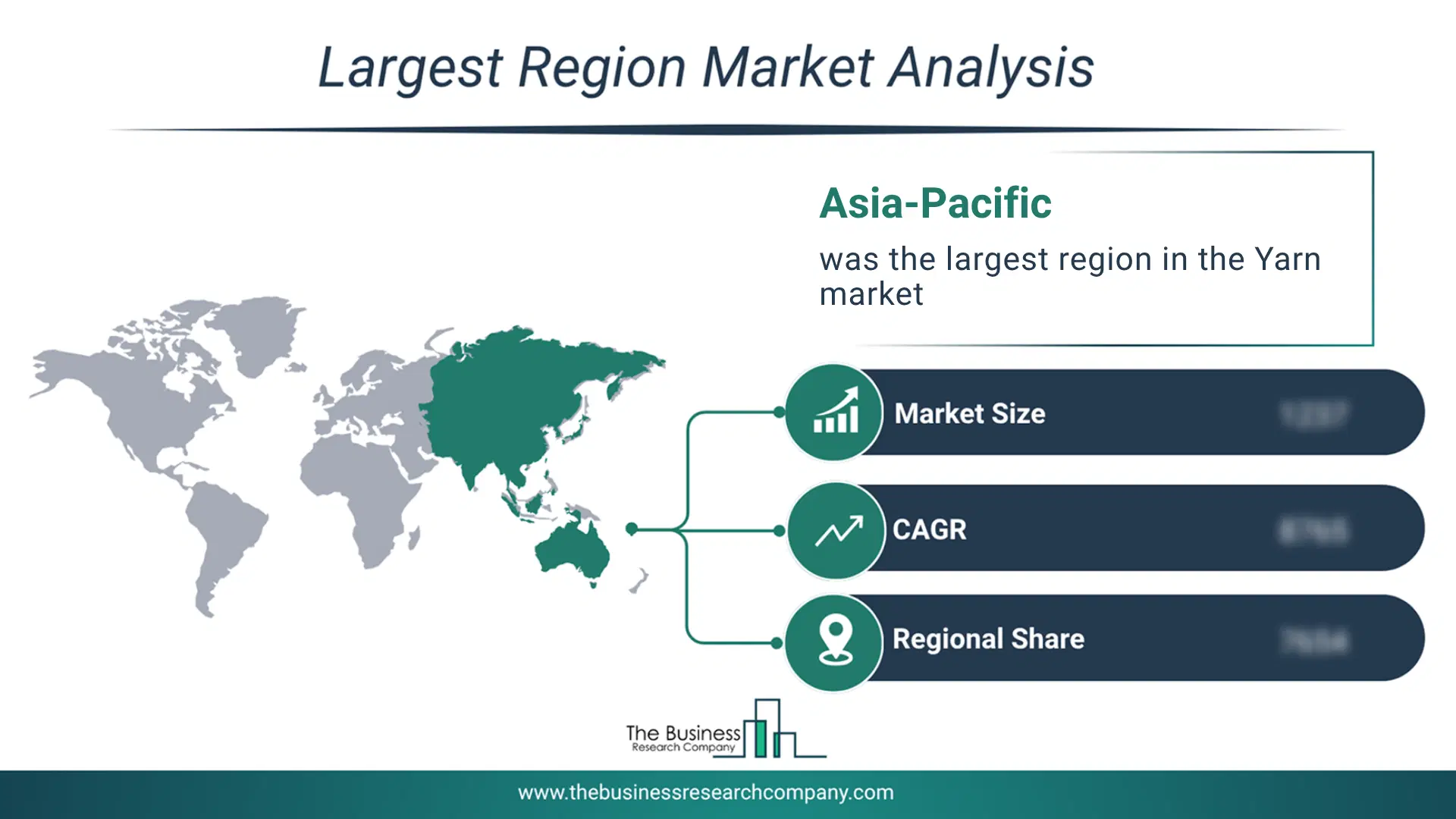
Regional Insights
Asia-Pacific was the largest region in the yarn market in 2025. Middle East And Africa are expected to be the fastest-growing region in the forecast period. The regions covered in this market report are Asia-Pacific, South East Asia, Western Europe, Eastern Europe, North America, South America, Middle East, Africa. The countries covered in this market report are Australia, Brazil, China, France, Germany, India, Indonesia, Japan, Taiwan, Russia, South Korea, UK, USA, Canada, Italy, Spain.What Defines the Yarn Market?
The yarn market consists of sales of melange yarn, slub yarn, compact yarn, open-end (rotor) yarn, ring-spun yarn, air-jet yarn, textured yarn, drawn textured yarn (DTY), fully drawn yarn (FDY), partially oriented yarn (POY), and covered yarn. Values in this market are ‘factory gate’ values, that is, the value of goods sold by the manufacturers or creators of the goods, whether to other entities (including downstream manufacturers, wholesalers, distributors, and retailers) or directly to end customers. The value of goods in this market includes related services sold by the creators of the goods.How is Market Value Defined and Measured?
The market value is defined as the revenues that enterprises gain from the sale of goods and/or services within the specified market and geography through sales, grants, or donations in terms of the currency (in USD unless otherwise specified). The revenues for a specified geography are consumption values that are revenues generated by organizations in the specified geography within the market, irrespective of where they are produced. It does not include revenues from resales along the supply chain, either further along the supply chain or as part of other products.
This chart presents market attractiveness based on a quantitative evaluation of growth, competition, strategic alignment, and risk, offering a clear view of opportunity areas for decision-making. This chart is for illustrative purposes; the full report contains the complete analysis.

This chart highlights the Total Addressable Market (TAM) by estimating the maximum revenue opportunity using an assumption-driven approach, supporting strategic planning and opportunity sizing across markets. The chart is illustrative; the full report provides a more comprehensive analysis.
What Key Data and Analysis Are Included in the Yarn Market Report 2026?
The yarn market research report is one of a series of new reports from The Business Research Company that provides market statistics, including industry global market size, regional shares, competitors with the market share, detailed market segments, market trends and opportunities, and any further data you may need to thrive in the yarn industry. The market research report delivers a complete perspective of everything you need, with an in-depth analysis of the current and future state of the industry.Yarn Market Report Forecast Analysis
| Report Attribute | Details |
|---|---|
| Market Size Value In 2026 | $70.65 billion |
| Revenue Forecast In 2030 | $84.29 billion |
| Growth Rate | CAGR of 4.50% from 2026 to 2030 |
| Base Year For Estimation | 2025 |
| Actual Estimates/Historical Data | 2020-2025 |
| Forecast Period | 2026 - 2030 |
| Market Representation | Revenue in USD Billion and CAGR from 2026 to 2030 |
| Segments Covered | Type, Source, Distribution Channel, Application |
| Regional Scope | Asia-Pacific, Western Europe, Eastern Europe, North America, South America, Middle East, Africa |
| Country Scope | The countries covered in the report are Australia, Brazil, China, France, Germany, India, Indonesia, Japan, Taiwan, Russia, South Korea, UK, USA, Canada, Italy, Spain. |
| Key Companies Profiled | Reliance Industries Limited, Toray Industries Inc., Indorama Ventures Public Company Limited, Grasim Industries Limited, Hengli Group Co. Ltd., Hyosung TNC Corporation, Texhong International Group Ltd., Lenzing AG, Vardhman Textiles Ltd., Trident Group, Huvis Corporation, KPR Mill Ltd., Adriafil S.p.A., RSWM Limited, Sutlej Textiles and Industries Ltd., Nahar Spinning Mills, Chainlon, Parkdale Mills Incorporated, Nishat Chunian Limited, Loyal Textile Mills Ltd., Lion Brand Yarn Company, Arvind Group, Brown Sheep Company Inc., Cascade Yarns Inc., Fazal Group, Huntingdon Yarn Mill Inc., Sanathan Textiles Limited. |
| Customization Scope | Request for Customization |
| Pricing And Purchase Options | Explore Purchase Options |