
Zero User Interface (UI) Technologies Market Report 2026
Global Outlook – By Component (Hardware, Software, Services), By Technology (Voice Or Speech Recognition, Gesture And Motion Recognition, Touch And Haptic Surfaces, Computer Vision And Gaze Tracking, Brain-Computer Interfaces, Other Technologies), By Interaction Type (Voice-Based Interaction, Gesture-Based Interaction, Motion-Based Interaction, Biometric-Based Interaction, Environmental-Awareness Interaction, Context-Aware Interaction), By Deployment Mode (On-Premise, Cloud-Based), By End User (Residential Users, Commercial Enterprises, Industrial Users, Government And Public Sector, Healthcare Providers) – Market Size, Trends, Strategies, and Forecast to 2030
Zero User Interface (UI) Technologies Market Overview
• Zero User Interface (UI) Technologies market size has reached to $36.23 billion in 2025 • Expected to grow to $105.72 billion in 2030 at a compound annual growth rate (CAGR) of 23.8% • Growth Driver: Increasing Use Of IoT Devices Fueling The Growth Of The Market Due To Rising Need For Seamless, Screenless, And Intuitive Interactions • Market Trend: Advancing Gesture-Based Zero UI Controls To Enhance Accessibility, Intuitive Interaction, And Inclusive Entertainment Experiences • North America was the largest region in 2025 and Asia-Pacific is the fastest growing region.What Is Covered Under Zero User Interface (UI) Technologies Market?
Zero user interface technologies refer to interaction systems that minimize or eliminate traditional screens and touch based controls. They enable natural communication through voice, gestures, motion, biometrics, and environmental awareness. These technologies create seamless and intuitive experiences by allowing digital devices to respond automatically to human intent and context. The main components of the zero user interface (UI) technologies include hardware, software, and services. Hardware components encompass sensors, cameras, microphones, and haptic devices that detect and interpret user presence, gestures, motion, and biometrics. Different technologies include voice or speech recognition, gesture and motion recognition, touch and haptic surfaces, computer vision and gaze tracking, and brain-computer interfaces, among others. Multiple interaction types include voice-based interaction, gesture-based interaction, motion-based interaction, biometric-based interaction, environmental-awareness interaction, and context-aware interaction. Various deployment modes include on-premise and cloud-based solutions, and they are used by several end users include residential users, commercial enterprises, industrial users, government and public sector entities, and healthcare providers.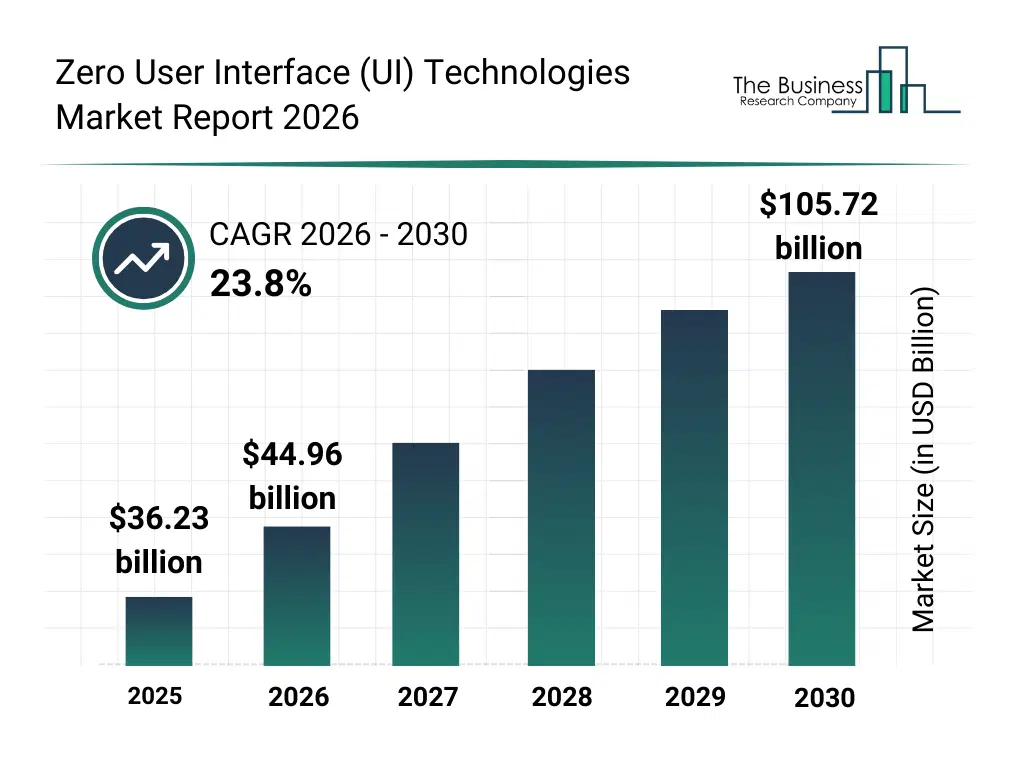
What Is The Zero User Interface (UI) Technologies Market Size and Share 2026?
The zero user interface (UI) technologies market size has grown exponentially in recent years. It will grow from $36.23 billion in 2025 to $44.96 billion in 2026 at a compound annual growth rate (CAGR) of 24.1%. The growth in the historic period can be attributed to increasing adoption of voice enabled devices, growing investments in sensor integration, rising use of gesture based controls, expansion of smart home ecosystems, and growing demand for touchless interfaces.What Is The Zero User Interface (UI) Technologies Market Growth Forecast?
The zero user interface (UI) technologies market size is expected to see exponential growth in the next few years. It will grow to $105.72 billion in 2030 at a compound annual growth rate (CAGR) of 23.8%. The growth in the forecast period can be attributed to increasing deployment of artificial intelligence driven interfaces, growing need for contactless interaction, rising integration of biometrics in consumer devices, expansion of context aware computing, and growing adoption of ambient intelligence platforms. Major trends in the forecast period include advancements in natural language processing, innovations in brain computer interfaces, developments in multimodal interaction systems, research and development in context aware intelligence, and technology advancements in sensor fusion.
Global Zero User Interface (UI) Technologies Market Segmentation
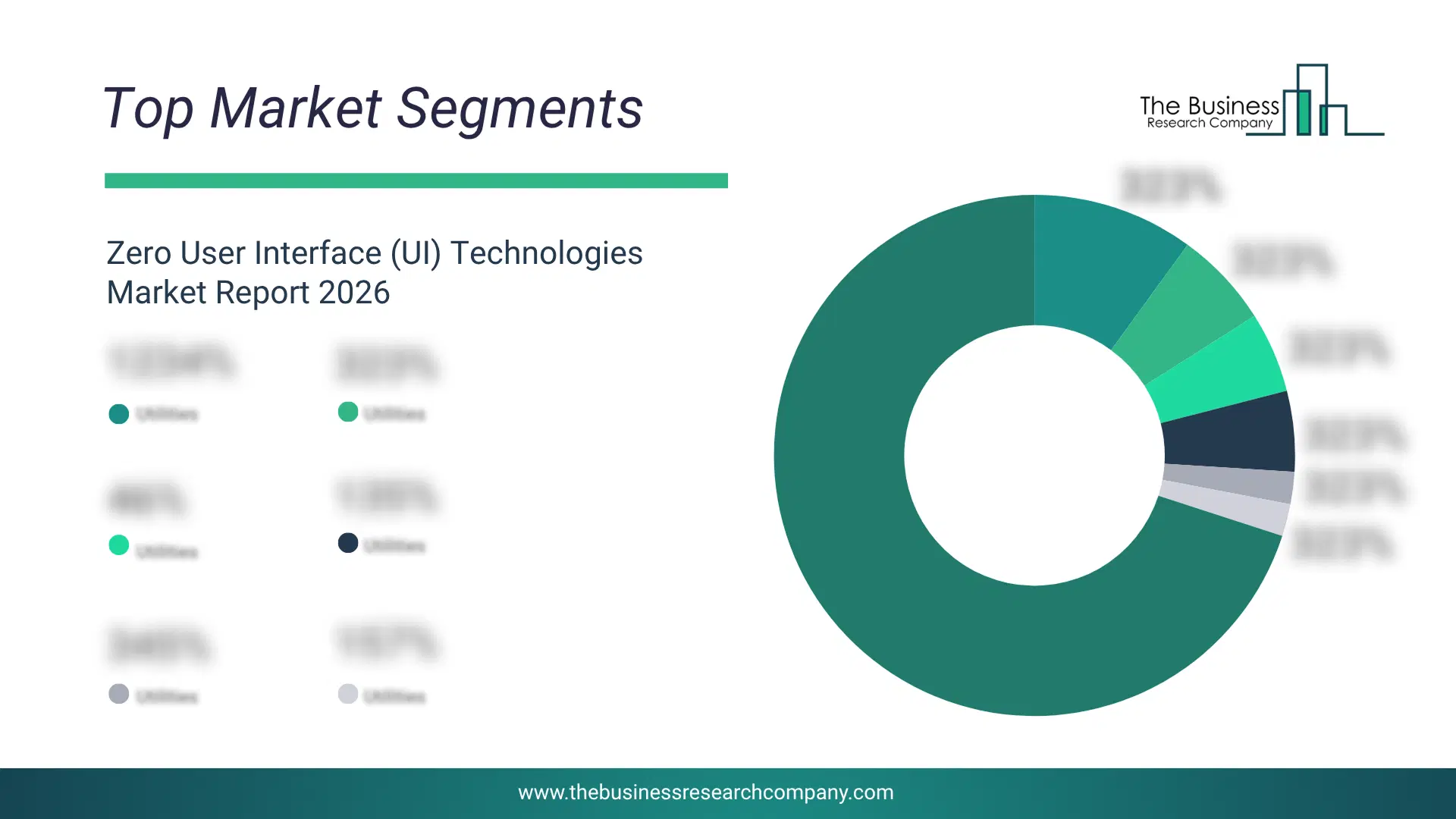
1) By Component: Hardware, Software, Services 2) By Technology: Voice Or Speech Recognition, Gesture And Motion Recognition, Touch And Haptic Surfaces, Computer Vision And Gaze Tracking, Brain-Computer Interfaces, Other Technologies 3) By Interaction Type: Voice-Based Interaction, Gesture-Based Interaction, Motion-Based Interaction, Biometric-Based Interaction, Environmental-Awareness Interaction, Context-Aware Interaction 4) By Deployment Mode: On-Premise, Cloud-Based 5) By End User: Residential Users, Commercial Enterprises, Industrial Users, Government And Public Sector, Healthcare Providers Subsegments: 1) By Hardware: Sensors, Cameras, Microphones, Processors, Displays 2) By Software: Voice Recognition Software, Gesture Recognition Software, Motion Detection Software, Biometric Recognition Software, Context Awareness Software 3) By Services: Integration Services, Consulting Services, Maintenance Services, Training Services, Implementation ServicesWhat Is The Driver Of The Zero User Interface (UI) Technologies Market?
The increasing use of internet of things (IoT) devices is expected to propel the growth of the zero user interface (UI) technologies market going forward. IoT devices refer to interconnected physical objects embedded with sensors, software, and communication technologies that enable them to collect, exchange, and respond to data autonomously. The rise in Internet of Things (IoT) adoption is due to advancements in 5G networks, enabling ultra-low latency connectivity for real-time device communication at scale. Zero UI technologies support the use of internet of things (IoT) devices by enabling interactions through voice, gestures, biometrics, environmental cues, and AI-driven automation instead of traditional screens or touch interfaces, resulting in more natural and intuitive human-machine communication. For instance, in July 2025, according to VelosIOT, a US-based Internet of Things (IoT) solutions provider, the number of connected Internet of Things (IoT) devices was expected to reach 18.8 billion by the end of 2024, up 13% from 16.6 billion in 2023, and is projected to exceed 40 billion by 2030. Therefore, the increasing use of Internet of Things (IoT) devices is driving the growth of the zero user interface (UI) technologies industry.Key Players In The Global Zero User Interface (UI) Technologies Market
Major companies operating in the zero user interface (ui) technologies market are Apple Inc., Google LLC, Microsoft Corporation, Samsung Electronics Co. Ltd., Qualcomm Incorporated, STMicroelectronics N.V., Texas Instruments Incorporated, NXP Semiconductors N.V., NCR Corporation, Zebra Technologies Corporation, Diebold Nixdorf Incorporated, IDEMIA Group, Sonos Inc., Synaptics Incorporated, Tobii AB, Cerence Inc., KIOSK Information Systems Inc., SoundHound Inc., RealWear Inc., Ultraleap Ltd., Sensory Inc., FaceTec Inc.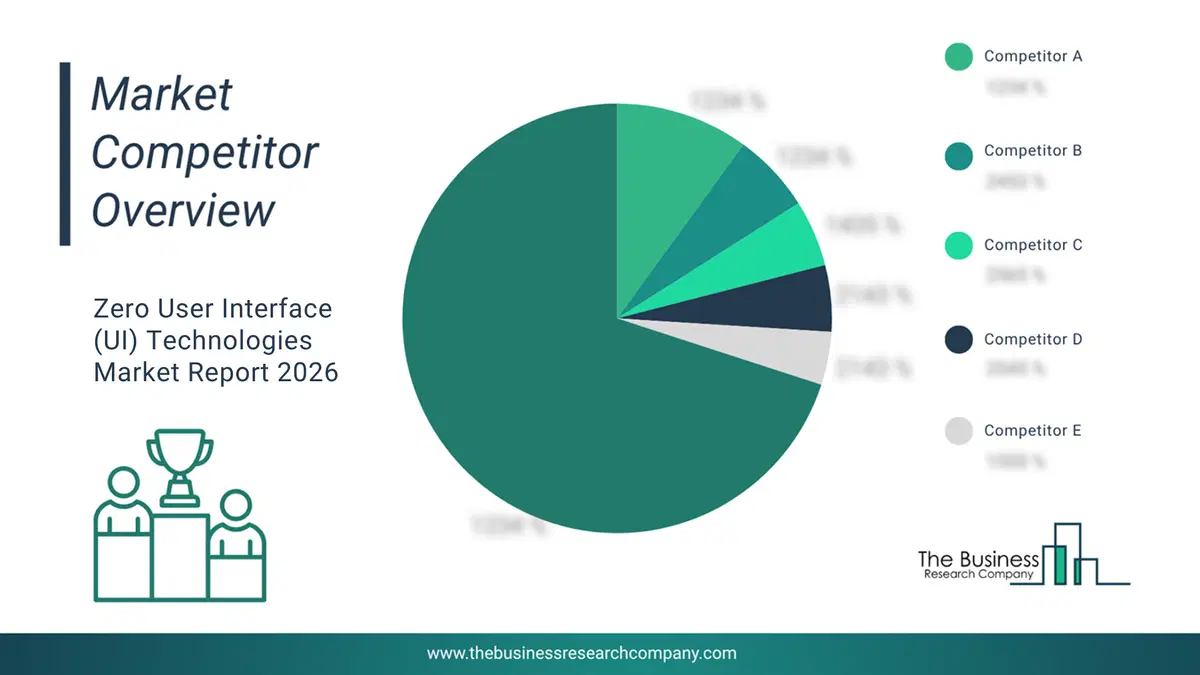
This chart is for illustrative purposes; the full report includes a detailed competitor analysis and comprehensive overview of the top 10 companies in the market.
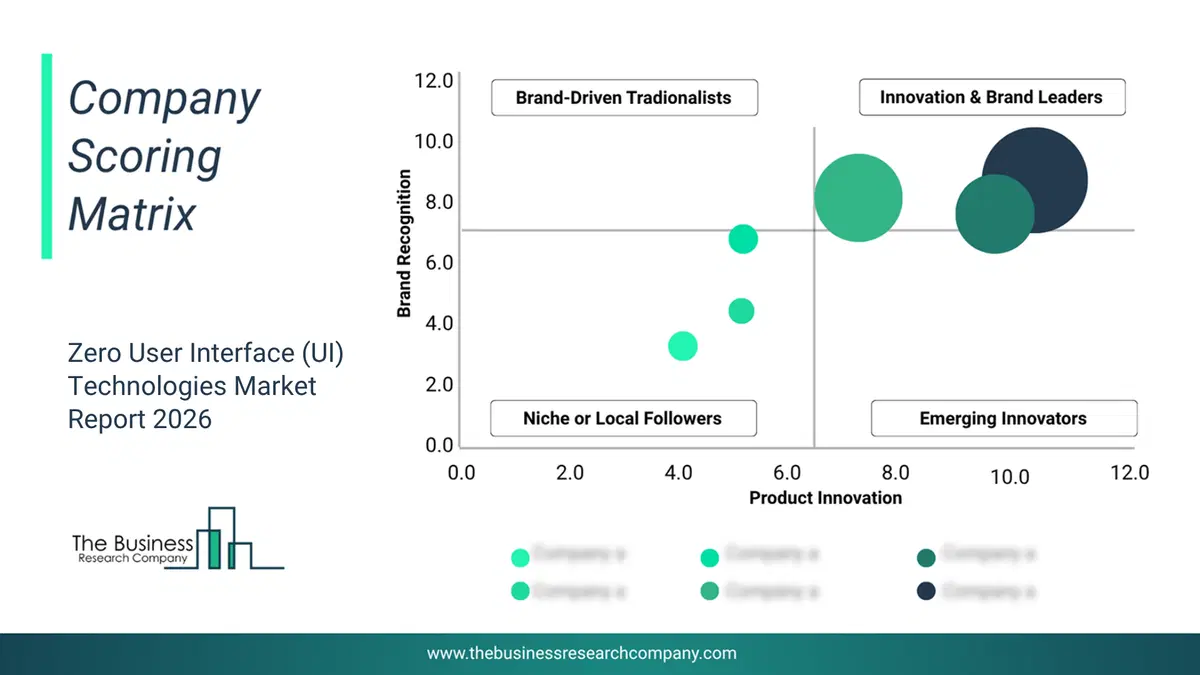
This chart maps companies by product innovation and brand strength, with bubble size indicating relative revenue, helping identify market leaders, challengers, and niche players. This is an illustrative chart; the full report provides a complete and accurate competitive analysis.
Global Zero User Interface (UI) Technologies Market Trends and Insights
Major companies operating in the zero UI technologies market are focusing on product advancements, such as gesture enabled TVs, to let users control content or accessibility features without a remote or physical buttons and enhance usability and inclusive experiences. Gesture enabled TVs refers to televisions using gesture recognition technology where built-in cameras and artificial intelligence (AI) software interpret hand or body movements to control functions like volume and channels without remotes. For instance, in March 2025, Samsung Electronics Co., Ltd., a South Korea–based electronics company, launched its Neo QLED 4K lineup, featuring three model series – QN90F, QN80F, and QN70F – all equipped with Quantum Matrix Mini LEDs for precise brightness control and vivid color accuracy. The flagship QN90F series incorporates the upgraded NQ4 AI Gen3 Processor, Neo Quantum HDR+, and Glare-Free technology to ensure ultra-realistic visuals and enhanced sound. The QN80F and QN70F series feature the NQ4 AI Gen2 Processor, AI 4K upscaling, and Motion Xcelerator technology for smooth, tear-free motion during fast-paced content and gaming.bAdditionally, Samsung Vision AI powers intuitive smart features across the Neo QLED, OLED, The Frame, and QLED series, enabling Click to Search, Live Translate, and Universal Gestures for simplified interaction and a personalized entertainment experience.What Are Latest Mergers And Acquisitions In The Zero User Interface (UI) Technologies Market?
In November 2025, ROLI Ltd., a UK‑based music‑technology company known for its expressive digital instruments, acquired Ultraleap Ltd. for an undisclosed amount. Through this acquisition, ROLI Ltd. aims to enhance its music creation and learning platforms by integrating Ultraleap’s advanced hand‑tracking and computer‑vision technologies, enabling gesture‑based control and artificial intelligence (AI)‑powered spatial interaction, thereby making musical expression and learning more intuitive, immersive, and accessible. Ultraleap Ltd. is a UK‑based extended‑reality (XR) and spatial‑interaction technology company working on Zero UI technologies.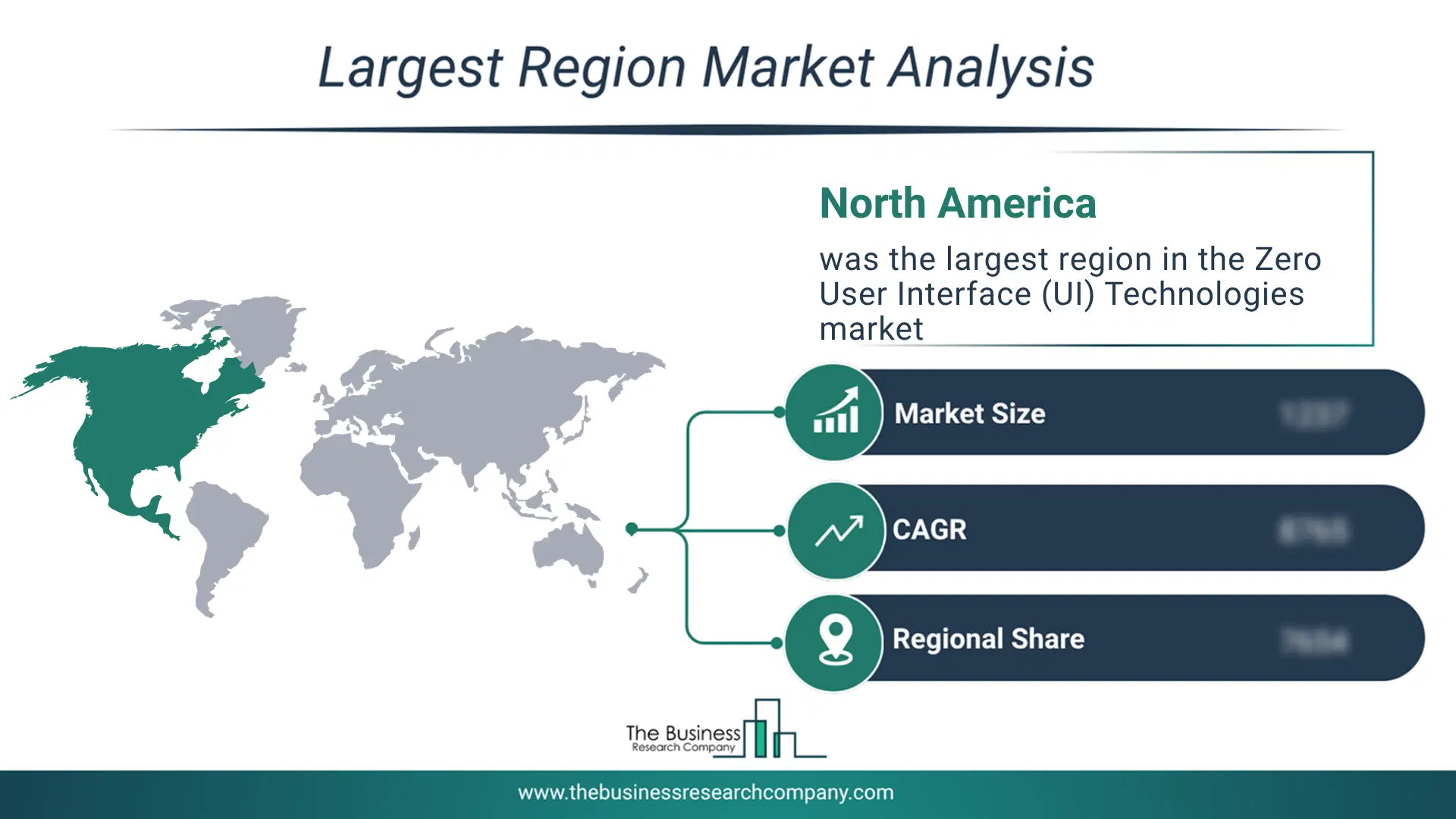
Regional Insights
North America was the largest region in the zero user interface (UI) technologies market in 2025. Asia-Pacific is expected to be the fastest-growing region in the forecast period. The regions covered in this market report are Asia-Pacific, South East Asia, Western Europe, Eastern Europe, North America, South America, Middle East, Africa. The countries covered in this market report are Australia, Brazil, China, France, Germany, India, Indonesia, Japan, Taiwan, Russia, South Korea, UK, USA, Canada, Italy, Spain.What Defines the Zero User Interface (UI) Technologies Market?
The zero user interface (UI) technologies market consists of revenues earned by entities by providing services such as voice interface development, sensor integration services, artificial intelligence interaction design, ambient computing implementation, biometric interaction services, natural language processing services, context aware system development, touchless experience design, and machine learning interaction optimization. The market value includes the value of related goods sold by the service provider or included within the service offering. The zero user interface (UI) technologies market also includes sales of voice activated assistants, gesture controlled devices, smart home hubs, touchless kiosks, biometric authentication systems, ambient computing devices, sensor enabled wearables, context aware smart displays, artificial intelligence interaction platforms, and motion sensing controllers. Values in this market are ‘factory gate’ values, that is the value of goods sold by the manufacturers or creators of the goods, whether to other entities, including downstream manufacturers, wholesalers, distributors, and retailers, or directly to end customers. The value of goods in this market includes related services sold by the creators of the goods.How is Market Value Defined and Measured?
The market value is defined as the revenues that enterprises gain from the sale of goods and/or services within the specified market and geography through sales, grants, or donations in terms of the currency (in USD unless otherwise specified). The revenues for a specified geography are consumption values that are revenues generated by organizations in the specified geography within the market, irrespective of where they are produced. It does not include revenues from resales along the supply chain, either further along the supply chain or as part of other products.
This chart presents market attractiveness based on a quantitative evaluation of growth, competition, strategic alignment, and risk, offering a clear view of opportunity areas for decision-making. This chart is for illustrative purposes; the full report contains the complete analysis.

This chart highlights the Total Addressable Market (TAM) by estimating the maximum revenue opportunity using an assumption-driven approach, supporting strategic planning and opportunity sizing across markets. The chart is illustrative; the full report provides a more comprehensive analysis.
What Key Data and Analysis Are Included in the Zero User Interface (UI) Technologies Market Report 2026?
The zero user interface (ui) technologies market research report is one of a series of new reports from The Business Research Company that provides market statistics, including industry global market size, regional shares, competitors with the market share, detailed market segments, market trends and opportunities, and any further data you may need to thrive in the zero user interface (ui) technologies industry. The market research report delivers a complete perspective of everything you need, with an in-depth analysis of the current and future state of the industry.Zero User Interface (UI) Technologies Market Report Forecast Analysis
| Report Attribute | Details |
|---|---|
| Market Size Value In 2026 | $44.96 billion |
| Revenue Forecast In 2030 | $105.72 billion |
| Growth Rate | CAGR of 23.8% from 2026 to 2030 |
| Base Year For Estimation | 2025 |
| Actual Estimates/Historical Data | 2020-2025 |
| Forecast Period | 2026 - 2030 |
| Market Representation | Revenue in USD Billion and CAGR from 2026 to 2030 |
| Segments Covered | Component, Technology, Interaction Type, Deployment Mode, End User |
| Regional Scope | Asia-Pacific, Western Europe, Eastern Europe, North America, South America, Middle East, Africa |
| Country Scope | The Countries Covered In This Market Report Are Australia, Brazil, China, France, Germany, India, Indonesia, Japan, Taiwan, Russia, South Korea, Uk, Usa, Canada, Italy, Spain. |
| Key Companies Profiled | Apple Inc., Google LLC, Microsoft Corporation, Samsung Electronics Co. Ltd., Qualcomm Incorporated, STMicroelectronics N.V., Texas Instruments Incorporated, NXP Semiconductors N.V., NCR Corporation, Zebra Technologies Corporation, Diebold Nixdorf Incorporated, IDEMIA Group, Sonos Inc., Synaptics Incorporated, Tobii AB, Cerence Inc., KIOSK Information Systems Inc., SoundHound Inc., RealWear Inc., Ultraleap Ltd., Sensory Inc., FaceTec Inc. |
| Customization Scope | Request for Customization |
| Pricing And Purchase Options | Explore Purchase Options |