

3D Telepresence Market Report 2026
Global Outlook – By Product (Software, Hardware), By Technology (3D Display Technology, 3D Camera Technology, Sensors And Tracking Technology), By Application (Education, Advertising, Conferencing, Customer Service, Healthcare, Entertainment, Retail), By End-User (Small And Medium Enterprises (SMEs), Large Enterprise) – Market Size, Trends, Strategies, and Forecast to 2030
3D Telepresence Market Overview
• 3D Telepresence market size has reached to $3.38 billion in 2025 • Expected to grow to $7.7 billion in 2030 at a compound annual growth rate (CAGR) of 17.9% • Growth Driver: Increasing Adoption Of Remote Work Practices Fueling The Growth Of The Market Due To The Rising Need For Immersive Collaboration Solutions • Market Trend: Emerging AI-Powered Platforms Revolutionize Immersive Remote Communication • North America was the largest region in 2025 and Asia-Pacific is the fastest growing region.What Is Covered Under 3D Telepresence Market?
3D telepresence refers to an advanced form of telecommunication technology that enables users to interact with distant individuals or environments in a three-dimensional (3D) virtual space in real-time. It is used to create a sense of presence and immersion by replicating the depth and spatial perception of face-to-face interactions. The main types of products in 3D telepresence are software and hardware. Software is a set of instructions that control what a computer does and enable it to perform specific tasks based on user commands. It includes several technologies, such as 3D display technology, 3D camera technology, and sensors and tracking technology, which are used in various applications, including education, advertising, conferencing, customer service, healthcare, entertainment, retail, and others, by several end-users, including small and medium enterprises (SMEs) and large enterprises.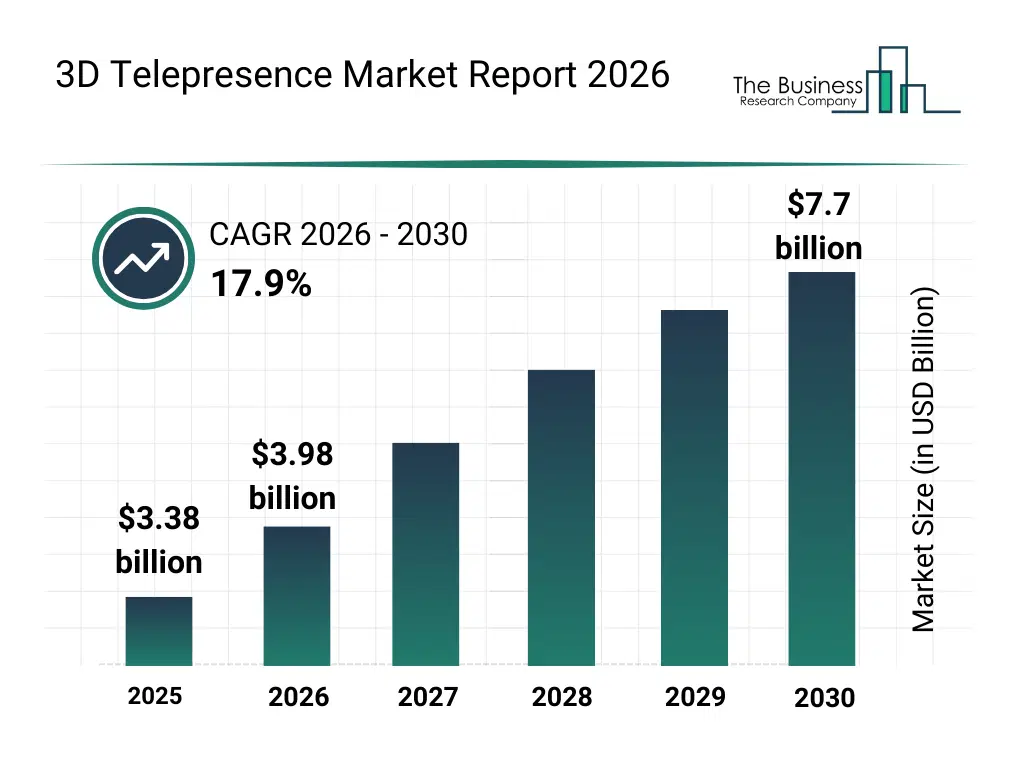
What Is The 3D Telepresence Market Size and Share 2026?
The 3D telepresence market size has grown rapidly in recent years. It will grow from $3.38 billion in 2025 to $3.98 billion in 2026 at a compound annual growth rate (CAGR) of 17.8%. The growth in the historic period can be attributed to rise of remote working and virtual collaboration, increasing adoption of video conferencing tools, early use of 3D display and camera technologies, growth in immersive media and entertainment, demand for interactive customer engagement solutions.What Is The 3D Telepresence Market Growth Forecast?
The 3D telepresence market size is expected to see rapid growth in the next few years. It will grow to $7.7 billion in 2030 at a compound annual growth rate (CAGR) of 17.9%. The growth in the forecast period can be attributed to expansion of virtual and augmented reality integration, increased use in telehealth and remote medical services, adoption in educational technology platforms, growth in enterprise collaboration solutions, integration with advanced audio and processing hardware. Major trends in the forecast period include integration of 3D telepresence in virtual conferencing, adoption in remote education and training, use in customer service and retail experiences, implementation in healthcare consultations, deployment in advertising and entertainment.
Global 3D Telepresence Market Segmentation
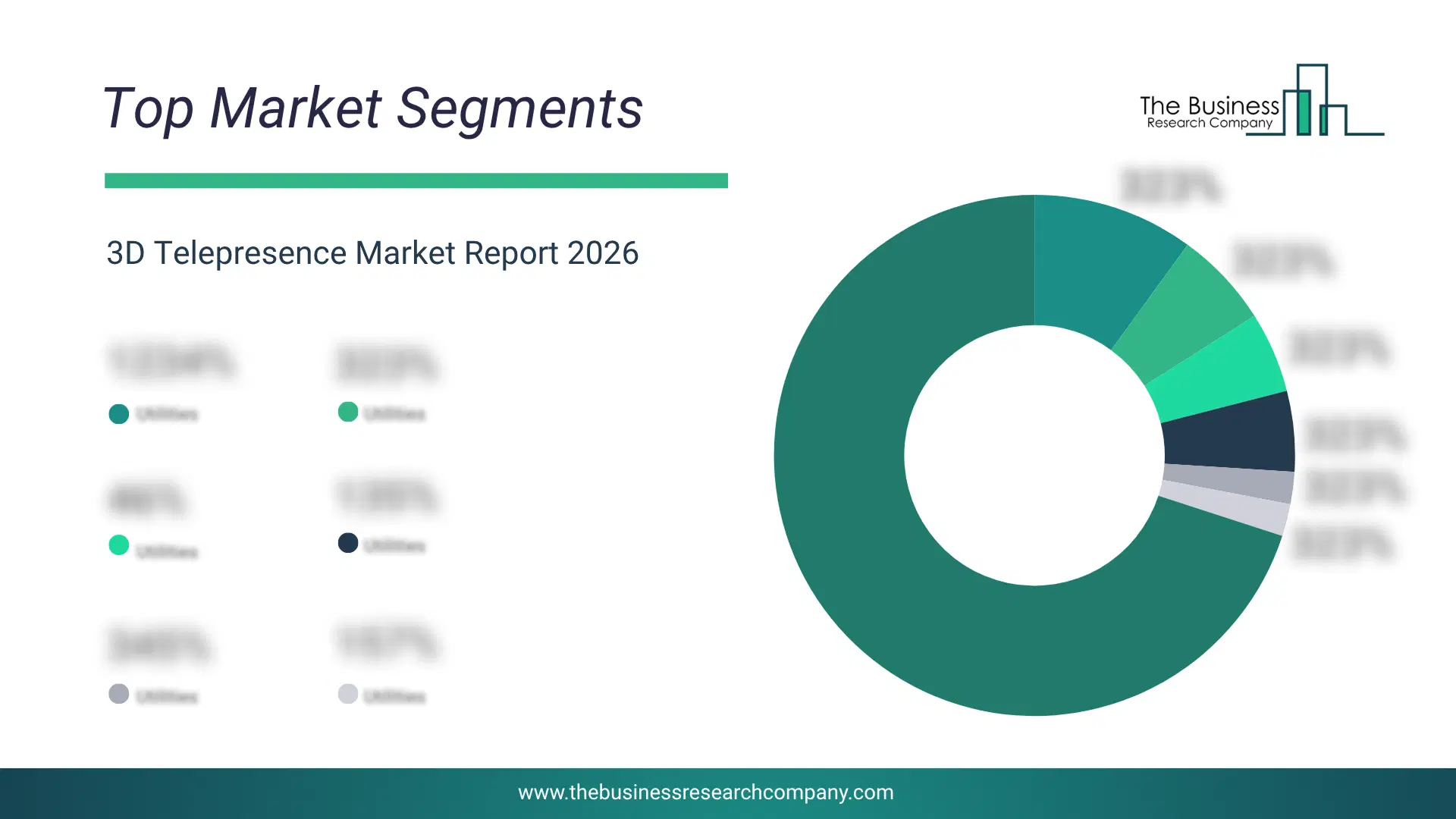
1) By Product: Software, Hardware 2) By Technology: 3D Display Technology, 3D Camera Technology, Sensors And Tracking Technology 3) By Application: Education, Advertising, Conferencing, Customer Service, Healthcare, Entertainment, Retail 4) By End-User: Small And Medium Enterprises (SMEs), Large Enterprise Subsegments: 1) By Software: 3D Rendering Software, Collaboration Platforms, Virtual Environment Software 2) By Hardware: 3D Cameras, Display Systems, Audio Equipment, Processing UnitsWhat Is The Driver Of The 3D Telepresence Market?
The increasing adoption of remote work practices is expected to propel the growth of the 3D telepresence market going forward. Remote work refers to the strategies, methodologies, and technologies that enable individuals and organizations to perform their duties outside of traditional office environments. The rise in remote and hybrid work models is being driven by the growing emphasis on flexibility, employee well-being, and digital collaboration. 3D telepresence technology supports this transformation by providing immersive, lifelike virtual interactions that enhance teamwork, accessibility, and engagement compared to standard video conferencing solutions. For instance, in March 2025, according to the U.S. Bureau of Labor Statistics, a US-based federal government agency, in the first quarter of 2024, 35.5 million people worked from home or teleworked for pay, an increase of 5.1 million compared with the previous year. These workers made up 22.9% of all employed individuals during the period, up from 19.6% in the same quarter of the prior year. Therefore, the increasing adoption of remote work practices is driving the growth of the 3D telepresence industry.Key Players In The Global 3D Telepresence Market
Major companies operating in the 3D telepresence market are Microsoft Corporation; Sony Corporation; Panasonic Corporation; Cisco Systems Inc.; Qualcomm Incorporated; Logitech International S.A.; Polycom Inc.; Unity Technologies; Barco NV; Avaya Inc.; Videxio; Eon Reality Inc.; Vuzix Corporation; ObEN Inc.; Voxon Photonics; TelePresence Tech; Magic Leap; Varjo Technologies; 8i; Spatial Systems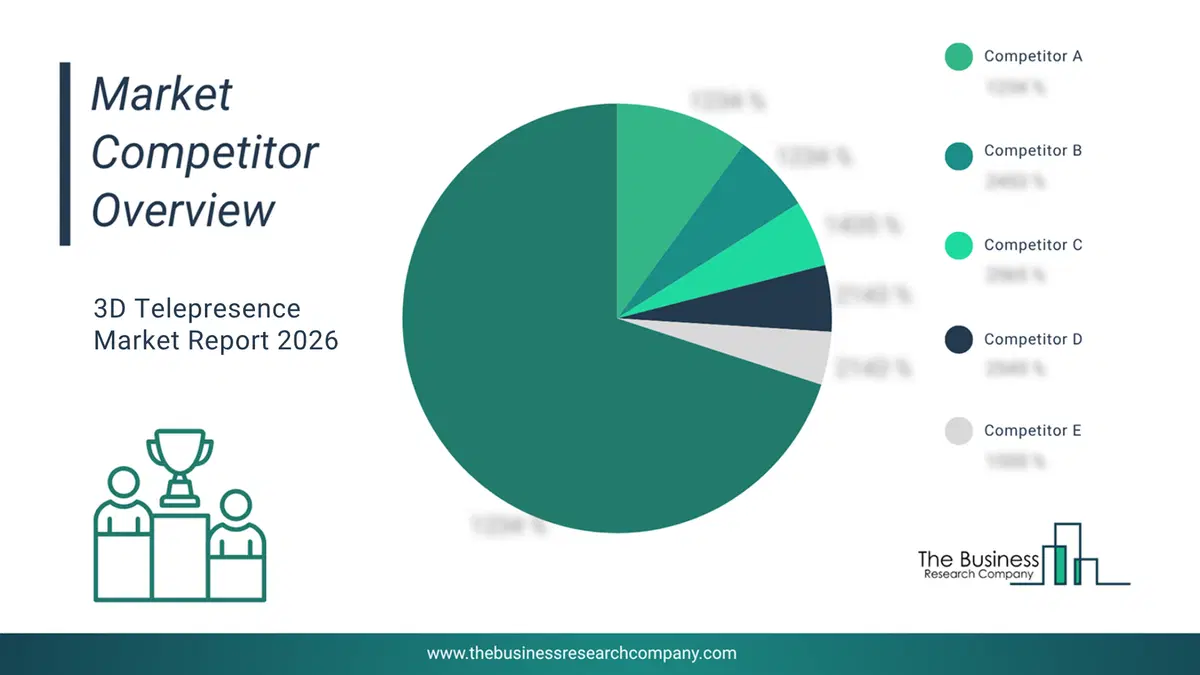
This chart is for illustrative purposes; the full report includes a detailed competitor analysis and comprehensive overview of the top 10 companies in the market.
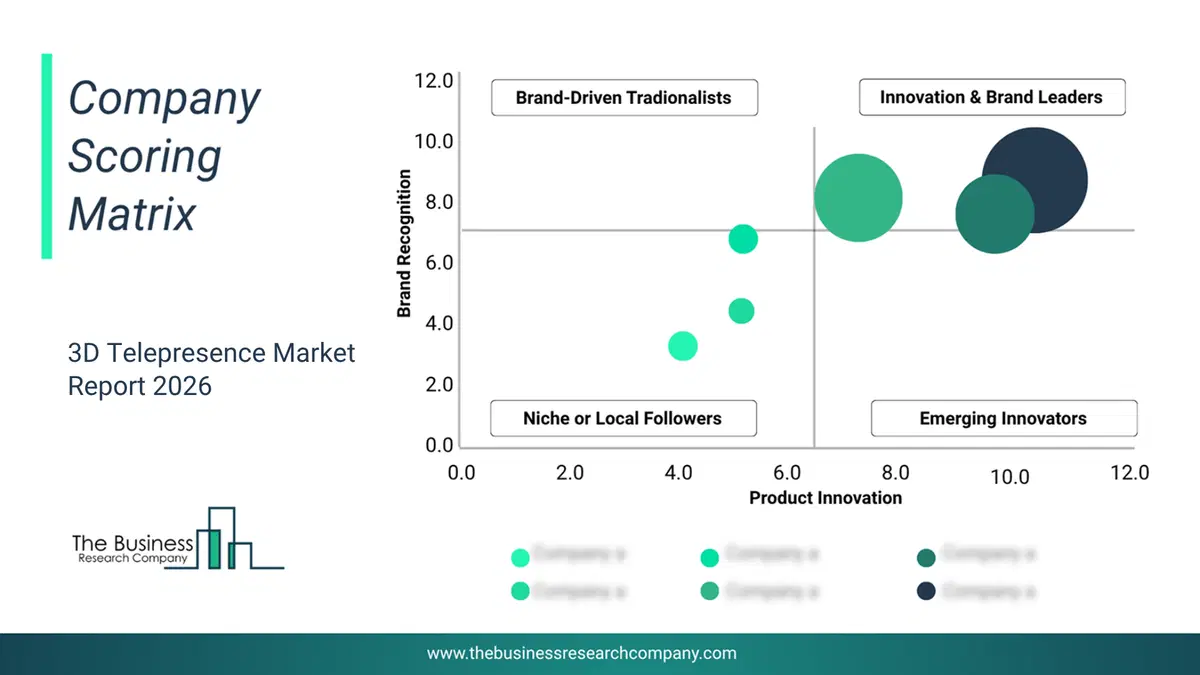
This chart maps companies by product innovation and brand strength, with bubble size indicating relative revenue, helping identify market leaders, challengers, and niche players. This is an illustrative chart; the full report provides a complete and accurate competitive analysis.
Global 3D Telepresence Market Trends and Insights
Major companies operating in the 3D telepresence market are focusing on developing innovative solutions such as AI-powered 3D digital human platforms, to meet the rising demand for immersive remote communication, virtual collaboration, and realistic remote customer engagement. AI-powered 3D digital human platforms leverage artificial intelligence (AI) and 3D rendering technologies to create lifelike virtual avatars that can interact in real time, offering a more engaging alternative to traditional video conferencing and static virtual meeting tools. For instance, in July 2024, NVIDIA Corporation, a U.S.-based technology company, launched NVIDIA Maxine, an advanced platform designed to enable next-generation digital humans and 3D telepresence experiences. NVIDIA Maxine combines AI-driven facial tracking, speech synthesis, and real-time 3D rendering to create highly realistic virtual avatars that can replicate human expressions, gestures, and voice interactions. Unique features include customizable avatars, real-time interaction, and integration with existing communication platforms, making it suitable for applications in remote work, online education, telehealth, and virtual events. This technology significantly enhances user engagement and presence compared to traditional 2D video calls, offering a seamless and immersive communication experience.What Are Latest Mergers And Acquisitions In The 3D Telepresence Market?
In August 2023, Square Yards Consulting Private Limited, an India-based prop-tech platform, acquired PropVR for an undisclosed amount. This acquisition is expected to enhance Square Yards, which aims to redefine the digital real estate experience for its customers, agents, and property developers and to digitize and index the built world by creating the digital twins of every single property. PropVR is an India-based developer of 3D telepresence technology.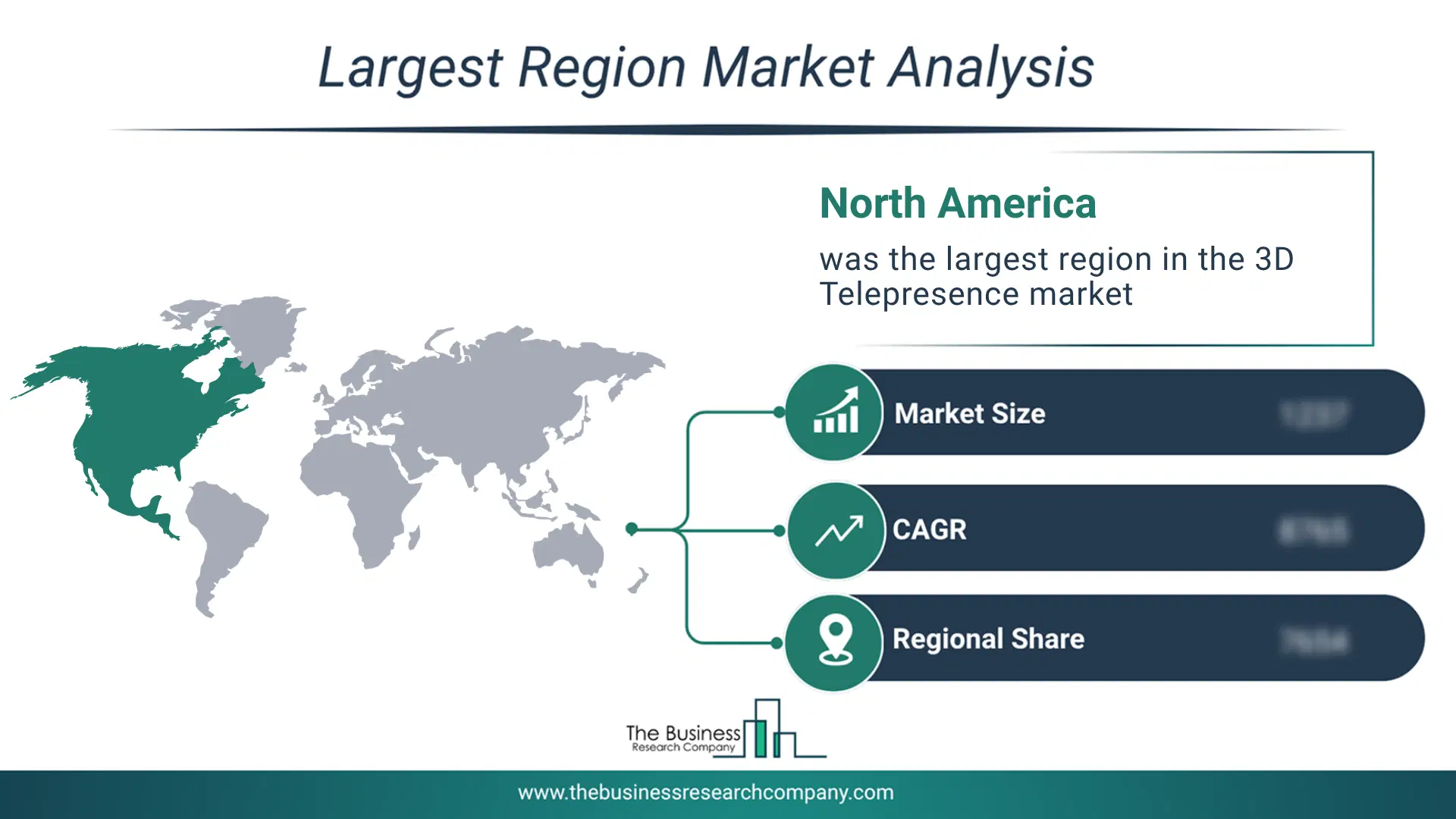
Regional Insights
North America was the largest region in the 3D telepresence market in 2025. Asia-Pacific is expected to be the fastest-growing region in the forecast period. The regions covered in this market report are Asia-Pacific, South East Asia, Western Europe, Eastern Europe, North America, South America, Middle East, Africa. The countries covered in this market report are Australia, Brazil, China, France, Germany, India, Indonesia, Japan, Taiwan, Russia, South Korea, UK, USA, Canada, Italy, SpainWhat Defines the 3D Telepresence Market?
The 3D telepresence market includes revenues earned by entities by providing services such as virtual meetings and conferences, avatar customization, spatial audio, real-time communication, and security and privacy features. The market value includes the value of related goods sold by the service provider or included within the service offering. The 3D telepresence market consists of sales of integration with hardware devices, telepresence robots, virtual reality (VR) headsets, and gesture recognition systems. Values in this market are ‘factory gate’ values, that is, the value of goods sold by the manufacturers or creators of the goods, whether to other entities (including downstream manufacturers, wholesalers, distributors, and retailers) or directly to end customers. The value of goods in this market includes related services sold by the creators of the goods.How is Market Value Defined and Measured?
The market value is defined as the revenues that enterprises gain from the sale of goods and/or services within the specified market and geography through sales, grants, or donations in terms of the currency (in USD unless otherwise specified). The revenues for a specified geography are consumption values that are revenues generated by organizations in the specified geography within the market, irrespective of where they are produced. It does not include revenues from resales along the supply chain, either further along the supply chain or as part of other products.
This chart presents market attractiveness based on a quantitative evaluation of growth, competition, strategic alignment, and risk, offering a clear view of opportunity areas for decision-making. This chart is for illustrative purposes; the full report contains the complete analysis.

This chart highlights the Total Addressable Market (TAM) by estimating the maximum revenue opportunity using an assumption-driven approach, supporting strategic planning and opportunity sizing across markets. The chart is illustrative; the full report provides a more comprehensive analysis.
What Key Data and Analysis Are Included in the 3D Telepresence Market Report 2026?
The 3d telepresence market research report is one of a series of new reports from The Business Research Company that provides market statistics, including industry global market size, regional shares, competitors with the market share, detailed market segments, market trends and opportunities, and any further data you may need to thrive in the 3d telepresence industry. The market research report delivers a complete perspective of everything you need, with an in-depth analysis of the current and future state of the industry.3D Telepresence Market Report Forecast Analysis
| Report Attribute | Details |
|---|---|
| Market Size Value In 2026 | $3.98 billion |
| Revenue Forecast In 2030 | $7.7 billion |
| Growth Rate | CAGR of 17.9% from 2026 to 2030 |
| Base Year For Estimation | 2025 |
| Actual Estimates/Historical Data | 2020-2025 |
| Forecast Period | 2026 - 2030 |
| Market Representation | Revenue in USD Billion and CAGR from 2026 to 2030 |
| Segments Covered | Product, Technology, Application, End-User |
| Regional Scope | Asia-Pacific, Western Europe, Eastern Europe, North America, South America, Middle East, Africa |
| Country Scope | The Countries Covered In This Market Report Are Australia, Brazil, China, France, Germany, India, Indonesia, Japan, Taiwan, Russia, South Korea, Uk, Usa, Canada, Italy, Spain. |
| Key Companies Profiled | Microsoft Corporation, Sony Corporation, Panasonic Corporation, Cisco Systems Inc., Qualcomm Incorporated, Logitech International S.A., Polycom Inc., Unity Technologies, Barco NV, Avaya Inc., Videxio, Eon Reality Inc., Vuzix Corporation, ObEN Inc., Voxon Photonics, TelePresence Tech, Magic Leap, Varjo Technologies, 8i, Spatial Systems |
| Customization Scope | Request for Customization |
| Pricing And Purchase Options | Explore Purchase Options |