
Aerospace And Defense Ducting Market 2026
By Duct Type (Rigid, Semi-Rigid, Flexible), By Material (Titanium Ducts, Stainless Steel Ducts, Nickel Alloy Ducts, Composite Ducts, Other Materials), By Application (Commercial Aircraft, Regional Aircraft, General Aviation, Helicopter, Military Aircraft), By Pressure (High Pressure, Low Pressure), And By Region, Opportunities And Strategies – Global Forecast To 2035
Aerospace And Defense Ducting Market Definition
Aerospace and defense ducting refers to specialized conduits and tubing systems designed to transport air, fluids, or gases within aircraft, spacecraft, and military vehicles. These ducts are made from materials such as titanium, composites, or high-performance polymers and are engineered to withstand extreme temperatures, pressure variations, and vibration while maintaining lightweight and durable performance. The primary purpose of aerospace and defense ducting is to ensure efficient environmental control, cooling, and fluid transfer across critical systems such as engines, cabins, and avionics. The aerospace and defense ducting market consists of sales, by entities (organizations, sole traders, or partnerships), of aerospace and defense ducting systems designed to transport air, gases, and fluids within aircraft, spacecraft, and defense vehicles, supporting essential functions such as ventilation, temperature control, pressurization, and fluid management. These ducting systems are utilized by aircraft and defense vehicle manufacturers, maintenance, repair, and overhaul (MRO) providers, system integrators, and research and development (R&D) organizations to regulate airflow, temperature, and fluid movement, ensuring the safety, reliability, and optimal performance of aerospace and defense platforms.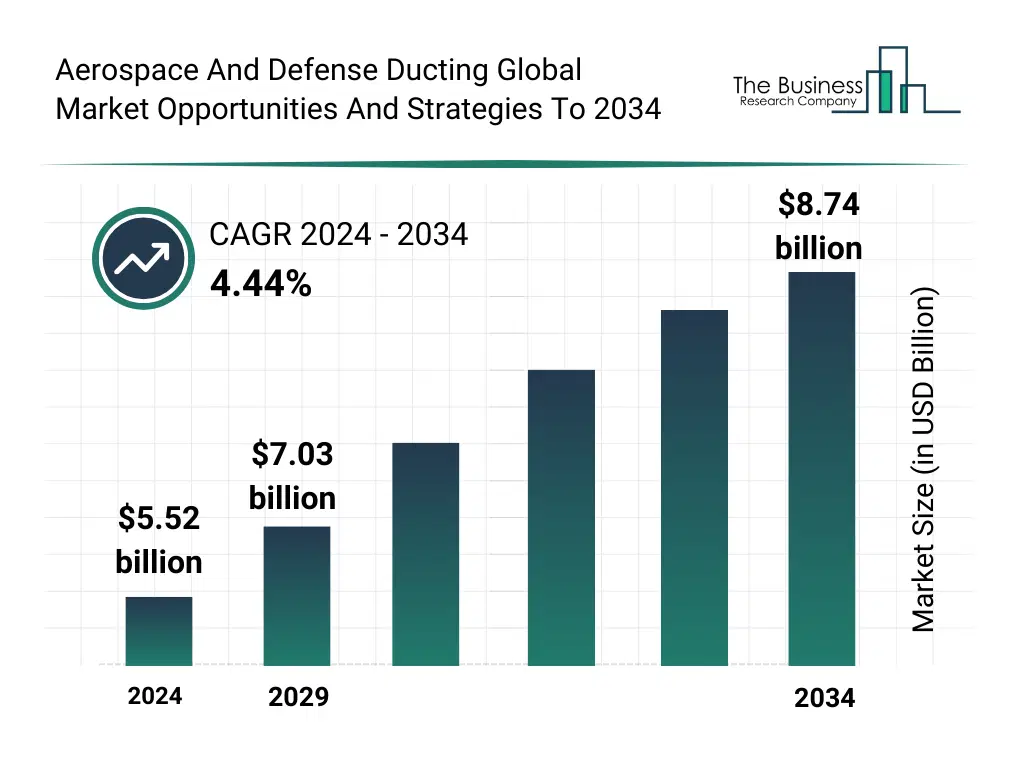
Aerospace And Defense Ducting Market Size
The global aerospace and defense ducting market reached a value of nearly $5,520.25 million in 2024, having grown at a compound annual growth rate (CAGR) of 3.65% since 2019. The market is expected to grow from $5,520.25 million in 2024 to $7,030.45 million in 2029 at a rate of 4.96%. The market is then expected to grow at a CAGR of 4.44% from 2029 and reach $8,736.70 million in 2034. Growth in the historic period resulted from the growth of defense modernization programs, rise in sustainability and emission regulations, focus on fuel efficiency and growth in aerospace maintenance, repair, and overhaul (MRO) activities. Factors that negatively affected growth in the historic period were skilled workforce shortages and stringent certification requirements. Going forward, the rising defense spending, growth in aircraft production, rising investments in urban air mobility (UAM) and EVTOL aircraft and rising demand for lightweight and corrosion-resistant materials will drive the growth. Factors that could hinder the growth of the aerospace and defense ducting market in the future include high production and maintenance costs, complex design and integration challenges and impact of trade war and tariff.Aerospace And Defense Ducting Market Drivers
The key drivers of the aerospace and defense ducting market include: Growth in Aircraft Production Aircraft production growth during the forecast period is expected to significantly drive the aerospace and defense ducting market. Modern aircraft demand complex ducting systems for environmental control, fuel delivery, hydraulics, and pneumatics. Rising global air travel, airline fleet expansions, and increasing aircraft orders—especially from emerging markets—are contributing to higher production volumes of both narrow-body and wide-body aircraft. This surge in output directly boosts demand for lightweight, heat-resistant, and high-efficiency ducting components that support improved fuel economy and system reliability. Furthermore, next-generation aircraft designs, which prioritize aerodynamics and sustainability, require custom ducting solutions that integrate advanced materials and fit within compact, streamlined airframes. As major manufacturers ramp up production and streamline supply chains to fulfill global demand, the aerospace and defense ducting market is set to grow in tandem with these expanding operations. The growth in aircraft production growth contribution during the forecast period in 2024 is 1.50%.Aerospace And Defense Ducting Market Restraints
The key restraints on the aerospace and defense ducting market include: High Production and Maintenance Costs The aerospace and defense ducting market faces growth constraints during the forecast period due to high production and maintenance costs. Producing advanced ducting components often involves the use of specialized materials like titanium, nickel alloys, and high-performance composites, along with precision machining, intricate fabrication processes, and strict quality control—all of which significantly raise manufacturing expenses. These cost pressures make it challenging for suppliers to scale operations or offer competitively priced solutions. On the maintenance side, ducting systems in aircraft, helicopters, and military platforms require frequent inspection, repair, and replacement to maintain optimal performance and safety, adding to operational costs. Collectively, these high costs can hinder market expansion by limiting adoption among budget-conscious customers, delaying new product rollouts, and compressing profit margins for manufacturers and service providers. Growth affected by high production and maintenance costs during the forecast period in 2024 is -1.00%.Aerospace And Defense Ducting Market Trends
Major trends shaping the aerospace and defense ducting market include: Development Of Titanium And Hybrid Metal-Composite Rigid Ducts For High-Temperature Applications Major companies in the aerospace and defense ducting market are seeing innovation to handle very high temperature, high pressure, or corrosive environments, e.g., engine bleed air systems, exhaust, and anti-ice. This helps suppliers to qualify new materials and hybrid structures, increase pressure and temperature thresholds, and partner with material specialists to get certifications. For example, in March 2024, Eaton Corporation, a US-based multinational power management company, developed a carbon-reinforced PEKK (polyetheretherketone) material as a substitute for aluminum in aircraft air ducts. This 3D (dimension)-printable rigid and hybrid composite material meets essential requirements and allows more flexible manufacturing without heavy tooling. This innovation helps reduce weight and improves thermal performance in harsh operating conditions. Advancements In Reinforced Plastic Semi-Rigid Ducts For Corrosion Resistance And Flexibility Major companies in the aerospace and defense ducting market are increasingly investing in reinforced plastic semi‑rigid ducts to enhance corrosion resistance and flexibility in various applications. These innovations allow for improved durability, reduced maintenance costs, and better performance in challenging environments. Such semi-rigid ducts enable easier routing in constrained spaces, allow bending without full flexibility, reduce joint counts, and therefore reduce leak risk and weight. For instance, in March 2024, Durkduct, a China-based company specializing in fabric ducting systems, introduced its Fiber Fabric Composite Air Ducts. These ducts are composed of a duct layer, an insulation layer, and an outer insulation layer, achieving a dual-layer insulation effect. This design enhances the ducts' resistance to corrosion and improves their flexibility, making them suitable for a wide range of aerospace applications.Opportunities And Recommendations In The Aerospace And Defense Ducting Market
Opportunities – The top opportunities in the aerospace and defense ducting markets segmented by duct type will arise in the rigid segment, which will gain $646.98 million of global annual sales by 2029. The top opportunities in the aerospace and defense ducting markets segmented by material will arise in the composite ducts segment, which will gain $893.78 million of global annual sales by 2029. The top opportunities in the aerospace and defense ducting markets segmented by application will arise in the commercial aircraft segment, which will gain $784.10 million of global annual sales by 2029. The top opportunities in the aerospace and defense ducting markets segmented by pressure will arise in the high pressure segment, which will gain $1,020.51 million of global annual sales by 2029. The aerospace and defense ducting market size will gain the most in the USA at $447.41 million. Recommendations- To take advantage of the opportunities, The Business Research Company recommends the aerospace and defense ducting companies to focus on advanced materials and strategic partnerships, focus on reinforced plastic semi-rigid ducting and material innovation, focus on semi-rigid ducting for scalable growth, focus on composite ducts to accelerate market growth, focus on high-pressure ducting to maximize growth and margin, expand in emerging markets, focus on strategic partnerships and supply chain integration, focus on competitive pricing discipline to drive sustainable growth, promotion strategy recommendations for aerospace and defense ducting companies, brand visibility and targeted outreach priorities in aerospace and defense ducting markets and focus on military aircraft to capture high-growth demand.
Aerospace And Defense Ducting Market Segmentation
The aerospace and defense ducting market is segmented by duct type, by material, by application and by pressure.By Duct Type –
The aerospace and defense ducting market is segmented by duct type into:
- a) Rigid
- b) Semi-Rigid
- c) Flexible
By Material –
The aerospace and defense ducting market is segmented by material into:
- a) Titanium Ducts
- b) Stainless Steel Ducts
- c) Nickel Alloy Ducts
- d) Composite Ducts
- e) Other Materials
By Application –
The aerospace and defense ducting market is segmented by application into:
- a) Commercial Aircraft
- b) Regional Aircraft
- c) General Aviation
- d) Helicopter
- e) Military Aircraft
By Pressure –
The aerospace and defense ducting market is segmented by pressure into:
- a) High Pressure
- b) Low Pressure
By Geography - The aerospace and defense ducting market is segmented by geography into:
- • China
- • India
- • Japan
- • Australia
- • Indonesia
- • South Korea
- • USA
- • Canada
- • Brazil
- • France
- • Germany
- • UK
- • Italy
- • Spain
- • Russia
-
o Asia Pacific
o Africa