
Aerospace Ceramics Market Report 2026
Global Outlook – By Type (Oxide Ceramics, Non-Oxide Ceramics, Composite Ceramics), By Manufacturing Process (Powder Processing, Slip Casting, Hot Pressing, 3D Printing, Other Advanced Manufacturing Techniques), By Temperature Resistance (High-Temperature Resistant Ceramics, Intermediate-Temperature Resistant Ceramics, Low-Temperature Resistant Ceramics), By Application (Engine Components, Thermal Protection Systems, Structural Components, Electronics And Sensors, Aerospace Structural Parts), By End-User (Commercial Aviation, Military Aviation, Space Exploration, Drone Technology, Other End-Users) – Market Size, Trends, Strategies, and Forecast to 2030
Aerospace Ceramics Market Overview
• Aerospace Ceramics market size has reached to $4.53 billion in 2025 • Expected to grow to $6.25 billion in 2030 at a compound annual growth rate (CAGR) of 6.6% • Growth Driver: Rising Aircraft Production Fueling The Growth Of The Market Due To Increasing Demand For Advanced Ceramic Components In Modern Aircraft • Market Trend: Innovative Ceramic-Filled Composite Resin Enhances Aerospace Additive Manufacturing Capabilities • North America was the largest region in 2025 and Asia-Pacific is the fastest growing region.What Is Covered Under Aerospace Ceramics Market?
Aerospace ceramics refer to a class of advanced ceramic materials specifically engineered for use in aerospace applications, where they must withstand extreme conditions such as high temperatures, mechanical stress, corrosive environments, and thermal shock. These ceramics are known for their lightweight nature, high hardness, thermal stability, and resistance to wear and corrosion. The main types of aerospace ceramics include oxide ceramics, non-oxide ceramics, and composite ceramics. Oxide ceramics are inorganic compounds composed of metal elements bonded with oxygen, such as alumina, zirconia, and magnesia. These materials are valued for their superior hardness, excellent heat resistance, and strong electrical insulation. The key manufacturing processes include powder processing, slip casting, hot pressing, 3D printing, and others, and multiple temperature resistance categories consist of high-temperature resistant ceramics, intermediate-temperature resistant ceramics, and low-temperature resistant ceramics. The various applications include engine components, thermal protection systems, structural components, electronics and sensors, and aerospace structural parts and are used by several end-users such as commercial aviation, military aviation, space exploration, drone technology, and others.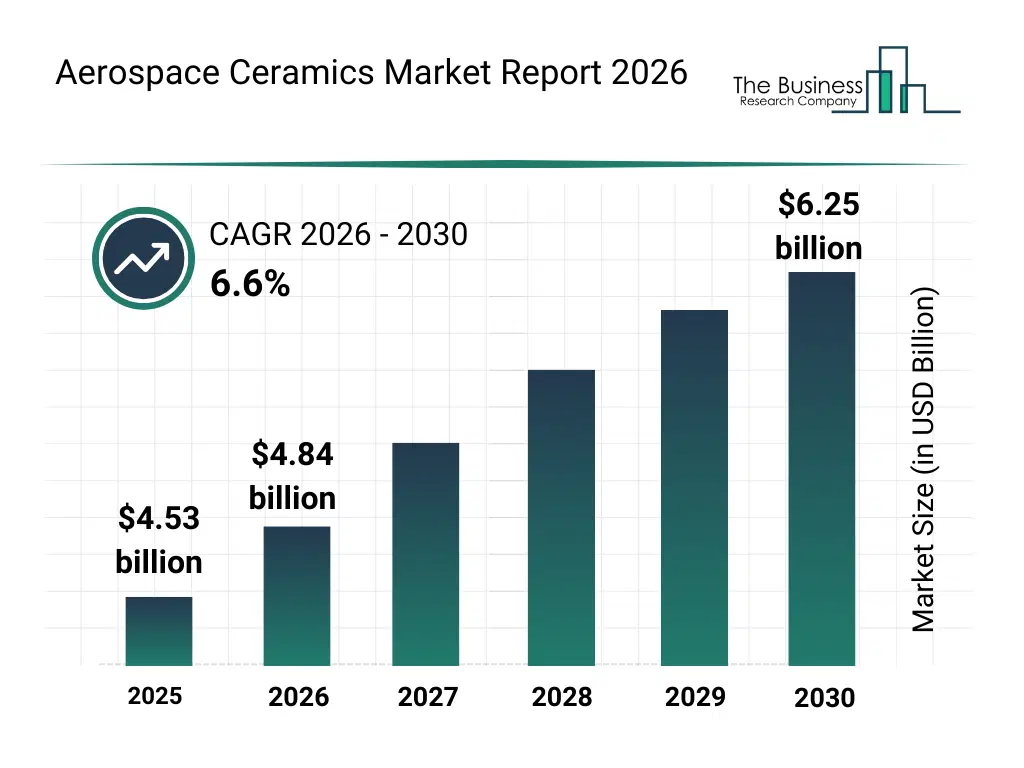
What Is The Aerospace Ceramics Market Size and Share 2026?
The aerospace ceramics market size has grown strongly in recent years. It will grow from $4.53 billion in 2025 to $4.84 billion in 2026 at a compound annual growth rate (CAGR) of 6.8%. The growth in the historic period can be attributed to increasing use of ceramic matrix composites in aerospace components, development of thermal barrier coatings for high-temperature engines, rising demand for lightweight and wear-resistant materials, adoption of silicon carbide components in structural and propulsion systems, government investment in advanced materials research for aerospace applications.What Is The Aerospace Ceramics Market Growth Forecast?
The aerospace ceramics market size is expected to see strong growth in the next few years. It will grow to $6.25 billion in 2030 at a compound annual growth rate (CAGR) of 6.6%. The growth in the forecast period can be attributed to growing demand for high-performance ceramics in next-generation aircraft and spacecraft, expansion of ceramic applications in hypersonic and high-speed defense systems, focus on improving thermal shock and corrosion resistance, integration of advanced manufacturing techniques for complex ceramic parts, increasing procurement of customized ceramics for mission-critical aerospace and defense operations. Major trends in the forecast period include rising demand for ultra-lightweight ceramic materials, increased use of ceramic matrix composites in aerospace engines, growing need for thermal barrier coatings for hypersonic platforms, expansion of ceramics in next-generation structural and protective systems, improved high-temperature ceramic performance for deep-space missions.
Global Aerospace Ceramics Market Segmentation
1) By Type: Oxide Ceramics, Non-Oxide Ceramics, Composite Ceramics 2) By Manufacturing Process: Powder Processing, Slip Casting, Hot Pressing, 3D Printing, Other Advanced Manufacturing Techniques 3) By Temperature Resistance: High-Temperature Resistant Ceramics, Intermediate-Temperature Resistant Ceramics, Low-Temperature Resistant Ceramics 4) By Application: Engine Components, Thermal Protection Systems, Structural Components, Electronics And Sensors, Aerospace Structural Parts 5) By End-User: Commercial Aviation, Military Aviation, Space Exploration, Drone Technology, Other End-Users Subsegments: 1) By Oxide Ceramics: Alumina, Zirconia, Mullite, Magnesia 2) By Non-Oxide Ceramics: Silicon Carbide, Boron Carbide, Silicon Nitride, Aluminum Nitride 3) By Composite Ceramics: Ceramic Matrix Composites, Fiber-Reinforced Ceramics, Oxide-Oxide Composites, Carbon-Ceramic CompositesWhat Is Driver Of The Aerospace Ceramics Market?
The rising aircraft production is expected to propel the growth of the aerospace ceramics market going forward. The aircraft production is increasing due to advancements in manufacturing technologies, enabling faster and more efficient assembly processes. Aerospace ceramics are used in aircraft production, offering high strength-to-weight ratios and thermal resistance, allowing the design of lighter, more durable components that streamline manufacturing. For instance, in January 2024, according to Airbus SE, a Netherlands-based aerospace and defense company, it delivered 735 commercial aircraft in 2023, an 11% increase compared to the 663 aircraft delivered in 2022. Therefore, the rising aircraft production rates are driving the growth of the aerospace ceramics industry.Key Players In The Global Aerospace Ceramics Market
Major companies operating in the aerospace ceramics market are Boeing Company, Lockheed Martin Corporation, Saint-Gobain Ceramics & Plastics Inc., General Electric Company, Honeywell International Inc., BAE Systems plc, 3M Company, Safran SA, Kyocera Corporation, Murata Manufacturing Co. Ltd., NGK Spark Plug Co. Ltd., CoorsTek Inc., Morgan Advanced Materials plc, CeramTec GmbH, Ceradyne Inc., Superior Technical Ceramics Corporation, Blasch Precision Ceramics Inc., Applied Ceramics Inc., Rauschert GmbH, Precision Ceramics USA, McDanel Advanced Ceramic Technologies LLC, International Syalons Limited, Advanced Ceramic Manufacturing LLC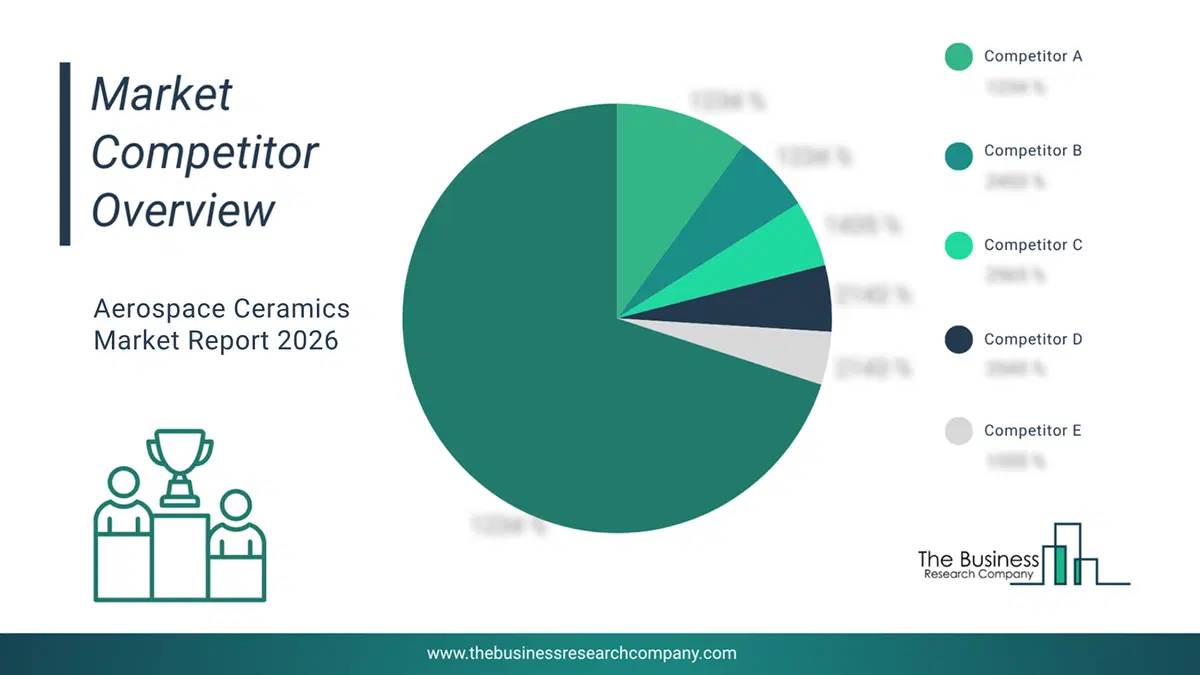
This chart is for illustrative purposes; the full report includes a detailed competitor analysis and comprehensive overview of the top 10 companies in the market.
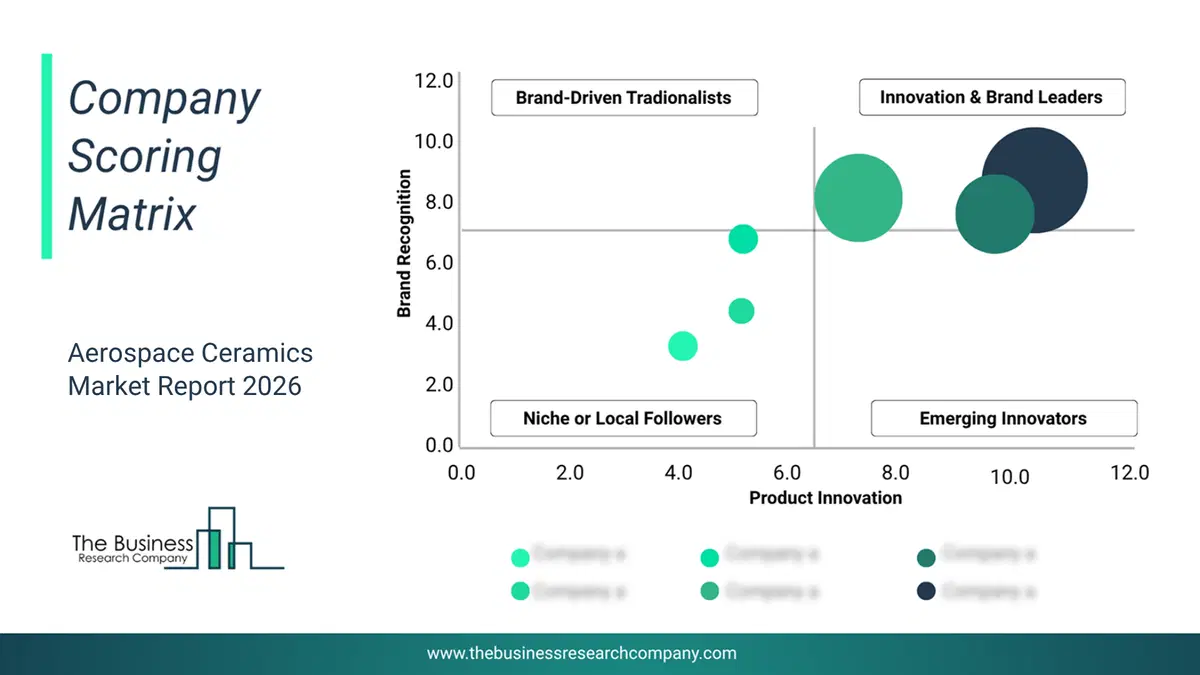
This chart maps companies by product innovation and brand strength, with bubble size indicating relative revenue, helping identify market leaders, challengers, and niche players. This is an illustrative chart; the full report provides a complete and accurate competitive analysis.
Global Aerospace Ceramics Market Trends and Insights
Major companies operating in the aerospace ceramics market are focusing on developing innovative solutions, such as ceramic-filled composite resin, to enhance component strength, thermal resistance, and performance in extreme environments. Ceramic-filled composite resin is a material composed of a polymer resin matrix reinforced with finely dispersed ceramic particles, designed to combine the toughness and processability of polymers with the high strength, stiffness, and thermal resistance of ceramics. For instance, in April 2025, PolySpectra Inc., a US-based provider of photopolymer materials for 3D printing, partnered with Tethon 3D, a US-based ceramic additive manufacturing specialist, and launched ThOR 10, a rugged ceramic-filled composite resin. This innovative material combines polySpectra's durable cyclic olefin resin chemistry with Tethon 3D's advanced ceramic filler technology, resulting in a resin that offers exceptional thermal stability, improved stiffness, and enhanced dimensional accuracy. ThOR 10 is optimized for use in DLP and other resin-based 3D printing systems, enabling the production of parts that can withstand demanding mechanical loads and elevated temperatures. Its unique formulation also provides superior wear resistance and low shrinkage, making it ideal for functional prototypes and end-use parts in aerospace, automotive, and industrial applications.What Are Latest Mergers And Acquisitions In The Aerospace Ceramics Market? Kanfit Acquired Xjet’s Metal And Ceramic Additive Manufacturing Systems To Expand 3D Printing Capabilities
In September 2025, Kanfit, an Israeli-based aerospace manufacturing company, acquired XJet’s metal and ceramic additive manufacturing systems for an undisclosed amount. With this acquisition, Kanfit’s aim is to expand its manufacturing capabilities by integrating cutting-edge NanoParticle Jetting (NPJ) technology for both metal and ceramic 3D printing. XJet is an Israeli-based company specializing in additive manufacturing (3D printing) technologies for metal and ceramic materials.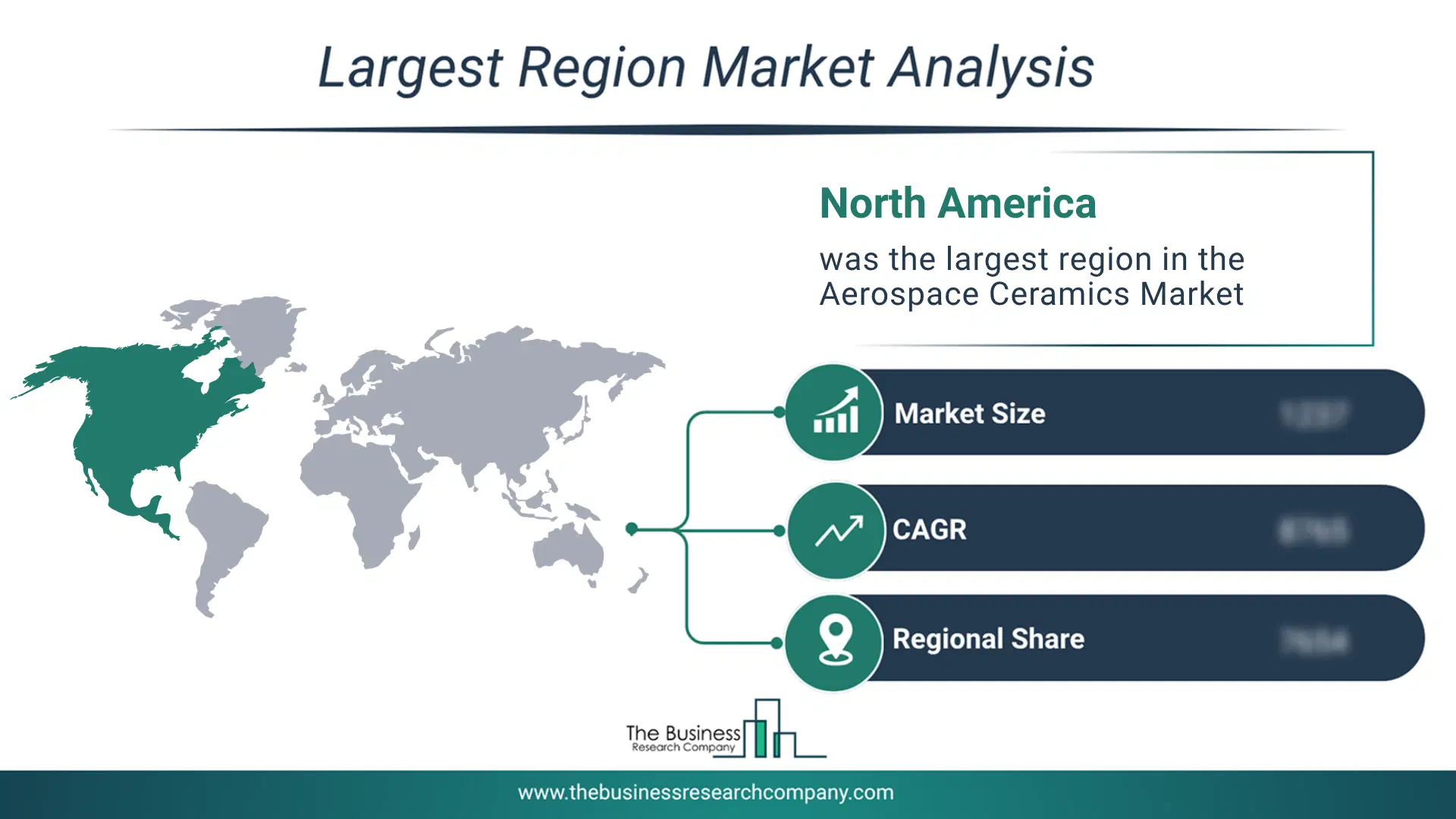
Regional Insights
North America was the largest region in the aerospace ceramics market in 2025. Asia-Pacific is expected to be the fastest-growing region in the forecast period. The regions covered in this market report are Asia-Pacific, South East Asia, Western Europe, Eastern Europe, North America, South America, Middle East, Africa. The countries covered in this market report are Australia, Brazil, China, France, Germany, India, Indonesia, Japan, Taiwan, Russia, South Korea, UK, USA, Canada, Italy, SpainWhat Defines the Aerospace Ceramics Market?
The aerospace ceramics market includes sales of products such as ceramic matrix composites, silicon carbide components, thermal barrier coatings, and high-temperature ceramic tiles. Values in this market are ‘factory gate’ values, that is, the value of goods sold by the manufacturers or creators of the goods, whether to other entities (including downstream manufacturers, wholesalers, distributors, and retailers) or directly to end customers. The value of goods in this market includes related services sold by the creators of the goods.How is Market Value Defined and Measured?
The market value is defined as the revenues that enterprises gain from the sale of goods and/or services within the specified market and geography through sales, grants, or donations in terms of the currency (in USD unless otherwise specified). The revenues for a specified geography are consumption values that are revenues generated by organizations in the specified geography within the market, irrespective of where they are produced. It does not include revenues from resales along the supply chain, either further along the supply chain or as part of other products.
This chart presents market attractiveness based on a quantitative evaluation of growth, competition, strategic alignment, and risk, offering a clear view of opportunity areas for decision-making. This chart is for illustrative purposes; the full report contains the complete analysis.

This chart highlights the Total Addressable Market (TAM) by estimating the maximum revenue opportunity using an assumption-driven approach, supporting strategic planning and opportunity sizing across markets. The chart is illustrative; the full report provides a more comprehensive analysis.
What Key Data and Analysis Are Included in the Aerospace Ceramics Market Report 2026?
The aerospace ceramics market research report is one of a series of new reports from The Business Research Company that provides market statistics, including industry global market size, regional shares, competitors with the market share, detailed market segments, market trends and opportunities, and any further data you may need to thrive in the aerospace ceramics industry. The market research report delivers a complete perspective of everything you need, with an in-depth analysis of the current and future state of the industry.Aerospace Ceramics Market Report Forecast Analysis
| Report Attribute | Details |
|---|---|
| Market Size Value In 2026 | $4.84 billion |
| Revenue Forecast In 2030 | $6.25 billion |
| Growth Rate | CAGR of 6.6% from 2026 to 2030 |
| Base Year For Estimation | 2025 |
| Actual Estimates/Historical Data | 2020-2025 |
| Forecast Period | 2026 - 2030 |
| Market Representation | Revenue in USD Billion and CAGR from 2026 to 2030 |
| Segments Covered | Type, Manufacturing Process, Temperature Resistance, Application, End-User |
| Regional Scope | Asia-Pacific, Western Europe, Eastern Europe, North America, South America, Middle East, Africa |
| Country Scope | The countries covered in the aerospace ceramics market report are Australia, Brazil, China, France, Germany, India, Indonesia, Japan, Taiwan, Russia, South Korea, UK, USA, Canada, Italy, Spain |
| Key Companies Profiled | Boeing Company, Lockheed Martin Corporation, Saint-Gobain Ceramics & Plastics Inc., General Electric Company, Honeywell International Inc., BAE Systems plc, 3M Company, Safran SA, Kyocera Corporation, Murata Manufacturing Co. Ltd., NGK Spark Plug Co. Ltd., CoorsTek Inc., Morgan Advanced Materials plc, CeramTec GmbH, Ceradyne Inc., Superior Technical Ceramics Corporation, Blasch Precision Ceramics Inc., Applied Ceramics Inc., Rauschert GmbH, Precision Ceramics USA, McDanel Advanced Ceramic Technologies LLC, International Syalons Limited, Advanced Ceramic Manufacturing LLC |
| Customization Scope | Request for Customization |
| Pricing And Purchase Options | Explore Purchase Options |