
AI In Logistics And Supply Chain Management Market Report 2026
Global Outlook – By Offering (Solution, Services), By Type (Artificial Intelligence (AI), Machine Learning, Robotics Process Automation (RPA), Natural Language Processing (NLP)), By Deployment (Cloud-Based, On-Premise), By Application (Warehouse Management, Transportation Management, Order Fulfillment, Demand Forecasting, Inventory Optimization, Supply Chain Planning, Other Applications), By End User (Automotive, Aerospace, Manufacturing, Retail, Healthcare, Other End Users) – Market Size, Trends, Strategies, and Forecast to 2030
AI In Logistics And Supply Chain Management Market Overview
• AI In Logistics And Supply Chain Management market size has reached to $34.04 billion in 2025 • Expected to grow to $189.29 billion in 2030 at a compound annual growth rate (CAGR) of 41% • Growth Driver: E-commerce's Influence On The AI in Logistics And Supply Chain Management Market • Market Trend: Technological Innovations In Supply Chain Management Tools • North America was the largest region in 2025.Market Gains By 2030 – Top Opportunities By Segment
Market Gain identifies the most promising market opportunities by highlighting the segments or products expected to generate the highest incremental revenue growth over the next five years.
What Is Covered Under AI In Logistics And Supply Chain Management Market?
AI in logistics and supply chain management refers to the process of using artificial intelligence technologies to optimize and automate various processes within the supply chain, from raw material sourcing to final delivery. It encompasses various activities to improve operational performance and customer satisfaction while reducing costs and mitigating risks. The main offerings of AI in logistics and supply chain management are solutions and services. Solutions refer to software applications or platforms that utilize artificial intelligence to address specific challenges or improve processes. It has several types, such as artificial intelligence (AI), machine learning, robotics process automation (RPA), and natural language processing (NLP). It can be deployed both in the cloud and on-premise. It is applied for warehouse management, transportation management, order fulfillment, demand forecasting, inventory optimization, supply chain planning, and others, and it is used by different end-user industries, including automotive, aerospace, manufacturing, retail, healthcare, and others.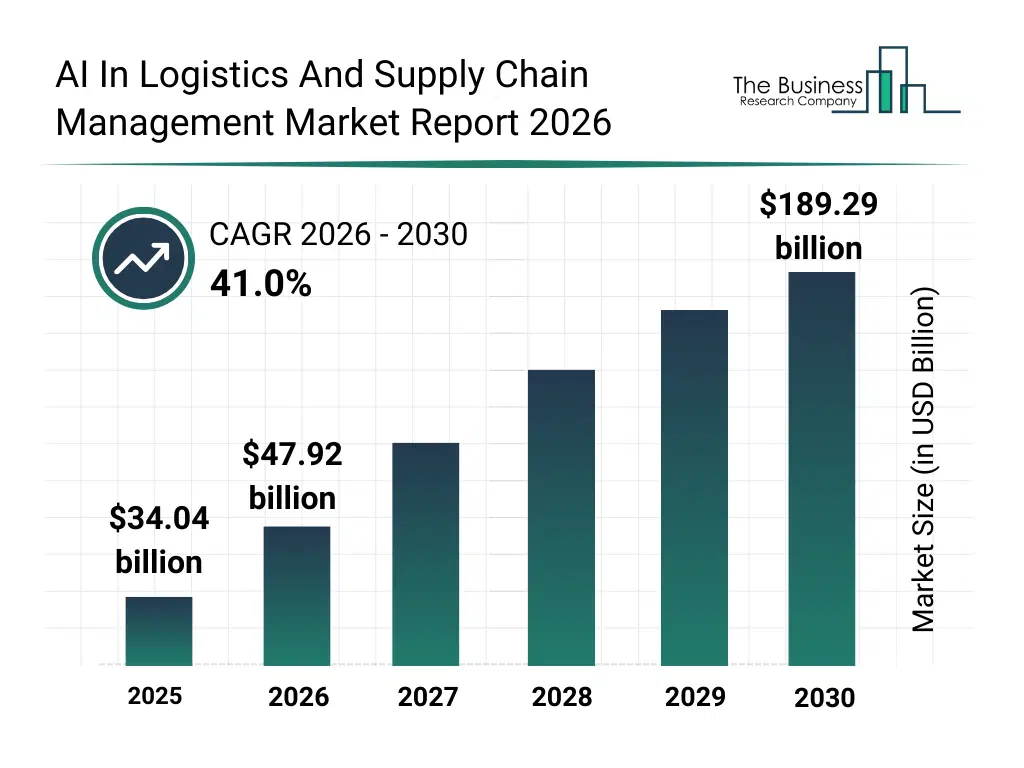
What Is The AI In Logistics And Supply Chain Management Market Size and Share 2026?
The AI in logistics and supply chain management market size has grown exponentially in recent years. It will grow from $34.04 billion in 2025 to $47.92 billion in 2026 at a compound annual growth rate (CAGR) of 40.8%. The growth in the historic period can be attributed to expansion of global supply chains, increasing complexity of logistics networks, growth of e-commerce fulfillment operations, adoption of digital logistics platforms, rising demand for cost optimization.What Is The AI In Logistics And Supply Chain Management Market Growth Forecast?
The AI in logistics and supply chain management market size is expected to see exponential growth in the next few years. It will grow to $189.29 billion in 2030 at a compound annual growth rate (CAGR) of 41.0%. The growth in the forecast period can be attributed to increasing investments in autonomous supply chain systems, rising demand for real-time logistics intelligence, expansion of cloud-based supply chain platforms, growing use of AI for risk mitigation, increasing focus on resilient supply chains. Major trends in the forecast period include increasing adoption of AI-based demand forecasting tools, rising use of intelligent warehouse automation systems, growing integration of predictive analytics in inventory management, expansion of AI-driven transportation optimization, enhanced focus on end-to-end supply chain visibility.
Global AI In Logistics And Supply Chain Management Market Segmentation
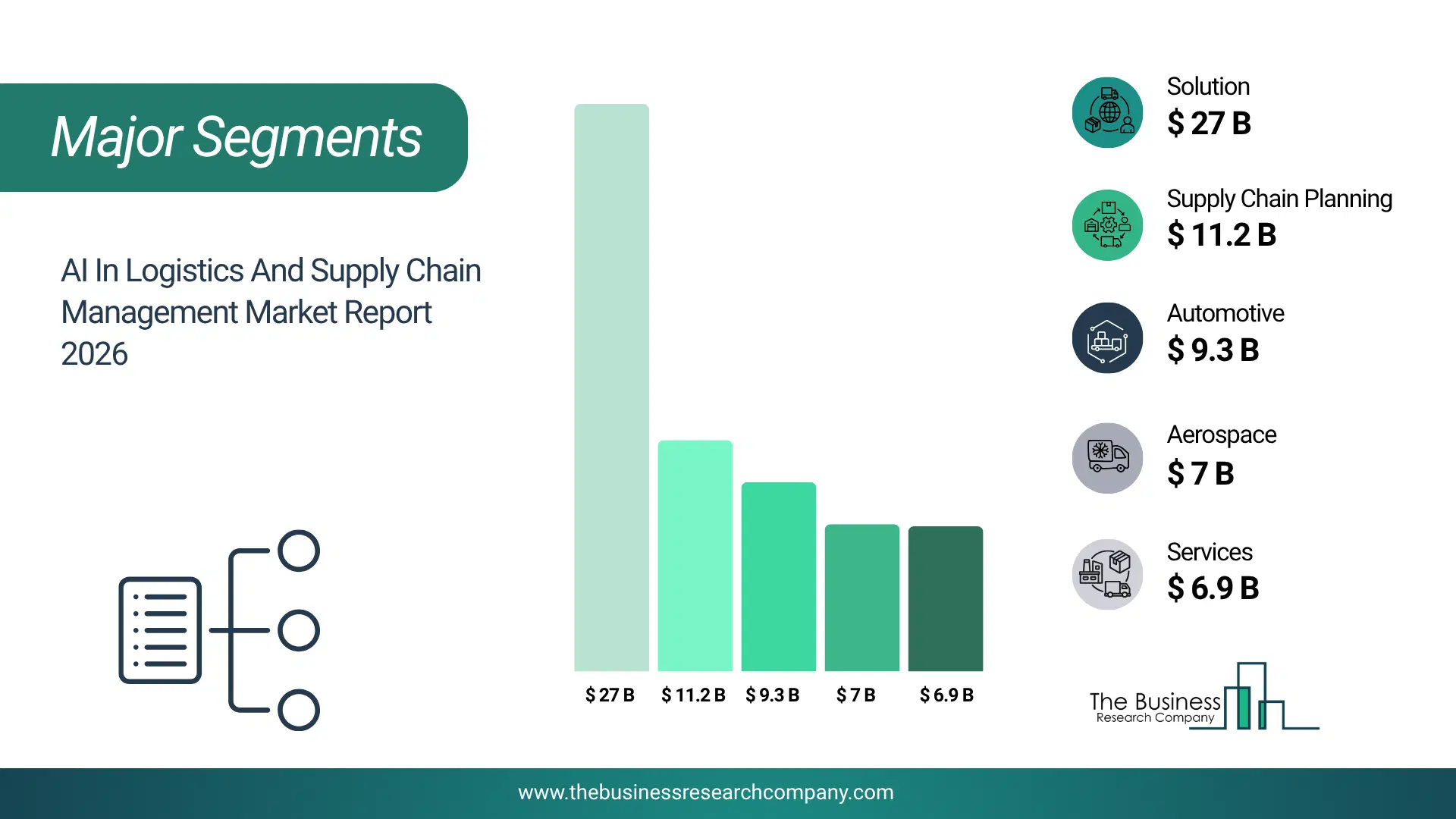
1) By Offering: Solution, Services 2) By Type: Artificial Intelligence (AI), Machine Learning, Robotics Process Automation (RPA), Natural Language Processing (NLP) 3) By Deployment: Cloud-Based, On-Premise 4) By Application: Warehouse Management, Transportation Management, Order Fulfillment, Demand Forecasting, Inventory Optimization, Supply Chain Planning, Other Applications 5) By End User: Automotive, Aerospace, Manufacturing, Retail, Healthcare, Other End Users Subsegments: 1) By Solution: AI Software, AI Platforms, AI Tools For Automation, AI-Based Analytics 2) By Services: Consulting Services, Integration And Implementation Services, Managed Services, Support And Maintenance Services The top segments in the ai in logistics and supply chain management market will be: • Solution will reach $27060.41 Million by 2025. • Supply Chain Planning will reach $11270.28 Million by 2025. • Automotive will reach $9383.05 Million by 2025. • Aerospace will reach $7004.68 Million by 2025. • Services will reach $6980.57 Million by 2025.What Is The Driver Of The AI In Logistics And Supply Chain Management Market?
The growing e-commerce industry is expected to propel the growth of the AI in logistics and supply chain management market going forward. The e-commerce industry encompasses the business sector that involves the buying and selling goods and services conducted primarily through electronic means, such as the Internet, mobile apps, or other digital platforms. The e-commerce industry is driven by convenience, expanding internet access, and shifting consumer preferences toward online shopping. AI enhances e-commerce logistics and supply chain management by forecasting demand, fine-tuning inventory management, optimizing delivery routes, reducing costs, and increasing customer satisfaction. For instance, in February 2024, according to the United States Census Bureau, a US-based government agency, e-commerce sales reached $1,118.7 billion in 2023, marking a 7.6% (±1.2%) increase from 2022. Further, e-commerce sales constituted 15.4% of total sales in 2023, compared to 14.7% in 2022. Therefore, the growing e-commerce industry is driving the growth of the AI in logistics and supply chain management industry.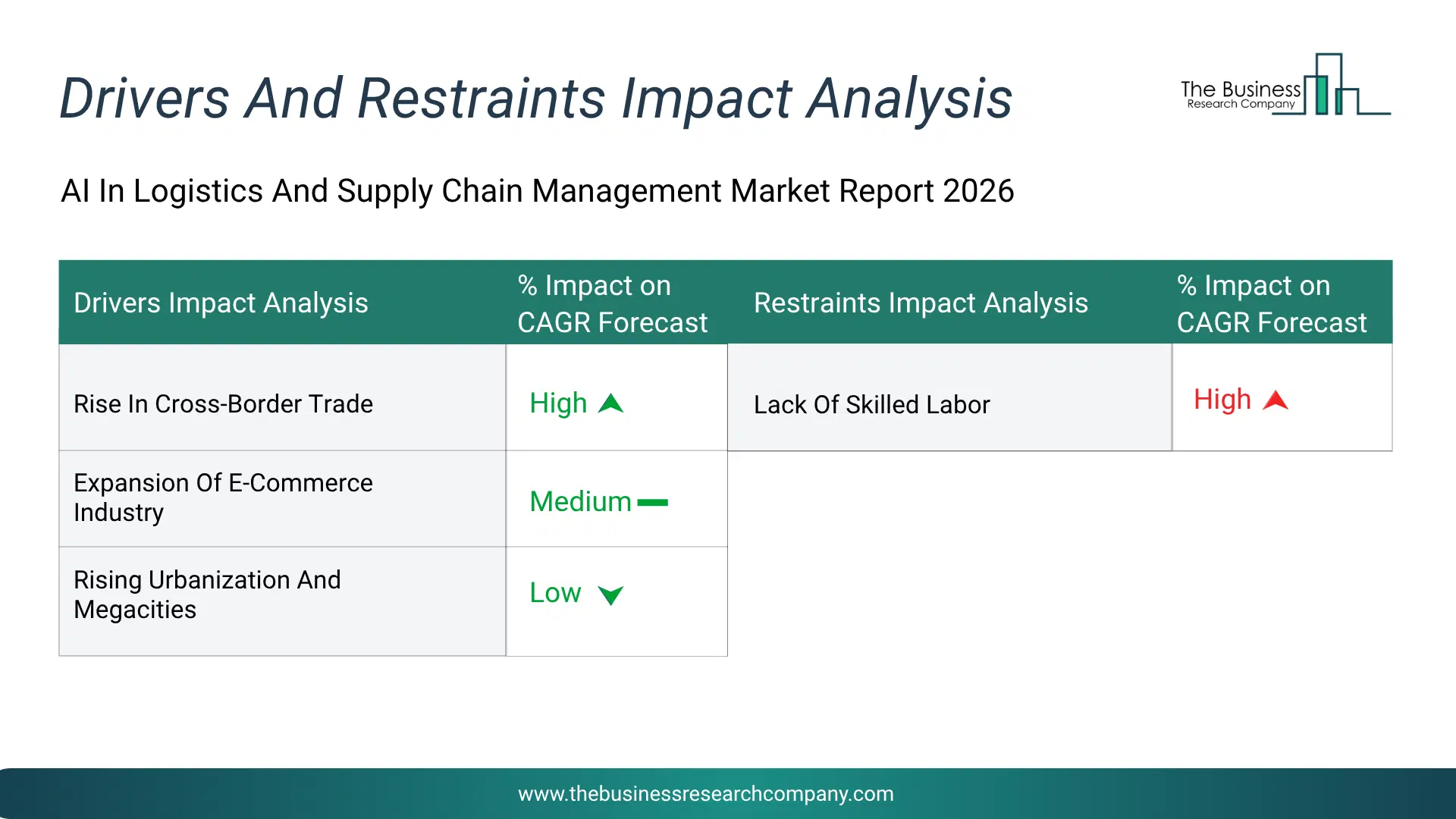
Infographic Chart Showing Key Market Drivers Analysis And Restraints For Ai In Logistics And Supply Chain Management Market
The chart presents an impact analysis of key drivers and restraints, quantifying their relative influence on the market's growth rate and helping assess the balance between growth enablers and limiting factors. This chart offers a high-level perspective; the full report contains more detailed insights.
How Will The Drivers Impact Growth In The Global AI In Logistics And Supply Chain Management Market?
• Rise In Cross-Border Trade (High) – The rise in cross-border trade will become a key driver of growth in the ai in logistics and supply chain management market by 2030. Cross-border trade refers to the exchange of goods, services, or capital between businesses or individuals located in different countries, involving the movement of products across international borders. Cross-border trade is rising due to globalization, advancements in technology, improved logistics and the growing demand for diverse products from international markets. AI in logistics and supply chain management is required for cross-border trade to optimize inventory management, streamline customs processes, predict demand, enhance route planning and improve real-time tracking and risk management across complex international supply chains. As a result, the rise in cross-border trade is anticipated to contributing to annual growth in the market. • Expansion Of E-Commerce Industry (Medium) – The expansion of e-commerce industry will emerge as a major factor driving the expansion of the market by 2030. E-commerce is rising due to increased internet penetration, convenience, a growing preference for online shopping and advancements in digital payment systems. AI in logistics and supply chain management is crucial for the e-commerce industry to optimize inventory management, automate order fulfilment and enhance delivery efficiency. It also helps predict demand patterns, personalize customer experiences and improve real-time tracking and route optimization, ensuring faster and more accurate services. As a result, the expansion of e-commerce industry is anticipated to contributing to annual growth in the market. • Rising Urbanization And Megacities (Low) – The rising urbanization and megacities will serve as a key growth catalyst for the market by 2030, Urbanization and megacities are rising due to economic opportunities, industrialization, improved infrastructure and better living standards attracting people from rural areas to urban centres. Urbanization and the growth of megacities drive the demand for efficient logistics and supply chain management, providing a vast amount of data for AI to analyse and optimize delivery routes, inventory management and resource allocation. The concentration of population and businesses in urban areas enables AI-powered solutions to enhance speed, reduce costs and improve last-mile delivery efficiency. As a result, the rising urbanization and megacities is anticipated to contributing to annual growth in the market. • Favorable Government Initiatives (Low) – The favourable government initiatives will become a significant driver contributing to the growth of the market by 2030. Automation is the use of technology and systems to perform tasks or processes with minimal human intervention, improving efficiency, accuracy and productivity. Automation is rising due to the growing demand for increased efficiency, cost reduction, improved accuracy and the ability to handle complex tasks in industries such as manufacturing, logistics and services. Automation enhances AI in logistics and supply chain management by streamlining repetitive tasks, allowing AI systems to focus on data analysis, optimization and decision-making. This synergy enables more efficient operations, faster processing times and improved accuracy in inventory management, route planning and demand forecasting. As a result, the favourable government initiatives is anticipated to contributing to annual growth in the market.How Will The Restraints Impact Growth In The Global AI In Logistics And Supply Chain Management Market?
• Lack Of Skilled Labor (High) – Lack Of Skilled Labor will restrict the growth of the AI In Logistics And Supply Chain Management market during the forecast period. The implementation and maintenance of AI logistics solutions require specialized skills in artificial intelligence, data science, and supply chain management. The shortage of qualified professionals in these areas limits the capacity of organizations to adopt AI technologies. This skill gap can lead to implementation challenges, suboptimal solutions, and reduced return on AI investments, slowing market adoption and growth.Key Players In The Global AI In Logistics And Supply Chain Management Market
Major companies operating in the AI in logistics and supply chain management market are Google LLC, Microsoft Corporation, Amazon Web Services Inc., General Electric Company, International Business Machines Corporation, Oracle Corporation, SAP SE, Zebra Technologies Corp., Databricks Inc., Manhattan Associates Inc., o9 Solutions Inc., Locus, Trax Technologies Ltd., SenseTime, Project44, FourKites Inc., Turvo Inc., Everstream Analytics, GreyOrange Pte. Ltd., Elementum Ltd., Ambi Robotics, ClearMetal Inc., Aurrigo International Plc, Nexocode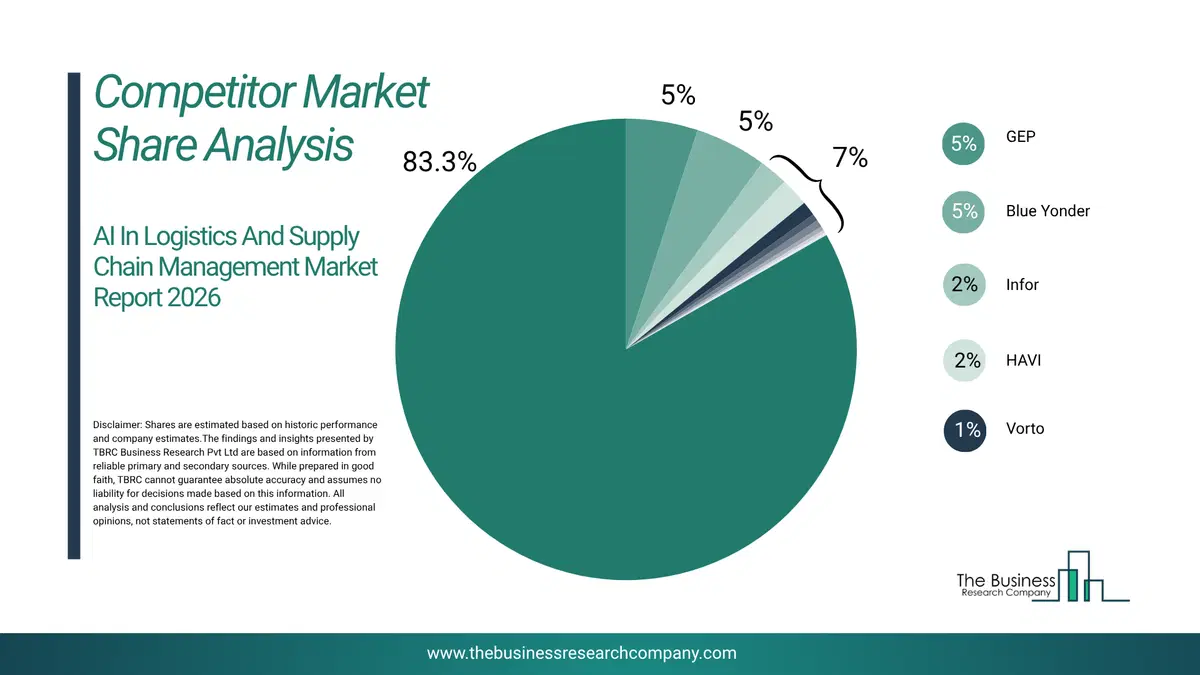
This chart is for illustrative purposes; the full report includes a detailed competitor analysis and comprehensive overview of the top 10 companies in the market.
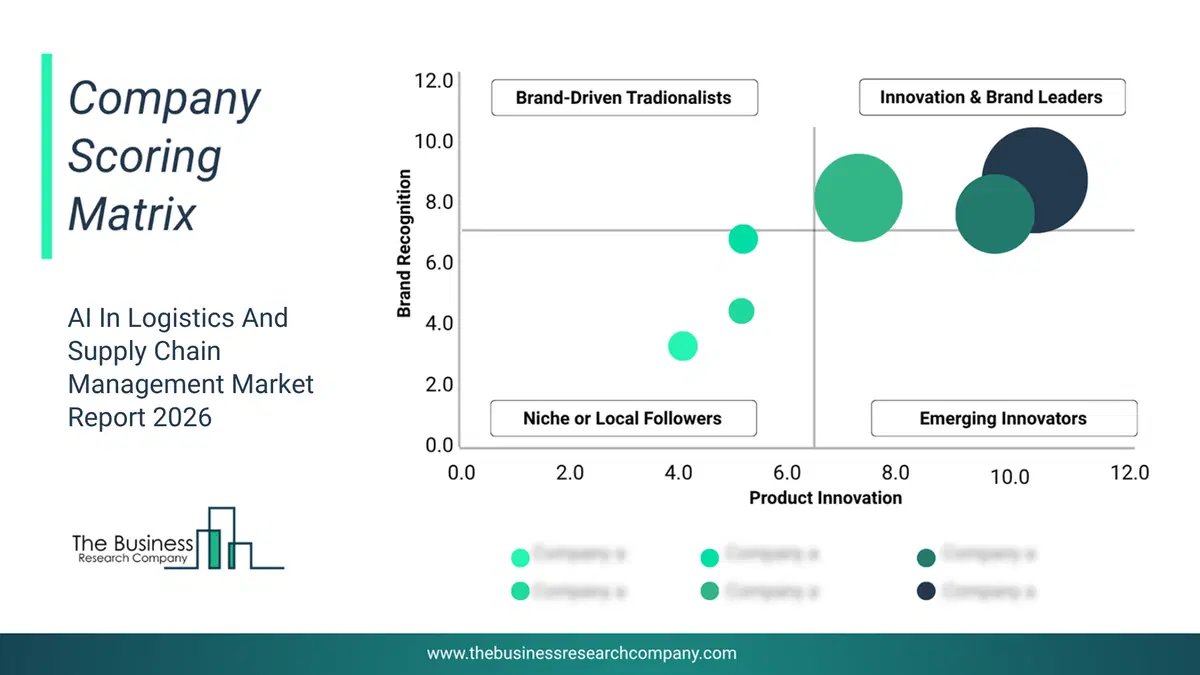
This chart maps companies by product innovation and brand strength, with bubble size indicating relative revenue, helping identify market leaders, challengers, and niche players. This is an illustrative chart; the full report provides a complete and accurate competitive analysis.
Global AI In Logistics And Supply Chain Management Market Trends and Insights
Major companies operating in the AI in logistics and supply chain management markets are developing technologically advanced products, such as AI-based supply chain management tools, to enhance efficiency and sustainability in operations. AI-based supply chain management tools leverage artificial intelligence to optimize various aspects of the supply chain, from planning and forecasting to logistics and customer service. For instance, in December 2023, Blue Yonder Group Inc., a US-based supply chain management company, launched the Blue Yonder Orchestrator, a state-of-the-art tool that utilizes artificial intelligence to optimize decision-making processes and improve supply chain orchestration. The tool's standout feature is its ability to enable business users to instantly access recommendations, predictive insights, and intelligent decisions, ensuring the best possible outcomes for their supply chain. This innovative capability combines large language models (LLMs), cloud data, and rapid engineering to provide personalized recommendations for supply chain decisions.What Are Latest Mergers And Acquisitions In The AI In Logistics And Supply Chain Management Market?
In August 2024, Blue Yonder, a US-based supply chain management company, acquired One Network Enterprises for $0.839 billion. This acquisition aligns with Blue Yonder’s strategy to enhance its real-time, AI-driven supply chain solutions, strengthening its position in the industry. With One Network’s technology, Blue Yonder customers can now collaborate seamlessly across all levels of their supply chain, engaging trading partners both upstream and downstream. One Network Enterprises is a US-based provider of real-time collaboration and AI solutions for supply chain management.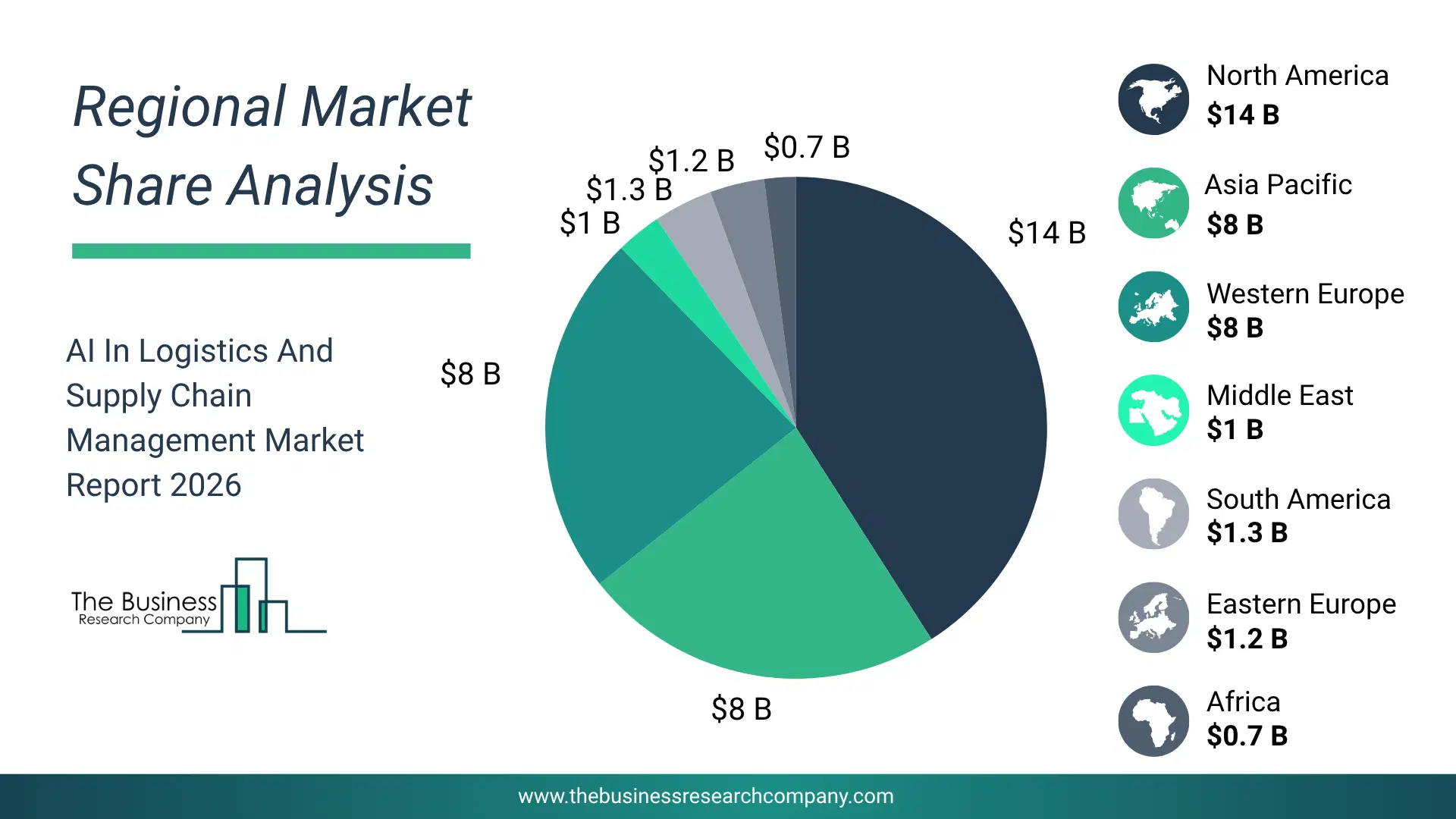
Regional Insights
North America was the largest region in the AI in logistics and supply chain management market in 2025. The regions covered in this market report are Asia-Pacific, South East Asia, Western Europe, Eastern Europe, North America, South America, Middle East, Africa. The countries covered in this market report are Australia, Brazil, China, France, Germany, India, Indonesia, Japan, Taiwan, Russia, South Korea, UK, USA, Canada, Italy, Spain.What Defines the AI In Logistics And Supply Chain Management Market?
The AI in logistics and supply chain management market consists of revenues earned by entities by providing services such as real-time traffic updates and re-routing, predictive analytics, supplier selection and relationship management and resource management. The market value includes the value of related goods sold by the service provider or included within the service offering. The AI in logistics and supply chain management market also includes sales of AI-based supply chain visibility tools, AI-based quality control systems and risk management systems. Values in this market are ‘factory gate’ values, that is the value of goods sold by the manufacturers or creators of the goods, whether to other entities (including downstream manufacturers, wholesalers, distributors and retailers) or directly to end customers. The value of goods in this market includes related services sold by the creators of the goods.How is Market Value Defined and Measured?
The market value is defined as the revenues that enterprises gain from the sale of goods and/or services within the specified market and geography through sales, grants, or donations in terms of the currency (in USD unless otherwise specified). The revenues for a specified geography are consumption values that are revenues generated by organizations in the specified geography within the market, irrespective of where they are produced. It does not include revenues from resales along the supply chain, either further along the supply chain or as part of other products.
This chart presents market attractiveness based on a quantitative evaluation of growth, competition, strategic alignment, and risk, offering a clear view of opportunity areas for decision-making. This chart is for illustrative purposes; the full report contains the complete analysis.

This chart highlights the Total Addressable Market (TAM) by estimating the maximum revenue opportunity using an assumption-driven approach, supporting strategic planning and opportunity sizing across markets. The chart is illustrative; the full report provides a more comprehensive analysis.
What Key Data and Analysis Are Included in the AI In Logistics And Supply Chain Management Market Report 2026?
The ai in logistics and supply chain management market research report is one of a series of new reports from The Business Research Company that provides market statistics, including industry global market size, regional shares, competitors with the market share, detailed market segments, market trends and opportunities, and any further data you may need to thrive in the ai in logistics and supply chain management industry. The market research report delivers a complete perspective of everything you need, with an in-depth analysis of the current and future state of the industry.AI In Logistics And Supply Chain Management Market Report Forecast Analysis
| Report Attribute | Details |
|---|---|
| Market Size Value In 2026 | $47.92 billion |
| Revenue Forecast In 2030 | $189.29 billion |
| Growth Rate | CAGR of 40.8% from 2026 to 2030 |
| Base Year For Estimation | 2025 |
| Actual Estimates/Historical Data | 2020-2025 |
| Forecast Period | 2026 - 2030 |
| Market Representation | Revenue in USD Billion and CAGR from 2026 to 2030 |
| Segments Covered | Offering, Type, Deployment, Application, End User |
| Regional Scope | Asia-Pacific, Western Europe, Eastern Europe, North America, South America, Middle East, Africa |
| Country Scope | The countries covered in the report are Australia, Brazil, China, France, Germany, India, Indonesia, Japan, Taiwan, Russia, South Korea, UK, USA, Canada, Italy, Spain. |
| Key Companies Profiled | Google LLC, Microsoft Corporation, Amazon Web Services Inc., General Electric Company, International Business Machines Corporation, Oracle Corporation, SAP SE, Zebra Technologies Corp., Databricks Inc., Manhattan Associates Inc., o9 Solutions Inc., Locus, Trax Technologies Ltd., SenseTime, Project44, FourKites Inc., Turvo Inc., Everstream Analytics, GreyOrange Pte. Ltd., Elementum Ltd., Ambi Robotics, ClearMetal Inc., Aurrigo International Plc, Nexocode |
| Customization Scope | Request for Customization |
| Pricing And Purchase Options | Explore Purchase Options |