
E-Commerce Logistics Market Report 2026
Global Outlook – By Service Type (Transportation, Warehousing, Value-Added Services), By Operational Area (Domestic, International), By Delivery Type (Standard Delivery, Same-Day Delivery), By Category (Apparels and Lifestyle, Automotive, Books and Periodicals, Engineering, FMCG and Consumer Electronics, Healthcare, Hi-Tech, Other Categories), By End-User (B2B, B2C) – Market Size, Trends, Strategies, and Forecast to 2030
E-Commerce Logistics Market Overview
• E-Commerce Logistics market size has reached to $842.8 billion in 2025 • Expected to grow to $1666.91 billion in 2030 at a compound annual growth rate (CAGR) of 14.6% • Growth Driver: E-Commerce Logistics Market Thriving On The Growth Of Cross-Border Trade • Market Trend: Revolutionizing E-Commerce Logistics The Impact of Technological Advancements and Strategic Partnerships • Asia-Pacific was the largest region and fastest growing region.What Is Covered Under E-Commerce Logistics Market?
E-commerce logistics refers to the process of providing shipping services to online businesses, and it involves inventory management, warehousing, packaging, labelling, billing, shipping, payment collection, return, and exchange of delivered products. E-commerce logistics are used to deliver products to online businesses or customers. The main types of e-commerce logistics are transportation, warehousing, and value-added services. Transportation refers to the movement of goods and people from place to place and the various means by which such movement is accomplished. The operational area includes domestic and international and is delivered through standard delivery and same-day delivery. Several categories involved are apparel and lifestyle, automotive, books and periodicals, engineering, FMCG, consumer electronics, healthcare, hi-tech, and other categories. The end-users involved are B2B and B2C.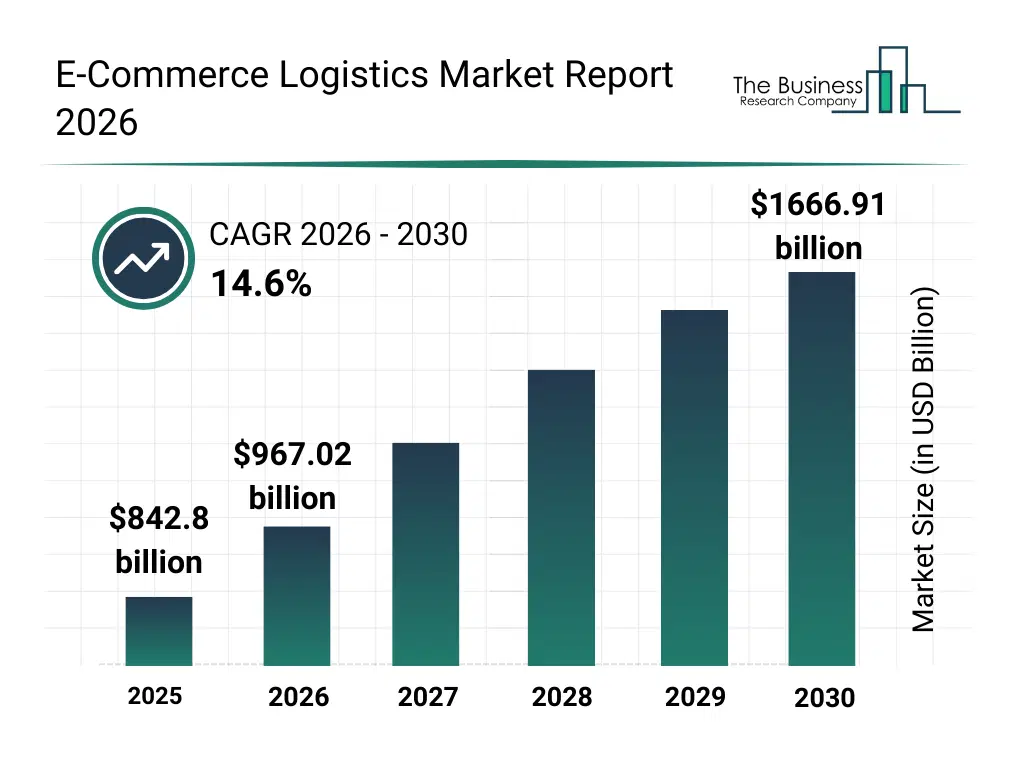
What Is The E-Commerce Logistics Market Size and Share 2026?
The e-commerce logistics market size has grown rapidly in recent years. It will grow from $842.8 billion in 2025 to $967.02 billion in 2026 at a compound annual growth rate (CAGR) of 14.7%. The growth in the historic period can be attributed to expansion of online retail platforms, rising consumer preference for doorstep delivery, growth of digital payment ecosystems, increasing warehouse network expansion, improvements in transportation infrastructure.What Is The E-Commerce Logistics Market Growth Forecast?
The e-commerce logistics market size is expected to see rapid growth in the next few years. It will grow to $1666.91 billion in 2030 at a compound annual growth rate (CAGR) of 14.6%. The growth in the forecast period can be attributed to increasing investment in smart logistics solutions, rising demand for sustainable delivery models, expansion of autonomous delivery technologies, growing focus on real-time supply chain visibility, increasing cross-border e-commerce activity. Major trends in the forecast period include increasing adoption of automated fulfillment centers, rising demand for same-day and express delivery, growing integration of ai-driven logistics platforms, expansion of cross-border e-commerce logistics, enhanced focus on last-mile optimization.
Global E-Commerce Logistics Market Segmentation
1) By Service Type: Transportation, Warehousing, Value-Added Services 2) By Operational Area: Domestic, International 3) By Delivery Type: Standard Delivery, Same-Day Delivery 4) By Category: Apparels and Lifestyle, Automotive, Books and Periodicals, Engineering, FMCG and Consumer Electronics, Healthcare, Hi-Tech, Other Categories 5) By End-User: B2B, B2C Subsegments: 1) By Transportation: Last-Mile Delivery, Freight Transportation, Express Delivery, Cross-Border Shipping 2) By Warehousing: Fulfillment Centers, Distribution Centers, Cold Storage Facilities 3) By Value-Added Services: Packaging And Labeling, Kitting And Assembly, Inventory Management, Returns ProcessingWhat Is The Driver Of The E-Commerce Logistics Market?
The growth in cross-border trade is expected to boost the growth of the e-commerce logistics market going forward. Cross-border trade, also known as international trade or foreign trade, refers to the exchange of goods, services, or commodities between countries. The growth in cross-border trade not only expands the market for e-commerce logistics services but also fuels innovation and specialization in this sector, as logistics providers strive to meet the unique challenges of international commerce. For instance, in August 2023, according to a report published by the Organization for Economic Co-operation and Development, a France-based intergovernmental organization, during Q2 2023, there was an estimated growth of 0.2% in exports, building on the strong performance of 4.5% growth in exports and 8.8% growth in imports during Q1 2023. Notably, services exports in the United States saw a 1.0% increase. Therefore, the growth in cross-border trade is driving the growth of the e-commerce logistics industry.Key Players In The Global E-Commerce Logistics Market
Major companies operating in the e-commerce logistics market are DHL International GmbH; Aramex International; FedEx Corporation; S. F. Express (ShunFeng) Co. Ltd; Ceva Holdings LLC; United Parcel Service Inc.; Amazon. com Inc.; Clipper Logistics PLC.; Deutsche Post AG; Gati Limited; C. H. Robinson Worldwide Inc.; Kerry Logistics Network Limited; Nippon Express Co Ltd.; Kenco Group Inc.; Agility Public Warehousing Company K. S. C. P; Blue Dart; Desk To Desk Courier and Cargo; Ekart Logistics; Shadowfax Technologies Ltd.; XpressBees; Ecom Express; XPO Logistics Plc.; DB Schenker; DSV Panalpina A/S; Expeditors International of Washington Inc.; GEODIS; Kuehne + Nagel International AG; Sinotrans Ltd.; Yusen Logistics Co. Ltd.; ZTO Express Inc.
This chart is for illustrative purposes; the full report includes a detailed competitor analysis and comprehensive overview of the top 10 companies in the market.
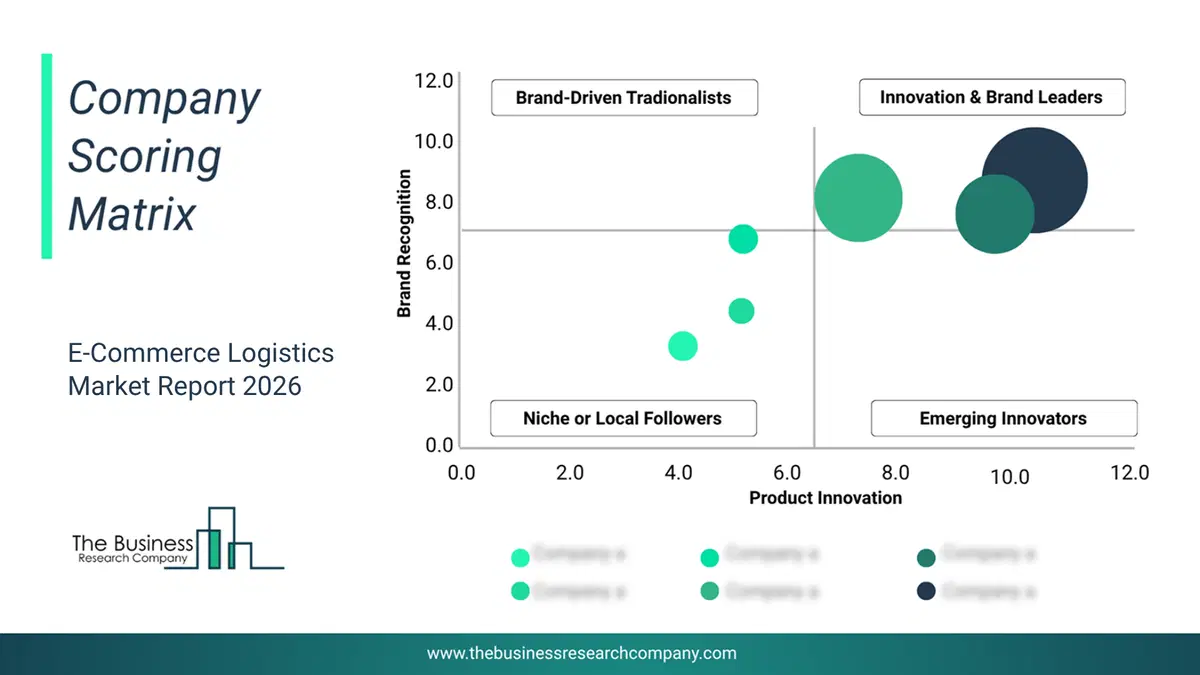
This chart maps companies by product innovation and brand strength, with bubble size indicating relative revenue, helping identify market leaders, challengers, and niche players. This is an illustrative chart; the full report provides a complete and accurate competitive analysis.
Global E-Commerce Logistics Market Trends and Insights
Major companies operating in the e-commerce logistics market are increasingly focusing on technological advancements such as blockchain, automation, and proprietary technologies to enhance operational efficiency, strengthen security, and elevate the overall consumer experience. These innovations help reduce delivery time and cost, improve visibility across the supply chain, and support more reliable and transparent logistics operations. For instance, in September 2024, Parcel Perform PTE, a US-based logistics platform and software company, launched a partnership program aimed at transforming the e-commerce delivery experience. The initiative fosters collaboration among key players in the e-commerce logistics ecosystem, enabling them to enhance their service offerings through shared technology and data-driven insights. By building a connected network of stakeholders, the program seeks to redefine the value of technology and services within the industry, boosting operational capabilities and improving customer satisfaction.What Are Latest Mergers And Acquisitions In The E-Commerce Logistics Market?
In October 2023, GXO Logistics, Inc., a US-based logistics company managing outsourced supply chains, warehousing, and reverse logistics for leading clients across more than thirty countries, acquired PFSweb Inc. for $181 million. With this acquisition, GXO Logistics, Inc., aims to enhance its capabilities in high-growth verticals like cosmetics and luxury goods, expand its customer base through established relationships with premium brands, and improve operational efficiency in e-commerce fulfillment services. PFSweb Inc., a US-based company, provides eCommerce fulfillment and logistics services for consumer brands and internet retailers.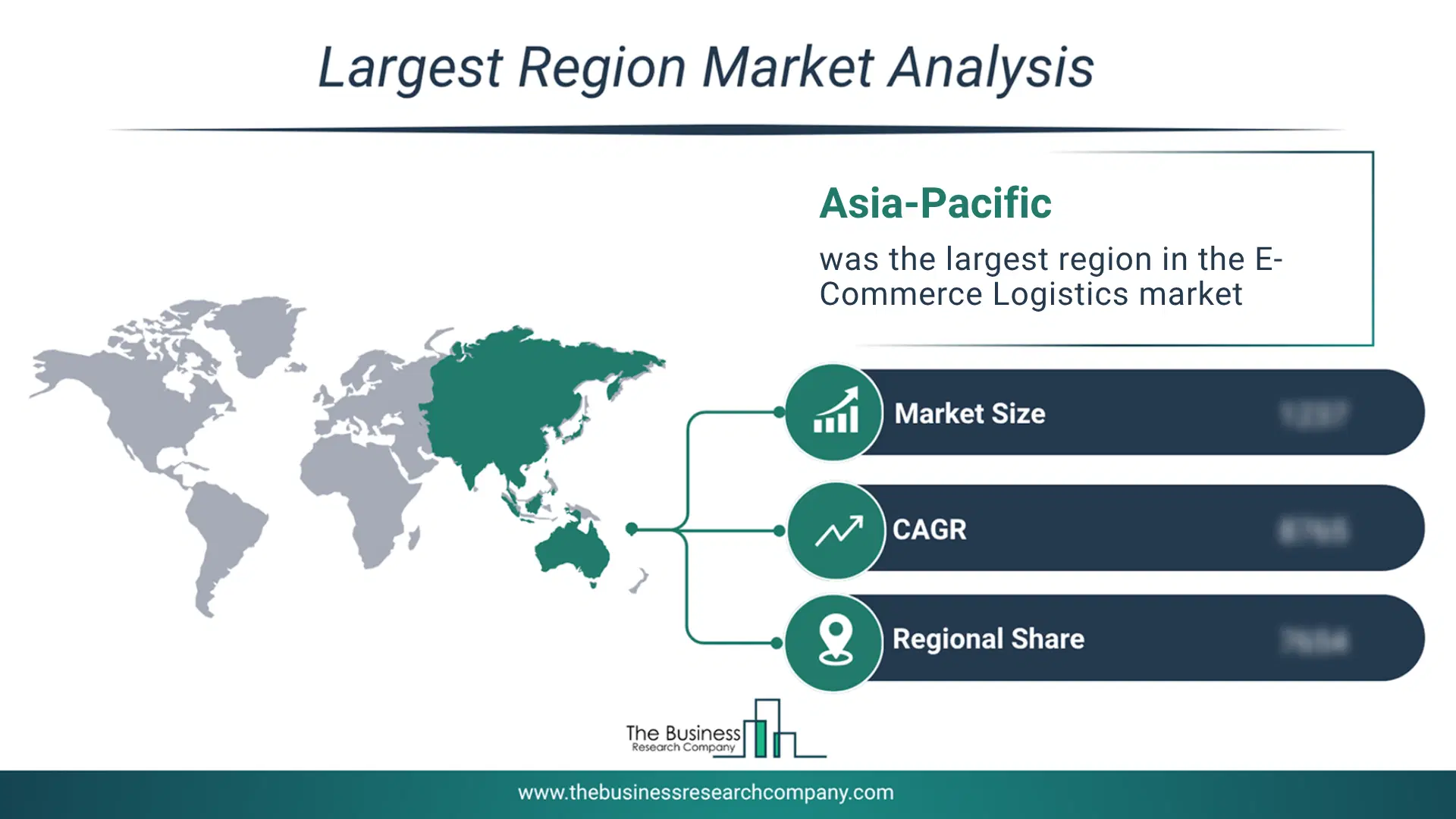
Regional Insights
Asia-Pacific was the largest region in the e-commerce logistics market in 2025.Asia-Pacific is expected to be the fastest-growing region in the forecast period. The regions covered in this market report are Asia-Pacific, South East Asia, Western Europe, Eastern Europe, North America, South America, Middle East, Africa. The countries covered in this market report are Australia, Brazil, China, France, Germany, India, Indonesia, Japan, Taiwan, Russia, South Korea, UK, USA, Canada, Italy, SpainWhat Defines the E-Commerce Logistics Market?
The e-commerce logistics market consists of revenues earned by entities by providing drop shipping, wholesaling and warehousing and white labelling services. Values in this market are ‘factory gate’ values, that is the value of goods sold by the manufacturers or creators of the goods, whether to other entities (including downstream manufacturers, wholesalers, distributors, and retailers) or directly to end customers. The value of goods in this market includes related services sold by the creators of the goods.How is Market Value Defined and Measured?
The market value is defined as the revenues that enterprises gain from the sale of goods and/or services within the specified market and geography through sales, grants, or donations in terms of the currency (in USD unless otherwise specified). The revenues for a specified geography are consumption values that are revenues generated by organizations in the specified geography within the market, irrespective of where they are produced. It does not include revenues from resales along the supply chain, either further along the supply chain or as part of other products.
This chart presents market attractiveness based on a quantitative evaluation of growth, competition, strategic alignment, and risk, offering a clear view of opportunity areas for decision-making. This chart is for illustrative purposes; the full report contains the complete analysis.

This chart highlights the Total Addressable Market (TAM) by estimating the maximum revenue opportunity using an assumption-driven approach, supporting strategic planning and opportunity sizing across markets. The chart is illustrative; the full report provides a more comprehensive analysis.
What Key Data and Analysis Are Included in the E-Commerce Logistics Market Report 2026?
The e-commerce logistics market research report is one of a series of new reports from The Business Research Company that provides market statistics, including industry global market size, regional shares, competitors with the market share, detailed market segments, market trends and opportunities, and any further data you may need to thrive in the e-commerce logistics industry. The market research report delivers a complete perspective of everything you need, with an in-depth analysis of the current and future state of the industry.E-Commerce Logistics Market Report Forecast Analysis
| Report Attribute | Details |
|---|---|
| Market Size Value In 2026 | $967.02 billion |
| Revenue Forecast In 2030 | $1666.91 billion |
| Growth Rate | CAGR of 14.6% from 2026 to 2030 |
| Base Year For Estimation | 2025 |
| Actual Estimates/Historical Data | 2020-2025 |
| Forecast Period | 2026 - 2030 |
| Market Representation | Revenue in USD Billion and CAGR from 2026 to 2030 |
| Segments Covered | Service Type, Operational Area, Delivery Type, Category, End-User |
| Regional Scope | Asia-Pacific, Western Europe, Eastern Europe, North America, South America, Middle East, Africa |
| Country Scope | The Countries Covered In This Market Report Are Australia, Brazil, China, France, Germany, India, Indonesia, Japan, Taiwan, Russia, South Korea, Uk, Usa, Canada, Italy, Spain. |
| Key Companies Profiled | DHL International GmbH, Aramex International, FedEx Corporation, S. F. Express (ShunFeng) Co. Ltd, Ceva Holdings LLC, United Parcel Service Inc., Amazon. com Inc., Clipper Logistics PLC., Deutsche Post AG, Gati Limited, C. H. Robinson Worldwide Inc., Kerry Logistics Network Limited, Nippon Express Co Ltd., Kenco Group Inc., Agility Public Warehousing Company K. S. C. P, Blue Dart, Desk To Desk Courier and Cargo, Ekart Logistics, Shadowfax Technologies Ltd., XpressBees, Ecom Express, XPO Logistics Plc., DB Schenker, DSV Panalpina A/S, Expeditors International of Washington Inc., GEODIS, Kuehne + Nagel International AG, Sinotrans Ltd., Yusen Logistics Co. Ltd., ZTO Express Inc. |
| Customization Scope | Request for Customization |
| Pricing And Purchase Options | Explore Purchase Options |