

Contact Us
  Search
The Business Research Company Logo
AI Infrastructure Global Market Opportunities And Strategies To 2035
Published :July 2026
Pages :401
Format :PDF
Delivery Time :2-3 Business Days
Why 2-3 days? We update the report with the latest data and news before delivery. Let us know if you need us to expedite.
Report Price :$4,490.00

AI Infrastructure Global Market Opportunities And Strategies To 2035

By Offerings (Hardware, Server Software), By Function (Training, Inference), By Technology (Machine Learning, Deep Learning, Other Technologies), By Deployment Type (On-Premises, Cloud, Hybrid), By End User (Enterprises, Government Organizations, Cloud Service Providers), And By Region, Opportunities And Strategies – Global Forecast To 2035

AI Infrastructure Market Definition

AI infrastructure refers to the integrated ecosystem of hardware, software, networking, storage and computational resources designed to develop, train, deploy and operate artificial intelligence (AI) models and applications. AI infrastructure provides the foundational environment required for processing large datasets, executing complex algorithms and supporting machine learning and deep learning workloads across industries. The AI infrastructure market consist of sales by entities (organizations, sole traders and partnerships) that provide AI-focused hardware systems, server software, cloud-based AI platforms and related infrastructure services that enable the development, deployment and management of AI workloads.
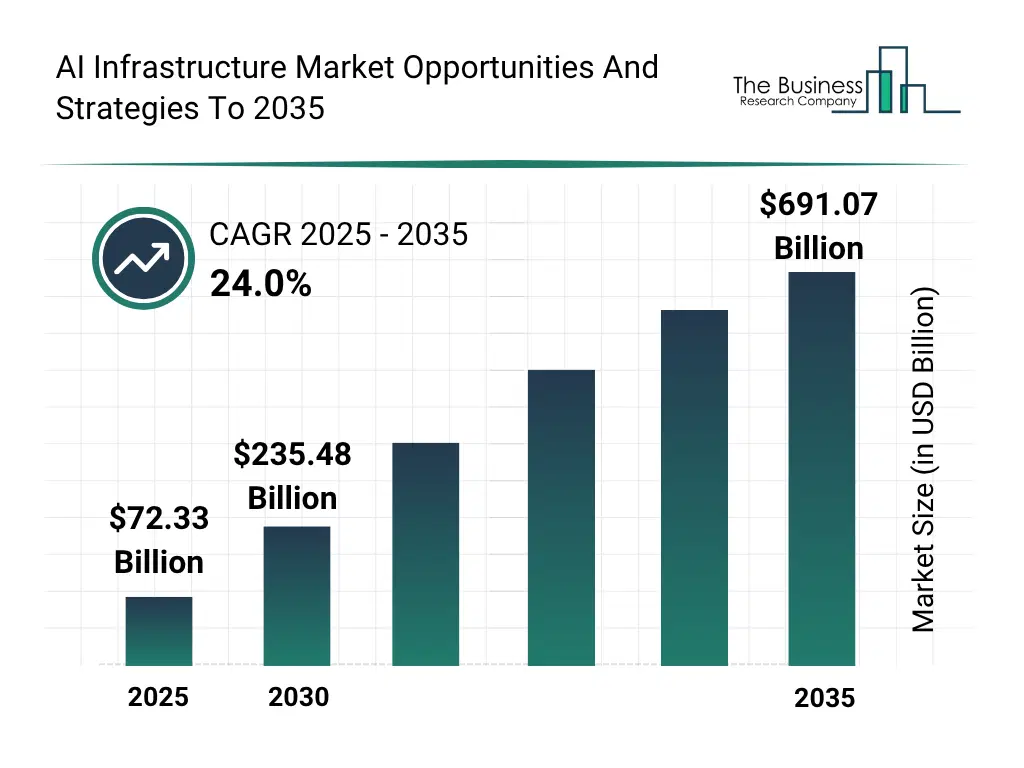
AI Infrastructure Global Market Opportunities And Strategies To 2035 Market Size and growth rate 2026 to 2030: Graph

AI Infrastructure Market Size

The global AI infrastructure market reached a value of nearly $72,333.2 million in 2025, having grown at a compound annual growth rate (CAGR) of 29.5% since 2020. The market is expected to grow from $72,333.2 million in 2025 to $235,482.2 million in 2030 at a rate of 26.6%. The market is then expected to grow at a CAGR of 24.0% from 2030 and reach $691,074.5 million in 2035. Growth in the historic period resulted from expansion of ai-driven industrial IoT ecosystems, expansion of cloud computing services, increase in data traffic and government funding and semiconductor incentive programs. Factors that negatively affected growth in the historic period were thermal management and cooling challenges and data privacy and protection laws. Going forward, rapid digital transformation across enterprises, increasing enterprise AI adoption across industries, growing demand for high-performance computing (HPC) infrastructure and growing adoption of AI-As-A-Service (AIaaS) platforms will drive the growth. Factors that could hinder the growth of the high capital investment requirements and shortage of skilled professionals in AI infrastructure engineering and operations and impact of trade wars and tariffs.
Research Expert

Book your 30 minutes free consultation with our research experts

AI Infrastructure Market Segmentation

The AI infrastructure market is segmented by offerings, by function, by technology, by deployment type, and by end user.

By Offerings –
The AI infrastructure market is segmented by offerings into:
    • a) Hardware
    • b) Server Software
The hardware market was the largest segment of the AI infrastructure market segmented by offerings, accounting for 54.6% or $39,467.4 million of the total in 2025. Going forward, the server software segment is expected to be the fastest growing segment in the AI infrastructure market segmented by offerings, at a CAGR of 31.1% during 2025-2030.

By Function –
The AI infrastructure market is segmented by function into:
    • a) Training
    • b) Inference
The training market was the largest segment of the AI infrastructure market segmented by function, accounting for 70.5% or $50,993.7 million of the total in 2025. Going forward, the inference segment is expected to be the fastest growing segment in the AI infrastructure market segmented by function, at a CAGR of 27.7% during 2025-2030.

By Technology –
The AI infrastructure market is segmented by technology into:
    • a) Machine Learning
    • b) Deep Learning
    • c) Other Technologies
The machine learning market was the largest segment of the AI infrastructure market segmented by technology, accounting for 52.2% or $37,775.4 million of the total in 2025. Going forward, the deep learning segment is expected to be the fastest growing segment in the AI infrastructure market segmented by technology, at a CAGR of 31.7% during 2025-2030.

By Deployment Type –
The AI infrastructure market is segmented by deployment type into:
    • a) On-Premises
    • b) Cloud
    • c) Hybrid
The cloud market was the largest segment of the AI infrastructure market segmented by deployment type, accounting for 54.1% or $39,159.8 million of the total in 2025. Going forward, the hybrid segment is expected to be the fastest growing segment in the AI infrastructure market segmented by deployment type, at a CAGR of 54.1% during 2025-2030.

By End User –
The AI infrastructure market is segmented by end user into:
    • a) Enterprises
    • b) Government Organizations
    • c) Cloud Service Providers
The cloud service providers market was the largest segment of the AI infrastructure market segmented by end user, accounting for 46.4% or $33,530.5 million of the total in 2025. Going forward, the enterprises segment is expected to be the fastest growing segment in the AI infrastructure market segmented by end user, at a CAGR of 30.4% during 2025-2030.

By Geography - The AI infrastructure market is segmented by geography into:
      o Asia Pacific
      • China
      • India
      • Japan
      • Australia
      • Indonesia
      • South Korea
      o North America
      • USA
      • Canada
      o South America
      • Brazil
      o Western Europe
      • France
      • Germany
      • UK
      • Italy
      • Spain
      o Eastern Europe
      • Russia
      o Middle East
      o Africa
North America was the largest region in the AI infrastructure market, accounting for 37.9% or $27,420.9 million of the total in 2025. It was followed by Asia Pacific, Western Europe and then the other regions. Going forward, the fastest-growing regions in the AI infrastructure market will be Asia Pacific and Middle East where growth will be at CAGRs of 31.2% and 29.2% respectively. These will be followed by Africa and South America where the markets are expected to grow at CAGRs of 27.3% and 26.7% respectively.

AI Infrastructure Market Drivers

The key drivers of the AI infrastructure market include: Increasing Enterprise AI Adoption Across Industries The increasing enterprise AI adoption across industries is expected to propel the growth of the AI infrastructure market during the forecast period. The rapid expansion of mobile broadband usage, cloud computing, video streaming, connected devices and AI-driven applications has significantly increased the volume of data generated, transmitted and processed worldwide. AI infrastructure, including hyperscale data centers, high-performance networking systems, GPUs, storage solutions and edge computing platforms, plays a critical role in managing rising data workloads while ensuring low latency, scalability and efficient processing capabilities. The growing demand for real-time analytics and AI model training has encouraged technology providers and enterprises to expand and modernize digital infrastructure to accommodate surging traffic volumes and maintain service performance. The increasing enterprise AI adoption across industries growth contribution during the forecast period in 2026 is 1.5%.

AI Infrastructure Market Restraints

The key restraints on the AI infrastructure market include: High Capital Investment Requirements High capital investment requirements is expected to hinder the growth of the AI infrastructure market in the forecast period. AI infrastructure development requires substantial capital investment for advanced semiconductors, high-performance servers, data centers, networking systems and power infrastructure. The growing need for GPUs, AI accelerators and advanced cooling technologies significantly increases upfront deployment and operational costs for infrastructure providers. Smaller enterprises and emerging markets often face financial limitations in adopting large-scale AI computing environments due to these high investment requirements. These cost pressures can slow infrastructure expansion, delay technology adoption and restrict scalability across the AI ecosystem. Growth affected by the high capital investment requirements during the forecast period in 2026 is -3.0%.

AI Infrastructure Market Competitive Landscape

Major Competitors are:

  • NVIDIA Corp.
  • Amazon.com Inc.
  • Microsoft Corporation (Microsoft Azure)
  • Google LLC
  • Oracle Corp.
  • Other Competitors Include:

  • Meta Platforms Inc.
  • Advanced Micro Devices Inc.
  • International Business Machines Corporation
  • Hewlett Packard Enterprise Company
  • Dell Technologies Inc.
  • Baidu Cloud
  • Alibaba Cloud
  • Tencent Cloud
  • Micron Technology Inc.
  • Cambricon Technologies Corporation Limited
  • NEC Corporation
  • Fujitsu Limited
  • NTT Data Corporation
  • Hitachi, Ltd.
  • Intel Corporation
  • Samsung Group
  • Naver Cloud
  • SK Hynix Inc.
  • SenseTime Group Limited
  • Taiwan Semiconductor Manufacturing Company (TSMC)
  • MediaTek
  • Foxconn
  • Quanta Computer
  • NVIDIA Taiwan
  • Taiwan AI Cloud
  • ASUS
  • Chunghwa Telecom
  • Wistron Corporation
  • YTL Power International
  • Equinix
  • SpaceDC
  • Digital Edge
  • FPT Corporation
  • BDx Data Centers
  • AIMS Data Centre
  • STT GDC Pte. Ltd.
  • Apper Digital Inc.
  • Lightweight Solutions
  • Zenlayer
  • Singtel
  • Xilinx Inc.
  • Habana Labs Limited
  • Tenstorrent Inc.
  • Graphcore Limited
  • Pure Storage Inc.
  • Nutanix Inc.
  • Imagination Technologies Limited
  • Cisco Systems Inc.
  • Toshiba Corporation
  • Gyrfalcon Technology Inc.
  • Nscale
  • Nokia Corporation
  • IREN (Iris Energy)
  • Deutsche Telekom
  • G42
  • Scala Data Centers
  • OpenAI
  • Nebius
  • Yandex
  • Beyond.pl
  • Core42
  • SabancıDx
  • DataVolt
  • Need data on a specific region in this market?

    Opportunities And Recommendations In The AI Infrastructure Market

    Opportunities – The top opportunities in the AI infrastructure market segmented by offerings will arise in the server software segment, which will gain $94,218.6 million of global annual sales by 2030. The top opportunities in the AI infrastructure market segmented by function will arise in the training segment, which will gain $111,962.4 million of global annual sales by 2030. The top opportunities in the AI infrastructure market segmented by technology will arise in the machine learning segment, which will gain $75,945.5 million of global annual sales by 2030. The top opportunities in the AI infrastructure market segmented by deployment type will arise in the cloud segment, which will gain $95,674.3 million of global annual sales by 2030. The top opportunities in the AI infrastructure market segmented by end user will arise in the enterprises segment, which will gain $71,860.0 million of global annual sales by 2030. The AI infrastructure market size will gain the most in the USA at $43,395.9 million. Recommendations- To take advantage of the opportunities, The Business Research Company recommends the AI infrastructure companies to focus on integrated AI-ready infrastructure platforms, focus on enterprise AI factory platforms for scalable deployment, focus on distributed AI infrastructure for edge and multicloud operations, focus on AI-ready IoT infrastructure for edge intelligence, focus on server software solutions for AI infrastructure, focus on AI inference infrastructure expansion, focus on deep learning infrastructure capabilities, focus on hybrid AI infrastructure deployment, expand in emerging markets, continue to focus on developed markets, focus on regional partnerships and multi-channel distribution expansion, focus on tiered and usage-based pricing models, focus on industry education and strategic partnerships, focus on developer engagement and account-based marketing, focus on enterprise AI infrastructure demand.
    Chat with us