
Aircraft Survivability Equipment Market Report 2026
Global Outlook – By Component (Hardware, Software, Services), By Technology (Active, Passive), By Fit (Line, Forward), By Application (Combat Aircraft, Combat Helicopter, Special Mission Aircraft, Unmanned Aerial Vehicle (UAV)) – Market Size, Trends, Strategies, and Forecast to 2030
Aircraft Survivability Equipment Market Overview
• Aircraft Survivability Equipment market size has reached to $4.66 billion in 2025 • Expected to grow to $6.39 billion in 2030 at a compound annual growth rate (CAGR) of 6.7% • Growth Driver: Increasing Accidents Boost The Aircraft Survivability Equipment Market • Market Trend: Innovative AI-Enabled VTOL Solutions For Enhanced Combat Survivability • North America was the largest region in 2025.What Is Covered Under Aircraft Survivability Equipment Market?
Aircraft survivability equipment refers to a collection of linked electronic devices and systems, and countermeasures designed to protect aircraft and crews by detecting and defeating threats to the aircraft, such as laser-guided RF missiles, and unguided bombs. It reduces the vulnerability of aircraft, allowing aircrews to accomplish their missions safely and effectively. The main components of aircraft survivability equipment are hardware, software, and services. Hardware refers to the actual parts of an electrical device or computer system. It is based on various technologies, such as active and passive, and comes in line and forward-fit sizes. It is used for various applications such as combat aircraft, combat helicopters, special mission aircraft, and unmanned aerial vehicles (UAV).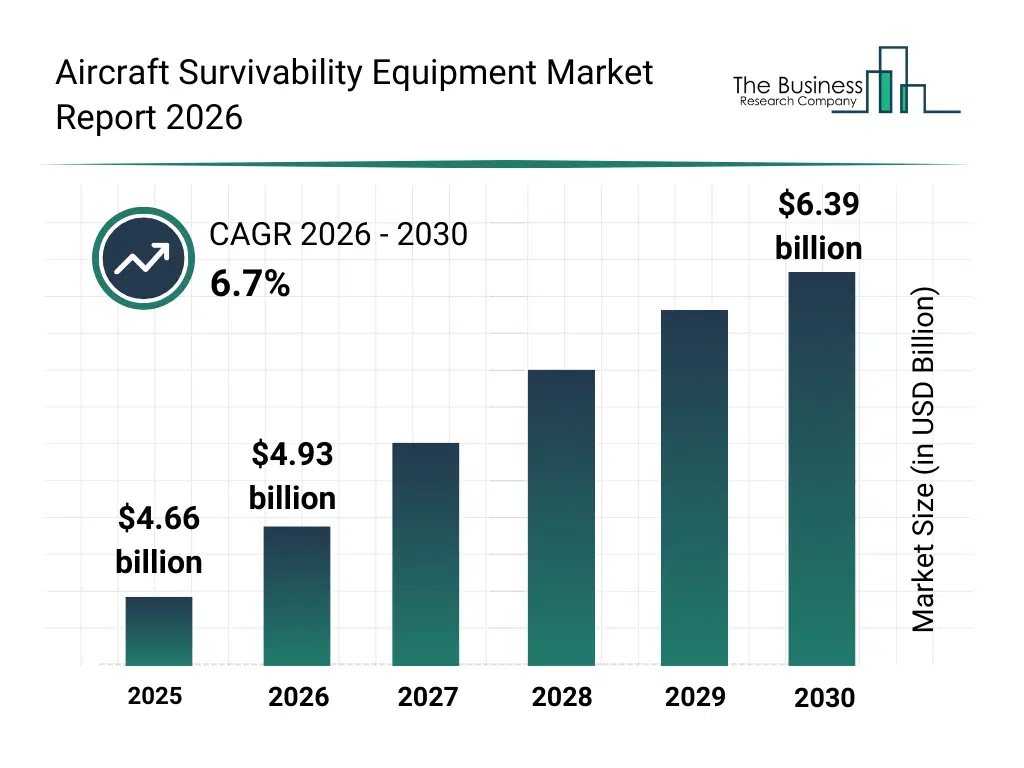
What Is The Aircraft Survivability Equipment Market Size and Share 2026?
The aircraft survivability equipment market size has grown strongly in recent years. It will grow from $4.66 billion in 2025 to $4.93 billion in 2026 at a compound annual growth rate (CAGR) of 5.7%. The growth in the historic period can be attributed to increased military aircraft modernization programs driving procurement of missile detection and warning systems, rising operational deployments elevating demand for armor plating, self-sealing fuel tanks, and ice protection systems, advancements in electronic countermeasure technologies enhancing aircraft survivability performance, growth in manufacturer-provided warranty-period maintenance and system integration services, expanded adoption of lightning strike protection and emergency escape systems across fixed- and rotary-wing fleets.What Is The Aircraft Survivability Equipment Market Growth Forecast?
The aircraft survivability equipment market size is expected to see strong growth in the next few years. It will grow to $6.39 billion in 2030 at a compound annual growth rate (CAGR) of 6.7%. The growth in the forecast period can be attributed to growing demand for next-generation survivability suites capable of countering advanced guided missile threats, increasing integration of multi-sensor detection and tracking systems for real-time threat response, rising procurement of lightweight yet high-strength protective materials to improve aircraft performance, expanding deployment of survivability equipment across unmanned aerial systems, expected growth in comprehensive lifecycle service packages including upgrades, diagnostics, and predictive maintenance for survivability equipment. Major trends in the forecast period include integration of advanced missile and threat detection systems, miniaturization of survivability equipment for lightweight aircraft, enhanced situational awareness through sensor fusion, development of multi-layered electronic countermeasures, adoption of predictive maintenance and performance monitoring.
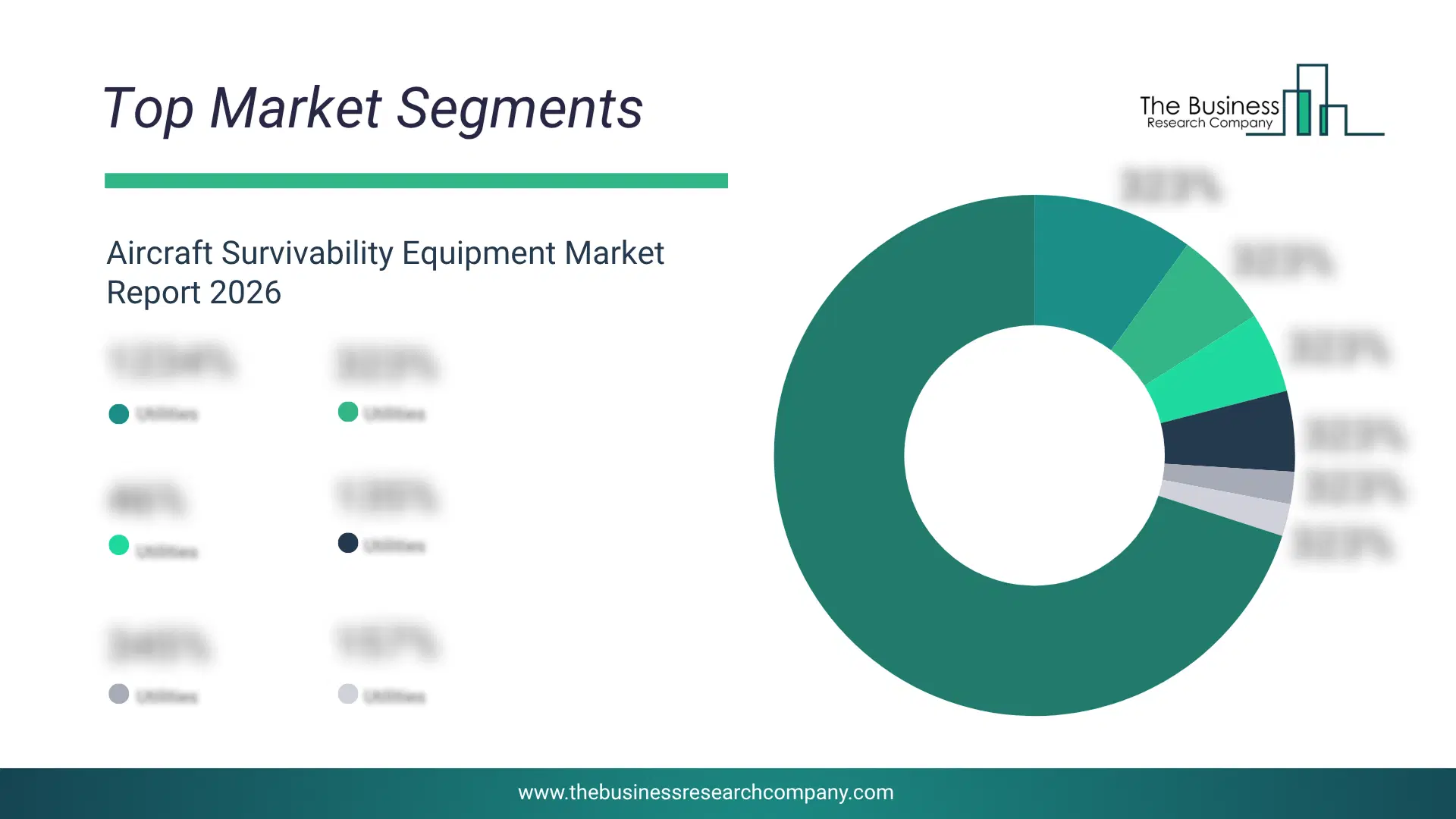
Global Aircraft Survivability Equipment Market Segmentation
1) By Component: Hardware, Software, Services 2) By Technology: Active, Passive 3) By Fit: Line, Forward 4) By Application: Combat Aircraft, Combat Helicopter, Special Mission Aircraft, Unmanned Aerial Vehicle (UAV) Subsegments: 1) By Hardware: Electronic Warfare Systems, Countermeasure Systems, Sensors And Detectors, Ballistic Protection Systems 2) By Software: Threat Detection Software, Situational Awareness Software, Data Analysis And Fusion Software 3) By Services: Installation And Integration Services, Maintenance And Support Services, Training ServicesWhat Is Driver Of The Aircraft Survivability Equipment Market?
The increasing air accidents is expected to drive the growth of the aircraft survivability equipment market. Air accidents are defined as incidents connected to an aircraft's operation that occur after someone onboard the aircraft. Aircraft survivability equipment (ASE) is a suite of systems designed to protect aircraft from being attacked using missile detection, warning, and tracking technologies, signal jamming, chaff and flare dispensers, and infrared laser beam countermeasures. For instance, in September 2024, according to the International Civil Aviation Organization, a Canada-based United Nations agency, in 2023, the accident rate was 0.80 per million flights, equating to one accident for every 1.26 million flights. There was a 3.1% increase in the total number of accidents from 2022 to 2023. Therefore, the increased number of aircraft is driving the growth of the aircraft survivability equipment industry.Key Players In The Global Aircraft Survivability Equipment Market
Major companies operating in the aircraft survivability equipment market are United Technologies Corporation, Lockheed Martin Corporation, Boeing Rotorcraft Systems, Raytheon Company, Airbus SE, Northrop Grumman Corporation, BAE Systems plc, Harris Corporation, Thales Group, L3 Technologies Inc., Leonardo S.p.A., Textron Inc., Rheinmetall AG, Elbit Systems Ltd., Israel Aerospace Industries Ltd., Saab AB, General Dynamics Corporation, Sikorsky Aircraft, Moog Inc., Curtiss-Wright Corporation, Cobham Limited, Orbital ATK Inc., FLIR Systems Inc., Ultra Electronics Holdings plc, Chemring Group, Cobham plc., Aselsan A.S., Terma A/S, Esterline Technologies Corporation, Edo Corporation Ltd.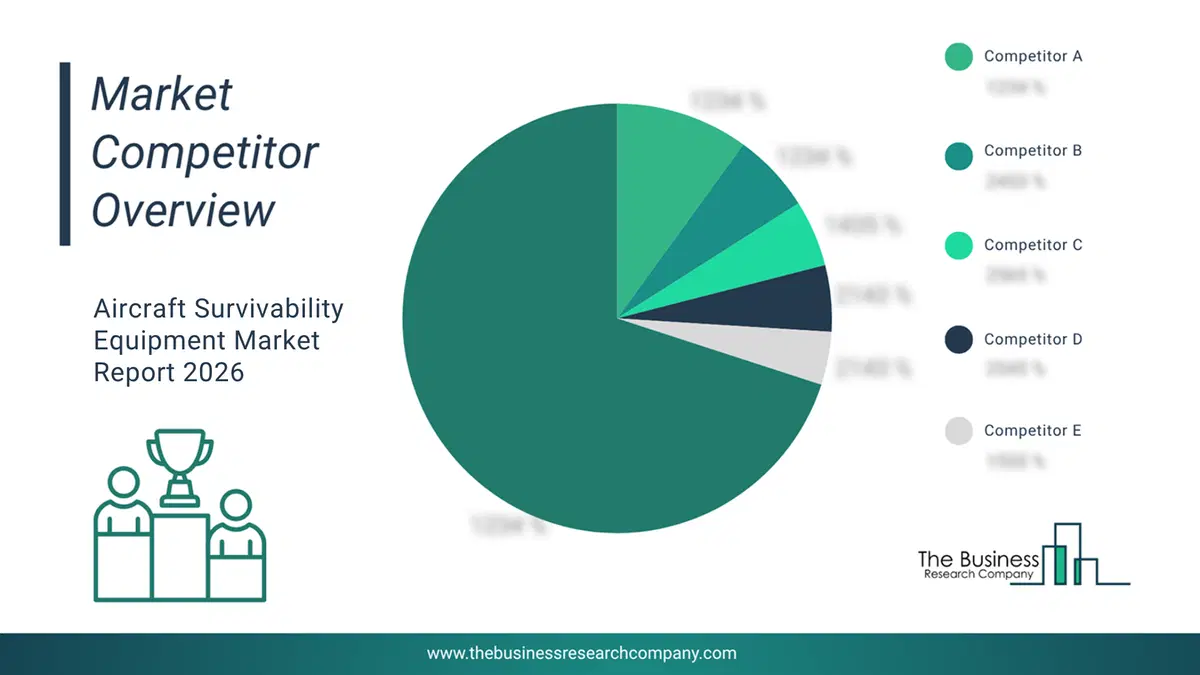
This chart is for illustrative purposes; the full report includes a detailed competitor analysis and comprehensive overview of the top 10 companies in the market.
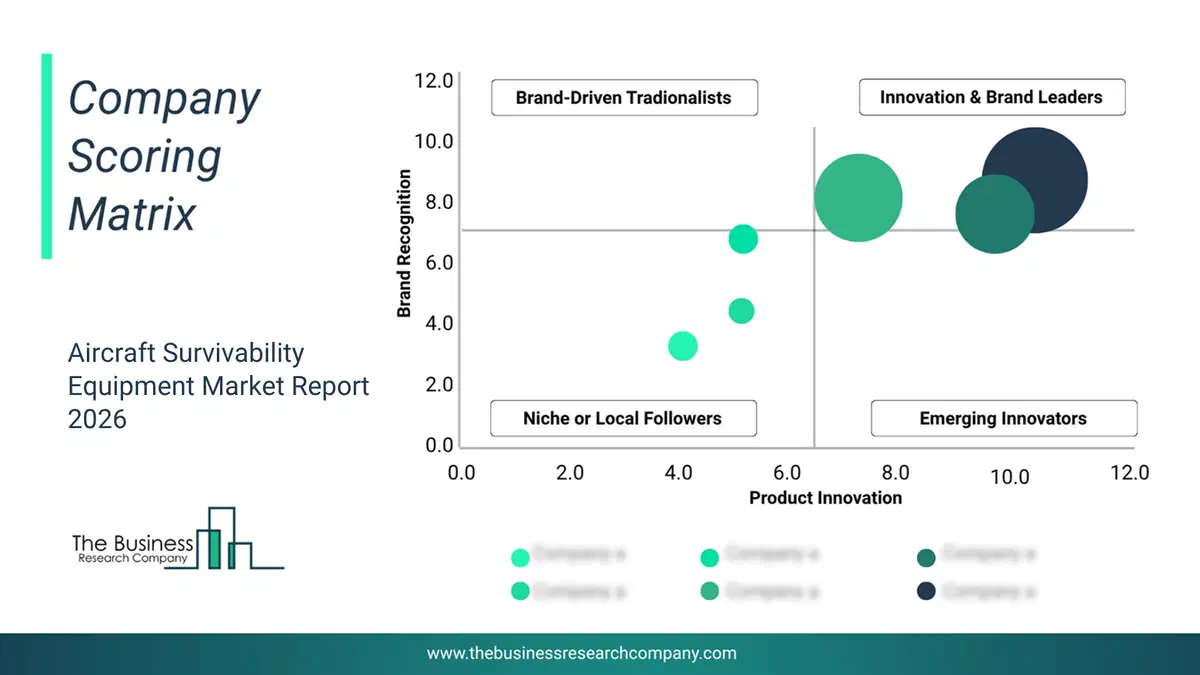
This chart maps companies by product innovation and brand strength, with bubble size indicating relative revenue, helping identify market leaders, challengers, and niche players. This is an illustrative chart; the full report provides a complete and accurate competitive analysis.
Global Aircraft Survivability Equipment Market Trends and Insights
Major companies operating in the aircraft survivability equipment market are focusing on developing innovative solutions such as AI-piloted vertical takeoff and landing (VTOL) fighter jets to enhance mission survivability, improve autonomous threat response, and optimize tactical operational efficiency. An AI-piloted vertical takeoff and landing (VTOL) fighter jet refers to a combat aircraft capable of taking off and landing vertically without a runway, which is operated autonomously or semi-autonomously using artificial intelligence to manage navigation, flight control, and mission execution. For instance, in October 2025, Shield AI, Inc., a US-based aerospace and defense company, launched an X-BAT, designed for expeditionary and maritime operations in contested environments. The X-BAT is distinctive for being runway-independent, which provides persistence, reach, and survivability in combat scenarios, especially where traditional runway access is limited or denied.What Are Latest Mergers And Acquisitions In The Aircraft Survivability Equipment Market? Collaboration Between Bae Systems And Leonardo S.P.A. Advancing Aircraft Survivability Solutions
In February 2023, BAE Systems PLC, a UK-based aerospace company, collaborated with Leonardo S.p.A. Through this collaboration, they aim to allow the two companies to share their expertise and resources in the field of aircraft survivability, develop and deliver more innovative and effective aircraft survivability solutions, expand their reach, and offer their products and services to a wider range of customers. Leonardo S.p.A. is an Italy-based aerospace company that designs and manufactures a wide range of aircraft survivability equipment.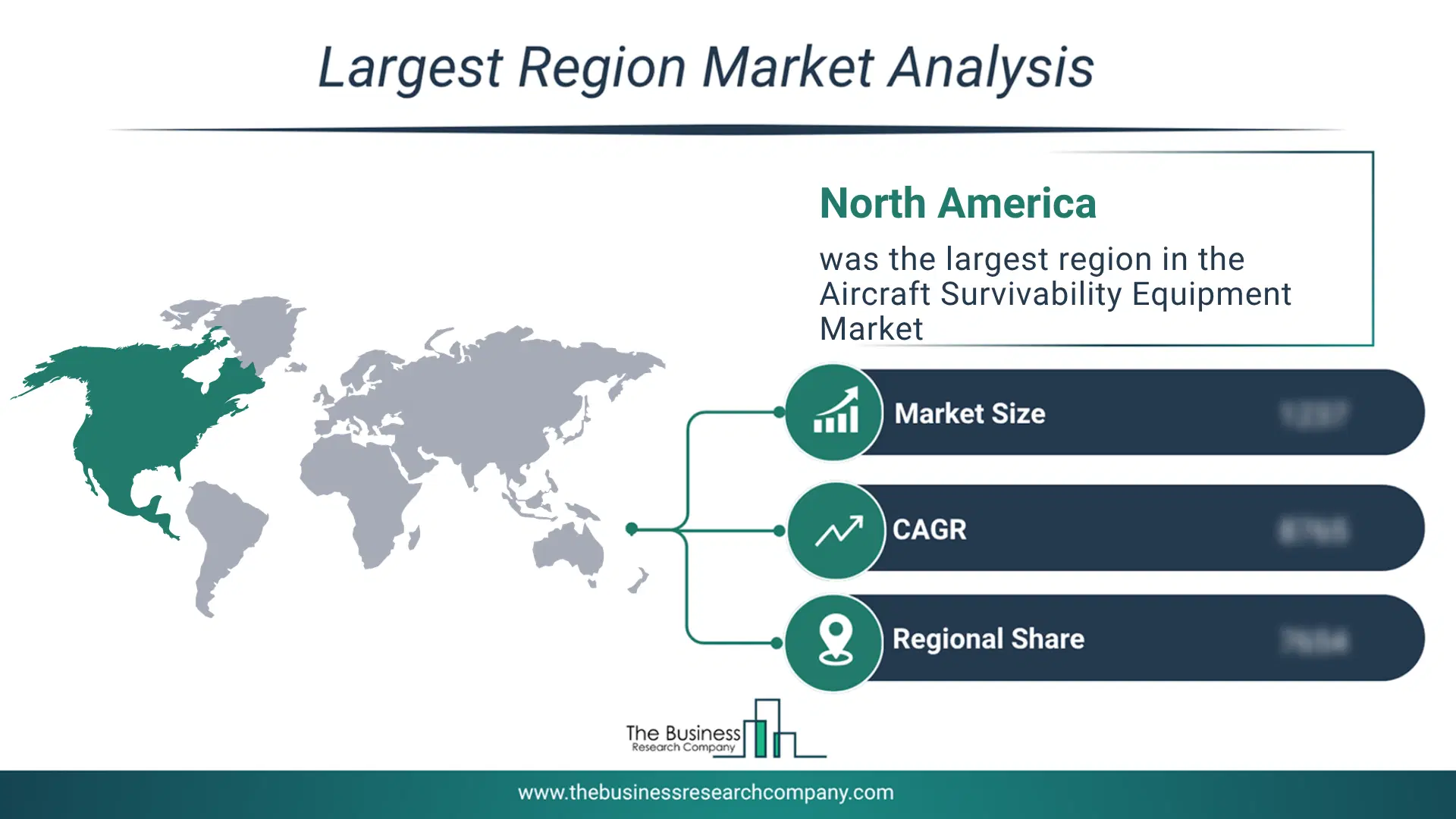
Regional Insights
North America was the largest region in the aircraft survivability equipment market in 2025. The regions covered in this market report are Asia-Pacific, South East Asia, Western Europe, Eastern Europe, North America, South America, Middle East, Africa. The countries covered in this market report are Australia, Brazil, China, France, Germany, India, Indonesia, Japan, Taiwan, Russia, South Korea, UK, USA, Canada, Italy, SpainWhat Defines the Aircraft Survivability Equipment Market?
The aircraft survivability equipment market consists of revenues earned by entities by providing services such as missile detection, warning, and tracking. The market value includes the value of related goods sold by the service provider or included within the service offering. The aircraft survivability equipment market consists of sales of collisions, gunfire, armor plating, self-sealing fuel tanks, ice protection systems, lightning strike protection systems, and emergency escape systems. Values in this market are ‘factory gate’ values, that is the value of goods sold by the manufacturers or creators of the goods, whether to other entities (including downstream manufacturers, wholesalers, distributors and retailers) or directly to end customers. The value of goods in this market includes related services sold by the creators of the goods.How is Market Value Defined and Measured?
The market value is defined as the revenues that enterprises gain from the sale of goods and/or services within the specified market and geography through sales, grants, or donations in terms of the currency (in USD unless otherwise specified). The revenues for a specified geography are consumption values that are revenues generated by organizations in the specified geography within the market, irrespective of where they are produced. It does not include revenues from resales along the supply chain, either further along the supply chain or as part of other products.
This chart presents market attractiveness based on a quantitative evaluation of growth, competition, strategic alignment, and risk, offering a clear view of opportunity areas for decision-making. This chart is for illustrative purposes; the full report contains the complete analysis.

This chart highlights the Total Addressable Market (TAM) by estimating the maximum revenue opportunity using an assumption-driven approach, supporting strategic planning and opportunity sizing across markets. The chart is illustrative; the full report provides a more comprehensive analysis.
What Key Data and Analysis Are Included in the Aircraft Survivability Equipment Market Report 2026?
The aircraft survivability equipment market research report is one of a series of new reports from The Business Research Company that provides market statistics, including industry global market size, regional shares, competitors with the market share, detailed market segments, market trends and opportunities, and any further data you may need to thrive in the aircraft survivability equipment industry. The market research report delivers a complete perspective of everything you need, with an in-depth analysis of the current and future state of the industry.Aircraft Survivability Equipment Market Report Forecast Analysis
| Report Attribute | Details |
|---|---|
| Market Size Value In 2026 | $4.93 billion |
| Revenue Forecast In 2030 | $6.39 billion |
| Growth Rate | CAGR of 6.7% from 2026 to 2030 |
| Base Year For Estimation | 2025 |
| Actual Estimates/Historical Data | 2020-2025 |
| Forecast Period | 2026 - 2030 |
| Market Representation | Revenue in USD Billion and CAGR from 2026 to 2030 |
| Segments Covered | Component, Technology, Fit, Application |
| Regional Scope | Asia-Pacific, Western Europe, Eastern Europe, North America, South America, Middle East, Africa |
| Country Scope | The countries covered in the aircraft survivability equipment market report are Australia, Brazil, China, France, Germany, India, Indonesia, Japan, Taiwan, Russia, South Korea, UK, USA, Canada, Italy, Spain |
| Key Companies Profiled | United Technologies Corporation, Lockheed Martin Corporation, Boeing Rotorcraft Systems, Raytheon Company, Airbus SE, Northrop Grumman Corporation, BAE Systems plc, Harris Corporation, Thales Group, L3 Technologies Inc., Leonardo S.p.A., Textron Inc., Rheinmetall AG, Elbit Systems Ltd., Israel Aerospace Industries Ltd., Saab AB, General Dynamics Corporation, Sikorsky Aircraft, Moog Inc., Curtiss-Wright Corporation, Cobham Limited, Orbital ATK Inc., FLIR Systems Inc., Ultra Electronics Holdings plc, Chemring Group, Cobham plc., Aselsan A.S., Terma A/S, Esterline Technologies Corporation, Edo Corporation Ltd. |
| Customization Scope | Request for Customization |
| Pricing And Purchase Options | Explore Purchase Options |